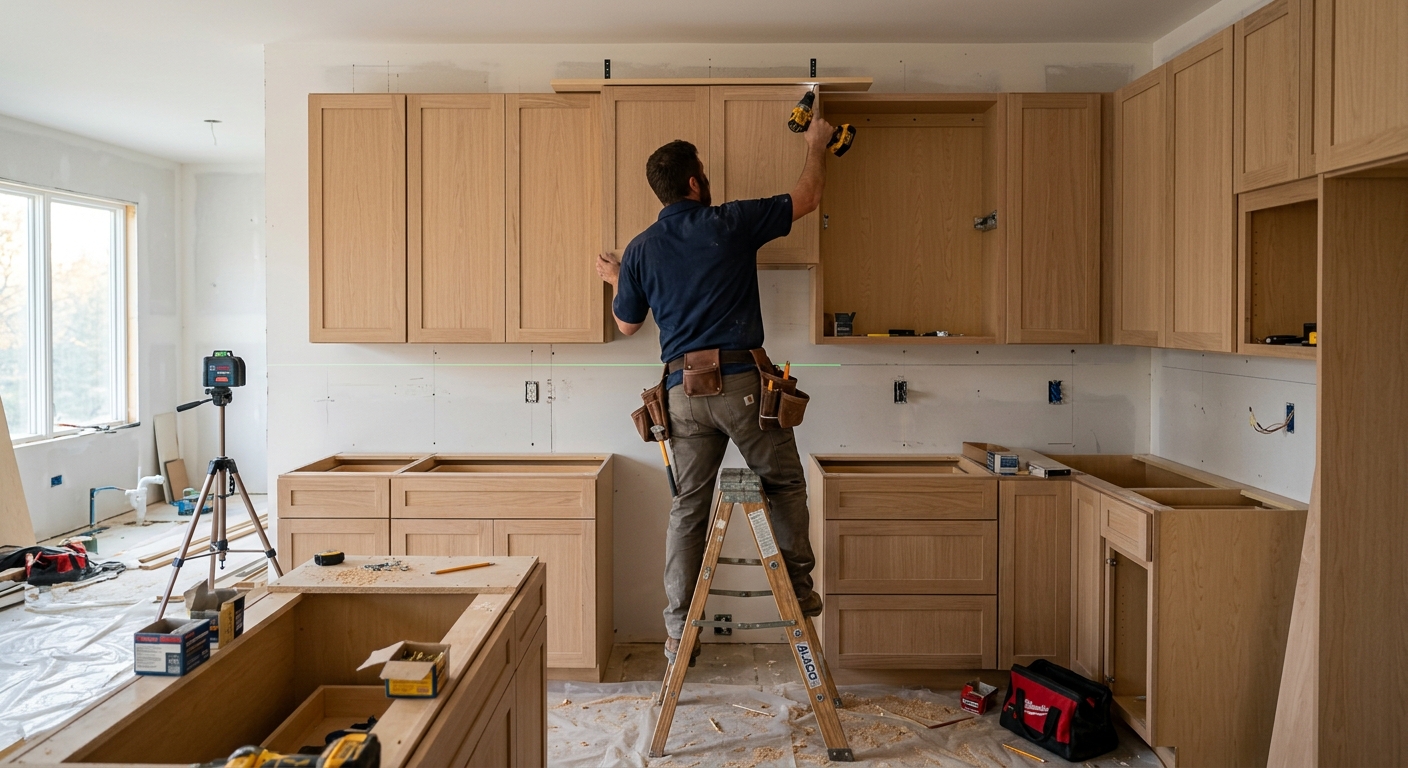
What a kitchen remodel costs in White Oak
White Oak homeowners planning a kitchen renovation face a particularly wide budget range. With a median household income of $57,054 and 68.2% of households owning their homes (U.S. Census Bureau, ACS 2024), most local kitchen projects are owner-driven decisions that need to balance resale value with daily use. This is especially true because much of the housing was built before 1980, similar to Pittsburgh’s large stock of pre-1940 homes. These kitchens are often small, walled-off spaces that simply don’t work for modern living, meaning many renovations become full gut jobs to reconfigure layouts—not just surface updates. But not every kitchen needs walls moved and every finish replaced.
The biggest source of blown budgets is planning for a kitchen upgrade, then requesting a custom or layout change mid-process. Set your budget for the scope you truly need—and stick to it.
| Scope |
What's included |
Duration |
Price range |
| Full gut remodel, same layout |
cabinets, counters, appliances, flooring, lighting, fixtures |
6–10 weeks |
$28,000–$113,000 |
| Gut plus layout change |
all of the above plus moved plumbing, electrical, walls |
10–16 weeks |
$61,000–$113,000 |
| Cabinet replacement (stock to semi-custom) |
remove and install cabinets, hardware, patching |
1–3 weeks |
$6,600–$28,000 |
| Cabinet refacing |
new doors and drawer fronts, veneer, hardware |
3–6 days |
$6,600–$19,000 |
| Countertop replacement only |
template, fabricate, install, reconnect sink |
1–3 weeks |
$3,800–$15,000 |
| Kitchen flooring only |
remove existing, install new flooring |
3–6 days |
$4,700–$19,000 |
Estimates for a typical White Oak kitchen. Cabinet grade and whether the layout changes move these figures more than square footage.
Code requirements for White Oak kitchens
In White Oak, most kitchen renovations fall under the Pennsylvania Uniform Construction Code (UCC), which is based on the International Residential Code. Cosmetic updates—like painting, switching out cabinet hardware, refacing cabinets, or replacing an existing countertop without moving plumbing—don’t typically require a permit. Local enforcement means that actual permit requirements may differ slightly between boroughs, but throughout Allegheny County, anything involving new or relocated plumbing lines, adding or moving electrical circuits, or changing the structure such as removing or moving a wall, will almost always trigger a building permit. Mechanical work like installing a new ducted range hood may also require one, especially in the City of Pittsburgh and surrounding boroughs.
For major remodels or any job altering the kitchen’s footprint, especially those that move walls or utilities, the project is typically reviewed by the municipal code office before work can start. Electrical inspections are conducted by the Pittsburgh permitting authority or, in some suburbs, an approved third-party agency.
By law, any contractor you hire for a job over $500 must be registered with the Pennsylvania Office of Attorney General’s Home Improvement Contractor (HIC) registry. You can verify this at hic.attorneygeneral.gov. Every employer working on your home is required to carry workers' compensation insurance; you can check coverage through WCAIS (wcais.pa.gov). Unpermitted work can block your sale or kill a buyer’s deal when the title search catches it—never skip the paperwork if you’re touching anything that isn’t purely cosmetic.
Resale value and kitchen spending
Kitchen renovations in White Oak help a home sell faster and avoid buyer objections, but rarely pay back their entire cost in resale—especially at the higher end. Mid-range projects using durable, neutral finishes are usually a better bet for recouping costs than luxury remodels. The reality: if your house is worth less than $300,000, spending $61,000 or more on a kitchen renovation is unlikely to return that investment when you go to sell, particularly in a market with a median household income of $57,054 (U.S. Census Bureau, ACS 2024).
If your family plans to stay put for years, design for your daily needs—maximize storage, upgrade appliances you’ll use, and make the space comfortable for your routine without much concern for broad buyer preferences. But if you’re renovating to sell, your dollars go farther in a simple, flexible layout and classic, light finishes. Skip major layout changes and luxury brands. Buyers don’t expect heated floors or imported stone, and those choices don’t set your listing apart in White Oak’s price bracket.
In short, renovation for enjoyment and renovation for resale are two different goals. Spend to enjoy your home, not just to chase a sale price that’s set by the neighborhood, not by your upgrades.
The real timeline for a White Oak kitchen
Most White Oak homeowners underestimate the true duration of a kitchen renovation. Finish-trade labor demand is high in Allegheny County, which means trades are often booked out further than you’d expect. The step-by-step sequence is critical: first comes design and measurement, then cabinets are ordered—often with a lead time of several weeks. Only then should you begin demolition, followed by any necessary rough-ins and inspections. Cabinets are set next, and only after they are installed can the countertop company come to template for new counters. Countertops are always templated from the installed base cabinets, not a plan, so there’s a real and unavoidable gap of a week or more between cabinet install and countertop fabrication. Many homeowners are frustrated by this period when the kitchen is at a standstill.
Once the countertops are installed, it’s time for sink, backsplash, flooring (if not already done), and final trim. Throughout, the pacing depends on material arrival—especially cabinets and countertops, the main bottlenecks. In White Oak’s saturated remodel market, ordering cabinets before demolition is the best way to avoid drawn-out projects. Don’t gamble on “quick-ship” unless your finish and sizing are truly standard, which is rare for older homes. With most kitchens in White Oak built before 1980, surprises behind the walls are a real risk and can cause further delays.
All told, expect 6–10 weeks for a full remodel without layout changes, and potentially 10–16 weeks if you’re reworking walls or major systems.
Planning appliances before cabinets
Choosing your appliances before you order cabinets is the difference between a kitchen that functions and one that’s an expensive compromise. Cabinet layout is built around appliance widths, depths, and clearances. If you change your mind about appliances after cabinets are ordered, expect major headaches—either something won’t fit, or you’ll have to reorder expensive cabinets.
Standard refrigerators stick out several inches past the counters; counter-depth models create a streamlined look but sacrifice some storage and may need slightly wider openings. Ranges come as freestanding (finished sides, simple), or slide-in (controls at the front, require precise fit and counter overlap). Switching from gas to induction or electric almost always means upgrading the circuit, especially in older homes, while professional ranges can also need higher-capacity gas lines and ventilation planning. Panel-ready dishwashers integrate into cabinetry for a custom look but require exact door sizing.
One critical call: venting your range hood to the outside is far superior to recirculating models, especially in small kitchens common in White Oak’s older homes. Recirculating hoods trap grease and odors inside. Also, be aware that appliance lead times now sometimes exceed those for cabinets—especially for specialty models or if you want a consistent finish across all appliances.
Professional series appliances deliver robust performance and impressive aesthetics, but the cost premium is mostly in looks and heavy-duty build, less in practical difference for most home cooks.
General contractor, kitchen firm, or manage it yourself?
The delivery model you choose will shape your budget, stress level, and the smoothness of your kitchen renovation more than any single design choice. A design-build kitchen firm handles everything—design, materials, trades, and installation—with a single contract. This is the highest-cost route but gives you a clear timeline, a single point of accountability, and less day-to-day involvement from you. A general contractor coordinates the trades, but you or your designer specify the finishes, fixtures, and layout. This usually costs less than design-build, but requires you to be closely involved in design and selections. Owner-management—hiring each trade directly and sequencing them yourself—is the least expensive but the most demanding.
In Allegheny County, where the labor market is tight, professionals are busy and the best trades are booked months ahead. Scheduling your own trades is not for anyone with a day job or who can’t be on site regularly to check progress and solve problems. It’s also risky if your project triggers a permit, as self-managing the inspections, paperwork, and trade sequencing can lead to expensive mistakes and protracted delays. For jobs that move walls, plumbing, or major appliances, most White Oak homeowners are best served by a skilled general contractor or an experienced kitchen firm, unless you have hands-on construction experience and ample spare time.
Owner-management works for cosmetic facelifts only—painting, flooring, swapping hardware—but for anything triggering a permit, hand it off to a pro.
Layout changes and the cost cliff
The biggest financial leap in a White Oak kitchen project comes when you cross from replacing finishes to altering the layout. Keeping plumbing, wiring, and major appliances where they are means you stay in the price bracket of a standard gut remodel—$28,000–$113,000 for most homes. As soon as you move the sink, add circuits, or remove a wall, you add thousands, sometimes tens of thousands to the total, and the increase isn’t linear.
Relocating a sink or dishwasher means new drain lines, which need precise slope—an issue in older homes with limited access between floors or in concrete slabs. Moving an appliance across the room usually triggers new circuits or even a panel upgrade if the existing service is at capacity. If you want an island with a cooktop, you’ll need power and venting to the middle of the kitchen—always more complicated to rough in. Taking out a wall? First, determine if it’s load-bearing; if so, you’ll need an engineer, a permit, more inspections, and structural work.
Even venting a range hood to a new spot involves pricing an exterior penetration and patching the old opening. Across the board, these changes require permit applications and sometimes plan review by the local department. The honest advice: unless your current layout is truly dysfunctional or you have a very specific need, think hard before reworking plumbing or walls. A great deal of money in White Oak kitchens is spent shifting a sink a few feet, when that money could deliver far more value in brighter finishes, better appliances, or custom storage.
Frequently asked questions — kitchen renovation in White Oak
Is induction worth it over gas?
Induction cooktops are gaining popularity in Pennsylvania, and White Oak is no exception. Induction is faster, safer (no open flame), and very easy to clean. If you like instant control or have safety concerns for kids or older adults, induction is an upgrade with real benefits. However, switching from gas to induction in an older home often means you’ll need to add a new 240v circuit, which could require some electrical upgrades if your service panel is full—this is a common extra in White Oak kitchens built before 1980. The price difference for replacing an electric-only cooktop versus running a new circuit is typically a few hundred to a couple thousand dollars, but as part of a full remodel, it’s built into the overall cost bracket of $28,000–$113,000.
What are cabinet lead times in White Oak right now?
Lead times for kitchen cabinets around White Oak depend on cabinet grade and the manufacturer’s pipeline. Stock cabinets can arrive in roughly 2–4 weeks if finishes are standard, while semi-custom and custom cabinets generally take 6–10 weeks—and sometimes even longer if there’s a materials shortage or specialty paint. With high demand in Allegheny County, some local suppliers are backed up, especially during spring and summer. Always order cabinets before you start demolition; don’t assume quick-ship stock works for your space, particularly in older houses that rarely have standard measurements. If your timeline is tight and your layout tricky, consider cabinet refacing, which can be turned around in just 3–6 days and keeps the project in the $6,600–$19,000 range.
What does a full gut kitchen remodel cost in White Oak?
For a full gut kitchen remodel in White Oak—new cabinets, counters, flooring, lighting, fixtures, and appliances, but keeping the layout roughly the same—expect to spend between $28,000–$113,000. Most typical projects land around $61,000. Layout changes, moving walls, and updating utilities (plumbing or electrical) can easily push your total to the upper end of that band. In older White Oak homes, budgets often increase mid-project as hidden issues behind the walls emerge, especially if the existing electrical or framing isn’t up to code.
Is a cosmetic refresh enough or do I need a gut remodel?
In many White Oak homes, especially those built before 1980, a cosmetic refresh—painting, new hardware, flooring, or a countertop—can do a lot for resale and daily enjoyment, at a fraction of full gut costs. If your cabinets are structurally sound and the layout works, you may only need $4,700–$19,000 to transform the space with new flooring or counters. But if your kitchen still feels cramped, or you’re dealing with failing plumbing/electrical, a gut remodel may be unavoidable. Get a contractor’s honest opinion before sinking money into finishes that might not address the true issues.
Does replacing cabinets require a permit?
In most Allegheny County boroughs—including White Oak—replacing cabinets in the same location, without moving plumbing or electrical, usually does not require a building permit. That means you can often undertake a cabinet replacement project—at a cost of $6,600–$28,000—without municipal paperwork. However, if your contractor needs to move wiring, install new lighting layouts, or relocate plumbing, a permit will be required. Always check your borough’s code office, as interpretation can vary slightly from one municipality to another, and documentation is critical for resale.
Do older White Oak homes need electrical upgrades for a kitchen?
Most kitchens in White Oak were built before GFCI protection or dedicated appliance circuits were standard—meaning upgrades are usually needed for modern code compliance. If you’re doing anything beyond surface updates, have an electrician assess your panel’s capacity: adding a dishwasher, microwave, or induction cooktop may require new circuits or even a panel upgrade. For a mid-range kitchen remodel in White Oak, expect electrical work to fit into the overall project cost band of $28,000–$113,000 if it’s bundled with other improvements.
What does a quartz countertop cost in White Oak?
Installing new quartz countertops in White Oak generally costs between $3,800–$15,000, with most jobs coming in around $8,500 for a typical kitchen. The final price is driven by the specific color, brand, whether you need a full backsplash, how many seams there are, and cutouts for special sinks or ranges. Demolition and disposal of old countertops are usually included. If your kitchen has unusual angles or extra-large islands, factor in a higher number within that range.
What is an allowance in a renovation quote?
An “allowance” in your kitchen renovation quote is a placeholder budget for an item that hasn’t been selected yet—like countertops, tile, or appliances. For example, a contract might include a quartz countertop allowance of $8,500. If you choose a material costing more, you pay the difference; if you pick something less expensive, you get a credit. Be sure you understand what is and isn’t included in each allowance line, and get written confirmation from your contractor to avoid unpleasant surprises at closing.
Which upgrades are not worth the money?
In White Oak, most kitchen buyers aren’t looking for chef-grade appliances, smart faucets, high-end wine coolers, or heated flooring; these upgrades rarely pay off. Spending at the top end of the range—$113,000—usually only makes sense in luxury homes or if you have specific lifestyle needs. For most White Oak homes, a well-executed midrange renovation with solid cabinetry, quartz counters, good lighting, and efficient appliances delivers nearly all the daily and resale value at a reasonable cost.