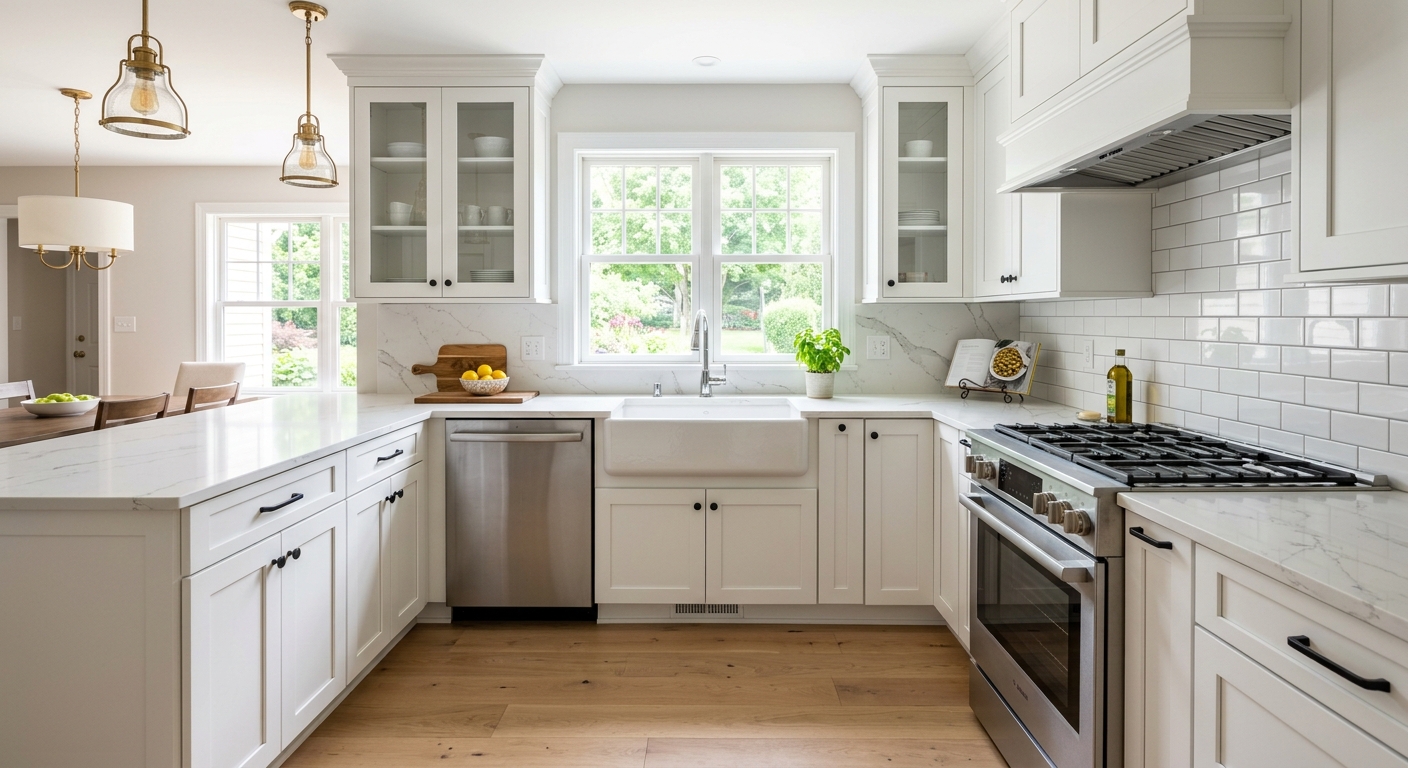
Kitchen renovation costs in Union — 2026
Union’s kitchen renovation budgets reflect what most homeowners in the area actually spend and recoup. With a median household income of $68,217 and a homeownership rate over 88.1% (U.S. Census Bureau, ACS 2024), most kitchen projects target practical value rather than luxury. Washington County’s dominant 1950–1980 suburban construction boom yields many outdated tract kitchens needing layout modernization—if your kitchen still has a cramped 1960s galley, you’re not alone. These older layouts often require more than just new finishes: wall changes, rethinking appliance locations, and bringing wiring to current code all mean higher budgets.
The biggest reason kitchen projects go over budget is starting with a price for new cabinets and countertops, then deciding to move plumbing, swap in high-end appliances, or open up walls. Price out the scope you actually plan to execute before you commit.
| Scope |
What's included |
Duration |
Price range |
| Full gut remodel, same layout |
cabinets, counters, appliances, flooring, lighting, fixtures |
6–10 weeks |
$28,500–$115,000 |
| Gut plus layout change |
all of the above plus moved plumbing, electrical, walls |
10–16 weeks |
$62,000–$115,000 |
| Cabinet replacement (stock to semi-custom) |
remove and install cabinets, hardware, patching |
1–3 weeks |
$6,700–$28,500 |
| Cabinet refacing |
new doors and drawer fronts, veneer, hardware |
3–6 days |
$6,700–$19,000 |
| Countertop replacement only |
template, fabricate, install, reconnect sink |
1–3 weeks |
$3,800–$15,500 |
| Kitchen flooring only |
remove existing, install new flooring |
3–6 days |
$4,800–$19,000 |
Estimates for a typical Union kitchen. Cabinet grade and whether the layout changes move these figures more than square footage.
Resale value and kitchen spending
Union homeowners often ask if their kitchen investment will “come back” at resale. The straight answer: a well-renovated kitchen makes a house easier to sell but rarely recovers the full spend, especially above the mid-range. Buyers in Union are cautious; with a median household income of $68,217, a high-end bespoke kitchen may grab attention, but it will not command a $100,000 premium over well-executed, practical updates. The smart resale-minded approach here is to upgrade with medium tones, durable surfaces, and avoid major layout shifts unless the existing pattern is truly dysfunctional.
Renovating to live in is a different equation; if you plan to stay, buy what you want to use every day and don’t sweat the theoretical payback. Renovating to sell is about neutral finishes, keeping spend in the $28,500–$62,000 range, and sticking with the existing footprint if possible. Over-improving—such as a $90,000 kitchen in a block of $220,000 homes—rarely ends well in Union’s market. If your goal is to make the house move in a few years, it’s better to refresh and modernize at a practical level rather than aiming for magazine features.
What moving the sink really costs
The factor that blows up kitchen budgets fast in Union is moving plumbing or electrical—especially the sink. If your remodel keeps water, gas, and electricity roughly where they are, you can stick to the base cost band. As soon as you relocate the sink or range, you enter the higher “gut plus layout change” category. The jump is not a few hundred dollars—it’s thousands—because drains need precise slope, and in homes built on slabs or with finished ceilings below, establishing that slope means more demo and rebuild than most expect.
New electrical circuits aren’t just a wire run; you have to confirm that the panel can handle the extra load. Moving a wall means determining if it’s load-bearing—if so, you’ll need an engineer and, in the City of Washington, a building permit plus a formal plan review. Relocating a range hood requires venting to the exterior, which is another penetration through siding or masonry. All these items trigger inspections and can push a remodel that begins as a cosmetic upgrade straight into major-construction territory, especially for a house dating to the 1950–1980 era prevalent in Union.
Honestly ask yourself: is the existing layout impossible, or just dated? Bringing all-new plumbing and wiring to a new location easily adds $20,000–$40,000 above a same-layout remodel, putting the project solidly in the $62,000–$115,000 price class.
Why the electrical line grew
The most common surprise expense in older Union kitchens is electrical—specifically, bringing wiring and circuits up to current standards. Modern code based on the Pennsylvania Uniform Construction Code (UCC) requires dedicated small appliance circuits, GFCI-protected counter outlets, correct receptacle spacing, and separate lines for dishwashers, disposals, and built-in microwaves, plus provision for 240V electric ranges if present.
But Washington County’s dominant home construction from 1950–1980 means you’re likely starting with two-wire, ungrounded circuits shared across lighting and outlets, and sometimes aluminium branch wiring. Older panels may be full, and once walls are open and permit pulled, the inspector expects the entire kitchen zone to meet today’s code—partial upgrades are not permitted. Even kitchens built into the late 1990s often lack the five to seven circuits current kitchens demand; replacing an electric panel may be required as part of the remodel.
Budgeting $4,000–$12,000 for electrical brings most Union kitchens up to current code, depending on the panel, location, and whether the house has safe accessible grounding. When the walls are open, take the opportunity to get this right: it’s safer and avoids headaches at sale.
Three ways to organise the project
How you structure your Union kitchen remodel makes as much difference as what you buy. A design-build kitchen firm handles everything turnkey, from design through construction under one roof. This is the highest cost path but comes with a single responsible party: you approve the plan, pay the bill, and deal with one company. For homeowners who want low stress and don’t want to chase trades, this is the surest route—though expect a premium.
Using a general contractor is the middle-ground. You might work with a separate designer or just specify finishes yourself, but the general contractor hires and schedules trades (carpenters, plumbers, electricians). Expect somewhat lower cost than design-build but more hands-on from you, especially when decisions or city inspections are due.
Owner-managed is the cheapest, where you hire every trade and buy all materials yourself—but the risks are real. With Washington County finish-trade labor in higher demand than Pittsburgh itself, delays or no-shows can derail projects for months. Unless you have project management experience or a very flexible schedule, this is usually more headache than savings for a permit-triggering remodel.
Choosing cabinetry
Your cabinetry choice dictates most of your Union kitchen’s cost. With Washington County’s mix of mid-century and 1970s tract homes, standard wall runs and square corners are not guaranteed. That pushes many homeowners to semi-custom, whether the budget allowed for it or not. Here’s how the main options stack up:
Refacing can be a smart play—if your box structures are solid, plumb, and the current configuration still works. Refacing replaces doors, drawer fronts, and applies new veneer, delivering a dramatic visual update for less money. But it cannot fix awkward layouts, add new storage, or address failing boxes.
Stock cabinets come in fixed sizes, are bought off the shelf, and suit homes where the layout is straightforward. The downside: you’ll often use filler strips, and finish options are fewer. Semi-custom cabinets let you tweak dimensions and finishes, are much more forgiving of not-quite-square walls or older additions, and are the “middle way” for most local renovations. Full custom fits any space and offers any feature, but brings high cost and extended lead times.
Don’t pay extra for “premium” boxes if all you get is particleboard sides and stapled drawer boxes. Look for plywood construction, dovetail drawers, full-extension soft-close hardware, and the fit—frameless for clean, modern lines, or face-frame for traditional looks.
| Option |
Cost |
Best when |
Limitation |
| Painting existing cabinets |
$1,200–$3,500 |
boxes and doors sound, tight budget |
no layout or style change |
| Refacing |
$6,700–$19,000 |
boxes square and layout works |
storage unchanged |
| Stock cabinets |
$6,700–$28,500 |
standard dimensions fit |
filler strips, limited finishes |
| Semi-custom |
$19,000–$28,500 |
non-standard walls or finishes |
6–12 week lead time |
| Full custom |
$19,000–$28,500 |
unusual layout or high-end design |
longest lead, highest cost |
What requires a permit in a kitchen renovation
In Union’s part of Washington County, cosmetic work like painting cabinets, swapping out hardware, or refacing existing cabinet doors rarely triggers a permit. Replacing countertops in place—without relocating sinks—falls in the same category. But as soon as you propose moving plumbing lines, adding or relocating electrical circuits, or changing any wall structure, a permit is typically required. In the City of Washington, a formal plan review is triggered for any remodel that alters walls, services, or plumbing risers.
Electrical inspections in Washington County municipalities are often performed by third-party agencies such as the Middle Department Inspection Agency, which can surprise homeowners used to direct municipal oversight. For work over $500, Pennsylvania requires all contractors to be registered with a Home Improvement Contractor (HIC) registration (verify at hic.attorneygeneral.gov), and all employers must carry workers’ compensation (check status by searching WCAIS at wcais.pa.gov).
Skipping the permit process can cost more than the fee or hassle—unpermitted work is red-flagged at resale, leading to expensive fixes or lost buyers. Always confirm permit requirements before starting any scope beyond pure surface swaps.
Frequently asked questions — kitchen renovation in Union
Is a cosmetic refresh enough or do I need a gut remodel?
For many Union homes, a cosmetic refresh—paint, new hardware, countertop replacement—can do a surprising amount when the basic cabinet layout and bones are good. If your cabinet boxes are solid and your kitchen hasn’t suffered water damage or functional problems, refacing or painting (typically in the $1,200–$19,000 band) can modernize the look at a fraction of full gut costs. However, if you deal with chronic storage problems, hazardous wiring, or want to open up walls, a gut renovation (from $28,500–$115,000) is warranted. Older Union kitchens from the 1950–1980s may fall into both categories. Walk through what frustrates you daily—sometimes, spending smart up front saves you from re-doing work later, though not every tired kitchen needs to be stripped to the studs.
What is a change order and how should it work?
A change order is an official modification to your kitchen renovation contract after work has started—either adding, removing, or altering scope. In Union and across Pennsylvania, you should always request a written change order outlining the new work, how it affects the price and timeline, and both parties’ signatures before the change happens. For instance, deciding mid-project to swap standard cabinets for a semi-custom build might increase your total by $5,000–$12,000, which should be documented. The Home Improvement Consumer Protection Act protects you here: changes over $500 must be in writing. Don’t accept vague promises or “we’ll settle up later” agreements—get every change detailed up front to avoid disputes, delays, or surprises when the final bill comes.
What countertop material is best for a family kitchen?
In Union’s busy family homes, durability and maintenance should outweigh fleeting trends. Granite and quartz dominate for good reason—they resist stains, take a beating, and last decades with minimal care. Laminate is cheapest but doesn’t stand up well to heat or impact. Countertop replacement in this area typically lands in the $3,800–$15,500 range, depending on material and complexity. For most households, quartz strikes the best compromise between performance and appearance—it’s non-porous, available in many looks, and doesn’t need sealing. You should skip high-maintenance surfaces (like marble) unless you tolerate stains and etching. Look for suppliers with strong fabrication and installation references in southwestern Pennsylvania’s climate.
Which upgrades are not worth the money?
Many Union homeowners over-invest in features that sound impressive but return little day to day or at resale. Built-in espresso makers, specialty wine storage, and elaborate pot fillers mostly benefit a very specific lifestyle—and can drive project costs up by $3,000–$10,000 each. High-gloss trendy finishes often look out of place in 1950s and 1970s era homes, and are expensive to touch up. Unless your kitchen is unusually large, skipping the double oven or expensive integrated appliance suites is also practical. Invest where it matters: robust surfaces, good lighting, practical storage. Spend on what you’ll notice every meal, not what’ll be a conversation piece twice a year.
Are Union kitchens typically small galley layouts?
Yes, many Union homes were built during Washington County’s 1950–1980 suburban boom, and a lot have original small galley kitchens. These spaces are usually long and narrow, often boxed in by unnecessary walls and minimal floor area. If you’re hoping for an island or open-plan design, it will almost always require structural changes and moving plumbing or electric, which tends to push projects up toward the $62,000–$115,000 range. For some, retaining the galley and upgrading finishes suffices. For others, removing a wall becomes the main scope. Assessing your real needs (and budget) comes first—don’t spend to “open up” unless it delivers a clear benefit in your daily life.
What does a full gut kitchen remodel cost in Union?
A full gut remodel in Union, replacing everything (cabinets, appliances, counters, flooring, lighting), falls within $28,500–$115,000, though most local projects come in around $62,000. The wide range covers differences in cabinet grade, appliance choices, and whether the project retains the existing layout or moves plumbing, walls, or electrical. If you’re staying within the original footprint without major utility moves, costs are at the lower end. The moment you add layout changes—opening walls, relocating the sink, or running all new electrical—the price jumps. It’s a sizable investment, so always tie your scope (and budget) to what you plan to use daily and how long you intend to stay in the home.
Who inspects kitchen electrical work in Union?
In Union and much of Washington County, electrical inspections on kitchen renovations are usually carried out by third-party agencies such as the Middle Department Inspection Agency, rather than directly by your municipality. This sometimes catches homeowners off guard, especially when trying to self-manage a project. If your renovation adds outlets, moves circuits, or installs new appliances, expect a third-party inspector to review rough and final wiring before drywall, and before appliances are hooked up. You, your contractor, and your trades must plan schedules around those inspection dates to avoid delays. Whether your project lands in the $6,700–$115,000 range, passing inspection is not optional—and any failed review can mean costly re-work.
How much does a kitchen renovation cost in Union?
Kitchen renovations in Union break down into clear price bands. Refreshing surfaces—painting cabinets, new hardware—can be done for $1,200–$3,500. Cabinet refacing or replacement starts around $6,700–$28,500. Full gut remodels with no layout change run from $28,500–$115,000, including cabinets, appliances, counters, and flooring. Once you start moving plumbing or electrical, or open up walls, expect to spend toward the top of that range (and more). Most typical remodels trend to the $62,000 mark. Always budget with a 10–15% buffer for surprises, especially in older Union homes.
How far ahead should I book a contractor in Union?
Plan well in advance. Because Washington County’s finish-trade labor market is somewhat tighter than Pittsburgh’s core, it’s normal for quality kitchen contractors in Union to book three to six months ahead for start dates, and longer if you want custom cabinetry or high-demand suppliers (lead times can run 6–12 weeks). After finalizing your scope and budget—for example, a full gut remodel of $28,500–$115,000—sign your contract and lock your dates early. Don’t wait until appliances are in your garage or a demo is scheduled; the best pros are rarely available on short notice. This lead time helps you get competitive bids, work through permitting, and avoid a rushed (or more expensive) build.