Kitchen renovation costs in Monaca — 2026
Kitchen renovations in Monaca cover a wide price range, reflecting both the needs of homeowners and the character of the local housing stock. With a homeownership rate of 60.9% and a median household income of $62,125 (U.S. Census Bureau, ACS 2024), most residents are planning upgrades with an eye on everyday quality and budget discipline. The concentration of pre-1980 homes — 89.0% of Monaca’s stock — means many kitchens are overdue for more than just new countertops, especially those built between 1940 and 1960. Full-gut remodels are common, especially when the original layout no longer works for modern appliances or family flow. Meanwhile, late-model homes may only need a pull-and-replace facelift, saving on major trades but still requiring careful planning to prevent hidden cost overruns.
Most homeowners run into budget problems by pricing the “pull and replace” tier and then drifting into “gut remodel plus layout change” scope with last-minute additions, especially when old wiring, plumbing, or nonstandard room sizes come to light. In Monaca, keeping to the intended scope is the best way to keep a project on track financially and on schedule.
| Scope |
What's included |
Duration |
Price range |
| Full gut remodel, same layout |
cabinets, counters, appliances, flooring, lighting, fixtures |
6–10 weeks |
$28,000–$112,000 |
| Gut plus layout change |
all of the above plus moved plumbing, electrical, walls |
10–16 weeks |
$60,500–$112,000 |
| Cabinet replacement (stock to semi-custom) |
remove and install cabinets, hardware, patching |
1–3 weeks |
$6,500–$28,000 |
| Cabinet refacing |
new doors and drawer fronts, veneer, hardware |
3–6 days |
$6,500–$18,500 |
| Countertop replacement only |
template, fabricate, install, reconnect sink |
1–3 weeks |
$3,700–$15,000 |
| Kitchen flooring only |
remove existing, install new flooring |
3–6 days |
$4,700–$18,500 |
Estimates for a typical Monaca kitchen. Cabinet grade and whether the layout changes move these figures more than square footage.
Electrical work in an older Monaca kitchen
Older homes in Monaca, especially those from the 1940–1960 era in areas modeled after Beaver Falls and Aliquippa, typically come with electrical surprises that drive up kitchen renovation costs. Current building code expects dedicated circuits for each major appliance — microwave, dishwasher, disposal — as well as at least two 20-amp small appliance circuits for counters, GFCI protection at all receptacles near sinks and countertops, and tamper-resistant outlets spaced every four feet. Modern kitchens also require a separate 240-volt line for an electric range, which a majority of original kitchens around here simply do not have.
In reality, many pre-1980 Monaca homes still run on two-wire, ungrounded circuits or have the whole kitchen sharing a single breaker with marginal panel space. When demolition opens up the walls, any electrical work will be brought up to current code — it isn’t optional. This often means new home runs to the panel, more circuits, possible subpanel installs, and in rare older homes, replacement of aluminium branch wiring. These upgrades are very frequently left out of DIY or “handyman” budgets but cannot be waved away once visible to an inspector. Even late-1990s kitchens in the area commonly lack enough circuits for new appliance layouts.
In Monaca, bringing an older kitchen’s electrical system to code during a remodel typically adds $4,500–$13,000 to the project, depending on panel access and how much rewiring is needed. Planning for this upfront is the most effective way to avoid mid-project cost surprises.
Does a kitchen renovation pay back in Monaca?
If you’re renovating to sell your Monaca home, a new kitchen makes a house stand out and sell faster, but it rarely pays back the entire investment. The homes that sell quickly after a remodel tend to have updated, neutral finishes, not top-of-the-market upgrades. Most mid-range kitchen renovations here cost $28,000–$60,500. High-end projects — where the choices go well beyond what’s typical in the neighborhood — don’t recover the difference when it’s time to sell.
Here’s the key: the decision to renovate for living versus resale are two different paths. Renovating to live in is about what you want every day — deeper drawers, induction ranges, specialty storage. If you plan to stay a while and enjoy the space, those costs are justified by use, not resale. But if you’re preparing to sell, neutral cabinets, durable counters, and a sensible layout (often at the “pull and replace” tier) will net the best return. Most Monaca buyers compare kitchens across similar properties, and the local median income of $62,125 makes over-improving risky. A $100,000+ kitchen in a neighborhood of modest, older homes is unlikely to recoup much above what a practical, modernized space would.
Ultimately, a well-done renovation helps a house sell but should not be counted on as an investment that pays back dollar for dollar.
Defining your scope before you get quotes
Before you call a contractor in Monaca, it’s vital to know exactly which type of kitchen project you want to tackle. “Kitchen remodel” can mean anything from new paint to a full structural gut, and prices run fivefold based on what’s included. Here’s how contractors actually divide projects:
- Cosmetic refresh: new paint, hardware, lights, maybe backsplash, but cabinets and layout stay unchanged.
- Pull and replace: old cabinets and counters out, new in, but all plumbing and electrical remain where they are. Looks like a brand-new kitchen but without moving walls or major utilities.
- Gut, same layout: everything down to the studs, wiring and plumbing updated in the same locations, full reset with new finishes and insulation.
- Layout change: walls moved, plumbing and electrical re-routed, structure altered. This is a different class of project — and cost.
The steepest cost cliff is between “gut, same layout” and “layout change.” In Monaca and across Beaver County, moving the sink or range triggers new permits, possibly engineering, and coordination with trades that often have long lead times. It’s not a marginal upcharge — it’s a multiplier.
Contractors need your scope defined before they can quote meaningfully. A contractor cannot give you a firm price or timeline if you haven’t decided, for example, whether the wall between kitchen and dining is coming out. Decide your tier, write it down, and communicate it clearly. That single step is the surest way to get apples-to-apples quotes and to avoid the scenario where you price a basic project and end up with gut-and-rebuild costs.
What requires a permit in a kitchen renovation
Permit requirements for kitchen work in Monaca follow patterns set throughout Beaver County. For most cosmetic jobs — painting, new cabinet fronts, swapping faucets or lights, or replacing a countertop in its original place — no permit is needed. This is the case in nearby Beaver Falls, where direct cabinet-front replacement commonly proceeds without one.
As soon as your project gets beyond surface work, the bar rises. Moving or adding electrical circuits (especially for appliances or outlets), shifting plumbing, or removing/altering a structural wall all trigger a permit requirement, particularly in Aliquippa, where structural wall removal or relocation in a kitchen remodel explicitly needs one. If a remodel changes the layout, or egress paths, formal plan review is typically required (per Aliquippa practices). Don’t expect to skip this step and get away with it — at resale, missing permits are usually flagged and can delay or complicate closings.
Electrical work in many parts of Beaver County, including Aliquippa, is inspected by approved third-party agencies rather than a city employee, which often adds an extra week to the job. For contractor legitimacy, Pennsylvania requires Home Improvement Contractor (HIC) registration for jobs over $500 (verify at hic.attorneygeneral.gov). Employers must also carry workers’ compensation, confirmable via WCAIS (wcais.pa.gov).
Skipping permits or hiring unregistered contractors in Monaca may save a little upfront but risks real headaches at resale — title companies and buyers’ agents have become vigilant about unpermitted kitchen work.
Lead times, sequencing and why it takes longer
A full kitchen renovation in Monaca typically stretches longer than many expect, especially compared to larger urban markets. Scheduling challenges arise partly because finish-trade labor is thinner than in Pittsburgh and Beaver County serves a broad suburban area with moderate demand.
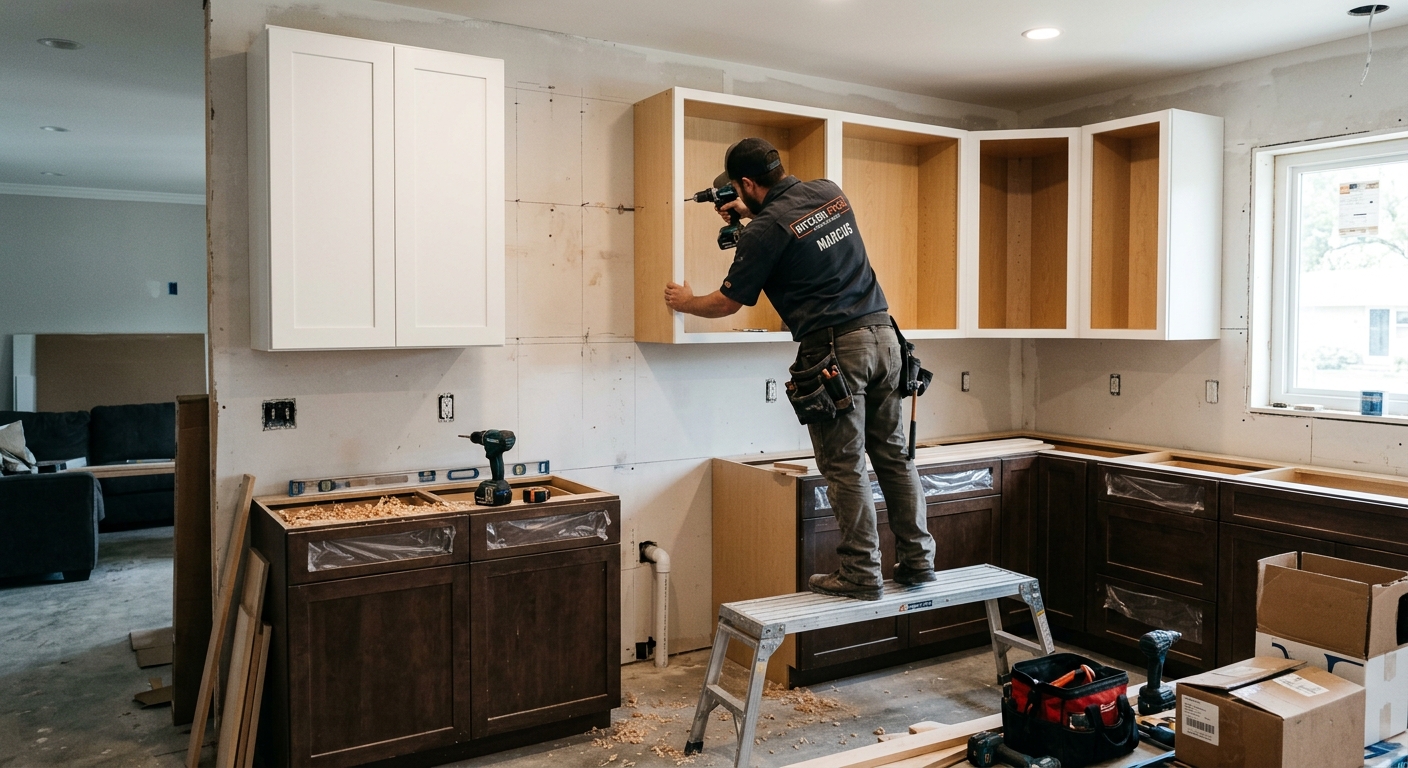
The project always begins with design and precise measurement. Next comes cabinet ordering — and that’s where the bottleneck sits. Cabinets, whether stock or semi-custom, routinely take 4–8 weeks to arrive. Demolition and rough-ins (framing, plumbing, electrical) only start once product is scheduled and on site to prevent your kitchen from sitting empty for weeks. After demo, rough-ins are completed and inspected if required. Cabinets are then installed, which triggers the next dependency: the countertop template.
Here’s why schedules slip: countertop templating cannot be done from plans. Granite and quartz suppliers in Monaca will only measure after cabinets are set, not before. Fabrication then takes another 1–2 weeks. This built-in dead period, with your kitchen half-assembled, catches many by surprise. Only after countertops are installed can you bring in flooring, tile, backsplash, and final trim.
Realistically, even a straightforward cabinet replacement may take 4–6 weeks door to door, with 1–2 weeks of kitchen downtime for countertops after cabinets are in. Ordering all cabinets and major fixtures before starting demolition is the best hedge against frustrating dead time — a step worth taking even if it means living with a dated kitchen a bit longer upfront.
What's behind the walls in a Monaca kitchen
Renovating kitchens in Monaca’s mostly pre-1980 housing means opening up walls of unknowns, especially in houses built during the 1940–1960 boom. Once cabinets are out, you might encounter out-of-plumb plaster walls or floors out of level by an inch or more — installing new cabinets may then need elaborate shimming, which adds labor and sometimes custom cuts. If original wiring is present, it’s frequently ungrounded or undersized, and you’ll likely need to run new circuits to meet code (see the electrical section above).
Plumbing surprises are common, too. Many older homes have galvanized water supply lines that are now at the end of their life, or cast iron drains that can be partially blocked or leaking. Upgrading to modern PEX or PVC — especially when the walls are open — is often the only responsible option. Another frequent issue is exterior walls with no insulation at all, which becomes glaring once demo starts and should be addressed before anything is closed back up.
If your older Monaca kitchen predates 1978, any painted surfaces or old flooring are subject to the federal EPA Lead RRP Rule — meaning a certified contractor must test and, if present, follow lead-safe practices. These extra labor precautions add some cost but protect your family and are a legal requirement.
Modern code also expects proper range hood ducting, which older kitchens usually lack. All these “hidden” upgrades add quickly — typical mid-project fixes run from a few hundred dollars (for minor framing shims) to $4,500–$13,000 for electrical and plumbing corrections. Planning for at least some surprises is a necessity here.
Frequently asked questions — kitchen renovation in Monaca
Why are kitchen quotes in Monaca so far apart?
Contractors in Monaca quote kitchen remodels across a huge price range for two main reasons: scope ambiguity and hidden conditions. Many older homes here (nearly 9 in 10 built before 1980) bring hidden costs — old wiring, odd framing, lead paint rules — that can double what looks like a simple project once the walls are open. But the biggest factor is scope definition. There’s a world of difference between a cosmetic update and a full gut remodel with layout changes, and the price tags reflect that: anything from $6,500–$112,000. Contractors who don’t walk the site or who quote “pull and replace” level work may give a lower figure, only for the price to rise with each surprise. When comparing bids, nail down exactly what’s included, ask for specifics on contingencies, and don’t take the lowest number at face value without understanding what it leaves out.
How much more does moving the sink and range cost?
Moving the sink and range in a Monaca kitchen can take a project from practical to expensive in a hurry. Relocating plumbing and electrical isn’t just a matter of running pipes and wires — it usually means opening up more walls, upgrading circuits, revising the subfloor, and potentially losing some cabinetry in the process. Changing the kitchen’s basic layout is what triggers permit and inspection requirements here (especially in Aliquippa and throughout Beaver County), adds planning time, and often puts you into a new price tier entirely. Expect a remodel with a layout change to start around $60,500 and climb, compared to keeping everything in place at $28,000–$60,500. It’s not a marginal add-on; it’s a whole category shift when it comes to complexity and cost.
Which upgrades are not worth the money?
High-end bells and whistles rarely pay back in Monaca’s modest market. Appliance garages, built-in espresso machines, and exotic countertop materials like imported marble don’t recover anywhere near their cost at resale. The major mistake is spending at the top of the market on features most buyers here don’t value, given the local median income and typical home prices. Also, full custom cabinets are rarely justified when semi-custom or even stock will handle most needs. Unless you have a true design vision or unusual space, stick to durable, reputable finishes and moderate upgrades. For reference, a full gourmet kitchen with every “magazine” upgrade often lands at $112,000, but the next buyer in Monaca is unlikely to pay up for those details. Focus on what’s durable, practical, and suits how you actually use the space.
What is the difference between stock and semi-custom cabinets?
In Monaca, stock cabinets are off-the-shelf, ready-made boxes sized in standard 3-inch increments. They’re quickest to get — sometimes within a week or two — and the most affordable option, with replacements starting at $6,500. Semi-custom cabinets, on the other hand, are built to order: you still pick from set styles and sizes, but you can tweak dimensions, finishes, and configurations to better suit your space. This flexibility helps fit older kitchens with wavy walls or nonstandard layouts, which are common here. Semi-custom costs more, with a typical full replacement landing closer to $18,500, and lead times run 4–8 weeks. Pure custom, which means anything goes, is usually overkill for most homes in Monaca, unless you have truly unique needs (and the patience to wait months). For most households, semi-custom delivers the best mix of fit and value.
What should I expect in a pre-1980 Monaca kitchen?
Most pre-1980 Monaca kitchens come with quirks — and costly surprises once demolition begins. Expect out-of-level floors, plaster or lath walls that aren’t square, and wiring that’s likely ungrounded or undersized for today’s appliance demands. Plumbing may be galvanized steel (prone to clogging and leaks) or even cast iron for drains, both candidates for replacement. If your house was built before 1978, painted surfaces may fall under the federal EPA Lead RRP Rule; any painted demolition or sanding will require testing, handled only by certified crews. All told, you should plan for additional spend — frequently $4,500–$13,000 extra — to bring electrical and plumbing fully up to code. The upside is that you’ll end up with a safer, more comfortable kitchen that’s less likely to spring costly surprises down the line.
How do I set up a temporary kitchen?
Setting up a makeshift kitchen is a Monaca renovation necessity, since most projects will take several weeks. Pick a space near a water source — a basement laundry tub or half-bath works well. Move your fridge, microwave, coffee maker, and toaster oven there, and stock up on paper goods and simple pantry items. You’ll want a folding table, dish tub, and access to a garden hose for bigger clean-ups, especially if your main water shutoff is involved. Plan out meals that can be made with minimal cooking — sandwiches, salads, or grill-based dinners work better than slow-cooker marathons with limited outlets. If your remodel includes everything down to the subfloor, be aware that periods without water or power are common. For longer gut jobs, especially at the $28,000–$60,500 scope, a rented utility sink or portable induction burner can be a sanity-saver. Don’t be afraid to lean on neighbors or local takeout during the worst stretch.
What is the cheapest way to update a Monaca kitchen?
The most cost-effective upgrades in Monaca kitchens are cosmetic: painting cabinets, updating hardware, swapping out light fixtures, and installing a new backsplash. These changes make a tired kitchen feel fresh for a fraction of a full replacement — sometimes under $6,500 if you do the labor yourself. Cabinet refacing (just new doors, fronts, and veneer) is a step up and runs $6,500–$18,500, usually less than half the price of full replacement. Avoid the complex and costly stuff: moving walls, adding circuits, or relocating plumbing all put you into another price band. In Monaca’s modest housing market, going for a clean, neutral update with durable fixtures will satisfy most owners and buyers without risking your savings on a kitchen overhaul you can’t recover.
Can I cancel a renovation contract in Pennsylvania?
Yes, Pennsylvania’s Home Improvement Consumer Protection Act (HICPA) gives homeowners a three business-day right of cancellation for any written home improvement contract over $500 — which applies to almost any kitchen remodel in Monaca. The contract must clearly describe this right. If you sign for a new kitchen — whether it’s a modest cabinet replacement at $18,500 or a full gut remodel — you have three business days to walk away without penalty. The law also prohibits contractors from waiving or crediting your homeowners insurance deductible as part of a deal. Always read the contract, check that the cancellation period is stated plainly, and keep records of all communications. If your contractor doesn’t provide this right in writing, that’s a red flag — check their registration at hic.attorneygeneral.gov before proceeding.
Should I order cabinets before demolition?
In Monaca, the answer is almost always yes. Cabinet lead times are rarely under a month — and for semi-custom, 4–8 weeks is typical. Waiting until demolition is complete to order means your kitchen could be down for weeks longer than necessary. Plan your timeline so your new cabinets arrive just after rough-ins are done, not months later. Contractors in Beaver County are often balancing multiple jobs, and delays pile up when products aren’t on site. Even for straightforward jobs, like a full replacement costing $18,500, ordering cabinets before you demo lets you move from rough-in straight into installation, limiting the disruptive “dead zone” when you’re living without a kitchen. The only thing worse than demolition dust is staring at empty studs, waiting for a delivery truck.