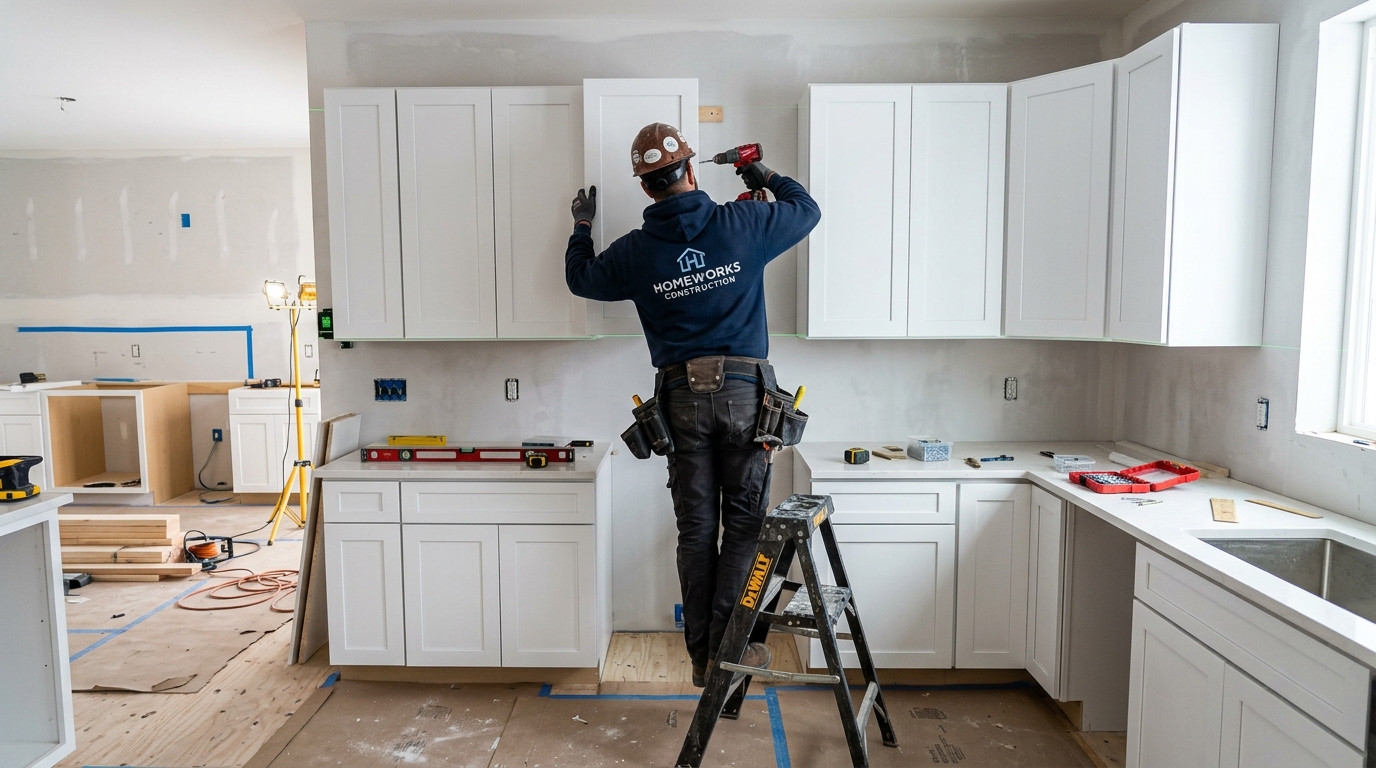
Ligonier kitchen renovation prices by scope — 2026
If you live in Ligonier, you’re not choosing kitchen projects the way a city landlord would. High homeownership—83.4% (U.S. Census Bureau, ACS 2024)—means most renovations here are for families who plan to stay, and kitchen budgets tend to track real home values and local incomes (median household income is $68,125). Ligonier’s mix of heavily 1960s–1980s suburban housing shows up in remodel costs: older layouts tend to need wall moves and electrical upgrades, while more recent builds might just need new finishes. That construction era often shapes your budget more than square footage does.
The frustration—and the blown budgets—start when a homeowner prices a “pull and replace” and then sketches a design that shifts sinks, knocks out soffits, or adds circuits. Once electrical or plumbing lines move, the number jumps.
| Scope |
What's included |
Duration |
Price range |
| Full gut remodel, same layout |
cabinets, counters, appliances, flooring, lighting, fixtures |
6–10 weeks |
$28,500–$115,000 |
| Gut plus layout change |
all of the above plus moved plumbing, electrical, walls |
10–16 weeks |
$62,000–$115,000 |
| Cabinet replacement (stock to semi-custom) |
remove and install cabinets, hardware, patching |
1–3 weeks |
$6,700–$28,500 |
| Cabinet refacing |
new doors and drawer fronts, veneer, hardware |
3–6 days |
$6,700–$19,000 |
| Countertop replacement only |
template, fabricate, install, reconnect sink |
1–3 weeks |
$3,800–$15,500 |
| Kitchen flooring only |
remove existing, install new flooring |
3–6 days |
$4,800–$19,000 |
Estimates for a typical Ligonier kitchen. Cabinet grade and whether the layout changes move these figures more than square footage.
Why the contingency exists
Ligonier’s kitchens are mostly in homes built before 1980 (71.4% per U.S. Census Bureau, ACS 2024), and that means opening up the walls is a gamble. The typical surprises—and what they cost to address—include:
- Out-of-plumb walls and uneven floors: Shimming cabinets or self-leveling floors often means several hundred to several thousand dollars depending on severity.
- Old wiring: 1960s–1970s houses often have undersized, ungrounded, or minimal circuits. Upgrading to modern code for a kitchen can run from a few hundred up to a few thousand dollars, especially if adding AFCI/GFCI protection or new circuits.
- Galvanized supply lines or cast iron drains: If you find these, replacement as part of the remodel is almost always a smart move, with costs scaling by kitchen size and accessibility, commonly $1,000–$3,500 extra.
- No insulation on exterior walls: Retrofits cost $400–$1,000, but not doing it means a cold kitchen.
- Previous unpermitted work: Fixing hidden shortcuts can mean anything from patching to full replacement, and is hard to price before demolition.
- Lead paint and asbestos flooring (pre-1978): Federal EPA Lead Renovation, Repair and Painting (RRP) rules apply. Professional testing is required before disturbance, and remediation can add $500–$2,500 depending on extent.
Newer homes in the area aren’t immune. Builder-grade kitchens from the 1980s onward often skimped with particleboard cabinets or minimal electrical service. These reach end-of-life at the same time, and that can push you into a more involved renovation even if the layout is modern enough.
Code requirements for Ligonier kitchens
In Ligonier and the rest of Westmoreland County, kitchen projects fall under the Pennsylvania Uniform Construction Code (UCC), based on the IRC and enforced at the municipal level. Standard cosmetic upgrades—like painting, hardware, refacing, or swapping in a new countertop that matches the old one—generally do not need a permit. But if your project moves or adds electrical circuits, relocates plumbing, or alters any walls or structure, you can expect to need a permit. In Greensburg, specifically, moving plumbing lines or removing a structural wall during a kitchen remodel will trigger a building permit and likely a formal plan review. In Hempfield Township, replacing cabinets—if you’re not moving appliances—typically does not.
Third-party agencies such as Code.sys are commonly used for electrical inspections in both Greensburg and Hempfield, so don’t count on a municipal inspector every time. Inspections must be scheduled before the walls are closed up, and final electrical sign-off is a separate step.
Anyone signing a contract over $500 must be registered with the Pennsylvania Office of Attorney General as a Home Improvement Contractor (HIC) and must carry workers’ compensation insurance if they have employees, which you can verify in WCAIS.
Unpermitted work catches up to sellers at resale time. Appraisers and buyers do look for permits—and lack of one can mean delay or price reduction.
Four kinds of kitchen project, four budgets
In Ligonier, the vague phrase “kitchen remodel” covers a price range from finishing touches to full rebuild. Break it into four tiers so you know what you’re asking:
- Cosmetic refresh: new paint, cabinet hardware, lighting, maybe a backsplash—no cabinets or layout changes. Fast, inexpensive, and no permit triggered.
- Pull and replace: new cabinets and counters, same layout and footprint. Plumbing and electrical stay put. Minimal disruption, often no permit needed, unless you upgrade electrical or make structural changes. This is where most “cabinet replacement” numbers ($6,700–$28,500) land.
- Gut, same layout: everything down to the studs, with updated plumbing, electrical, insulation, but keeping everything in place. Full replacement but not reimagined—the costs are higher ($28,500–$115,000) because of the mechanicals and finishes.
- Layout change: moving the sink, opening walls, rearranging floor plan. This is where the budget jumps—permits, engineering, possibly relocation of services—rarely under $62,000 and going up from there.
The steepest cost jump is from gutting in place to changing the layout. The crossover is when you move plumbing or electrical: that’s a bigger crew, more inspections, and different timelines. Decide your project tier before calling contractors—no pro can give you a meaningful number without knowing which category you mean, and “just a few changes” puts you in a new budget bracket.
Renovating to live in versus renovating to sell
A new kitchen helps a home sell faster in Ligonier, but it’s not a magic investment. The reality is, if your goal is to move within a few years, a big spend is not coming back dollar for dollar. Data shows mid-range renovations recoup a far greater share of their cost at sale than top-shelf ones, especially in Ligonier, where the median household income is $68,125 (U.S. Census Bureau, ACS 2024). Over-improving—adding features or spending well above the typical range ($62,000 and above)—rarely pays off, unless you’re planning to stay and enjoy it for a decade.
If you’re renovating to sell, aim for updated but neutral finishes, mid-range cabinetry and counters, and avoid moving the layout. The goal is to remove objections for buyers, not to build your dream. If you’re renovating to live in, the calculation changes—spend on what matters to you: storage, lighting, a layout that works for your cooking, even if it’s not a sure resale winner. Don’t let resale math stop you from enjoying your home, but do know where the market lines are in Ligonier’s price bands.
Planning appliances before cabinets
Avoid the sequencing trap—appliance dimensions dictate cabinet layout, not the other way around. If you pick appliances after cabinet plans are set, you’re at the mercy of what fits, not what you want. For example, standard refrigerators are deeper than counter-depth, which means the wrong choice can leave you with a fridge sticking out past the new cabinetry. Ranges come as freestanding or slide-in; slide-ins need different counter treatments. Gas and induction cooktops require not just a gas or electrical line, but also enough amps; you may need to plan for a dedicated 40-amp circuit if you want induction. Panel-ready dishwashers need custom cabinet panels sized correctly, and cannot simply be swapped in later.
Range hood vents should ideally duct to the outside; recirculating hoods fit more situations but won’t actually clear out smoke or humidity after a cooking marathon. Upgrading to a ducted hood requires planning for wall or roof penetration before cabinet installation, not after.
Professional-grade appliances do give better temperature control and heavier hardware, but above all you are paying for looks and brand. Unless cooking is a hobby, most families are well served by mid-range lines.
Finally, double-check lead times: Some high-end appliances are backordered months, longer than it takes to fabricate cabinets, and scheduling around them can be the hardest part.
Allowances, exclusions and change orders
Comparing kitchen remodel bids is more complicated than lining up bottom lines, because much of the total gets carried as an "allowance." An allowance is a placeholder—a rough dollar figure for an item you haven’t selected yet (like tile, lighting, or appliances). One contractor might plug in $8,000 for cabinets, another $15,000, and it’s easy to mistake lower allowances for real savings. Always compare the allowance lines first: If a “tile” row reads $500 in one bid and $1,500 in another, you know most of the difference is just what’s set aside, not actual cost cutting.
A strong quote will call out the cabinet brand and construction in detail; slab descriptions should list countertop material (quartz, granite), thickness, finished edge profiles, and how seams are handled. Good contracts also spell out what happens with surprises in the walls: Are you billed time and materials, a set rate, or must you approve a written change order first? Payments should be linked to clear milestones and come with lien waivers from subcontractors so you’re protected against later claims. Pennsylvania’s Home Improvement Consumer Protection Act (HICPA) requires a written contract on jobs over $500, and gives you a three-day window to cancel with no penalty.
| Line item |
What to look for |
Red flag if… |
| Allowances |
realistic amounts, itemised |
round numbers with no basis |
| Cabinetry |
brand, line, box construction |
'quality cabinets' |
| Countertops |
material, thickness, edge, seams |
material name only |
| Electrical |
circuits to be added, GFCI scope |
'as needed' |
| Unforeseen conditions |
how they are priced and approved |
not addressed |
| Change orders |
written approval before work |
verbal |
| Payment |
milestone-based, modest deposit |
front-loaded |
| Lien waivers |
from subs at each payment |
not offered |
Frequently asked questions — kitchen renovation in Ligonier
How long does a kitchen renovation take in Ligonier?
A typical kitchen renovation in Ligonier takes anywhere from 1 to 16 weeks, depending on the scope. Cabinet replacement jobs often wrap up in 1–3 weeks, while a full gut remodel with a layout change can stretch from 10 to 16 weeks. Most projects fall into the $28,500–$115,000 range (gut remodel), but lead time for trades is longer in Ligonier than in Pittsburgh due to a tighter local labor market. Adding a layout change or specialty materials can add several weeks, especially if inspections and supply chains slow things down. Always allow for some slippage—weather, inspections, and unexpected conditions in old houses can push even the best-planned job out by a week or two.
What is a realistic contingency for a Ligonier kitchen?
For any kitchen renovation in Ligonier—especially in homes built before 1980—it’s wise to set aside a contingency budget of around 10–20% of the project cost. This is because unexpected issues like old wiring, uneven floors, or lead paint (in homes constructed before 1978) are common. For example, with a pull-and-replace job in the $6,700–$28,500 range, a reasonable reserve would be $1,000–$5,000. If you’re gutting to the studs, set aside even more. Contingency budgets go toward hidden surprises found after demolition—not upgrades or wish-list items.
What is the difference between stock and semi-custom cabinets?
In Ligonier, stock cabinets are factory-made in fixed sizes and finishes, costing less and installing faster. Semi-custom cabinets, which still fall within the $6,700–$28,500 cabinet replacement band, let you adjust dimensions, pick more finishes, or upgrade storage. The flexibility helps fit odd wall lengths or older homes with wavy floors—something common in the area’s 1960s–1980s housing stock. True custom is more, but most local projects are stock or semi-custom.
What should I expect in a pre-1980 Ligonier kitchen?
Kitchens in Ligonier built before 1980—over 70% of local homes—often have uneven floors, lack insulation, and may feature old, undersized wiring or galvanized plumbing. Hidden surprises pop up: lead paint in pre-1978 homes (which fall under EPA rules), asbestos-containing flooring, or DIY repairs. Fixing these can add to both duration and cost, and is one reason to keep a 15–20% contingency in your gut remodel budget, which here runs from $28,500–$115,000. Always plan for some correction work once walls and floors open up.
Does a kitchen renovation increase home value in Ligonier?
A solid, well-done kitchen renovation helps your home sell faster in Ligonier, but it doesn’t guarantee you’ll recoup what you spend. In this market, where the median household income is around $68,125, a practical pull-and-replace or midrange gut remodel ($28,500–$62,000) generally recovers a larger share than high-end custom work. If you overspend for luxury finishes far above what other local homes feature, don’t expect appraisers or buyers to pay extra at resale—enjoy the new kitchen, but know it’s mainly value to you while you live there.
What does a quartz countertop cost in Ligonier?
Quartz countertop replacement in Ligonier typically falls between $3,800–$15,500, depending on the size of your kitchen, the edge style, and the grade of quartz selected. Most homeowners here spend around $8,600 for new quartz countertops, including templating, fabrication, and installation. Ligonier’s housing stock—extra small or extra large kitchens are rare—puts most projects in the middle of that band.
Can I renovate a kitchen in stages?
Staged renovation is possible in Ligonier, especially if you’re handling finishes first and bigger work later. For example, you could replace appliances and flooring (in the $4,800–$19,000 and up range), then take on cabinets or counters a year later. The downside is more disruption—moving in phases means multiple messes, and some work may have to be redone (like patching floors or paint). Planning ahead can help cut repeat labor, but expect a higher total project cost versus a single, all-in remodel.
How do I set up a temporary kitchen?
While your Ligonier kitchen is torn apart, set up a temporary kitchen in another room—often the basement, dining room, or garage. Move your fridge, microwave, and coffee maker out of the work zone, and stock up on disposable plates. A small utility sink or laundry tub helps with washing up, and an induction hot plate can stand in for a cooktop. Plan meals that don’t need much prep or rely on takeout for a couple of weeks. For a mid-range cabinet replacement project ($6,700–$28,500), expect to use the temporary setup for at least one to three weeks.
How do I verify a kitchen contractor in Pennsylvania?
Any kitchen contractor working in Ligonier or elsewhere in Pennsylvania must have a Home Improvement Contractor (HIC) registration for any contract over $500. You can verify this registration at hic.attorneygeneral.gov. If the contractor has employees, verify workers’ compensation insurance at WCAIS (wcais.pa.gov). A legitimate kitchen cabinet install, for example, at $6,700–$28,500 for replacement, always comes with a written contract, per the Pennsylvania Home Improvement Consumer Protection Act. Ask to see both registration and insurance certificates before signing or paying a deposit.