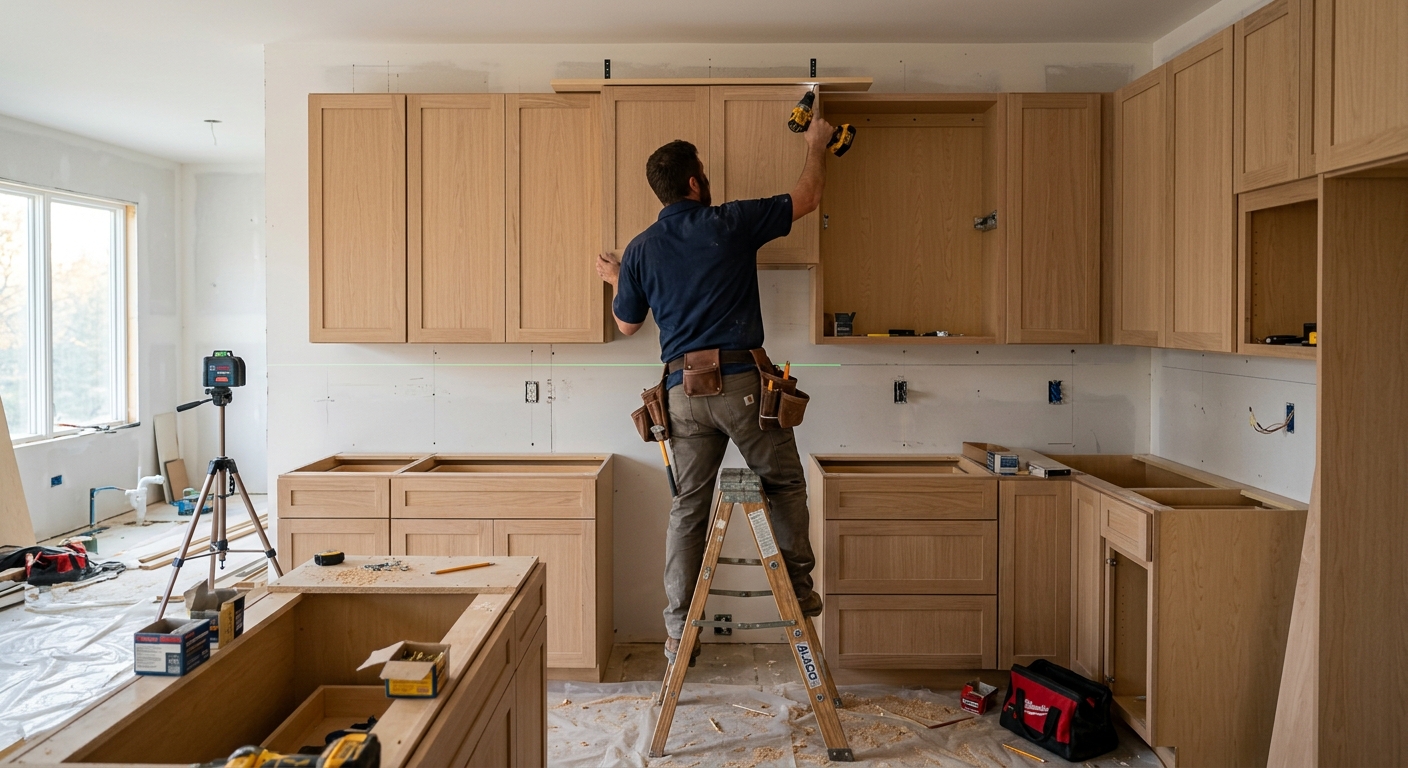
Perkiomen kitchen renovation prices by scope — 2026
In Perkiomen, kitchen renovation spending mainly tracks homeowner priorities and the strong household incomes locally—median household income here is $141,125 (U.S. Census Bureau, ACS 2024). With a homeownership rate of 88.4%, most kitchen projects in town are initiated by owners who want something lasting, not just functional for a tenant. The era and style of local homes matters as well: post‑1945 subdivisions like those in nearby Abington and Upper Dublin have kitchens that often need mid-scale modernization, while the bones are typically sound but the layout or finishes need updating.
The biggest variable in kitchen cost isn’t size, but scope. Most blown budgets I see start with someone pricing stock cabinet replacement, then picking out high-end amenities and moving plumbing, which puts them into a gut-remodel cost range—sometimes double the original plan. The layout and whether you change the locations of major utilities are the biggest drivers. Below is what you can expect, with estimates grounded in the 2026 Montgomery County market:
| Scope |
What's included |
Duration |
Price range |
| Full gut remodel, same layout |
cabinets, counters, appliances, flooring, lighting, fixtures |
6–10 weeks |
$35,500–$143,000 |
| Gut plus layout change |
all of the above plus moved plumbing, electrical, walls |
10–16 weeks |
$77,500–$143,000 |
| Cabinet replacement (stock to semi-custom) |
remove and install cabinets, hardware, patching |
1–3 weeks |
$8,300–$35,500 |
| Cabinet refacing |
new doors and drawer fronts, veneer, hardware |
3–6 days |
$8,300–$24,000 |
| Countertop replacement only |
template, fabricate, install, reconnect sink |
1–3 weeks |
$4,800–$19,000 |
| Kitchen flooring only |
remove existing, install new flooring |
3–6 days |
$6,000–$24,000 |
Estimates for a typical Perkiomen kitchen. Cabinet grade and whether the layout changes move these figures more than square footage.
When a Perkiomen kitchen needs walls moved
Many homeowners in Perkiomen start with minor changes in mind but quickly run into a budget “cliff” when the conversation turns to moving plumbing or electrical. The price jump isn’t proportional to how far things move—it’s triggered by the fact of moving them at all.
If you want to move a sink, remember: drain lines aren’t flexible, and they require a proper slope to work. If your kitchen sits over a finished basement or a slab, rerouting a drain can cascade into patching ceilings or jackhammering concrete. Likewise, moving a range or refrigerator to another wall means assessing whether your panel has space for new circuits, especially with induction or double electric ovens now common in this area’s modernizations.
Removing a wall—especially in the postwar homes found throughout Montgomery County’s suburbs—means first assessing if it’s load-bearing. That involves both an engineer and a building permit; in Lower Merion Township, structural wall removal or any kitchen reconfiguration triggers a permit and sometimes a plan review. Venting a relocated hood to an outside wall requires a proper exterior penetration and, in older homes with tight eaves, can mean either a custom vent path or settling for a recirculating hood.
The honest approach: run a hard test on whether your layout is fatally flawed or just not “2020s” fresh. Most kitchens can be vastly improved without sinking another $42,000–$65,000 (the difference between a typical full gut and a gut with layout change) just to move the sink or range a few feet. Often, your money is better spent on finishes, durable cabinets, and better lighting in place than chasing open-concept ideals.
Quartz, granite, laminate or butcher block
When picking a countertop for your Perkiomen kitchen, think about what you expect from daily use, not just what’s “in fashion.” Quartz—engineered stone—is the favorite here for a reason: it’s non-porous, highly consistent, and resists staining. Its only real flaw is poor heat tolerance—set a hot pan down, and you risk permanent marks.
Granite is genuine stone, so every slab is unique and it’s more heat-resistant than quartz, but it does need periodic sealing to avoid staining and can chip if abused. Seams with both quartz and granite are usually subtle but visible, especially on light or highly patterned stones.
Laminate has a dated reputation but isn’t the same product it was decades ago. For a rental or a modest kitchen, it’s a good use of money: improved edge profiles, colors, and the ability to replace panels easily. It does scratch and scorch more easily than stone, and seams will show no matter how well installed—but it’s repairable for less and perfectly practical.
Butcher block gives warmth but demands daily upkeep—it must be oiled, it stains, and it’s not especially forgiving of knives or water. Where you want repairability and a softer landing—think a small prep area or island—it works, but not everywhere.
On price, fabrication influences cost as much as material. Complex edge profiles, sink cutouts, and matching seams all drive fabrication hours. Most installers will visit once to template (using either laser or hard template), then fabricate off-site, and install in one trip. Don’t underestimate the value of simple lines and standard edges—you get more material quality for your money.
Choosing cabinetry
The cabinetry decision—replace or reface, and whether to go stock, semi-custom, or full custom—determines most of your kitchen’s budget. Refacing is the best-kept secret if your existing cabinet boxes are solid, square, and laid out the way you want. You keep what’s already attached to the wall, swap out the doors, drawer fronts, hardware, and veneer. The cost is far less than replacing with new—$8,300–$24,000—and quality is often better than entry-level new cabinets.
But you can only reface if your boxes are worth saving and you’re not changing the layout. Stock cabinets come in fixed sizes and only work well in rooms that happen to fit those modules—the average Perkiomen kitchen from the post‑1945 subdivisions around Abington and Upper Dublin often pushes you to semi-custom whether you expected it or not. Those houses tend to have a few odd dimensions, and semi-custom gives more flexibility on size and finish.
Custom gives a perfect fit and any finish you want, but it’s both the highest cost and the longest wait—driven as much by labor availability as by materials. For all types, check not just the face but the box itself: plywood boxes outlast particleboard; dovetail drawers are preferable to staples; full-extension, soft-close hardware is the standard you want today; and frameless (full overlay) cabinets give a sleeker look but need precise installation.
| Option |
Cost |
Best when |
Limitation |
| Painting existing cabinets |
$1,200–$3,500 |
boxes and doors sound, tight budget |
no layout or style change |
| Refacing |
$8,300–$24,000 |
boxes square and layout works |
storage unchanged |
| Stock cabinets |
$8,300–$35,500 |
standard dimensions fit |
filler strips, limited finishes |
| Semi-custom |
$24,000–$35,500 |
non-standard walls or finishes |
6–12 week lead time |
| Full custom |
$24,000–$35,500 |
unusual layout or high-end design |
longest lead, highest cost |
Code requirements for Perkiomen kitchens
In Perkiomen, as across Montgomery County, most kitchen work that remains cosmetic—painting, hardware changes, cabinet refacing, or direct countertop swaps without modifying what’s beneath—does not require a permit. As soon as your project involves added or moved electrical circuits, moved plumbing pipes, changing the floor plan, or any structural work (like removing or reconfiguring a wall), expect a permit. If you’re in a township like Lower Merion, layout changes or wall removal in a kitchen are a definite trigger for building permits and a plan review.
Electrical inspections can surprise: in Norristown they are handled by the municipal office, but in many townships around Perkiomen, third‑party electrical inspection agencies will be brought in—this is worth asking about up front.
Contractor choice matters. In Pennsylvania, any residential job over $500 requires that your contractor have a Home Improvement Contractor (HIC) registration with the Pennsylvania Office of Attorney General—verify at hic.attorneygeneral.gov. Workers’ compensation coverage is mandatory for any contractor with employees and can be checked on the WCAIS system (wcais.pa.gov).
Unpermitted or non-compliant work often comes up as a serious issue during resale. Inspectors—and buyers—look for evidence of recent kitchen work without documentation. If it should have been permitted, you could be pushed into getting retroactive approval, which costs far more after the fact.
What a kitchen quote should specify
The biggest challenge when comparing kitchen renovation quotes in Perkiomen is how allowances are handled. An allowance is a placeholder figure for something—often tile, plumbing fixtures, or appliances—you haven’t picked yet. Contractor A might carry a modest or even “token” allowance for tile, while Contractor B carries a number that will actually get you the tile you want. Totals might look similar, but as soon as you pick materials, one bid balloons.
Scrutinize how allowances are itemized and matched to local costs. Demand cabinet brand and line in writing, exact countertop materials, finish details, and how edge profiles and seams are handled. Make sure the quote spells out what happens when something unexpected is encountered—hidden water damage, asbestos, or structural surprises. Any change-order process should require your written approval before work continues, not just a conversation. Payments should be milestone-based, not lumped up front. At each payment, request lien waivers from subcontractors to protect yourself if a subcontractor is unpaid by the general contractor.
Pennsylvania law (Home Improvement Consumer Protection Act) requires a written contract over $500, and gives you three business days to cancel after signing. Insist on seeing both rules shown in your contract.
| Line item |
What to look for |
Red flag if… |
| Allowances |
realistic amounts, itemised |
round numbers with no basis |
| Cabinetry |
brand, line, box construction |
'quality cabinets' |
| Countertops |
material, thickness, edge, seams |
material name only |
| Electrical |
circuits to be added, GFCI scope |
'as needed' |
| Unforeseen conditions |
how they are priced and approved |
not addressed |
| Change orders |
written approval before work |
verbal |
| Payment |
milestone-based, modest deposit |
front-loaded |
| Lien waivers |
from subs at each payment |
not offered |
Planning appliances before cabinets
In kitchen renovation, sequencing matters—especially with appliances. Decide on your appliances before the cabinets are ordered. Cabinet configurations revolve entirely around appliance dimensions; wait until after cabinets are made, and you’re stuck with “almost fits” or expensive field changes.
Counter-depth refrigerators sit flush with new cabinets, but a standard-depth fridge will stick out unless you plan the cabinet depth accordingly. Slide-in ranges need a cut-out in the counter—freestanding ranges do not. When swapping from a gas to an induction range, remember modern induction needs a dedicated, high-amperage electrical feed; not all panels in Perkiomen’s older homes have room for this. Panel-ready dishwashers can be concealed behind a cabinet-matching facade, but only if planned.
Range hood venting is another early decision. Ducted hoods, which vent outside, remove more smoke and moisture, but require a clear route to an exterior wall. Recirculating models, which just filter and return air, are easier to retrofit but don’t perform as well.
Professional‑grade appliances deliver durability and very consistent heat, but above a certain price, most of what you pay is for styling and minor convenience. Also, in today’s market, some high‑end appliances take longer to arrive than new cabinets—order as soon as your design is set.
Frequently asked questions — kitchen renovation in Perkiomen
Should I reface or replace my kitchen cabinets?
Refacing is a strong option in many Perkiomen kitchens, especially in homes from the wave of post-war suburban development where boxes are largely solid and square. If your cabinet layout works, the boxes are sturdy, and you just want a new look, refacing lets you upgrade for $8,300–$24,000 without all the demo and cost of replacement. On the other hand, if the boxes are sagging, have water damage, or you want a radically different layout, replacement is the better use of your money. Don’t reface with hopes of moving cabinets later—it’s an investment only if you’re satisfied with where things are. For many Perkiomen homeowners, especially in houses from the late 20th century, refacing is a genuinely worthwhile investment.
Do older Perkiomen homes need electrical upgrades for a kitchen?
Yes, many older Perkiomen homes—especially those built before 1980, which make up 36.3% of housing stock (U.S. Census Bureau, ACS 2024)—don’t have the number of circuits or panel space needed for today’s kitchens. Modern standards require dedicated circuits for microwaves, dishwashers, and outlets with GFCI protection. If you’re adding appliances or changing the layout, rewiring may be necessary and will move your project up to the higher price band (think $77,500–$143,000 for a full gut including layout changes). Always have an electrician check panel capacity and wiring before you build around it.
How do I set up a temporary kitchen?
Setting up a temporary kitchen during a gut remodel is essential if you want to avoid weeks of eating out. In Perkiomen, most homeowners use the dining room or basement: bring in a microwave, toaster oven, fridge (even a mini-fridge will do), and a folding table for prep. Use disposable plates or a utility sink elsewhere in the house for washing up. If your remodel is on the shorter side—like a cabinet reface at $8,300–$24,000—you might get by with just a cooler and a coffee maker for a few days. The longer and more involved the project, the more value you’ll get from planning the setup before demolition starts.
What does a quartz countertop cost in Perkiomen?
In Perkiomen, a typical quartz countertop replacement runs $4,800–$19,000, depending on the length, depth, number of cutouts (sink, cooktop), and the edge profile you choose. While quartz commands a premium over laminate or butcher block, its durability, low maintenance, and appearance have made it the most commonly chosen option in recent years. Opting for a standard edge profile and a straightforward color keeps you towards the lower end of the price range. Make sure the quote covers template, fabrication, installation, and reconnecting plumbing.
What adds the most resale value in a kitchen?
Most resale value in a Perkiomen kitchen comes from upgrades that buyers can see and use daily: new cabinets, hard-surface countertops, updated lighting, and quality hardware. You don’t need to aim for the highest-end finishes; focusing on layout efficiency and durable, attractive materials brings the best return. Typically, midrange upgrades like cabinet replacement at $8,300–$35,500 and fresh countertops pay off better than over-customizing or chasing trends. Prospective buyers here—where the homeownership rate is 88.4%—recognize and value recent, code-compliant work.
How much more does moving the sink and range cost?
Moving the sink and range in a Perkiomen kitchen typically shifts your project from a basic remodel price point to the much higher “gut plus layout change” cost tier. Expect this change to add at least $42,000–$65,000 to the job (the jump between a full gut in place and one with new locations), even if the distance moved is modest. That’s because it’s not just running pipes or wires—it’s opening walls, possibly patching ceilings below, dealing with code inspection and permitting, and often addressing structural or venting issues. Always question whether the new layout justifies the extra spend.
How do I verify a kitchen contractor in Pennsylvania?
Every contractor offering kitchen renovation work over $500 in Pennsylvania must hold a valid Home Improvement Contractor (HIC) registration, issued by the Pennsylvania Office of Attorney General. You can verify this at hic.attorneygeneral.gov. If workers are involved—a given on larger renovations (think a full gut at $35,500–$143,000)—make sure workers’ compensation insurance is in force, verifiable via the WCAIS system. For projects involving electrical or major plumbing, check your township’s requirements, too, since licensure and inspection may be handled at the municipal level. Don’t rely on word-of-mouth or a patch-on-van—ask to see documentation before work starts.
Should I order cabinets before demolition?
No—especially not in Perkiomen, where the dimensions of old kitchens may surprise you. Template and field measurements are most accurate after demolition, once you can see the structure and walls as they truly are (not covered by multiple layers of wallboard or tile). If you order cabinets before demo and discover anything is off—even by half an inch—you’ll need expensive modifications or filler strips. Semi-custom or custom cabinets, at $24,000–$35,500, should be measured after the space is open and clean. For stock cabinets, sometimes the box sizes work, but don’t risk it.
What countertop material is best for a family kitchen?
For most family kitchens in Perkiomen, quartz offers the best mix of durability, appearance, and low maintenance. It resists stains, doesn’t require sealing, and handles typical daily abuse well—making it worth the $4,800–$19,000 cost for a typical install. Granite is also durable but needs periodic sealing and is less forgiving to impacts. Laminate is strongly improved in quality and absolutely makes sense where the budget is tight or the kitchen is modest; it handles daily spills well but can scorch. Butcher block is warm but high maintenance, not ideal with heavy family use unless you love regular care.