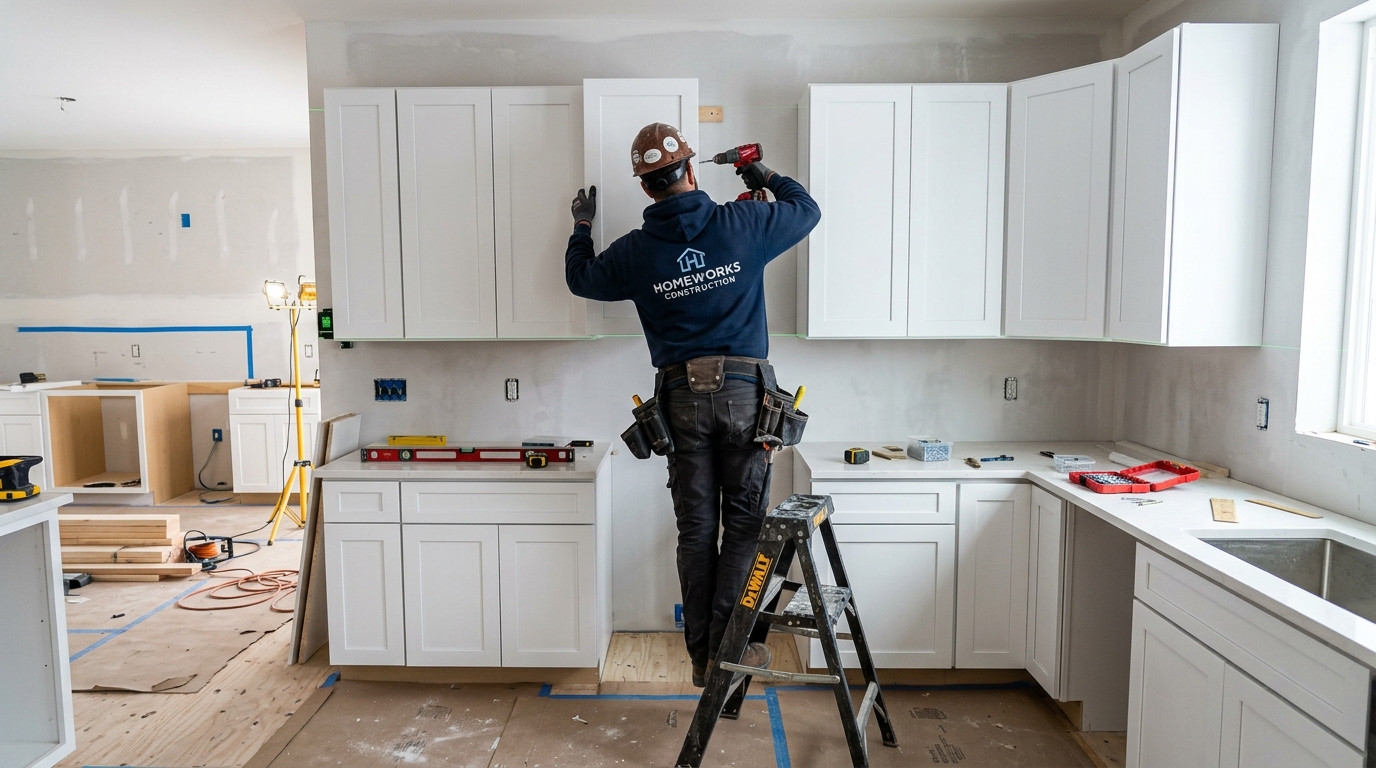
Palmer kitchen renovation prices by scope — 2026
In Palmer Township, kitchen renovation costs are shaped by a high homeownership rate of 79.2% and a median household income of $107,386 (U.S. Census Bureau, ACS 2024). This means homeowners here tend to approach kitchen projects as longer-term investments, not quick flips. If your home is one of the many built before 1980, you’re facing decisions that Bethlehem and Easton owners know well: whether to modernize a cramped postwar galley layout or simply refresh the finishes in a more recent build. The single biggest reason kitchen budgets blow up is not defining whether you need a full gut, a cabinet swap, or a real layout change. Pricing one scope, then deciding mid-project to move the sink or knock out a wall, is how $30,000 plans become $100,000 bills overnight.
Below are realistic price bands for Palmer in 2026, drawn from recent Lehigh Valley market figures. The ranges below reflect everything from a small cabinet refacing to a full gut and layout reconfiguration. Figuring out your scope is step one — and makes all the difference.
| Scope |
What's included |
Duration |
Price range |
| Full gut remodel, same layout |
cabinets, counters, appliances, flooring, lighting, fixtures |
6–10 weeks |
$32,500–$131,000 |
| Gut plus layout change |
all of the above plus moved plumbing, electrical, walls |
10–16 weeks |
$71,000–$131,000 |
| Cabinet replacement (stock to semi-custom) |
remove and install cabinets, hardware, patching |
1–3 weeks |
$7,600–$32,500 |
| Cabinet refacing |
new doors and drawer fronts, veneer, hardware |
3–6 days |
$7,600–$22,000 |
| Countertop replacement only |
template, fabricate, install, reconnect sink |
1–3 weeks |
$4,400–$17,500 |
| Kitchen flooring only |
remove existing, install new flooring |
3–6 days |
$5,500–$22,000 |
Estimates for a typical Palmer kitchen. Cabinet grade and whether the layout changes move these figures more than square footage.
What moving the sink really costs
The decision to move a sink — or any major appliance — is where kitchen renovation costs in Palmer climb sharply. As long as plumbing and electrical stay put, your project usually stays on the less expensive “same layout” side. But once you ask for a sink across the room, a dishwasher under a window, or a range on a different wall, the job jumps up a cost tier instantly. The added expense isn’t proportional to how far you move things. Relocating drain lines, for example, isn’t just about running new pipe: drains must slope continuously, and when your kitchen sits on a slab or above a finished ceiling, this becomes complicated and expensive. New electrical circuits often mean verifying that your panel has spare capacity, and sometimes an upgrade is required.
Moving a wall brings in engineering fees and a building permit, especially if it’s load-bearing. Venting a new range hood means creating a new exterior hole, which in a masonry wall or through siding carries its own complications.
If you’re in Bethlehem, any renovation involving moved plumbing lines or new circuits triggers a permit and required municipal inspection. The cost jump from a gut remodel that keeps the same layout ($32,500–$131,000) to one with a layout change ($71,000–$131,000) is never minor. Before you green-light moving your sink four feet, have a frank conversation: is the old layout truly unworkable, or just dated? Many homeowners spend tens of thousands mainly for aesthetic change they could have achieved with new cabinets and finishes.
Surprises in an older Palmer home
About half the homes in Palmer Township were built before 1980 (U.S. Census Bureau, ACS 2024), and the Lehigh Valley’s history of pre‑1940 stock in Bethlehem and Easton is often echoed here. Once cabinets and soffits come down, contractors find out-of-plumb walls, floors that drop more than half an inch over twelve feet, or decades-old wiring barely adequate for a toaster and microwave on the same circuit. Shimming cabinets plumb and level can add days to an install — and a few thousand dollars in labor.
Galvanized plumbing lines or cast iron stacks, common in mid-century homes, may need full replacement to meet current standards and avoid future leaks, which can run an extra $4,400–$17,500 depending on branch length and access. Discovering ungrounded or undersized wiring is a budget shock, leading to new circuits or even a panel upgrade. Exterior walls without insulation are common in homes predating energy code, and retrofitting adds both cost and complexity.
If your home is pre-1978, federal law requires contractors to follow the EPA Lead Renovation, Repair and Painting Rule. This means lead testing precedes disturbing painted surfaces, which adds time and cost but is mandatory. Asbestos-containing flooring is also a concern in the right era and demands proper testing and disposal. In Palmer’s newer subdivisions, the typical issue is builder-grade cabinetry and old laminate counters reaching the end of their life — usually less of a can of worms, but still ripe for a real upgrade.
Code requirements for Palmer kitchens
Kitchen renovations in Palmer Township and neighboring Northampton County communities are shaped by the Pennsylvania Uniform Construction Code (UCC), which is enforced by each township or city. A building permit isn’t typically required for cosmetic updates like painting, hardware, or swapping out a countertop — but the minute you move or add electrical circuits, touch plumbing locations, or want to remove or alter a structural wall, a permit is on the table. In Bethlehem, specifically, any renovation with structural changes or new electrical circuits triggers a permit along with a plan review by the City of Bethlehem Bureau of Code Enforcement.
Municipal inspectors, rather than third-party agencies, handle electrical inspections in Bethlehem—a detail that often surprises homeowners. Contractor registration is mandated by the Pennsylvania Office of Attorney General for all contracts over $500, and you can (and should) verify registration at hic.attorneygeneral.gov. Every contractor with employees must carry workers’ compensation insurance, verifiable via WCAIS (wcais.pa.gov).
Skipping permits or hiring unregistered contractors can bite hard at resale: unpermitted changes show up on disclosure and inspection, prompting lender or buyer demands to correct or tear out non-compliant work. Written contracts aren’t just smart—they’re required by state law for any job over $500.
Circuits, GFCI and code compliance
If you own one of Palmer’s many pre-1980 homes or an older place in the Bethlehem–Easton corridor, expect electrical upgrades to be a definite line item in your renovation. Current code requires dedicated 20-amp small appliance branch circuits, GFCI protection for all countertop outlets, proper spacing of receptacles, dedicated circuits for dishwashers and microwaves, plus 240-volt supply for electric ranges. Most kitchens from the 1940s–1970s have two-wire, ungrounded outlets and often one circuit serving everything — toaster, microwave, coffee maker, all fighting for amps. Even late 1990s kitchens often lack enough dedicated circuits for today’s code and appliances.
When walls are opened up, code requires all new wiring meet current standards, even on partial renovations. If your panel is already full, adding the required circuits or upgrading the service itself becomes unavoidable. Expect to spend $7,600–$22,000 for a full electrical update in a gut renovation, but even targeted upgrades can eat thousands if panel work is needed. It’s common for electrical code compliance to become the surprise big-ticket once the inspector reviews the open framing in older Palmer homes, especially given the region’s concentration of houses built before modern circuitry was the norm.
Why appliance selection comes first
In Palmer, failing to pick appliances up front is the number-one way for a kitchen project to go sideways. Cabinet design is built around very specific appliance dimensions; try retrofitting a range or fridge after the cabinets are already ordered, and you’re either filling ugly gaps or waiting months for a new cabinet box. Standard-depth versus counter-depth refrigerators change the entire cabinet run; going counter-depth means shallower cabinets on that wall or furring out the drywall. Choosing between a slide-in and freestanding range determines whether you need an exact-width opening and often impacts the countertop template.
Gas versus induction isn’t just about cooking preference — induction usually requires a dedicated 240-volt line, and sometimes a panel upgrade, especially in homes with older service. Panel-ready appliances create a seamless look but drive up the cabinet cost and lead time. As for range hoods, true venting to the exterior is always better than recirculating for air quality and odor removal, but it requires a proper duct run and, if rerouted, possibly new framing and patching work — never an afterthought.
Professional-grade appliances deliver precise controls and durability, but most of the upgrade is status and cosmetic unless you truly cook at that level. Appliance lead times these days can easily match or exceed cabinet lead times, so always order appliances before finalizing cabinets.
The real timeline for a Palmer kitchen
Kitchen renovations in Palmer rarely go as fast as TV would have you believe. A standard sequence: start with design and appliance selection, then accurate measuring (sometimes two visits), order cabinets — which triggers a wait of several weeks in Northampton County, where the denser Lehigh Valley market means demand outpaces the supply of finish trades. Only once cabinets are on order should demolition begin. Rough plumbing and electrical follow, with township inspection as needed. Once walls are buttoned up and floors are in, cabinets are installed — and here’s the part nobody warns you about: the countertop template cannot take place until cabinets are set, undamaged, and fully secured.
This triggers an unavoidable dead period, typically a week or two, as fabricators work from the on-site template back in the shop. No matter how well scheduled, you can’t shortcut this. Only after counters are in can the sink, backsplash, and trim go in. Flooring, especially under-cabinet, must be timed right as well. In every case, overall project pace is dictated by the critical path of cabinets and countertops, not just trade labor. In a tight Palmer market with fewer dedicated remodelers compared to nearby Allentown, ordering all materials ahead — especially cabinets — is the safest way to keep a project on schedule. Never wait for demolition to start before ordering cabinets in this county.
Frequently asked questions — kitchen renovation in Palmer
How much more does moving the sink and range cost?
Relocating the sink or range in a Palmer kitchen usually shifts the renovation from a simple gut remodel ($32,500–$131,000) to the much higher “layout change” category, starting at $71,000 and often running up to $131,000. The price jump isn’t just about extra pipe or wire. Moving a sink requires new drain lines, possibly cutting through joists or concrete, and often triggers a permit for plumbing work. Shifting the range means adding or moving 240V circuits, venting, and patching openings. These are structural and mechanical changes — not just cosmetic tweaks. Unless your current layout genuinely blocks function, the honest reality in Palmer is it’s rarely worth the extra five figures to move these elements a few feet.
What is a change order and how should it work?
In Palmer — and throughout Pennsylvania — a change order is a written agreement modifying the original contract, usually to account for extra work, material changes, or unforeseen conditions (like hidden rot or code problems). Under the state Home Improvement Consumer Protection Act, all work over $500 requires a written contract, and a good contractor always documents scope and price changes as they happen. For example, if you want to upgrade to quartz during a countertop replacement ($4,400–$17,500), your contractor should provide a detailed change order with description and price before doing the work. Never approve change orders verbally; always keep everything in writing. This protects both you and your contractor from disputes in Palmer’s market, especially as project costs climb.
How far ahead should I book a contractor in Palmer?
In Palmer, the kitchen remodeling labor market is much tighter than in nearby Allentown and fills up quickly, especially in the spring and summer. Most reputable contractors are booking several months out. For full gut remodels ($32,500–$131,000), plan on booking three to six months in advance to allow for design, permit application, and cabinet ordering. For smaller jobs like a cabinet refacing ($7,600–$22,000), you may find availability within a month or two, but the best trades are never waiting for work. If your timeline is tight, start planning as early as possible, and never wait until demolition to order cabinets — material lead times can be longer than scheduling the right crew.
How much do new kitchen cabinets cost in Palmer?
New cabinet installation in Palmer typically runs from $7,600–$32,500 for stock to semi-custom models, with most homeowners spending around $22,000. Your final price depends less on square footage and more on cabinet quality, special features (like pull-outs or built-in organizers), and trim details. The older the home, the more labor may be required for shimming and leveling — which increases costs. Factor in hardware, finishing, and installation. For many Palmer households where the median income is higher than average, investing in well-built cabinets makes sense — but price can climb fast with high-end finishes or custom work. Cabinet lead times frequently surprise, so lock in your order well before demolition starts.
What should I expect in a pre-1980 Palmer kitchen?
Expect the unexpected. In Palmer, nearly half the homes were built before 1980, and even more so in the older Bethlehem and Easton stock. Once demolition starts, issues like out-of-level floors (costs for subfloor repair are common), undersized or ungrounded wiring (full electrical update often $7,600–$22,000), and outdated plumbing surprise many. You may encounter lead paint, which puts your contractor under federal EPA rules for safe work, adding time and cost. Galvanized pipes, cast iron waste lines, and insulation gaps behind walls or above ceilings all occur regularly. These “hidden” costs are why contingency planning — both in schedule and budget — should be part of any renovation in Palmer’s aging housing stock.
Should I choose plywood or particleboard cabinet boxes?
In Palmer, better cabinet lines offer a choice between plywood and particleboard (sometimes called furniture board) for box construction. Plywood is stiffer and handles moisture better — worth considering if your kitchen is prone to humidity or minor plumbing leaks, or if you intend to stay a long time. Particleboard is less expensive and perfectly adequate for many homeowners, especially in well-ventilated, climate-controlled houses. For a basic cabinet replacement ($7,600–$32,500), particleboard can free up funds for features like soft-close hardware or better countertops. In short: use plywood if you need durability for heavy use or future resale; if it’s a short-term update or a budget-conscious choice, particleboard is reasonable in most Palmer homes.
Do I need to change my kitchen layout?
Not always. In Palmer, many kitchens are serviceable with only cabinet, flooring, and counter updates. Changing the layout — moving the sink, range, or both — is generally only worth the much higher costs ($71,000–$131,000 for gut plus layout change versus $32,500–$131,000 for same-layout) if the current footprint is unworkable: think galley kitchens where two people can’t pass or absolutely no counter space near major appliances. Most “dated” kitchens benefit more from better storage solutions and improved lighting rather than a full reconfiguration. Always weigh function (workflow, storage) against budget and resale — not just appearances — before taking on major layout changes in Palmer’s higher-priced renovation market.
How do I verify a kitchen contractor in Pennsylvania?
In Pennsylvania, including Palmer, the state requires all contractors working on jobs over $500 to be registered as Home Improvement Contractors (HIC) with the Office of Attorney General. Before hiring, check their registration at hic.attorneygeneral.gov — this site lets you confirm active status and see if any complaints are on file. If the contractor has employees, verify workers’ compensation coverage using WCAIS at wcais.pa.gov. Never hire based on a handshake; the state’s Home Improvement Consumer Protection Act requires a written contract. Skipping these checks can backfire at resale or if disputes arise. This process is especially important in Northampton County, where the labor pool is smaller and reputation matters.
Should I renovate before selling or let the buyer do it?
This is a common dilemma in Palmer, particularly with owner-occupied homes in the upper price bands. If your kitchen is badly outdated — original 1970s cabinets, cracked countertops, non-functioning appliances — a basic renovation ($7,600–$32,500) can help attract buyers and raise offers. However, full gut remodels rarely pay back dollar for dollar, especially in a market where many buyers want to customize finishes themselves. Consider minor upgrades: paint, new cabinet pulls, or a simple countertop replacement ($4,400–$17,500). In a strong market like Palmer’s, selling “as is” with the kitchen reflected in the price often makes more sense than shouldering a major renovation right before listing.