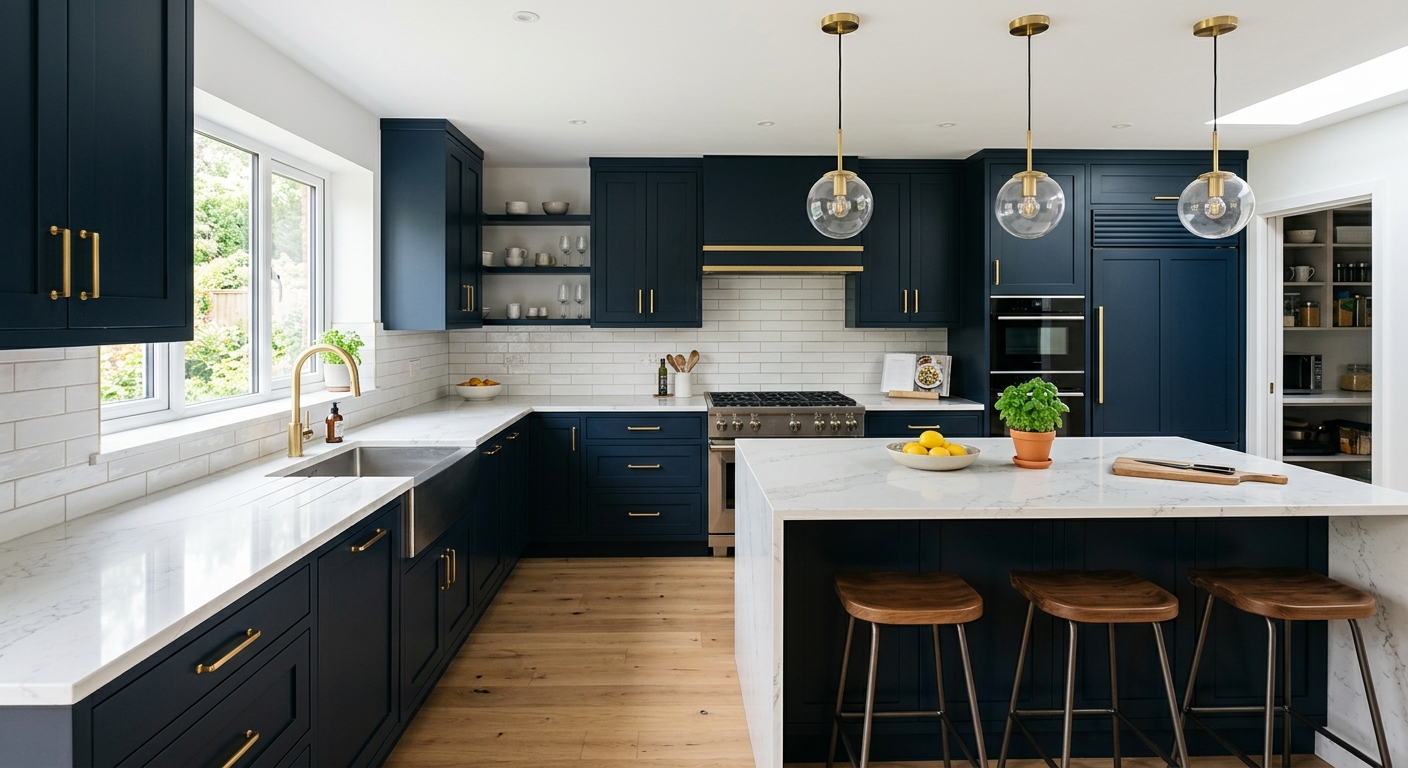
Ambler kitchen renovation prices by scope — 2026
Kitchen renovation budgets in Ambler are shaped not just by material costs, but by the town's homeownership rate and local incomes. With a median household income of $84,303 and a 51.0% homeownership rate (U.S. Census Bureau, ACS 2024), most kitchen remodeling in Ambler targets owner-occupied homes with a focus on daily usability and long-term value rather than investor flips.
If your Ambler home is from the post-1945 suburban tract housing wave seen in nearby Abington and Upper Dublin, you may be looking at a kitchen that's either a cramped galley in need of a wall removed or a larger space that mostly needs finishes refreshed. The best way to avoid a blown renovation budget is to be honest about what your project actually is—a full gut job or a cosmetic update. Most homeowners run over because they get a quote for cabinet replacement, but then start moving walls and updating electrical to match a higher tier.
| Scope |
What's included |
Duration |
Price range |
| Full gut remodel, same layout |
cabinets, counters, appliances, flooring, lighting, fixtures |
6–10 weeks |
$31,000–$125,000 |
| Gut plus layout change |
all of the above plus moved plumbing, electrical, walls |
10–16 weeks |
$67,500–$125,000 |
| Cabinet replacement (stock to semi-custom) |
remove and install cabinets, hardware, patching |
1–3 weeks |
$7,300–$31,000 |
| Cabinet refacing |
new doors and drawer fronts, veneer, hardware |
3–6 days |
$7,300–$21,000 |
| Countertop replacement only |
template, fabricate, install, reconnect sink |
1–3 weeks |
$4,200–$16,500 |
| Kitchen flooring only |
remove existing, install new flooring |
3–6 days |
$5,200–$21,000 |
Estimates for a typical Ambler kitchen. Cabinet grade and whether the layout changes move these figures more than square footage.
Comparing kitchen renovation bids in Ambler
If you collect three kitchen bids in Ambler and wonder why totals for “the same job” are so different, start by looking at the allowances. An allowance is a placeholder dollar amount for something you haven’t picked yet—like tile, plumbing fixtures, or lighting. Two bids with the same bottom line can be thousands apart, because one includes a real number for backsplash tile and the other drops in a lowball “$500” that won’t get you past the big-box basics. Always compare allowance lines before comparing the total.
After allowances, check that the cabinet brand and line are specified by name, not just “quality cabinets.” Countertop materials need to spell out thickness, edge detail, and how seams will be placed. Every bid should explain what happens if the contractors uncover hidden issues—say, bad framing or wiring—and how change orders will be handled. Payment schedules should match project milestones, not calendar dates, with only a modest deposit up front. Always ask for lien waivers from subcontractors as you pay, to keep you from getting caught between a contractor that’s paid and a sub that isn’t.
Pennsylvania law requires a written contract for any job over $500, and you have three business days to cancel a signed contract under the Home Improvement Consumer Protection Act. Anyone who dances around that isn’t someone you want in your house.
| Line item |
What to look for |
Red flag if… |
| Allowances |
realistic amounts, itemised |
round numbers with no basis |
| Cabinetry |
brand, line, box construction |
'quality cabinets' |
| Countertops |
material, thickness, edge, seams |
material name only |
| Electrical |
circuits to be added, GFCI scope |
'as needed' |
| Unforeseen conditions |
how they are priced and approved |
not addressed |
| Change orders |
written approval before work |
verbal |
| Payment |
milestone-based, modest deposit |
front-loaded |
| Lien waivers |
from subs at each payment |
not offered |
Resale value and kitchen spending
The reality in Ambler is simple: a kitchen renovation helps a house sell, but nearly never returns its full cost at resale—especially high-end projects. A mid-range kitchen, with the right selections and no unnecessary layout changes, often recoups a better share of what you spend because it fits what most local buyers are willing to pay for. Spending well beyond what homes in your neighborhood sell for, given Ambler’s median household income of $84,303, makes it tough to recover the difference if you decide to move.
There’s a big difference between renovating to live in—a job where you pick finishes and features that genuinely make your days better—and renovating to sell, where neutral colors and reliable fixtures matter most. Renovating purely for resale means focusing on a clean, functional space and holding your spending in the mid-tier range. Rarely will even an excellent full gut remodel—even one costing $67,500—turn into an equivalent bump in selling price on closing day.
If this is your “forever” house, worry less about the market and more about what you want to use daily. For resale, most experienced agents and buyers in Ambler are wary of high-end finishes if the rest of the home, or neighboring properties, don’t match that level. The best value is in an updated, neutral kitchen that's not out of step with the surrounding homes and incomes.
Cabinets are the critical path
In the Ambler market, nothing drags a kitchen schedule out more than waiting on cabinets and countertops—the two real bottlenecks in every project. Here’s the reality: you start with design and measurements, finalize your cabinet selections, and order cabinets before any demolition begins. That’s because in the busy Montgomery County corridor, with its deep but competitive finish-trade labor pool, cabinet lead times often run from a few weeks for stock to over two months for semi-custom.
The sequence matters. Design and finalize first. After cabinets are ordered, demolition begins. Once the space is stripped, trades come in for rough electrical and plumbing, which gets inspected locally—sometimes by township staff, sometimes by a third-party inspector. Cabinets can’t be set until all rough work passes. Only then can the countertop fabricator come in and template; there’s no way around this lag. Templating off a drawing risks a costly error, and no reputable installer will do it. The dead period between cabinet set and countertop install is at least a week, and there’s nothing to do but wait while the slab is cut.
Flooring, backsplash tile, and final trim only come after counters are installed and plumbing is connected. Homeowners rarely plan for that week or two of apparent “nothing” between cabinets and counters—it’s entirely normal. If you wait to order cabinets until after you rip out the old ones, you could double your kitchen downtime. In the Greater Philadelphia metro, seasoned contractors order before the first hammer swings.
Cabinets: reface, stock, semi-custom or custom
Your cabinet decision dictates both cost and function in an Ambler kitchen. Refacing is an overlooked option: it keeps your solid, square cabinet boxes but replaces the doors, drawer fronts, and veneer. In post-1945 Montgomery County tract homes—where layouts are often sensible but finishes are tired—refacing makes sense and can deliver a dramatic update for much less than replacement. But it’s only viable if your boxes are structurally sound and your layout isn’t changing.
Stock cabinets work if your walls run true and your layout fits the standard sizes—rare in Ambler’s mix of older and irregular construction. Expect to use fillers at the ends. Semi-custom cabinets are the sweet spot for many; you get the ability to fine-tune dimensions and finishes to fit out-of-square rooms, which are common here. Full custom is usually for unique layouts or high-end finishes, and demands the longest lead time.
Pay attention to construction: plywood boxes last far longer than particleboard, dovetail joints beat staples, and full-extension soft-close hardware is a must in any price tier. Frameless cabinets offer more usable space but require exact installation, while face-frame styles are more forgiving on older walls.
| Option |
Cost |
Best when |
Limitation |
| Painting existing cabinets |
$1,200–$3,500 |
boxes and doors sound, tight budget |
no layout or style change |
| Refacing |
$7,300–$21,000 |
boxes square and layout works |
storage unchanged |
| Stock cabinets |
$7,300–$31,000 |
standard dimensions fit |
filler strips, limited finishes |
| Semi-custom |
$21,000–$31,000 |
non-standard walls or finishes |
6–12 week lead time |
| Full custom |
$21,000–$31,000 |
unusual layout or high-end design |
longest lead, highest cost |
Permits and inspections for a Ambler kitchen
In Ambler, most cosmetic kitchen updates—painting, refacing, countertop swaps—do not require a permit, so long as you are not moving any utilities or walls. But the second you reconfigure the layout, open a wall, or run new electrical circuits or plumbing, a building permit is likely required. For example, in Lower Merion Township, altering the kitchen layout or removing a structural wall means submitting your plans for review.
Inspections in this part of Montgomery County can be municipal or, for electrical work in some surrounding townships, handled by third-party inspection agencies. Homeowners are often caught off guard by the requirement for a separate inspector and scheduling delays. Always clarify up front who is handling each inspection.
Every contractor working on kitchen remodels over $500 must hold a Pennsylvania Home Improvement Contractor registration, which you can verify online. If you have employees on the job, Pennsylvania mandates workers' compensation insurance; you can check coverage through the WCAIS system. The consequence for skipping permits—a failed inspection when you sell—is real and can disrupt closings or force costly after-the-fact corrections.
Surprises in an older Ambler home
With 91.6% of Ambler homes built before 1980, you have to expect surprises once the kitchen walls come down. First, out-of-plumb walls and sloping floors are common headaches—setting cabinets often involves a day of shimming and creative carpentry, adding to labor costs. Electrical is another concern. Older kitchens may reveal undersized wiring, ungrounded outlets, or circuits that don’t meet today’s code. Upgrading to modern code typically adds $2,500–$7,000 to a full gut remodel.
Plumbing can also be a minefield. Galvanized pipes or cast iron drains may need full or partial replacement, especially if you change the sink location. Insufficient insulation in exterior walls is a frequent find—most kitchens from this era were built before energy efficiency mattered, and fixing it requires opening those walls.
Lead paint is a concern for homes built before 1978; any disturbance of old finishes falls under the federal EPA Renovation, Repair and Painting (RRP) Rule, which requires testing and special containment. Asbestos flooring (like old sheet vinyl) is also sometimes uncovered. If you run into either, containment or abatement work is extra, and must be handled before anyone continues.
Finally, previous unpermitted work is an Ambler staple—don’t be surprised if you find extra junction boxes behind drywall or non-standard plumbing. Budgeting a contingency of 10–15% for the unknown is prudent if your home is pre-1980.
Frequently asked questions — kitchen renovation in Ambler
What happens if previous work was unpermitted?
In Ambler and throughout Montgomery County, unpermitted work can cause a headache when it comes time to sell your house or pull new permits. Municipalities routinely check for unpermitted alterations during resale, and if they find code violations—especially electrical or plumbing—they can require everything to be brought up to current standards before closing. In practical terms, this can mean opening up finished walls and re-doing work at the last minute, all on your dime. In some townships, this delays closings or forces price reductions. If your kitchen remodel will cost over $7,300, it's wise to confirm that any previous changes have permits on file. Fixing unpermitted work can carry surprise labor and permit costs that would have been cheaper to handle upfront.
Should I order cabinets before demolition?
Yes—you should order your cabinets as soon as you finalize the design, before tearing anything out. In Ambler, where lead times on quality cabinets can stretch from several weeks for semi-custom to even longer for full custom, waiting until after demolition extends your project delay by at least a month or more. This area, like much of Montgomery County, has a deep yet busy finishing trades market; contractors typically sequence work so that cabinets arrive just after the rough work passes inspection. If you wait, your kitchen could sit gutted, unused, while everyone waits for a box truck. For a typical replacement or semi-custom job costing $21,000, getting cabinets ordered early sets the whole project timeline and keeps your kitchen downtime to a minimum.
How much do new kitchen cabinets cost in Ambler?
For a standard Ambler kitchen, replacing all the cabinets with stock or semi-custom units runs between $7,300–$31,000. Most owner-occupied homes in town, where people care about longevity and daily use, land closer to the mid-teens or low twenty-thousand range—higher if you run into non-standard wall dimensions that require custom fitting. Refacing is the lower-cost alternative if your current boxes are solid, but truly low prices under $7,300 are rare unless you cut corners or do painting only. Remember, the price jumps with non-standard layouts, specialty finishes, or premium hardware, none of which are uncommon in Ambler's mix of tract and older homes.
What is the difference between stock and semi-custom cabinets?
Stock cabinets are factory-made in set widths and heights—great for straight, standard walls, but less useful for Ambler's many older homes where nothing is quite square. You'll end up using filler strips and lose storage potential on odd walls. Semi-custom cabinets cost more, typically falling between $21,000–$31,000 for a full replacement, but allow you to adjust sizes and pick among finishes to fit both your kitchen's dimensions and your style. In many post-1945 Ambler homes, semi-custom is the better long-term value, avoiding the piecemeal look you sometimes get when forcing stock units into a tricky space.
What does a full gut kitchen remodel cost in Ambler?
A true full gut kitchen remodel in Ambler, where everything—cabinets, counters, lighting, appliances, flooring—is replaced but the layout remains similar, starts at $31,000 and can reach or exceed $125,000 for premium finishes or structural changes. Most homeowners in Montgomery County, aiming for a mid-range but livable upgrade, find themselves spending about $67,500. Pricing jumps are often tied to cabinet quality, specialty appliances, and whether major walls, plumbing, or electrical are moved. If you stick to a similar layout and make prudent finish choices, you’re much less likely to blow your budget.
Do I need to change my kitchen layout?
Not always. In Ambler, most kitchens—especially those from the post-war tract housing boom—can be greatly improved without moving walls or appliances. Simply updating cabinets and finishes can give you a modern, efficient space while keeping costs well below $67,500. Consider changing the layout only if you consistently run into functional problems, like tight galleys or poor workflow. Just remember that as soon as you change the layout, trigger new permits, or move plumbing and electrical, your price and timeline jump significantly. For many Ambler homes, a smart cosmetic refresh goes further than you might think.
Should I hire a general contractor or a kitchen firm?
Both options work in Ambler, but your choice depends on the project's complexity. A specialized kitchen firm can handle design, cabinetry, and finish selections efficiently—ideal for standard replacements or refacing, typically running $7,300–$31,000. For more involved jobs with structural or mechanical changes, a general contractor will manage permits, coordinate multiple trades, and deal with unexpected issues common in Ambler's older housing stock. In a tight finish-trade labor market like Montgomery County, established firms sometimes have better vendor access and sub scheduling, but make sure whomever you hire is registered under the Pennsylvania Home Improvement Contractor system.
Is lead paint a concern in Ambler kitchen renovations?
Absolutely, if your Ambler home was built before 1978, lead paint is a real possibility. The federal EPA Lead Renovation, Repair and Painting (RRP) Rule kicks in for any work that disturbs painted surfaces. Certified contractors are required to test for lead and follow strict containment procedures. This can add to your project cost—sometimes several hundred dollars even on a smaller project like a $4,200–$16,500 countertop replacement—but ignoring it is a health and legal risk. Always ask your contractor about their EPA certification and request documentation of lead-safe practices if your house is of the right era.
Can I over-improve for my Ambler neighbourhood?
Yes, and it happens more than you might think. With a local median income of $84,303 and a broad range of home values, it’s easy to overspend—especially on high-end kitchens costing upwards of $125,000. If the rest of the house, or surrounding homes, don’t support that level of finish, you won’t recover the difference at resale. Focus upgrades on quality, layout improvements, and features that make daily cooking and entertaining better for you. If resale is a consideration, keep style and finishes neutral and spend closer to the median for your block. In Ambler, smart mid-range updates produce the best balance of function, appearance, and long-term value.