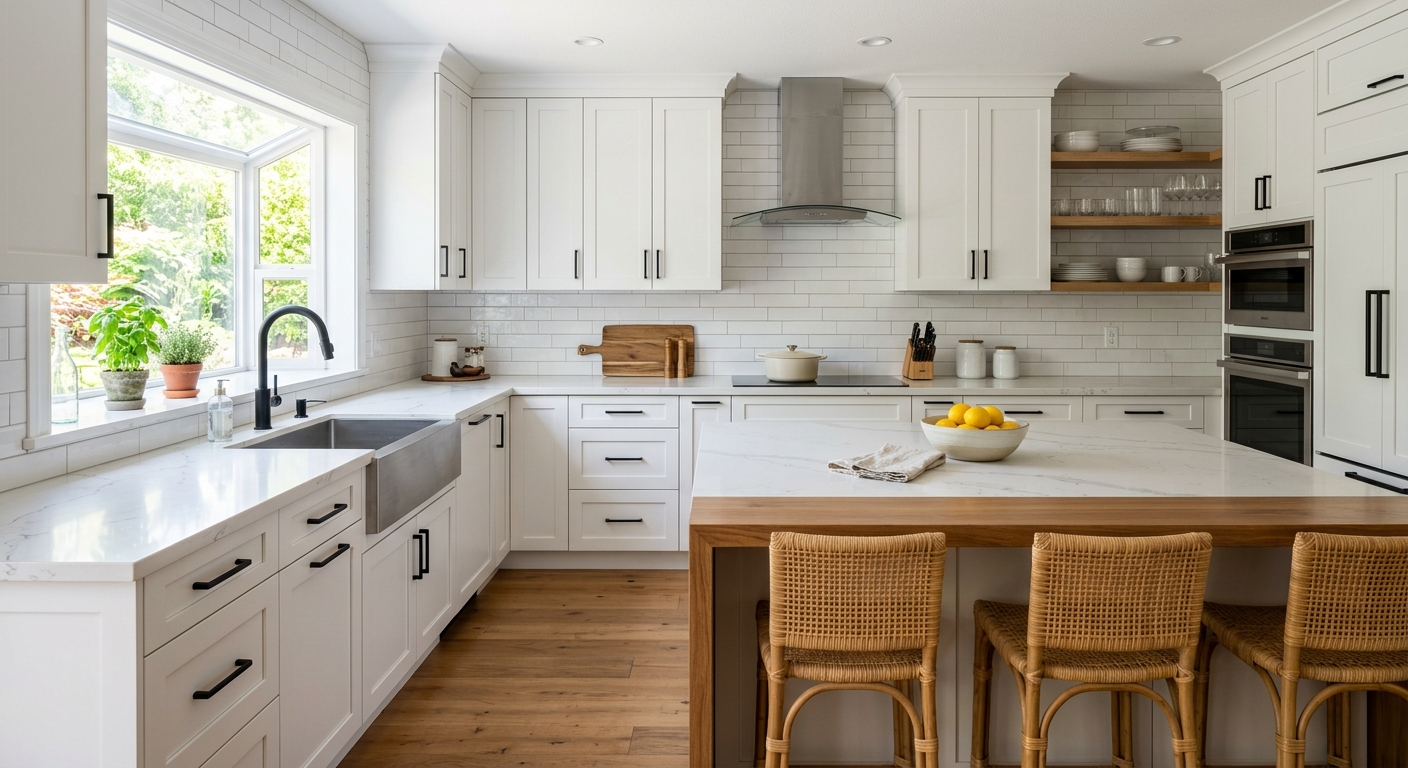
Kitchen renovation costs in Greensburg — 2026
In Greensburg, the cost of a kitchen renovation lands all over the map, influenced by home era, layout complexity, and the realities of Westmoreland County’s mainly owner-occupied single-family homes. With a homeownership rate around 54.6% and a median household income of $58,001 (U.S. Census Bureau, ACS 2024), most homeowners look to balance investment with practicality. Most houses here were built in the 1960s to 1980s, not only shaping what you’re starting with, but also explaining why kitchen projects here so often include rethinking the flow and updating old electrical.
The biggest surprises in kitchen budgeting are rarely about material choices—they come from misunderstanding project scopes. Most overruns happen when someone budgets for light work and ends up needing a full gut, or intends to keep the old layout but decides partway through to move plumbing or walls. The era of your house can push you toward one scope or another; a mid-century galley kitchen often wants a wall taken down, while a 1990s layout may adapt to new finishes without changing lines.
Here’s what typical projects in Greensburg look like in 2026, with their costs and timelines:
| Scope |
What's included |
Duration |
Price range |
| Full gut remodel, same layout |
cabinets, counters, appliances, flooring, lighting, fixtures |
6–10 weeks |
$27,500–$110,000 |
| Gut plus layout change |
all of the above plus moved plumbing, electrical, walls |
10–16 weeks |
$59,500–$110,000 |
| Cabinet replacement (stock to semi-custom) |
remove and install cabinets, hardware, patching |
1–3 weeks |
$6,400–$27,500 |
| Cabinet refacing |
new doors and drawer fronts, veneer, hardware |
3–6 days |
$6,400–$18,500 |
| Countertop replacement only |
template, fabricate, install, reconnect sink |
1–3 weeks |
$3,700–$14,500 |
| Kitchen flooring only |
remove existing, install new flooring |
3–6 days |
$4,600–$18,500 |
Estimates for a typical Greensburg kitchen. Cabinet grade and whether the layout changes move these figures more than square footage.
How a Greensburg kitchen budget breaks down
When you see how a Greensburg kitchen budget divides up, priorities become clear. Cabinetry is the biggest single item, often a quarter to a third of your total. Labor follows closely — more so if your house needs layout fixes or electrical upgrades, which is common in 1960s–1980s homes. Countertops and appliances trade places depending on your choices, while flooring and lighting are narrower slices but still add up fast.
Two lines homeowners rarely account for but should: an allowance for what’s hiding behind the walls, and the soft costs like permitting, design, and carting away the old kitchen. Discovering ungrounded wiring or a crooked wall can quickly drain contingency if you skip it.
If you have an extra thousand dollars, spend it on items you use every day, like drawer upgrades or low-maintenance counters. An expensive appliance looks out of place in budget cabinets, and designer lighting makes less impact than a durable floor in most Greensburg kitchens. For a typical gut remodel at $59,500, here’s how the lines fall out:
| Category |
Share of budget |
Notes |
| Cabinetry |
25–35% |
the largest line and the longest lead time |
| Labour and installation |
20–30% |
rises sharply if the layout changes |
| Countertops |
8–15% |
material choice drives the swing |
| Appliances |
10–20% |
widest range of any category |
| Flooring |
5–10% |
most kitchens here are modest in size |
| Lighting and electrical |
5–10% |
higher in older homes needing circuits |
| Plumbing and fixtures |
4–8% |
sinks, faucets, and rough-ins |
| Permits, design, disposal |
3–6% |
usually forgotten in early budgets |
| Contingency |
10–15% |
not optional in a pre-1980 house |
Choosing a countertop for a Greensburg kitchen
In daily use, countertops are about much more than first impressions — especially in Greensburg, where families often cook, host, and work in the kitchen. Quartz, the most requested material, is engineered and completely non-porous, so stains aren’t a worry, but it can scorch or discolor if you set down a hot pan. Granite is natural stone, varies from slab to slab, stands up to heat, and needs a reseal every few years. Solid surface (like Corian) handles minor scratches with sanding and has invisible seams, making it practical for many families. Laminate is still a sound choice in modest kitchens or rental properties; modern patterns have come a long way, seams are more noticeable but maintenance is nearly zero, and it’s the least expensive to replace.
Butcher block gives warmth you can’t fake, but needs frequent oiling and can stain or split if neglected. No other surface is as easily sanded and refinished, though. Edge profiles and how many cutouts are needed for sinks or cooktops affect fabrication price in any material. Every solid countertop starts with a template visit — where the fabricator makes a pattern of your base cabinets, rather than working off tape measure numbers.
If you’re renting out your home or watching your spend, laminate rarely disappoints for the money. Don’t let anyone talk you into spending granite or quartz money in a unit where turnover and durability matter more than resale.
Resale value and kitchen spending
A new kitchen helps sell a house in Greensburg; it doesn’t guarantee you’ll make back every dollar. It’s a mistake to think of kitchen remodeling as an investment that will always return its cost — particularly in a city where the median household income is $58,001 (U.S. Census Bureau, ACS 2024), so ceilings for home values are real. What gets a return is a well-chosen, neutral update in a similar cost range to what’s typical for comparable homes. Spend above the local market and you end up subsidizing someone else’s move-in-ready dream.
There’s a different mindset if you’re renovating to live in your home: then it’s about comfort, function, and what you value most in daily life — not what the next buyer wants. If you’re renovating for resale, aim for durable mid-range cabinets, easy-to-care-for countertops, and finishes that lean neutral. Skip structural changes, high-end appliances, and personal taste flourishes, as these rarely pay back.
For someone planning to sell in Greensburg, the sweet spot is a kitchen spend well within the typical remodel range — think $27,500–$59,500, not pushing toward the six-figure mark. There’s little upside in building the neighborhood’s fanciest kitchen if the local market can’t reward it. But for living, prioritize what matters to you and forget the resale math.
Four kinds of kitchen project, four budgets
Every “kitchen remodel” sounds similar until you see the price spread — in Greensburg, the scope and grade you choose easily swing by five times or more. You can divide projects into four tiers:
- Cosmetic refresh: New paint, hardware, maybe a backsplash or fresh lighting. No moving of fixtures, no cabinets out. This is sweat equity or a long weekend with a handy contractor. It’s the fastest, least disruptive, and cheapest tier.
- Pull and replace: Everything comes out and goes back in new — but in the same place. Cabinets, counters, appliances go, floor may get redone, but plumbing and electricity stay put. No permits or engineers, typically.
- Gut, same layout: Down to the studs. Walls open, all new services, everything built back in the same footprint, which modernizes but doesn’t reconfigure. Upgrades the bones while holding cost below major changes.
- Layout change: Move walls, open a floor plan, change where appliances live. This triggers drawings, permits, maybe engineering, and a different class of trades. Prices climb sharply from here.
The steepest price jump is between the third and fourth tiers — once you decide to move a sink or open a wall, you’re looking at not only more trades, but more oversight and higher risk. It’s smart to be brutally honest about which tier you need before getting quotes, as no contractor can give you a meaningful figure without knowing which of these describes your job. Scope creep is the biggest risk to both budget and timeline.
Permits and inspections for a Greensburg kitchen
Most cosmetic upgrades in Greensburg — paint, cabinet hardware, refacing, or replacing a countertop in place — don’t need a permit. Where most homeowners get caught is around anything that touches structure: removing or moving a wall, relocating plumbing or electrical, or increasing appliance loads. In Greensburg, these changes generally require a building permit, and formal plan review is part of the process if you’re touching framing or upgrading major services.
Inspections aren’t always done by the city itself. In Greensburg and surrounding townships like Hempfield, electrical inspections are often handled by certified third-party agencies such as Code.sys, not by a municipal employee. That can surprise homeowners, especially during resale or refinancing when documentation is requested.
Every contractor working on contracts over $500 must be registered as a Home Improvement Contractor (HIC) with the Pennsylvania Office of Attorney General — you can look this up before you sign. All employers must also have workers’ compensation (verified via WCAIS), and you should confirm this before work begins.
Skipping permits to “save time” is a short-term gain with long-term pain: unpermitted work can halt a sale or lower your property’s value when the paper trail is missing.
Surprises in an older Greensburg home
With over 80% of the Greensburg housing stock built before 1980, kitchen renovations here regularly uncover problems that look small until you price them out. Out-of-plumb walls — a common find in postwar construction — mean every cabinet run turns into a game of advanced shimming and scribing, adding labor hours. Floors that aren’t level can add challenges for large tile or floating flooring, sometimes requiring self-leveling or new subfloor, costing anywhere from a few hundred to several thousand dollars.
Galvanized pipes and old cast iron drains show up in many kitchens, both expensive to replace but nearly always needed if you’re opening walls. Undersized or ungrounded wiring is routine in mid-century homes and will not pass modern inspection if the walls are open — think rewiring costs layered on top of your main budget. Previous DIY or unpermitted work is another wild card, with unclear fixes that only surface mid-project.
If your home predates 1978, the federal EPA Lead RRP Rule applies: any disturbance of painted surfaces must be handled by a certified renovator, and testing for lead is required before work begins. Older sheet flooring can contain asbestos, though there’s no specific state law — insurers and smart contractors follow IICRC S520 and S500 for safe procedures if they suspect mold or asbestos.
For the newer end of the local housing wave, the headaches are often builder-grade shortcuts: low-end cabinets reaching failure together, original laminate counters showing seams, and breaker panels at capacity if the new appliances push electrical demand.
Frequently asked questions — kitchen renovation in Greensburg
How much do new kitchen cabinets cost in Greensburg?
New kitchen cabinets in Greensburg cost between $6,400–$27,500 for removal and installation of stock to semi-custom styles. Most jobs land near $18,500 when swapping out dated 1960s–1980s cabinetry for a mid-range upgrade with new hardware and trim. Fully custom or specialty storage features drive the price toward the top end. Installation labor is higher here than in urban Pittsburgh, due to a tighter finish-trade market in Westmoreland County. Remember to budget for patching or paint touchup around the new cabinets, as existing walls rarely line up perfectly in older Greensburg homes.
Why are kitchen quotes in Greensburg so far apart?
Kitchen quotes in Greensburg swing dramatically because “kitchen remodel” covers everything from a simple refacing to a full gut remodel with walls moved. Pricing varies based on house era, layout changes, quality of finishes, and how much wiring or plumbing needs upgrading — all issues common with Greensburg’s mostly pre-1980 homes. Local contractor supply also plays a role: labor availability is tighter here than in Pittsburgh, which moves prices further apart depending on who can take the job. For the same kitchen footprint, quotes could range from $27,500–$110,000. Detailed scope and honest conversations with your contractor narrow this spread quickly.
Which upgrades are not worth the money?
In Greensburg, spending top dollar for high-end appliances in a kitchen with stock cabinets, or splurging on luxury lighting when your subfloor or wiring remains original, rarely pays off. Minor cosmetic accents and gadget-heavy faucets look nice but make no difference to daily function. Structural layout changes — removing walls solely for an open concept — bring large cost but little return, especially if you plan to sell soon. Upgrades like under-cabinet interior lighting, wine fridges, or smart taps can push a project over budget with little impact on resale or quality of life. A wise kitchen project in Greensburg keeps spends on quality cabinets, reliable counters, and upgraded electrical before splurging. A functional kitchen at $27,500 will always outshine a mismatched one at twice the cost.
Why is there a gap after cabinets are installed?
Gaps between cabinets and walls are especially common in Greensburg’s pre-1980 houses, where old plaster and framing aren’t perfectly square or level. New cabinets are built straight in the shop, but rarely do field conditions match; in a 1960s–1970s home, a 1/2-inch to 1-inch gap along a wall or ceiling isn’t unusual. Contractors address these gaps with trim, scribe molding, or caulk for tight seams. Fillers and panels are ordered with the cabinets and adjusted on-site after installation. If floors have settled or walls were furred out in previous renovations, expect more shaping and shimming — which does add labor cost, especially in full replacements above $18,500.
Is a cosmetic refresh enough or do I need a gut remodel?
The answer depends on both your goals and your kitchen’s bones. In Greensburg, if the cabinets and layout are still serviceable — solid boxes, no water damage, working drawers — then a cosmetic refresh with paint, hardware, and lighting can bring noticeable improvement for far less than replacement. Typical costs here stay under $6,400. If, on the other hand, you’re dealing with dated wiring, poor lighting, failing finishes, or a cramped mid-century layout you want to open, a full gut will serve your needs and protect your investment. Given the age of most Greensburg homes, it’s rare that only surface upgrades are enough to truly modernize, but it’s worth assessing carefully with a contractor before deciding.
How does Greensburg's housing stock affect cabinet fit?
Most homes in Greensburg were built before 1980, which means walls and floors may have shifted, settled, or gone out of square over the decades. When installing new cabinets—whether it’s a full replacement at $6,400–$27,500 or a minor reface—installers spend considerable time shimming, trimming, and scribing to get tight, level lines. Stock cabinet sizes often don’t match exactly, leading to either gaps or the need for custom fillers. In some homes, soffits complicate things further, and existing plumbing or vent stacks may force minor reconfiguration. Professional installers with experience in older Greensburg homes expect these quirks and build in extra time to handle them.
Does replacing cabinets require a permit?
In most of Greensburg and townships like Hempfield, replacing your kitchen cabinets with new ones in the same configuration—without moving appliance locations or plumbing—does not require a building permit. If you start shifting the footprint, moving walls, or changing wiring and plumbing, a permit and plan review are typically triggered. Always check with the City of Greensburg Planning and Development office before starting, as requirements can shift by municipality and project scope. For a simple cabinet replacement or refacing, expect to be clear of the permit process and save on associated soft costs—usually 3–6% of a total kitchen budget (about $1,600–$3,600 on a mid-range job).
Can I live in the house during a kitchen renovation?
Yes, it’s common for Greensburg homeowners to live in their house during most renovations. A basic cabinet or countertop replacement ($3,700–$14,500) is minor inconvenience for a week or two. For a full gut remodel, expect a stretch of 6–10 weeks without a working kitchen: contractors can often set up a temporary sink or appliances elsewhere, but dust and noise are inevitable. Daily logistics matter more in the older neighborhoods, where homes are tighter and storage space is limited. Being realistic about meal planning and setting clear ground rules with your contractor go far in minimizing the disruption.
What flooring works best in a kitchen?
In Greensburg, kitchen flooring needs to handle heavy traffic, water spills, and our frequent freeze-thaw cycles that affect home settlement. Luxury vinyl plank and tile remain popular for their resilience, comfort underfoot, and value at $4,600–$18,500. Porcelain tile is excellent for durability and water resistance, but can get cold in winter if the kitchen isn’t well insulated—a consideration in many local homes built before 1980. Hardwood works when properly sealed but may show wear in high-moisture spots. Laminate can also suit smaller or lower-traffic kitchens, but is less tolerant of standing water. Always prioritize level subfloors and professional installation, especially in older homes with uneven surfaces.