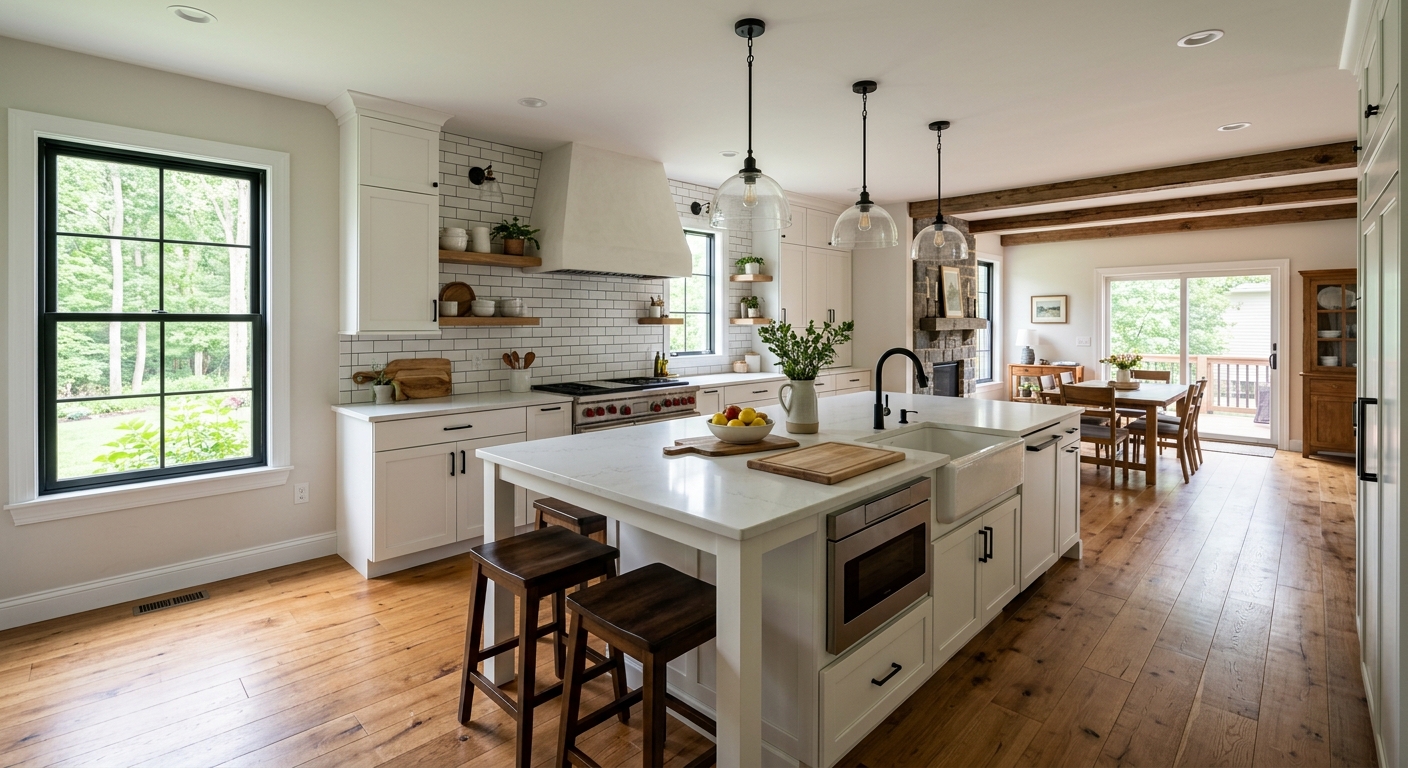
What a kitchen remodel costs in Quakertown
In Quakertown, kitchen renovation budgets often reflect what homeowners can reasonably invest, given a $70,813 median household income and a homeownership rate of 55.3% (U.S. Census Bureau, ACS 2024). Owners here aren’t looking to overspend on upgrades that don’t match the typical home’s value, especially since most are living in the house during the work. Because post-1960 suburban tracts in Lower Bucks created a wave of compact galley kitchens that now feel dated and undersized, gut-and-replace remodels to open up or modernize these spaces drive much of the market. That era’s layouts usually need more than new finishes—they often require at least some changes to walls, plumbing, or electrical.
What trips up most budgets is pricing a basic cabinet swap, then adding a wall move or appliance relocation late in planning. That single step can double the cost and extend the timeline, so it’s vital to firm up the desired scope before collecting quotes. Below are the typical costs for various kitchen project types in Quakertown:
| Scope |
What's included |
Duration |
Price range |
| Full gut remodel, same layout |
cabinets, counters, appliances, flooring, lighting, fixtures |
6–10 weeks |
$32,500–$129,500 |
| Gut plus layout change |
all of the above plus moved plumbing, electrical, walls |
10–16 weeks |
$70,000–$129,500 |
| Cabinet replacement (stock to semi-custom) |
remove and install cabinets, hardware, patching |
1–3 weeks |
$7,600–$32,500 |
| Cabinet refacing |
new doors and drawer fronts, veneer, hardware |
3–6 days |
$7,600–$21,500 |
| Countertop replacement only |
template, fabricate, install, reconnect sink |
1–3 weeks |
$4,300–$17,500 |
| Kitchen flooring only |
remove existing, install new flooring |
3–6 days |
$5,400–$21,500 |
Estimates for a typical Quakertown kitchen. Cabinet grade and whether the layout changes move these figures more than square footage.
General contractor, kitchen firm, or manage it yourself?
How you approach your Quakertown kitchen remodel affects both your cost and your day-to-day stress during the job. A design-build kitchen firm wraps design, cabinets, installation, and project management into a single contract. This is the least effort for the homeowner but also commands the highest price. If you want a single point of contact and don’t have much time to spare, this route is the closest to hands-off you’ll find, though it comes at a premium—especially with Bucks County’s finish-trade labor market being tighter than central Philadelphia, which drives up both cost and scheduling lead times.
Hiring a general contractor is the middle ground. The contractor coordinates tradespeople, scheduling, and sourcing while you or a designer make the style and finish selections. This offers some savings over design-build firms but still requires you to be available to answer questions, make decisions fast, and resolve scope changes as inevitable issues arise. It remains the right choice for most projects that are too complex to run solo but don’t need every detail controlled by a kitchen showroom.
Owner-management—directly hiring carpenters, plumbers, electricians, flooring installers, etc.—can save on markup, but it becomes a full-time job. For anything that triggers a permit in Quakertown, including new circuits or wall moves, you’ll be on the hook for lining up each trade in the right order, handling inspections, and resolving mistakes. Unless you have project management experience and ample time off work, managing your own kitchen renovation in Bucks County’s labor market can become overwhelming fast.
How a Quakertown kitchen budget breaks down
Most Quakertown homeowners are surprised by where the cost of a kitchen remodel goes. Cabinetry is the single largest expense and the longest lead time, usually accounting for 25–35% of the budget. Labor and installation follow, particularly when walls or utilities are moved. Countertops, appliances, and flooring make up notable portions, but lighting, electrical, and plumbing costs jump sharply in older homes—especially the pre-1980 houses that dominate this area (U.S. Census Bureau, ACS 2024).
Two lines are routinely omitted from homeowner estimates—but shouldn’t be. First, a 10–15% contingency for what is found in the walls, such as wiring that’s not to code or plumbing that needs rework. Second, soft costs like permits, design fees, delivery, and disposal. These are not optional, and skipping them leads to headaches and cost overruns.
Spend your extra dollars where they are most visible and useful. Upgrading to solid, full-extension soft-close drawers adds daily satisfaction. Moving from laminate to stone countertops is tangible. On the other hand, spending big on appliances while settling for low-grade cabinets is rarely wise—appliance value drops much faster than cabinet value, especially in Quakertown’s typical $70,813 median-income range.
| Category |
Share of budget |
Notes |
| Cabinetry |
25–35% |
the largest line and the longest lead time |
| Labour and installation |
20–30% |
rises sharply if the layout changes |
| Countertops |
8–15% |
material choice drives the swing |
| Appliances |
10–20% |
widest range of any category |
| Flooring |
5–10% |
|
| Lighting and electrical |
5–10% |
higher in older homes needing circuits |
| Plumbing and fixtures |
4–8% |
|
| Permits, design, disposal |
3–6% |
usually forgotten in early budgets |
| Contingency |
10–15% |
not optional in a pre-1980 house |
Code requirements for Quakertown kitchens
In Quakertown, kitchen updates that are strictly cosmetic—painting walls, swapping cabinet hardware, refacing cabinet doors, or replacing a countertop without moving the sink—generally can be done without a permit. But a permit is triggered if your renovation involves moving or adding electrical circuits, relocating plumbing lines, tearing down or moving walls, or installing a new range hood that requires new exhaust or ductwork. In nearby Bensalem Township, you need a permit for kitchen renovations that involve wall relocation or new electrical branch circuits; surrounding Bucks County townships follow similar patterns.
Plan review is required if you alter structural walls or plumbing fixture locations. In places like Bensalem Township, electrical inspections are not performed by the town but by third-party agencies such as Tri-County Inspection Company, which often surprises owners used to direct municipal inspection.
Your contractor must hold a Home Improvement Contractor (HIC) registration, issued by the Pennsylvania Office of Attorney General, for jobs over $500—always check at hic.attorneygeneral.gov. All employers must carry workers’ compensation insurance, and you can verify this at WCAIS (wcais.pa.gov). For homes built before 1978, certification for safe lead paint practices under the EPA Lead RRP Rule is mandatory—always verify at certifiedrenovatorsearch.epa.gov.
Skipping permits and hiring unregistered contractors may save time up front but almost always creates problems at resale or insurance claim time, risking both lost value and forced rework.
What a kitchen quote should specify
Comparing kitchen bids in Quakertown is harder than it looks, and the main reason is allowances. An allowance is a placeholder dollar amount for items not selected yet (like tile, fixtures, or appliances). Two quotes with the same total can be thousands of dollars apart once selections are made, because one builder might set a generous tile budget and another just a token that won’t cover real product. Be sure to compare the allowance lines item by item before judging the overall price.
A clear quote identifies cabinet brand and line (not just “custom”), countertop material and thickness, who pays and how for surprises behind the walls, and the change-order process—which should always require your written approval before further work. Payment schedules should follow milestones (such as “cabinets delivered” or “countertops installed”) instead of fixed dates, and every contractor in Bucks County should be ready to supply signed lien waivers from any subcontractors upon payment.
For all jobs over $500, Pennsylvania’s Home Improvement Consumer Protection Act requires a written contract and gives you a 3 business-day right to cancel. These protect you—do not waive them.
| Line item |
What to look for |
Red flag if… |
| Allowances |
realistic amounts, itemised |
round numbers with no basis |
| Cabinetry |
brand, line, box construction |
'quality cabinets' |
| Countertops |
material, thickness, edge, seams |
material name only |
| Electrical |
circuits to be added, GFCI scope |
'as needed' |
| Unforeseen conditions |
how they are priced and approved |
not addressed |
| Change orders |
written approval before work |
verbal |
| Payment |
milestone-based, modest deposit |
front-loaded |
| Lien waivers |
from subs at each payment |
not offered |
When a Quakertown kitchen needs walls moved
The steepest cost jump in a Quakertown kitchen remodel comes from changing the layout, especially moving walls, plumbing, or electrical. Keeping everything in place lets you stay in the lower band—full gut remodels with the same layout typically run $32,500–$129,500. But as soon as you move a sink or knock down a wall, costs jump to $70,000–$129,500, and the extra isn’t proportional to how far things move: even shifting plumbing four feet means new drain runs, supply lines, patching old holes, and satisfying slope requirements. In a home on a slab or with a finished ceiling underneath, this is a heavy lift.
Electrical upgrades are no less complex. New circuits for appliances or lighting have to terminate at a panel with enough capacity, and if the panel’s full, that’s another project. Removing a wall also means checking if it is load-bearing—if so, you’ll need an engineer to size a beam and a plan review for permit signoff. Venting a range hood to the outside runs into exterior wall penetrations, which have their own permitting and weatherproofing challenges.
If you are considering changing the kitchen layout just to “open it up,” work through whether the current arrangement is truly unworkable or just looks tired. Many galley kitchens in Lower Bucks post-1960 tract homes can function well with smarter cabinet and appliance choices, without costly structural changes. In Quakertown, small shifts in scope can be the difference between a basic, manageable project and one that drags on for months and costs double.
Choosing cabinetry
This is where most Quakertown kitchen budgets are made—or busted. You have four real options. First, refacing keeps your existing boxes and changes only the doors, drawer fronts, and exterior veneer. It’s a strong choice if your cabinet boxes are solid, square, and laid out the way you want. Refacing can’t add storage or correct a bad layout, but for solid boxes, the result can look brand new at a fraction of the cost.
Stock cabinets are straight from the catalog, made in fixed dimensions. In a standard room with square corners, these fill the space with some add-in fillers—acceptable for many, but not so good in older Bucks County homes, which often have non-standard wall runs thanks to decades of kitchen revisions. Semi-custom cabinets let you adjust dimensions, finishes, and features for a closer fit, and this is frequently what a homeowner in a post-1960 Lower Bucks tract home ends up needing, even if they started off budgeting for stock.
Custom cabinets are made to any specification—any size, finish, or layout—but carry the highest cost and longest wait. Construction quality does not strictly track the price: look for solid plywood boxes, dovetail or high-quality drawer construction, and full-extension soft-close hardware. Frameless styles offer more interior space, while face-frame is usually more forgiving in out-of-square rooms.
| Option |
Cost |
Best when |
Limitation |
| Painting existing cabinets |
$1,200–$3,500 |
boxes and doors sound, tight budget |
no layout or style change |
| Refacing |
$7,600–$21,500 |
boxes square and layout works |
storage unchanged |
| Stock cabinets |
$7,600–$32,500 |
standard dimensions fit |
filler strips, limited finishes |
| Semi-custom |
$21,500–$32,500 |
non-standard walls or finishes |
6–12 week lead time |
| Full custom |
$21,500–$32,500 |
unusual layout or high-end design |
longest lead, highest cost |
Frequently asked questions — kitchen renovation in Quakertown
Should I reface or replace my kitchen cabinets?
If your existing cabinet boxes are solid, square, and the layout works for you, refacing can be a smart financial decision in Quakertown. Most homes here were built before 1980, so it's common to find sturdy but outdated cabinets that respond well to refacing. You’ll get new doors, drawer fronts, veneer, and hardware at a cost of $7,600–$21,500. However, if you want to change the kitchen layout, add storage, or your boxes are damaged, rebuilding with stock or semi-custom cabinets (from $7,600–$32,500) is likely the better move. Assess carefully—refacing is excellent when the bones are good, but a waste if you’re still unhappy with function when the dust clears.
What is the difference between stock and semi-custom cabinets?
Stock cabinets are manufactured in set sizes and finishes, ideal if your Quakertown kitchen has square corners and standard runs, as in many late-20th-century Bucks County homes. Semi-custom cabinets allow you to modify size, finish, and select features to suit less-typical wall dimensions found in older local houses. While stock runs from $7,600–$32,500, semi-custom jumps to $21,500–$32,500 due to greater flexibility. For most kitchens in the area, semi-custom is often needed to get a close fit without excessive filler strips. The result is a more “built-in” look at a higher price and longer lead time.
How should renovation payments be scheduled?
In Pennsylvania, the Home Improvement Consumer Protection Act requires a written contract and limits how much deposit a contractor can take up front. In Quakertown, expect a modest deposit (often 10–20%), followed by progress payments tied to milestones — not calendar dates. For example, a schedule might tie payments to demolition completion, cabinet delivery, countertop installation, and final walkthrough. For a full kitchen gut/remodel (in the $32,500–$129,500 range), this kind of milestone-based schedule protects both homeowner and contractor from risk or stalling. Never pay more than the value of work performed, and always require lien waivers from subcontractors as you pay.
What adds the most resale value in a kitchen?
In the Quakertown market, buyers respond to functional improvements: well-laid-out cabinets, durable counters, and efficient lighting. Spending extra on cabinetry — within the $7,600–$32,500 range for replacement — generally holds value best. High-end appliances don’t yield a strong return here, especially in homes priced near the median household income of $70,813. Go for visible, quality upgrades like quartz or granite countertops, soft-close drawers, and good lighting; skip luxury features that won’t appeal to this area’s typical buyers. Always factor in what the local housing stock and market expect to recoup your investment.
Are Quakertown kitchens typically small galley layouts?
Yes, many Quakertown homes — especially those in post-1960 tracts throughout Lower Bucks — have compact galley kitchens that now feel cramped by today’s standards. These layouts drive the demand for gut-and-replace remodels and often challenge owners who hope to gain open space without a full reconfiguration. While cosmetic updates help, many owners opt for a full gut remodel (in the $32,500–$129,500 band) to eliminate bottlenecks and add storage. If your kitchen fits this pattern, any layout improvement will likely need careful planning and possibly engineering to move or remove walls.
Why are kitchen quotes in Quakertown so far apart?
Kitchen quotes in Quakertown can vary dramatically, mainly because of differences in what each quote includes — especially the size of allowances for materials not yet selected, and whether layout changes are part of the scope. Some contractors use lowball allowances to seem cheaper, but final costs then rise sharply during selections. Tight labor in Bucks County further drives prices up during busy seasons. A cabinet replacement might be quoted at $7,600–$32,500, but the wide band reflects not just size, but product quality, removal/disposal, patching, and hidden system upgrades that older homes often require. Always compare what’s included, not just the bottom line.
How much do new kitchen cabinets cost in Quakertown?
For most Quakertown homes, replacing old kitchen cabinets with new stock or semi-custom units will range from $7,600–$32,500. Where your project falls in that band depends on cabinet quality, quantity, finish, and whether installation reveals issues behind the old boxes. Refacing, if your boxes are solid and the layout works, typically costs $7,600–$21,500. Full custom cabinets and high-end finishes or specialty storage can push you toward the top of the range. Local demand and lead times also influence price, especially when many firms are booked months out.
How long does a kitchen renovation take in Quakertown?
A full gut remodel in Quakertown, keeping the same layout, usually runs 6 to 10 weeks from demo to final inspection. Adding layout changes — such as moving plumbing, tearing out walls, or upgrading electric — commonly extends the timeline to 10–16 weeks. Smaller projects, like just a countertop replacement ($4,300–$17,500), often finish in 1–3 weeks. Plan for extra time if your home is older (pre-1980) or if specialized trades are backlogged, which is common in Bucks County’s tight labor market. Always build in some buffer for inspections and unforeseen issues.
Do I need a permit for a kitchen renovation in Quakertown?
In Quakertown, you do not usually need a permit for simple cosmetic work — painting, swapping cabinet doors, or replacing a countertop without changing the sink or layout. But if your remodel includes moving or adding electrical circuits, relocating plumbing, altering structural walls, or adding mechanical systems (like a vented hood), a permit will be triggered. For example, in Bensalem Township, new circuits or wall changes require a permit and plan review. Electrical inspections are handled by third-party agencies, not always the township directly. A full kitchen renovation (in the $32,500–$129,500 range) almost always involves permitted work. Skipping the permit may create resale, safety, and insurance problems down the line.