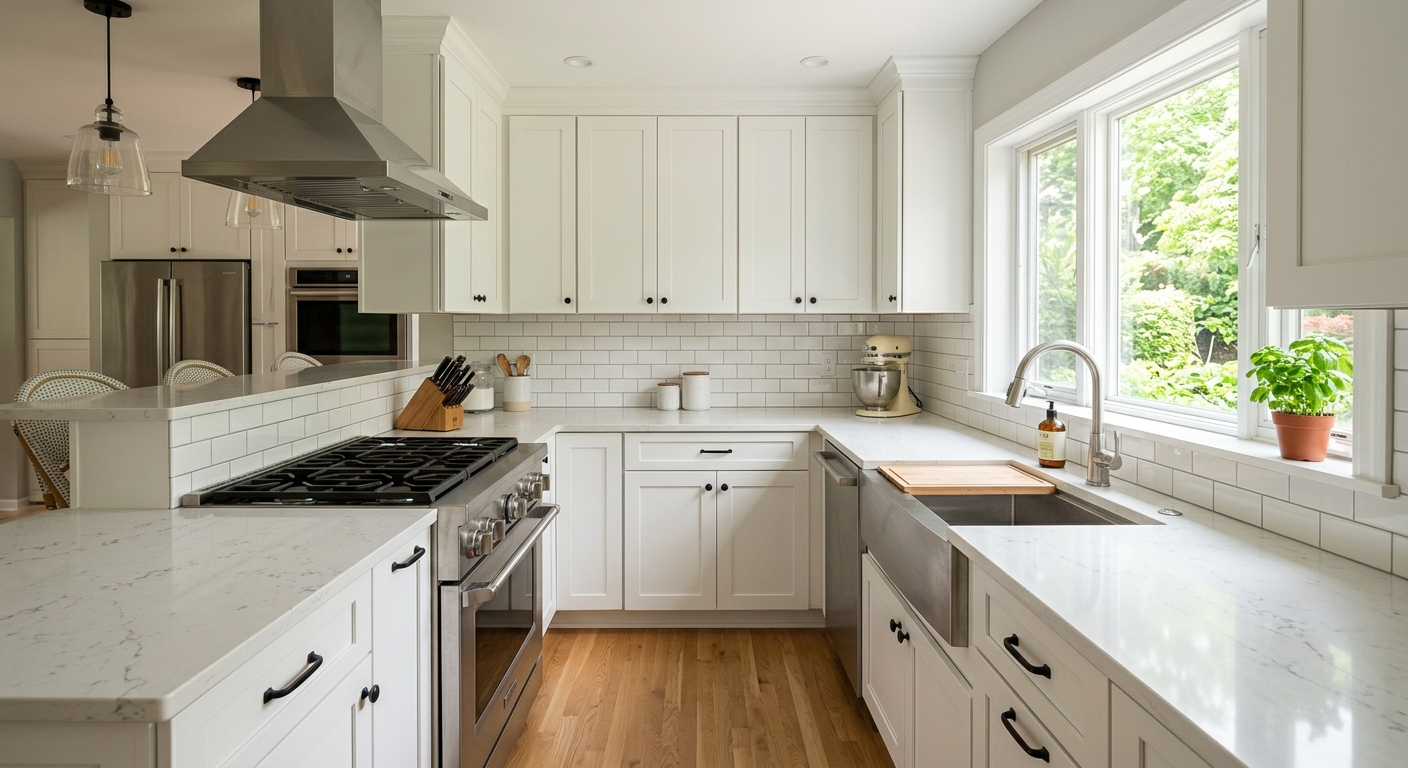
Kitchen renovation costs in College — 2026
Kitchen renovation costs in College Township and nearby State College reflect both Centre County’s strong homeownership rate and its higher median incomes (U.S. Census Bureau, ACS 2024). Homeowners here generally plan renovation budgets that align with typical home values, and a large share of houses stems from the 1960–1985 subdivision boom. Many kitchens in College are compact galley styles built for efficiency, which often means homeowners need to weigh the cost of reworking tight layouts versus upgrading finishes only.
Most kitchen budgets go off the rails when scope and expectations drift apart — especially when a homeowner starts pricing basic upgrades but specifies luxury or full reconfiguration mid-project. Before you set a number, make clear whether you’re simply replacing what’s there or moving plumbing and walls, which is a much higher tier with substantial price and permit differences.
| Scope |
What's included |
Duration |
Price range |
| Full gut remodel, same layout |
cabinets, counters, appliances, flooring, lighting, fixtures |
6–10 weeks |
$31,500–$126,500 |
| Gut plus layout change |
all of the above plus moved plumbing, electrical, walls |
10–16 weeks |
$68,500–$126,500 |
| Cabinet replacement (stock to semi-custom) |
remove and install cabinets, hardware, patching |
1–3 weeks |
$7,400–$31,500 |
| Cabinet refacing |
new doors and drawer fronts, veneer, hardware |
3–6 days |
$7,400–$21,000 |
| Countertop replacement only |
template, fabricate, install, reconnect sink |
1–3 weeks |
$4,200–$17,000 |
| Kitchen flooring only |
remove existing, install new flooring |
3–6 days |
$5,300–$21,000 |
Estimates for a typical College kitchen. Cabinet grade and whether the layout changes move these figures more than square footage.
Who should run your College renovation
The way you choose to structure your kitchen renovation in College makes as much difference as your material choices. Design-build firms offer a single contract covering design, cabinets, and installation. This approach is the most hands-off for the homeowner and provides one point of accountability, but it’s also the most expensive. A general contractor model, common in the State College–Bellefonte area, puts you or your designer in charge of specifying the major details, while the GC schedules and supervises trades. This is generally a mid-cost, mid-effort route.
The owner-managed approach — hiring each plumber, carpenter, electrician yourself and sequencing their work — is cheapest in dollars but by far the riskiest and most demanding. Unless you have flexible availability and prior experience, owner-management of a renovation that triggers permits in College is not practical. The local finish-trade labor market is tighter here than in nearby regions, and scheduling can fall apart fast if a sub is busy on other jobs. That said, smaller, cosmetic projects or those not requiring a permit — like countertop replacement or simple cabinet refacing — can sometimes be managed directly.
For any kitchen renovation in College that involves new plumbing, electrical, or structural work, most homeowners are better off with a reputable GC or design-build firm. These firms also have relationships with the Centre Region Code Administration and local third-party inspection agencies, smoothing the way for permit and inspection requirements.
Layout changes and the cost cliff
The biggest single jump in kitchen remodeling cost in College comes the moment you change your layout instead of working within it. When you move the sink, fridge, or range, you’re not just shifting lines — you’re triggering plumbing and electrical changes, and often structural work if a wall is coming out. The increase isn’t linear: moving a drain is all or nothing because drain lines need slope, which can be a real headache if you’re on a slab or have finished space below. That surprise drives many College renovations up into the $68,500–$126,500 range for gut jobs with layout changes, from what would otherwise have been a $31,500–$126,500 scope for an upgrade-in-place.
Other pain points: New electrical circuits may hit the limit of your panel’s capacity, so you might face a panel upgrade. Ripping out a wall means figuring out if it’s load-bearing — if it is, you need an engineer’s stamp and a permit, plus plan review by the Centre Region Code Administration. Moving the range hood to an exterior wall means cutting a new penetration for venting, which adds coordination and cost.
The hard truth in College is that many small-galley kitchens from the 1960–1985 build-out feel cramped or awkward, so owners want sweeping changes. But before you spend tens of thousands to move a sink or open a wall, check whether cabinet changes, better lighting, or minor rearrangements can deliver enough improvement. Every foot you move plumbing or electrical shifts your remodel to a higher permit and cost tier — and that cost is almost never proportionate to the distance moved.
The real timeline for a College kitchen
Homeowners in College often underestimate the total time a kitchen renovation takes, especially when local finish-trade labor is in short supply. The sequence runs like this: First comes design and precise measurement — do not skip these or guess. Cabinets must be ordered before demolition, as lead times can stretch from several weeks up to three months, particularly for semi-custom options popular in State College and Bellefonte’s subdivisions.
Once cabinets are on the way, demolition and rough trades (plumbing, electrical) follow, with required inspections by a third-party agency or your municipality’s code office, depending on location. Cabinets get installed next. The countertop template only happens after cabinets are fully set — a detail that introduces a dead week or more while fabricators template and build the tops. No amount of planning can eliminate that gap unless you select laminate countertops fabricated on-site, which is rare these days.
After countertops, finish flooring, backsplash tile, and trims bring the project home. In College, where labor demand is moderate but concentrated in smaller crews, delays can happen if a single trade slips even a couple of days. That’s why projects with layout changes, which require inspections and multiple subs, tend to run 10–16 weeks.
Key takeaway: Always have cabinets ordered and a confirmed delivery schedule before demo. This tightens your overall timeline and avoids living with a gutted kitchen for weeks longer than needed.
Planning appliances before cabinets
The most common planning misstep in a College kitchen renovation is selecting appliances after cabinets are on order — or worse, after cabinets are installed. Stock and semi-custom cabinet lines in Centre County subdivisions are built around standard appliance sizes, but there’s enough variation — especially with counter-depth refrigerators, slide-in ranges, or panel-ready dishwashers — that an inch’s difference can force an expensive and obvious filler panel or, in some cases, mean your new fridge or oven simply won’t fit.
If you’re considering professional-grade appliances, recognize that much of the premium is visual or about durable metal fittings. Actual performance gains, outside of serious home cooking, are usually less dramatic than their marketing suggests. For most College homes, slide-in or standard-depth models provide the best fit and value, and gas versus induction may require a dedicated circuit or gas line rerouting — both trigger added costs and, as always, possible permits in State College.
Don’t forget range hood venting; ducted to the outside is best for air quality but requires a direct path to an exterior wall, which isn’t always easy in an older State College layout. Recirculating hoods are a compromise, filtering but not removing moisture or odors. Lastly, double-check appliance lead times. Some high-demand models today may take as long or longer to arrive as your cabinets, risking delays if the appliances arrive late.
Does a kitchen renovation pay back in College?
The honest answer is that kitchen renovations in College help a house sell faster, but rarely return their full cost outright. Broadly, mid-range projects covering new cabinets, counters, and appliances tend to recoup a higher percentage than high-end builds with luxury materials. For most College owners, especially with a median household income of $96,097 (U.S. Census Bureau, ACS 2024), over-improving beyond neighborhood values does not mean those dollars come back at resale. Buyers here appreciate a clean, attractive, and functional space, but won’t pay a dollar-for-dollar premium for features that outstrip local housing stock.
The smarter frame: Renovate because you plan to stay, and focus on what matters to you every day. In that case, personal use outweighs payback. If you’re renovating to sell, stick to neutral design choices, skip costly layout changes, and aim for the middle of the finish spectrum using a budget that reflects home values in your subdivision. Resist the urge to make the kitchen better than anything else on the block.
Bottom line: A gut remodel in College typically costs $31,500–$126,500. That scale of project should match the value of your home and neighborhood — and not chase a payback figure you won’t see unless the market shifts dramatically.
Code requirements for College kitchens
In College and the greater State College area, most cosmetic kitchen work — such as painting, replacing hardware, cabinet refacing, or new countertops set atop existing cabinets — does not usually require a permit. A building permit typically comes into play if your renovation involves new or relocated plumbing or electrical, or any wall or structural changes. In State College, projects like these go through the Centre Region Code Administration, which also commonly requires a plan review if you are altering mechanical or structural systems in a kitchen.
If your project triggers a permit, expect electrical inspections to be done by certified third-party inspectors retained by the local code office — this is standard in State College and Bellefonte, and surprises many first-timers. This means schedules are sometimes tighter or less flexible than with direct municipal inspectors.
Your contractor must have a valid Home Improvement Contractor (HIC) registration from the Pennsylvania Office of Attorney General for any job over $500. If the contractor employs anyone, they must carry workers’ compensation, which you can check via the WCAIS system. The contract must be in writing, and you have a 3-business-day right of cancellation. If your home was built before 1978, any disturbing of painted surfaces must follow the federal EPA Lead RRP Rule.
Unpermitted work may escape detection for years, but it almost always comes up when you sell — and can derail sales or trigger costly after-the-fact corrections.
Frequently asked questions — kitchen renovation in College
What happens if previous work was unpermitted?
If a previous owner or contractor completed kitchen work in your College home without the required permits — especially for electrical, plumbing, or structural changes — you may run into problems at resale or when refinancing. In Centre County, lenders often require certificates of code compliance, and inspectors or buyers’ agents in State College and College Township are alert to missing permits. Unpermitted work may force you to hire trades to open walls, bring work up to current code, and have it inspected retroactively. This process can be both stressful and costly, sometimes running into the $7,400–$31,500 range if corrections are significant. Don’t ignore the issue — disclosing unpermitted work is always safer than hiding it, and most code offices can guide you on remedy steps.
What is the difference between stock and semi-custom cabinets?
Stock cabinets are mass-produced in standard sizes, usually available for shorter lead times and at lower prices. They work best in typical kitchens with few design quirks, like most 1960–1985 layouts in College. Semi-custom cabinets allow for more flexibility — adjustments to width or depth, a wider choice of finishes and designs, or interior organizers. These are a common upgrade in State College subdivisions, where many original kitchens have odd corners or non-standard measurements. Semi-custom options cost more, often placing the total replacement in the $7,400–$31,500 range. Unless you need specific solutions for a tough space or want a particular look, stock cabinets do the job very well for less.
Is lead paint a concern in College kitchen renovations?
Yes, lead paint is a real issue in College homes built before 1978 — which includes over a third of the housing stock here. During kitchen renovations, disturbing old painted surfaces triggers the federal EPA Lead RRP Rule, requiring certified contractors and safe work practices. This isn’t just red tape: Lead dust is dangerous, especially to kids and pregnant women. Fines for ignoring the rule are steep, and buyers’ inspectors in State College are known to check for compliance. In some cases, following proper procedures can add hundreds or a few thousand dollars to a typical project in the $31,500–$126,500 band, but skipping it is simply not worth the risk, to health or resale.
Should I hire a general contractor or a kitchen firm?
In College, the choice usually comes down to how much you want to manage yourself. General contractors handle coordination and scheduling of trades, while design-build kitchen firms also manage design and procurement. If you want a single point of contact, higher predictability, or are dealing with layout changes in an older 1960–1985 kitchen, hiring a kitchen-focused firm makes life easier — though typically at a higher price point than hiring a GC. Both can competently deliver a standard replacement project in the $7,400–$31,500 bracket. Save owner-management for simple projects; a full kitchen gut or any remodel needing permits quickly becomes more than most homeowners can manage on their own.
Why are kitchen quotes in College so far apart?
The wide gap in kitchen renovation quotes here usually reflects differences in scope, cabinet quality, and whether your project will move walls and systems or leave them in place. Labor rates are a factor, but in College and State College specifically, the biggest price differences are not from padding but from what’s actually included. Two quotes with the same line items can still land on either end of the $31,500–$126,500 bracket if one involves design changes, semi-custom cabinets, or higher-end countertops. Always compare detailed scopes, ask what is and isn’t included, and remember: the cheapest number up front can grow fast with change orders and surprises.
Do I need to change my kitchen layout?
You don’t have to, and for most College kitchens, sticking to the existing layout is the best value. Because a large portion of homes from the 1960–1985 period have tight galley spaces, it’s tempting to want to blow out a wall or move appliances. But this typically launches you from a straightforward upgrade in the $31,500–$126,500 range up to the full gut-plus-layout bracket at the top end. Before spending, assess whether reorienting cabinets or updating lighting achieves enough of a change. Sinks and ranges usually cost the most to move, so weigh your options, budget, and whether the payoff matches the expense.
Why is there a gap after cabinets are installed?
In College, once cabinets go in, there’s an unavoidable pause before countertops can be templated and installed. Countertop suppliers need exact cabinet locations — not just measurements or plans — before they begin templating. This process can take a week or longer for fabrication, especially for stone or quartz, which are standard in most Centre County renovations. During this time, your kitchen may sit idle. The delay isn’t a sign of poor planning; it’s a necessary sequence, since even a difference of a quarter-inch can affect the countertop fit. Factor this lag into timelines, whether your project is in the $31,500–$126,500 or $7,400–$31,500 band.
What does a full gut kitchen remodel cost in College?
A full gut kitchen remodel in College — including all new cabinets, countertops, appliances, flooring, fixtures, and lighting — typically lands in the $31,500–$126,500 range for 2026, with most projects coming in near $68,500 for a standard small-to-medium kitchen. Costs rise toward the upper end if you’re also moving plumbing lines, adding new windows, or rearranging structural walls. Material and finish selections have a significant impact: custom cabinets and high-end appliances will move you to the top of the range quickly. Plan your scope before setting a budget, and don’t compare prices to national averages — they simply don’t reflect Centre County’s construction market or code standards.
Which upgrades are not worth the money?
In College, the big money-losing upgrades are moving plumbing or gas for minor layout tweaks, installing fully custom cabinets when stock or semi-custom fit, or springing for luxury appliances that outclass the rest of the home. For most houses, an elaborate backsplash, under-counter wine fridge, or specialty lighting controls don’t add value at resale. Spending at the top of the $126,500 band on high-end finishes in a neighborhood of mid-range homes doesn’t pay off here given the area’s median household income. Focus your budget where you spend your time: durable surfaces and ample lighting. Save the rest for projects with more consistent return.