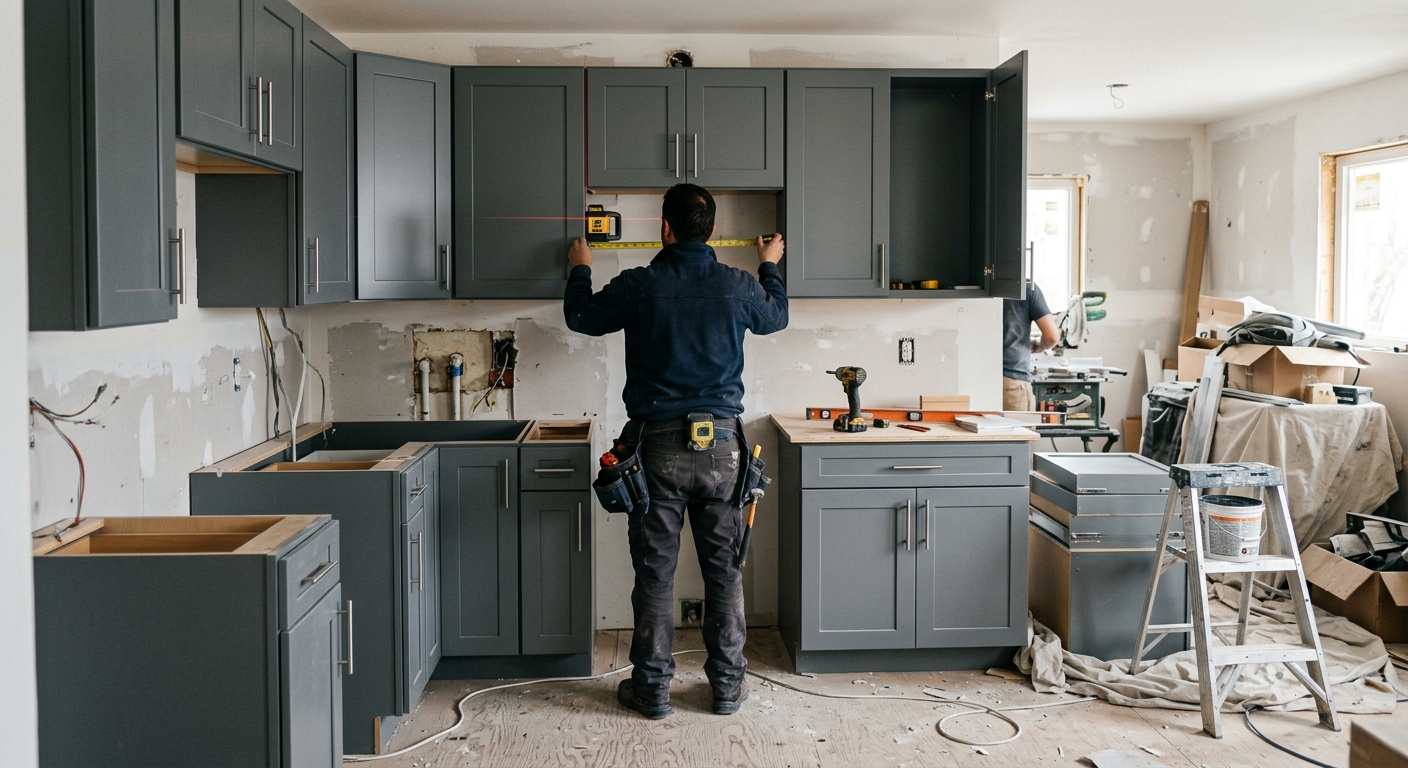
Swarthmore kitchen renovation prices by scope — 2026
Swarthmore homeowners approach kitchen renovations differently than landlords, and the numbers reflect it: the high homeownership rate (77.7%) and a median household income of $138,679 (U.S. Census Bureau, ACS 2024) mean higher budgets, longer planning windows, and a sharper focus on resale and quality. In much of Delaware County, including Swarthmore, homes built between 1920 and 1960 dominate the landscape. These kitchens tend to be tight galleys with minimal storage, and rarely support today’s open layouts or appliance sizes without some reconfiguration. Older kitchens here often call for moving walls or utilities—not just new cabinets and finishes.
The risk that blows up kitchen budgets is simple: pricing out one scope (like a cosmetic ‘pull-and-replace’) and then specifying a higher scope (like moving plumbing or taking out a wall) late in the planning. Differences are drastic; moving utilities or changing the footprint can add weeks and tens of thousands.
| Scope |
What's included |
Duration |
Price range |
| Full gut remodel, same layout |
cabinets, counters, appliances, flooring, lighting, fixtures |
6–10 weeks |
$34,000–$135,500 |
| Gut plus layout change |
all of the above plus moved plumbing, electrical, walls |
10–16 weeks |
$73,500–$135,500 |
| Cabinet replacement (stock to semi-custom) |
remove and install cabinets, hardware, patching |
1–3 weeks |
$7,900–$34,000 |
| Cabinet refacing |
new doors and drawer fronts, veneer, hardware |
3–6 days |
$7,900–$22,500 |
| Countertop replacement only |
template, fabricate, install, reconnect sink |
1–3 weeks |
$4,500–$18,000 |
| Kitchen flooring only |
remove existing, install new flooring |
3–6 days |
$5,600–$22,500 |
Estimates for a typical Swarthmore kitchen. Cabinet grade and whether the layout changes move these figures more than square footage.
Practical survival during the work
Living through a kitchen renovation in Swarthmore means adjusting daily life for weeks. Before work starts, set up a temporary kitchen—often in the dining room or basement. Move your fridge nearby (many use a rolling cart or spare extension cord), and put a microwave, toaster oven, and kettle on a folding table. For cleaning, a laundry sink or even a bathroom sink stands in for your kitchen—plan extra time for washing up, or rely on paper plates and disposable cutlery to reduce the hassle. Assume your grocery and takeout bill will spike; eating out for eight weeks typically costs more than new kitchen flooring.
Dust is constant: any real renovation kicks up fine particles that drift far beyond the work zone. Insist on plastic sheeting or zip walls to keep the rest of your home livable. Floor protection in walkways is a must, especially with Delaware County’s freeze-thaw winters and muddy spring weather. The crew will need space for a dumpster and staging—usually the driveway, which can block a car for weeks. Pets need extra care with doors propped for wheelbarrows and traffic all day.
Some move out for demolition week, especially if young kids or sensitive allergies are in the home. If that’s not practical, at least plan to be elsewhere during heavy demo and for the first sand or paint day. Survival is easier with planning—underestimate at your peril.
Electrical work in an older Swarthmore kitchen
Electrical upgrades are the most common budget surprise in Swarthmore kitchen renovations. Delaware County homes—especially those built from 1920 to 1960—almost never meet current electrical code. The odds are high your Swarthmore kitchen is running on a couple of old circuits, sometimes ungrounded or wrapped in fabric insulation. The modern code, enforced when you pull a permit for anything but cosmetic work, requires:
- Two or more 20-amp small-appliance circuits just for sockets at counters
- GFCI protection at all receptacles above counters and near water
- Dedicated breakers for dishwasher, disposal, microwave, and any electric oven or range (240V for full electric cooking)
- Spaced outlets—no more than four feet apart on counters
Once the walls are open, inspectors require current code—there’s no legal way around it. In these older homes, bringing wiring up to standard usually means running all new wire back to the panel, sometimes adding circuits or replacing the panel if there’s no space. In a kitchen that hasn’t been touched since before 1980—and 96.9% of local homes fit that description (U.S. Census Bureau, ACS 2024)—budget an extra $5,000–$20,000 for electrical, depending on whether the panel also needs upgrading. Even in late-1990s kitchens, expect to need at least some circuit work, as older standards allowed far fewer outlets and loads per breaker.
Cabinets: reface, stock, semi-custom or custom
How you handle cabinets sets the whole budget in Swarthmore. Refacing is by far the cheapest way for a visible overhaul: it retains existing cabinet boxes, applies new veneer, and replaces the doors and drawer fronts. This works well when boxes are still square and solid and you don’t hate the kitchen’s layout or storage. If those conditions aren’t true, refacing is wasted money. No refacer can fix an awkward layout or add a pantry to a 1940s galley.
Stock cabinets come in standard box sizes. They’re fast and cheap, but in older Delaware County homes, walls are rarely straight or sized for stock options, creating awkward gaps. Semi-custom cabinets can be ordered to fit those non-standard spaces—nearly essential with so many 1920–1960 homes needing layout reconfiguration. Custom cabinets are the priciest and slowest, but will fit anything and accommodate any finish or storage ask.
Across all tiers, pay attention to construction details: plywood boxes last longer and resist moisture better than particleboard, especially in humid Pennsylvania summers. Drawers with dovetail joints and heavy-duty full-extension, soft-close slides hold up far better than stapled particleboard with economy tracks. Frameless (Euro style) cabinets offer more accessible space, but require precise installation most easily done in a straight new build.
| Option |
Cost |
Best when |
Limitation |
| Painting existing cabinets |
$1,200–$3,500 |
boxes and doors sound, tight budget |
no layout or style change |
| Refacing |
$7,900–$22,500 |
boxes square and layout works |
storage unchanged |
| Stock cabinets |
$7,900–$34,000 |
standard dimensions fit |
filler strips, limited finishes |
| Semi-custom |
$22,500–$34,000 |
non-standard walls or finishes |
6–12 week lead time |
| Full custom |
$22,500–$34,000 |
unusual layout or high-end design |
longest lead, highest cost |
Code requirements for Swarthmore kitchens
For most kitchen work in Swarthmore, whether a permit is required hinges on what is being changed. Cosmetic upgrades—paint, new hardware, cabinet refacing, or replacing a countertop—do not typically need a permit across Delaware County townships. The moment you relocate plumbing, add or move electrical circuits, or move a wall, a permit becomes necessary. In Haverford Township, which sets the tone for the area, these changes not only trigger a permit but require a plan review by the township building department. Projects touching electrical almost always draw an inspection from a third-party agency approved by the township, not just the municipality itself.
In Pennsylvania, any contractor with a job over $500 must have Home Improvement Contractor (HIC) registration from the Office of Attorney General—this is not optional and can be verified at hic.attorneygeneral.gov. If the contractor has employees, their workers' compensation status (mandatory coverage) can be checked in the WCAIS system (wcais.pa.gov).
Do unpermitted work and you will have trouble at resale, as township records and third-party inspections surface missing permits. Fixing such issues after the fact is often more expensive than doing it correctly from the start.
Surprises in an older Swarthmore home
With 96.9% of Swarthmore homes built before 1980 (U.S. Census Bureau, ACS 2024), demolition nearly always reveals problems beyond what’s visible. Expect out-of-plumb walls and out-of-level floors—installing new cabinets here can turn into days spent shimming and scribing. It’s common to find that wiring is either undersized, ungrounded, or run inside old armored or cloth sheathing. Fixing just the worst felonies can add $3,000–$12,000, climbing higher if a new panel is needed.
Older plumbing is another regular headache: galvanized supply lines or cast iron drains may work today but will not survive another decade. Expect a line item for repiping sections in copper or PEX. Sometimes walls have no insulation (especially along exterior walls), which is exposed once cabinets come out—a chance to insulate before closing back up, but again, a cost.
Lead paint is a real factor: in any pre-1978 home, the federal EPA Lead Renovation, Repair and Painting Rule applies. Contractors need to be Lead RRP-certified, and testing is done before demolition. Asbestos is also likely in vinyl flooring or old adhesives—disturbing it safely is essential and can be costly if full abatement is triggered.
Finally, previous unpermitted work is sadly common in older Delaware County kitchens, and bringing those conditions to code can stall the project or inflate the budget fast.
Appliance choices and the decisions they force
Appliance planning in Swarthmore kitchens must come early: cabinets are built around your appliance sizes, not the other way around. The classic mistake is locking in cabinet dimensions and shopping for appliances later—only to find the chosen fridge, range, or dishwasher won’t fit. Counter-depth refrigerators deliver a sleeker profile and keep walking lanes open in older galley formats, but sacrifice storage space and often cost more. Slide-in ranges require precisely finished countertops and eliminate the crumbs trap, while freestanding ranges are more forgiving on fit.
Choosing between gas and induction cooking? Swarthmore’s older homes often need new electric circuits for induction, plus a 240-volt feed that most pre-1980 kitchens lack. Gas—if the home already has it—is simpler, but most code-compliant kitchen remodels force an electrical upgrade either way. Panel-ready dishwashers blend into cabinetry but need semi-custom panels and must be chosen before ordering cabinets.
Range hood venting should always go outside, especially in tightly insulated older homes. Recirculating hoods are a compromise and often leave cooking odors lingering, particularly in closed-plan galley kitchens common to the area.
Professional-grade appliances deliver higher power and durability, but most of the visible premium is in aesthetics and brand, not lifespan. And right now, many appliance models have lead times as long as or longer than custom cabinets, so secure those orders early or risk a project-stalling delay.
Frequently asked questions — kitchen renovation in Swarthmore
What is a realistic contingency for a Swarthmore kitchen?
In Swarthmore, a realistic contingency for kitchen renovation should be at least 15% of your total construction budget, and ideally closer to 20% if you are working in a pre-1980 home—meaning an extra $10,000–$27,000 on a typical project. The high number of older homes in town (over 96%) makes unknowns during demolition almost certain. Unforeseen costs often include electrical upgrades, hidden water damage, lead paint compliance, and structural fixes. Homeowners who try to squeeze the contingency usually end up financing surprises at a higher rate or making style sacrifices late in the project. Swarthmore’s above-average income and homeownership profile means most neighbors plan proactively, not reactively. Saving on contingency is a false economy; undershooting this figure can turn a manageable project into a stressful ordeal.
Which upgrades are not worth the money?
In Swarthmore, not every splashy kitchen upgrade earns its keep. Glass-front cabinets, pot fillers, and exotic countertops each have their fans, but rarely pay off when you resell—especially in older Delaware County homes where layouts are tight. A pot filler adds cost in both plumbing and permits and often sees little use. Expensive mosaic backsplashes can quickly date a kitchen. On the appliance side, professional ranges or built-in espresso makers are rarely recouped if you list your home in a few years. That money usually delivers more value invested in basics like upgraded electrical or quality cabinetry. For most households, a solid midrange counter (think $4,500–$18,000) and soft-close drawers offer more daily satisfaction than showy add-ons.
Should I choose plywood or particleboard cabinet boxes?
In Pennsylvania’s humid summers and freeze-thaw cycles, especially in Swarthmore’s older homes, plywood cabinet boxes have a clear durability edge over particleboard. Plywood is more resistant to water damage, stays rigid if kitchen floors or walls are less than perfect—a common scenario in Delaware County’s 1920–1960 housing. Particleboard cabinets, often found at big-box stores, are cheaper but prone to swelling and sagging over time, especially when in contact with plumbing or near sinks. If your renovation budget is already being pulled by necessary electrical or plumbing work, spending a bit more for plywood on base cabinets is money well spent. The difference is most pronounced in mid to upper price bands: a midrange cabinet replacement ($22,500) can easily absorb plywood construction for long-term return on investment.
How much more does moving the sink and range cost?
Moving the sink or range in a Swarthmore kitchen drives up both cost and complexity. Relocating either fixture requires rerouting plumbing, gas (if present), and upgrading electrical circuits to meet current code—often with drywall and floor patching. The total added cost is typically $10,000–$30,000 on top of a basic remodel. This is especially true in pre-1980 homes where existing services are undersized and rarely comply with modern standards. Not only does this lengthen construction (add weeks), but it invariably triggers plan review and inspection. Unless your kitchen layout is truly dysfunctional, staying with the existing “wet wall” for sink and range is the single biggest cost saver.
Can I renovate a kitchen in stages?
Yes, it’s possible to renovate a Swarthmore kitchen in stages, especially in owner-occupied homes. Many homeowners choose to replace flooring and refinish or reface cabinets ($7,900–$22,500), then return a year or two later for counters or appliances. Staged renovations help spread costs—and minimize time living with a gutted kitchen—but there are trade-offs. Labor and material costs can rise between phases, and, in older Delaware County homes, staged work risks uncovering issues late. If you suspect plumbing or electrical problems, address those early—waiting until cosmetic changes are finished can double corrective costs. Staged work is best for cosmetic upgrades or if you’ve already confirmed that key systems are sound.
What is an allowance in a renovation quote?
In Pennsylvania—including Swarthmore—an allowance is a placeholder dollar amount for a product or finish not yet selected, like tile, hardware, or lighting. For example, a contract may include a $8,000 cabinet allowance, which covers any style or finish up to that amount. If your final choice runs higher, you pay the difference; if it’s less, you get a credit. Allowances help keep projects moving, but can mask true costs if set unrealistically low by a contractor trying to “win” the bid. For older homes needing custom sizes or premium installation work, expect actual spends to run above base allowances, especially on cabinets and appliances.
Is lead paint a concern in Swarthmore kitchen renovations?
Yes—lead paint is a significant issue in Swarthmore, where nearly all homes pre-date 1980 and federal regulations apply. Any kitchen renovation disturbing painted surfaces in a pre-1978 home falls under the EPA Lead Renovation, Repair and Painting (RRP) Rule. That means contractors must use certified lead-safe practices, contain dust, and clean thoroughly throughout the job. Testing for lead paint is done before work starts. Lead-safe protocols can add $1,200–$4,500 to a kitchen project, mainly for dust containment, cleaning, and disposal. Skipping this step isn’t just unsafe—it’s illegal and can jeopardize your home’s resale if compliance is not documented.
How far ahead should I book a contractor in Swarthmore?
Swarthmore sits near the heart of Delaware County’s contractor market, but labor availability can be tight—especially for finish trades and during peak spring or fall remodeling seasons. For a full kitchen gut remodel ($34,000–$135,500), booking your contractor three to six months ahead is wise. Lead times are long for cabinets, appliances, and specialty trades. If you want your kitchen done over summer or by the holidays, start consultations before the ground thaws in February or March. Slots fill quickly—delays in decision-making often mean pushing the whole project by a season. Lining up your design and permits early is the surest way to stay on your timeline.
How do I verify a kitchen contractor in Pennsylvania?
In Swarthmore and across Pennsylvania, you must confirm two things before signing: contractor registration and valid workers’ compensation. Any home improvement contractor doing jobs over $500 in Pennsylvania needs an HIC (Home Improvement Contractor) registration from the Office of Attorney General—search hic.attorneygeneral.gov for current status. If the contractor employs anyone, check their workers’ compensation insurance via WCAIS (wcais.pa.gov). In Delaware County, these checks matter—local enforcement is active and resale attorneys will flag missing paperwork. Never work with a contractor who won’t provide both their registration and proof of insurance. It’s your legal and financial protection, and is required by state consumer protection law.