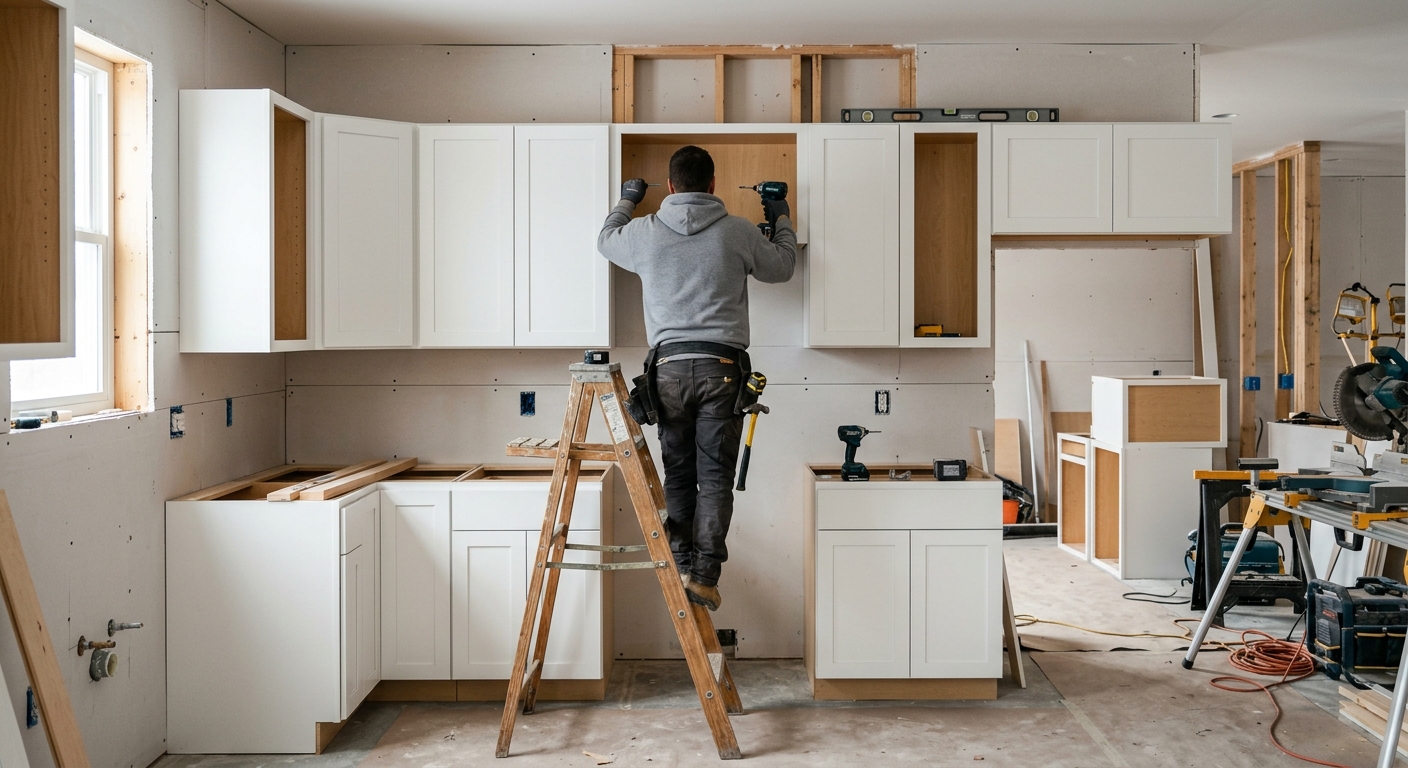
What a kitchen remodel costs in Harrisburg
In Harrisburg, full kitchen renovations are not a one-size-fits-all decision—especially given a median household income of $46,654 and a homeownership rate of just 35.5% (U.S. Census Bureau, ACS 2024). Budgets here have to fit real households, and most owners in the city and surrounding Dauphin County are working within homes built before 1980. Those postwar 1945–1975 subdivisions in Lower Paxton and Swatara have many small-galley kitchens that simply do not work for modern life without some kind of layout reimagining.
Most blown kitchen budgets come from making decisions by price band, and then specifying a scope from the tier above. For example, you start by pricing “just new cabinets and counters,” but halfway through, you “might as well” move the sink. Every step up in scope can double your budget—and it’s always cheaper to plan for scope changes before demolition, not after.
| Scope |
What's included |
Duration |
Price range |
| Full gut remodel, same layout |
cabinets, counters, appliances, flooring, lighting, fixtures |
6–10 weeks |
$28,500–$113,500 |
| Gut plus layout change |
all of the above plus moved plumbing, electrical, walls |
10–16 weeks |
$61,500–$113,500 |
| Cabinet replacement (stock to semi-custom) |
remove and install cabinets, hardware, patching |
1–3 weeks |
$6,600–$28,500 |
| Cabinet refacing |
new doors and drawer fronts, veneer, hardware |
3–6 days |
$6,600–$19,000 |
| Countertop replacement only |
template, fabricate, install, reconnect sink |
1–3 weeks |
$3,800–$15,000 |
| Kitchen flooring only |
remove existing, install new flooring |
3–6 days |
$4,700–$19,000 |
Estimates for a typical Harrisburg kitchen. Cabinet grade and whether the layout changes move these figures more than square footage.
Eight weeks without a kitchen
No matter how smooth the renovation, if you gut your kitchen in Harrisburg—or anywhere in Dauphin County—you’ll be living without a kitchen for weeks. Most homeowners underestimate what this means. You’ll want to set up a temporary space: the dining room or basement works, with your fridge plugged in, a microwave and kettle on a folding table, and heavy reliance on paper plates. If you don’t have a mudroom sink, you’ll likely be rinsing pans in a bathroom or laundry sink—not a long-term solution, but workable.
The dust is its own challenge, especially in the typical postwar or older homes with arched entries, not open plans. Plastic sheeting and zip walls work, but the mess creeps. Plan for the crew’s need to park a dumpster—usually in the driveway. They’ll also need a spot to drop cabinets and appliances before install; garages are ideal, but not everyone in Harrisburg has one.
Pets can complicate everything with doors open and unfamiliar people in and out. If you have smaller pets or anxious dogs, plan for extra containment. For demolition week, moving out—especially if you have allergies—makes sense. The biggest surprise is the eating out budget: if you eat out or order in for eight weeks, you can easily spend more than you would on new kitchen flooring—often $4,700–$9,400 over two months for a family.
Layout changes and the cost cliff
The single biggest cost jump in Harrisburg kitchen remodels comes when the layout changes. If your plumbing and electrical stay where they are, you stay in one price class. But move a sink, range, or wall—even a few feet—and the price isn’t proportional to the distance. You immediately add time, complexity, and at least tens of thousands to your bill.
Drain lines need slope to function—if your kitchen’s on a slab or over a nicely finished ceiling, that limits where things can move. Electrical upgrades mean new circuits, and most older houses (especially those postwar Lower Paxton and Swatara homes) don’t have spare panel capacity. Moving or removing a wall means figuring out if it’s structural, hiring an engineer, and submitting for a permit. Any arrangement change that involves moving the range or sink almost always means new venting and plumbing—and exterior penetrations for range hoods aren’t a small job.
This is why most permit-triggering work in Harrisburg and Lower Paxton starts with plumbing, electrical, or structural changes—not just cosmetic upgrades. The dollar difference is dramatic. Plan for $61,500–$113,500 for a full gut with layout change, versus $28,500–$113,500 if everything stays in its original location. Before tearing into walls, really ask if your existing kitchen is fundamentally broken or just out of style. Even moving a sink four feet can easily add another ten to fifteen thousand to your total.
Electrical work in an older Harrisburg kitchen
Electrical is where many Harrisburg kitchen remodels see the biggest unplanned expense. Code in Pennsylvania requires dedicated small-appliance circuits, GFCI protection on all countertop plugs, spaced outlets, plus separate circuits for a dishwasher, disposal, microwave, and—if electric—a 240-volt range. In nearly all homes built before 1980 (that’s nearly 90% of the local stock), you’re likely to find two-wire ungrounded circuits, a single circuit running the entire kitchen, or a panel without spare breakers. In Lower Paxton and Swatara, it’s common for those tight, galley kitchens to have out-of-date, patched-together wiring. Occasionally, you’ll see aluminum branch wiring, which adds its own headaches.
Once you open the walls, any municipality in Dauphin County will expect the new work to meet current code before it gets signed off. There’s no grandfathering for new circuits, and it’s inspected—sometimes by a City of Harrisburg or Lower Paxton-approved third-party electrical agency, not city staff. Even in 1990s homes, you may not have enough small appliance or lighting circuits to satisfy the Uniform Construction Code.
If your renovation includes new layouts or upgraded appliances, expect to pay $6,600–$19,000 just to bring the kitchen’s electrical up to current standards—this is typically a chunk of the project, not a rounding error.
What's behind the walls in a Harrisburg kitchen
With 87.6% of Harrisburg homes built before 1980, older-home surprises are more a rule than an exception. Start with walls that aren’t plumb or floors that aren’t level—installing new cabinets might mean extensive shimming and carpentry ($800–$2,500). Wiring can be undersized, ungrounded, or aluminum, pushing your budget up by $3,000–$7,000 for new circuits. Galvanized water supply lines or cast iron drains are nearing the end of their life; replacing them runs $2,500–$8,000 depending on access. You’ll often find no insulation in exterior kitchen walls, especially in those postwar subdivisions, which adds several hundred more.
Previous DIY or unpermitted upgrades can be lurking—anything from hidden junction boxes to improper taps off bathroom plumbing. Federal EPA Lead RRP rules apply if your house is pre-1978. A certified contractor must test paint before disturbing anything; proper handling and cleanup add both time and money. Asbestos typically shows up in floor tile or old linoleum, and should be tested and safely abated if disturbed—a must for any kitchen in Harrisburg of that vintage.
For newer suburban stock from the late 1980s or 1990s, the issues are different: expect builder-grade cabinets at the end of their life, minimal circuit counts, and laminate countertops and vinyl flooring all ready for replacement about the same time. Here, you’re paying to correct older cost-cutting, not century-old practices.
What requires a permit in a kitchen renovation
In Harrisburg, you typically do not need a permit for cosmetic kitchen upgrades—painting, cabinet refacing, switching hardware, or swapping out countertops in place. But once you move plumbing or electrical or change walls, a building permit is required. If you’re in Lower Paxton Township, you can usually replace cabinets and counters “like for like” without a building permit so long as plumbing and electrical are untouched.
Most jurisdictions in Dauphin County, including Harrisburg and Lower Paxton, will require you to submit permit plans for a full kitchen remodel that change the layout or move systems. These plans must show the new arrangement of appliances, plumbing, and electrical—surprises during inspection are rarely allowed. Municipalities here commonly outsource electrical inspections to third-party agencies instead of using city staff, which trips up many owners who expect to see a local inspector at the walk-through.
If your contractor’s bid for a kitchen job in Harrisburg is over $500, Pennsylvania law says they must be registered as a Home Improvement Contractor—a fact you can verify online. Workers’ compensation is mandatory for anyone with employees, and you should ask for proof before work starts. Skipping permits or using unregistered contractors in Dauphin County doesn’t just risk a stop-work order. It can mean real consequences when you decide to sell—and a buyer’s bank may require after-the-fact permitting, delaying your closing and adding to your final tally.
Choosing a countertop for a Harrisburg kitchen
Choosing the right countertop for your Harrisburg kitchen means thinking beyond looks. Start with maintenance and toughness—quartz is engineered, non-porous, and handles daily spills beautifully, but it can be damaged by excessive heat. Granite is a durable, natural stone option but needs to be resealed to protect against staining. Laminate is the loudest signal of value in this area: modern brands are much tougher than their reputation, impervious to normal kitchen abuse, and entirely appropriate for rentals or modest upgrades. Don’t dismiss them—they hold up fine, and you won’t spend nights worrying about a cracked seam.
Butcher block offers warmth and the ability to sand and refinish, but it demands oiling and careful maintenance. Solid surface (think Corian) is underrated: it’s nonporous, can be repaired if chipped, and seams can be nearly invisible with a skilled installer.
From the fabricator’s angle, your price will jump based on edge profiles, sink cutouts, custom inlays, and how seams are placed. The standard process is a template visit (to make an exact pattern of your space), then fabrication, delivery, and install. Laminate is measured on site, cut quickly, and installed without delays for stone templating.
If you own a rental or just need to refresh a dated kitchen economically, laminate is a sensible decision, not a “cheap-out.” It can look sharp, clean easily, and stands up well to tenants or heavy family use.
Frequently asked questions — kitchen renovation in Harrisburg
Can I cancel a renovation contract in Pennsylvania?
Yes—if you sign a contract for more than $500 with a registered Home Improvement Contractor in Harrisburg or anywhere in Pennsylvania, you have a 3 business-day right of cancellation under the Home Improvement Consumer Protection Act (HICPA). This right applies even if work has not yet started, and no contractor can make you waive it. You must receive written notice of this protection in your contract. If you change your mind in those three days, notify your contractor in writing (email or letter, ideally with read receipt or proof of mailing). After those three days, canceling may forfeit your deposit or incur charges for work already completed. It’s a safeguard designed to prevent buyers' remorse—especially with high-ticket projects that often reach $28,500–$113,500 in total cost.
Is lead paint a concern in Harrisburg kitchen renovations?
If your Harrisburg home was built before 1978—and nearly 90% of local housing was—the risk of lead paint is real. Any renovation that disturbs painted surfaces, from cabinet demo to wall changes, must comply with the federal EPA Lead RRP Rule. Contractors are required to test for lead before starting work and must follow specific containment and cleanup procedures if it's present. This adds both cost and time, but it's essential for safely working in older homes, especially with young children or pregnant residents. Certified firms are listed online, and you should always verify that yours follows the rule. For a full kitchen gut, proper lead-safe practices can mean an added $3,800–$8,000 over a basic job.
Is laminate countertop a bad choice?
Laminate countertops have a reputation from decades past, but in Harrisburg’s market, they’re a perfectly sound choice for many kitchens—especially rentals, smaller homes, or when doing an affordable refresh. Modern laminates resist stains, scratches, and heat surprisingly well; many now mimic stone or wood convincingly. They’re easy to clean, do not require sealing, and the cost is far lower than stone or engineered surfaces. In many Harrisburg homes—where a countertop replacement runs $3,800–$15,000, depending on material—choosing laminate lets you update an older kitchen without over-improving for the neighborhood. Unless you’re looking for luxury resale value, there’s no need to look down on a well-made laminate top.
Why is there a gap after cabinets are installed?
Gaps after cabinet installation are common in Harrisburg's older homes, especially where walls aren’t plumb or floors are out of level—a side effect of nearly all homes here being built before 1980. Skilled installers shim and scribe cabinets to fit, but some walls can be so bowed that a perfect fit is almost impossible. Typically, these gaps are covered by trim, filler strips, or clever scribing. Expect a little touch-up work afterward, but a gap doesn’t necessarily mean sloppy work—sometimes it’s revealing layers of earlier renovations or out-of-square framing. In a kitchen upgrade running $6,600–$28,500 for new cabinets, part of the labor covers making a modern installation look seamless in a house that’s anything but.
Can I live in the house during a kitchen renovation?
Most Harrisburg homeowners do live in the house while the kitchen is remodeled, especially for projects on a tight or average budget. You’ll need to set up a temporary kitchen in another room—plan on using a microwave, fridge, and perhaps a hot plate. The biggest disruptions are noise, dust, and loss of water in the kitchen area, with trades in and out for weeks. If you have allergies or small children, some choose to move out for the demo or rough-in stage. Eating out more often is inevitable and adds up: for a moderate-length project of 8 weeks, families often spend an extra $4,700–$9,400 just on food. The choice often comes down to personal tolerance for inconvenience versus extra spending on short-term rentals.
What does a quartz countertop cost in Harrisburg?
Quartz countertops are a popular upgrade in Harrisburg because they’re nonporous and easy to maintain, but they do come at a premium over laminate or solid surface. For a standard-size kitchen, expect to pay $3,800–$15,000 for quartz, depending on the brand, edge profile, and number of cutouts needed. Most projects land around $8,500. This includes templating, fabrication, installation, and reconnecting the sink. Quartz is less heat tolerant than stone and seams are visible, though far less so with a good fabricator. If your kitchen needs a sensible refresh rather than a full gut, quartz can strike the balance between function, appearance, and value in this market.
How much more does moving the sink and range cost?
Relocating the sink and range in a Harrisburg kitchen pushes your project across a major cost line. Leaving everything in the original location keeps your total between $28,500–$113,500, but moving plumbing and electrical for a new layout means a starting point near $61,500. The cost jump is not just for new pipes and wires—you’re paying for demo, engineering, permits, and sometimes structural changes (especially if you open a wall or need to vent a new range hood to the outside). Even shifting the sink by four feet can add ten thousand or more. Unless your current layout is truly limiting, it’s smart to explore options for keeping key fixtures in place.
Should I renovate before selling or let the buyer do it?
If your kitchen is substantially outdated or failing—peeling counters, failing cabinets, broken appliances—a mid-range renovation can help a Harrisburg home sell faster and avoid discounting for “project” status. However, with the local median income at $46,654 and homeownership below 40%, there’s a ceiling to what buyers in the city will recoup for a high-end kitchen. Spending in the lower-to-middle price band—cabinet and countertop replacement ($6,600–$28,500)—adds broad appeal. In postwar subdivisions, buyers notice a working, fresh kitchen more than gourmet upgrades. If your kitchen is simply dated but functional, sometimes letting the buyer customize post-sale is the best investment—especially if they want to tackle layout changes themselves.
Should I reface or replace my kitchen cabinets?
If your cabinets in Harrisburg are structurally sound—no water damage, sagging boxes, or failing joinery—refacing can save time and money. Refacing replaces doors, drawer fronts, and visible panels while keeping the cabinet boxes, typically wrapping up in less than a week and costing $6,600–$19,000. Full replacement runs longer (1–3 weeks) and costs $6,600–$28,500 for stock to semi-custom cabinets. In many postwar homes with sturdy but tired cabinetry, refacing is a smart path. But if your boxes are particleboard, cracked, or too small for modern storage, replacement is the better investment. For many Harrisburg kitchens, the answer comes down to age and how much reorganizing or resizing is needed.