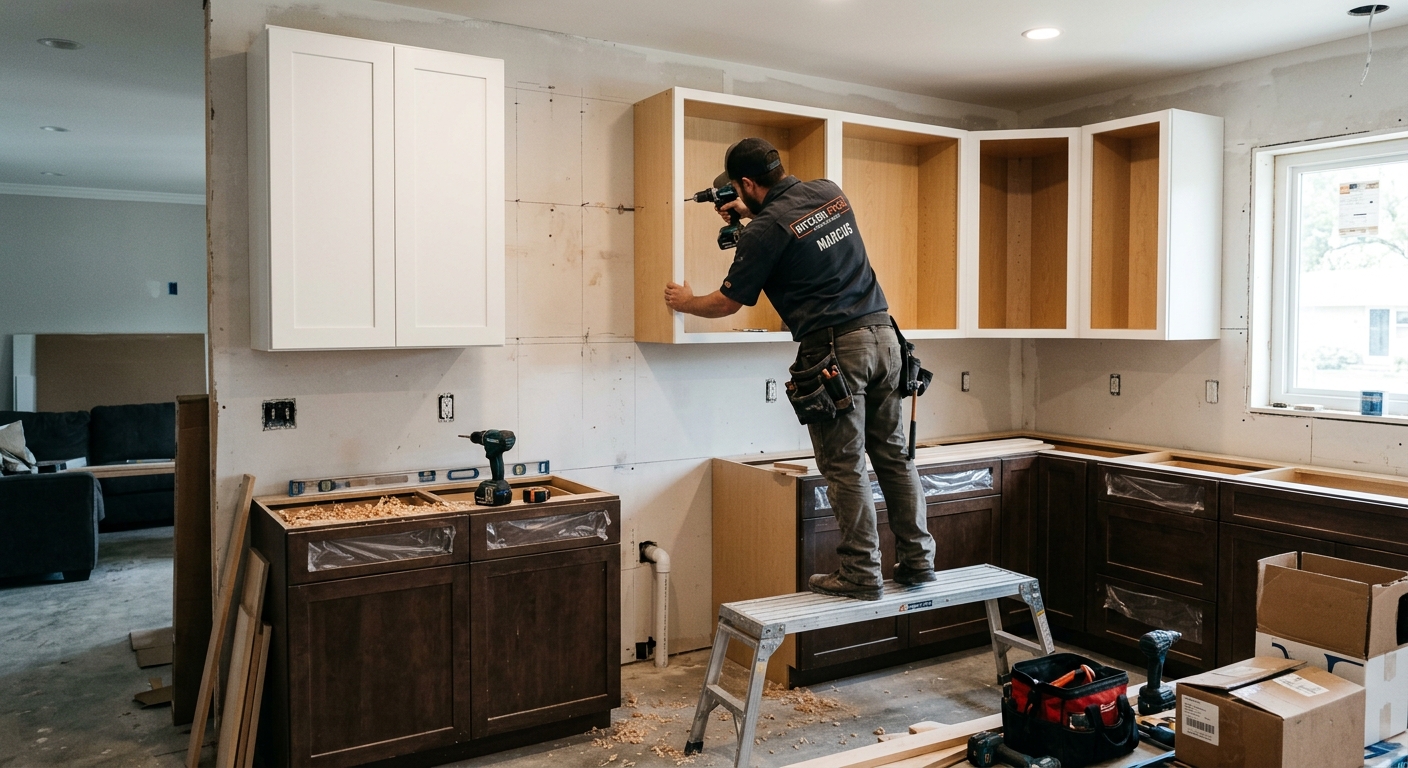
Kitchen renovation costs in Cumberland — 2026
In Cumberland Township and the Gettysburg area, kitchen renovation costs are shaped by the high rate of homeownership (83.1%) and a median household income of $95,890 (U.S. Census Bureau, ACS 2024). These figures suggest homeowners here are investing for the long term rather than flipping or just meeting rental standards. The area’s housing stock—ranging from Civil War-era homes to early 20th-century bungalows—often means renovations are driven both by aging infrastructure and by kitchens with layouts and features that no longer work for a modern family.
The most common way budgets get blown in Adams County is by planning for one project "tier" but specifying materials or work from the next tier up. For example, pricing for stock cabinets but then demanding semi-custom sizes, or fitting in relocation of plumbing mid-stream. In a market with a thinner contractor pool—many firms travel in from the York–Hanover area—lead times and labor costs are less predictable than in larger metro counties.
Below is a breakdown of the main kitchen renovation scopes you’ll see in Cumberland, including realistic timelines and price ranges for 2026. Your exact budget will swing most based on the cabinet selection and whether you stick with the original layout, not just square footage.
| Scope |
What's included |
Duration |
Price range |
| Full gut remodel, same layout |
cabinets, counters, appliances, flooring, lighting, fixtures |
6–10 weeks |
$31,500–$126,500 |
| Gut plus layout change |
all of the above plus moved plumbing, electrical, walls |
10–16 weeks |
$68,500–$126,500 |
| Cabinet replacement (stock to semi-custom) |
remove and install cabinets, hardware, patching |
1–3 weeks |
$7,400–$31,500 |
| Cabinet refacing |
new doors and drawer fronts, veneer, hardware |
3–6 days |
$7,400–$21,000 |
| Countertop replacement only |
template, fabricate, install, reconnect sink |
1–3 weeks |
$4,200–$17,000 |
| Kitchen flooring only |
remove existing, install new flooring |
3–6 days |
$5,300–$21,000 |
Estimates for a typical Cumberland kitchen. Cabinet grade and whether the layout changes move these figures more than square footage.
Why appliance selection comes first
Many Cumberland kitchen projects go off the rails when appliances are chosen after the cabinets have been ordered or even installed. Every major appliance—particularly the refrigerator, range, and dishwasher—has unique dimensions that dictate the layout and size of adjacent cabinets. Selecting appliances early ensures you don’t end up with a fridge that sticks out past the counters or a range hood that can't be properly ducted.
Counter-depth refrigerators create a seamless look but reduce your interior capacity versus standard-depth models, which means you’ll need to plan surrounding cabinetry accordingly. Slide-in ranges require precision with countertop cutouts, while freestanding ranges offer more forgiveness but may not blend as well visually. A choice between gas and induction has consequences: induction often requires upgraded electrical circuits, common in older Cumberland homes. Gas appliances will only work if gas service is present or a propane line is installed—something not always true in rural Adams County.
Panel-ready dishwashers and refrigerators can be set behind cabinet panels for a custom look, but require careful planning and significantly add to cabinetry costs. For ventilation, venting your range hood to the outside is strongly recommended—recirculating hoods (which just filter and send air back into the room) are a compromise and can lead to lingering odors and humidity issues.
A final practical point: some professional-grade appliances, while stylish and feature-rich, command a premium mainly for the look rather than any durability upgrade. Their lead times can exceed even custom cabinet orders—plan ahead so your project isn’t delayed over a missing fridge.
The biggest line item in your Cumberland kitchen
Cabinet decisions usually account for the largest share of any kitchen renovation budget in Cumberland. Your main choices are: painting, refacing, stock, semi-custom, or full custom.
Refacing means keeping your existing cabinet boxes and replacing the doors, drawer fronts, and covering boxes with new veneer. It’s cost-effective and can produce excellent results, but only if the original boxes are solid, square, and the existing layout works for you. It cannot increase storage or change the configuration.
Stock cabinets—common in big-box stores—come in fixed sizes and finishes. In older homes around Gettysburg, where walls are rarely straight and dimensions are non-standard, stock cabinets often need filler strips (which can waste space). Semi-custom gives some size flexibility and more finish choices. Full custom is only justified if you have an unusual layout, want high-end design, or run into structure that no off-the-shelf or semi-custom cabinet can fit—and costs accordingly, with the longest lead time.
No matter what you pick, pay attention to construction quality, which applies across tiers. Plywood cabinet boxes last far longer than particleboard. Dovetail joints on drawers, full-extension and soft-close hardware, and "frameless" construction (more storage, more critical install) are worth the premium.
Because so much of Cumberland’s housing predates standard dimensions and modern construction, even well-informed owners find themselves bumping up from stock to semi-custom to handle out-of-plumb walls and mismatched corners—not because they want to, but because off-the-shelf simply will not fit.
| Option |
Cost |
Best when |
Limitation |
| Painting existing cabinets |
$1,200–$3,500 |
boxes and doors sound, tight budget |
no layout or style change |
| Refacing |
$7,400–$21,000 |
boxes square and layout works |
storage unchanged |
| Stock cabinets |
$7,400–$31,500 |
standard dimensions fit |
filler strips, limited finishes |
| Semi-custom |
$21,000–$31,500 |
non-standard walls or finishes |
6–12 week lead time |
| Full custom |
$21,000–$31,500 |
unusual layout or high-end design |
longest lead, highest cost |
Permits and inspections for a Cumberland kitchen
In Cumberland Township and Gettysburg, a typical kitchen update like painting cabinets, installing new hardware, or swapping countertops can often proceed without filing for a permit—especially in rural Adams County townships. However, if you need to move plumbing lines, update electrical circuits, remove walls, or install a new range hood that vents outside, a building permit is usually required (Gettysburg Borough triggers permits for layout changes involving these systems, and plan review is common when changing structural walls or major utilities).
Electrical inspections in Gettysburg are often handled by a third-party agency like Commonwealth Code Inspection Service, not directly by the township. This can surprise homeowners used to seeing a municipal inspector for other trades.
Any contract over $500 must be handled with a written contract by a contractor registered as a Pennsylvania Home Improvement Contractor, which you can and should verify with the Attorney General's registry at hic.attorneygeneral.gov. Employers (even small, local contractors) must carry workers' compensation—check compliance through WCAIS (wcais.pa.gov).
Skirting the permitting process can be tempting, but keep in mind that unpermitted work will come back to haunt you at resale—especially with Gettysburg’s older homes and active code enforcement. Lenders and buyers regularly flag non-permitted kitchen remodels, which can delay or derail a sale.
Who should run your Cumberland renovation
Your choice of project manager will determine how much stress and risk you face. In the Adams County market—where contractor availability is thin and labor for finish trades is tighter than in York—a design-build kitchen firm handles almost everything: design, ordering, trades coordination, and installation, all under one contract. You pay the most, but have one point of contact and accountability.
Hiring a general contractor puts you in the middle. You or a kitchen designer finalize the plans and finishes, and the GC brings in the trades. This approach typically lands in the mid-cost tier: you shoulder some decision-making and product selection, but don’t need to schedule or manage the various trades. It also makes sense in Cumberland where specialized trades (tile, cabinets, electricians familiar with old wiring) may not always be available right away.
Owner-managed renovations—where you act as your own general contractor—will nearly always save money, but demand the most work and put every scheduling hiccup or miscommunication on your shoulders. In Cumberland, with longer lead times and fewer backup options if a trade cancels, owner management is only wise if you have project management experience, plenty of time, and a scope that doesn’t require permits or structural changes. Anyone with a day job or a permit-requiring project should avoid this route.
Quartz, granite, laminate or butcher block
Choosing a countertop in Cumberland isn’t about resale so much as daily function. Quartz is engineered stone, nonporous, and resists stains but can be damaged by heat—don’t set a pot down straight off the stove. Granite is natural, different in every slab, and resists heat, but must be sealed every year or two to avoid staining.
Laminate, often dismissed, is a smart pick in lower-budget homes and rentals where impact resistance and repairability matter more than prestige. Modern laminates are much better looking and more durable than the orange-peel counters of decades ago. If it gets damaged, it’s a lot cheaper to replace or patch.
Butcher block brings warmth you can’t get from stone, but needs careful care—water left standing will stain, and it will show knife marks and dents. It can, however, be sanded and refinished as often as you like. Solid surface brands like Corian are also repairable: scratches can be sanded out, and seams can be nearly invisible if the fabricator is skilled.
Countertop price in Cumberland is affected more by fabrication complexity than size. Edge profiles, number of cutouts (for sinks and cooktops), and where seams are placed all add up. Most stone fabricators now insist on a template visit (after cabinets are installed and leveled) rather than just measurements, to prevent expensive mistakes.
If your Adams County house is not forever, laminate in a modest kitchen is a proper choice and not a corner cut.
Surprises in an older Cumberland home
With close to half the homes in Cumberland Township built before 1980 (47.7%), mid-project surprises are the rule rather than the exception. The most frequent find is out-of-plumb walls and out-of-level floors, which can turn a cabinet install into a shimming marathon. If that’s the case, expect extra labor—sometimes adding $1,200–$2,800—to get everything level and functional.
Older homes in Gettysburg often hide undersized or ungrounded wiring behind plaster, and upgrading kitchen circuits (for code and new appliances) can run $2,800–$7,500. Galvanized steel supply lines and cast iron drains are common; replacing them usually adds both time and a bill of $3,500–$8,000. Where exterior walls lack insulation, the upgrade can add $800–$2,000 on a gut job.
Pre-1978 homes fall under the federal EPA Lead RRP Rule; any disturbance of painted surfaces means a certified renovator must test and, if lead is found, follow containment and cleaning procedures. Asbestos-containing flooring is also sometimes present—testing is required before disturbance.
Other common headaches: old DIY or handyman repairs without permits, which may mean opening more walls or correcting out-of-code plumbing and wiring. While every home presents its own puzzle, the odds of "hidden" costs go up with age—and with Cumberland’s surplus of 19th and early 20th-century housing, every gut renovation should include a budget contingency.
Frequently asked questions — kitchen renovation in Cumberland
What does a full gut kitchen remodel cost in Cumberland?
A full gut remodel in Cumberland typically runs from $31,500–$126,500, with the average homeowner project landing near $68,500. This range covers everything down to studs and back—cabinets, counters, floors, fixtures, appliances, and lighting. The high end tends to be for major changes, high-end finishes, or older Gettysburg homes where unforeseen issues crop up. Many Cumberland homeowners budget in the middle, but keep a contingency fund since nearly half the area’s housing was built before 1980 and extensive repairs to walls, plumbing, or wiring are common once demolition starts. In rural Adams County, with a tight contractor market, labor can also nudge things above neighboring counties’ pricing.
Are Cumberland kitchens typically small galley layouts?
Cumberland and Gettysburg homes draw heavily from Civil War and early 1900s housing stock, which often means tight, chopped-up kitchens. In these cases, you’ll commonly find small galley layouts or wall-heavy rooms not suited for today’s open kitchen preferences. While more recent construction in the area allows for larger footprints, nearly half (47.7%) of local homes predate 1980, making narrow kitchens the norm rather than the exception. If you’re looking to open up a galley or connect kitchen and living spaces, plan for extra costs—layout changes and moving plumbing or electrical bump up a gut remodel to $68,500–$126,500 territory.
What is the cheapest way to update a Cumberland kitchen?
The most affordable way to update your kitchen is to repaint the existing cabinets and swap out the hardware. For a typical kitchen in Cumberland, hiring out painting and new handles or knobs often falls between $1,200–$3,500. This strategy makes sense when the boxes are in good shape and there are no layout complaints. Refacing—replacing doors and adding veneer—costs more but still avoids a full tear-out. Since building permits are rarely required for cosmetic work in rural Adams County, these simple changes don’t trigger inspection or major project overhead. If budget is tight, avoid moving walls, plumbing, or electrical; those are the cost drivers.
What does a quartz countertop cost in Cumberland?
Quartz countertop replacement alone in Cumberland runs from $4,200–$17,000, with most projects around $9,500 for a straightforward kitchen. The price depends on total square footage, complexity of seams and cutouts, edge profiles, and your chosen brand. Quartz is engineered, low-maintenance, and great for busy households—the main caveat is it can be damaged by direct heat. While the material is nonporous and resists stains, repair isn’t as easy as with solid surface options. Because fabrication is handled in the region, you’ll see lead times similar to granite but longer than laminate. Always insist on professional installation in Cumberland’s older homes with out-of-square walls.
Can I live in the house during a kitchen renovation?
You can live in your house during a kitchen renovation in Cumberland, though it’s not always comfortable. Gut remodels (in the $31,500–$126,500 range) mean weeks of dust, noise, and no working kitchen. Most families set up a temporary kitchenette somewhere else in the house—microwave, fridge, and coffeemaker on a folding table helps, and if you have a utility sink or nearby bathroom, cleanup is easier. In hot housing stock with lead paint risk, contractors must contain dust, but you will still be living around noise and disruption for 6–12 weeks. If you have pets, young children, or work from home, consider staying elsewhere during the demolition phase.
Why is there a gap after cabinets are installed?
In Cumberland’s older homes (especially those with uneven walls and floors), it’s common to end up with small gaps between new cabinets and original walls or ceilings. This isn’t a sign of poor work—it’s the best option when walls can be out of plumb by over an inch. Filler strips and trim are used to close these gaps for a finished look, and semi-custom cabinets can minimize but not always eliminate them. Adding a wall furring step or reframing can bring walls true, but adds cost. It’s always wise to budget for a little extra carpentry (sometimes $1,200–$2,800) to handle the quirks of local construction.
Should I choose plywood or particleboard cabinet boxes?
For most Cumberland kitchens, plywood boxes are worth the upcharge—especially in older homes where floor and wall movement, humidity, and long-term stability all matter. Plywood holds screws better, is less likely to sag, and resists water damage much more reliably than particleboard. Particleboard is cheaper and perfectly adequate for short-term or low-use kitchens, but in a township where homeownership is high and remodels are a long-term investment, you don’t want to save a few dollars only to see sagging shelves or screw blowouts within five years. In the big picture of a kitchen budget ($7,400–$31,500 just for cabinets), stepping up to plywood is one upgrade you can feel in daily use.
Can I over-improve for my Cumberland neighbourhood?
It’s definitely possible to over-improve your kitchen in Cumberland. Neighborhood home values still shape resale, and sinking $126,500 into a top-tier kitchen in a street of modest homes rarely pays back. The region’s median household income and high rate of homeownership encourage quality upgrades, but you should keep renovation budgets proportionate. In older Gettysburg or Cumberland homes, bringing a kitchen up to current standards (with quality cabinets and layout improvements) pays off, but going full custom with the best appliances and exotic stone is typically only justified in historic homes that will be showpieces. Base your decision on the surrounding houses, not a national kitchen design magazine.
Do I need a permit for a kitchen renovation in Cumberland?
In Cumberland Township and rural Adams County, a building permit is not typically required for cosmetic updates like painting cabinets, refacing, or replacing countertops. However, if your kitchen project involves moving walls, rerouting plumbing or electrical, or adding new circuits, Gettysburg Borough and surrounding jurisdictions do require a permit. Inspections, especially for electrical work, are often handled by a third-party agency instead of the township itself, which can be a surprise. It’s important to ensure your contractor is registered as a Pennsylvania Home Improvement Contractor for any contract over $500 and that workers’ compensation is in place. Unpermitted work can cause headaches at resale, especially for older homes with more visible changes.