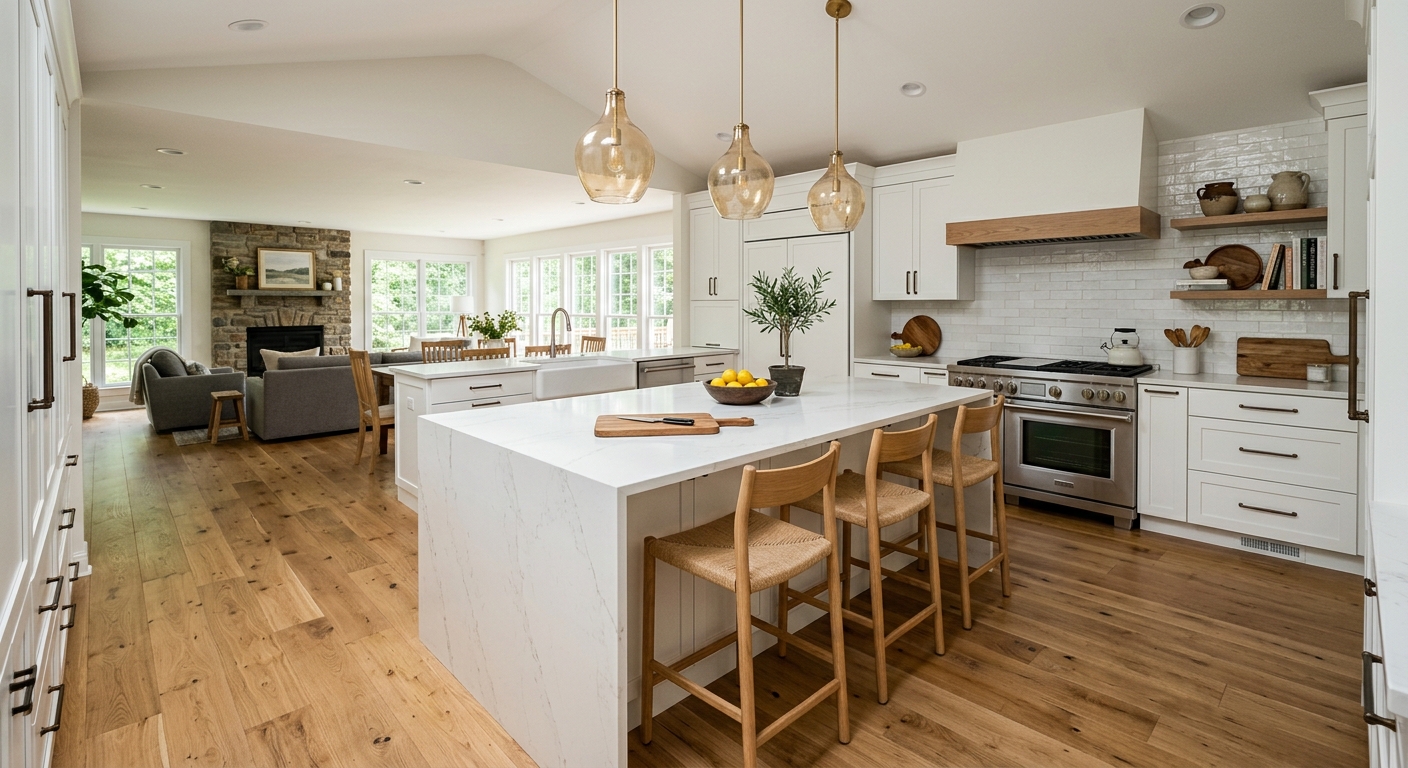
Kitchen renovation costs in Wayne — 2026
In Wayne, homeowners are planning kitchen renovations with an eye on both investment and daily living. With a median household income of $71,623 and a remarkably high homeownership rate of 90.6% (U.S. Census Bureau, ACS 2024), kitchen projects here are almost always for long-term use, not rentals. Most houses in this area—especially in towns like Pottsville and Shenandoah—are early-1900s coal-era rowhouses. That vintage matters: these kitchens tend to be compact, with outdated plumbing and limited electrical circuits, making upgrades more involved than in newer suburbs.
The most common budget shock happens when homeowners price a modest renovation but then choose materials or layout changes from a far costlier category. For instance, speccing a full wall removal or shifting the sink moves the job from "replace in place" to "major remodel" territory—often doubling costs and timelines.
| Scope |
What's included |
Duration |
Price range |
| Full gut remodel, same layout |
cabinets, counters, appliances, flooring, lighting, fixtures |
6–10 weeks |
$29,500–$118,500 |
| Gut plus layout change |
all of the above plus moved plumbing, electrical, walls |
10–16 weeks |
$64,000–$118,500 |
| Cabinet replacement (stock to semi-custom) |
remove and install cabinets, hardware, patching |
1–3 weeks |
$6,900–$29,500 |
| Cabinet refacing |
new doors and drawer fronts, veneer, hardware |
3–6 days |
$6,900–$19,500 |
| Countertop replacement only |
template, fabricate, install, reconnect sink |
1–3 weeks |
$3,900–$16,000 |
| Kitchen flooring only |
remove existing, install new flooring |
3–6 days |
$4,900–$19,500 |
Estimates for a typical Wayne kitchen. Cabinet grade and whether the layout changes move these figures more than square footage.
What requires a permit in a kitchen renovation
In Wayne and the rest of Schuylkill County, the need for a permit during your kitchen renovation depends entirely on the scope. Cosmetic changes—like painting, refacing cabinets, swapping hardware, or replacing a countertop without touching plumbing or wiring—do not typically require any permit. Where you cross the line is with jobs that involve new or relocated electrical circuits, any change to plumbing supply or drains, opening a wall (especially if it might be structural), or installing new mechanical ventilation for a range hood. In Pottsville and surrounding municipalities, these changes usually trigger the need for a building permit, and if walls are moved or utilities are rerouted, expect a formal plan review process.
Inspection is another wrinkle. Electrical inspections in Pottsville and Schuylkill Haven, for example, are often performed by independent, certified electrical agencies—not the city itself. This catches many homeowners by surprise when scheduling final sign-offs.
Legally, your contractor must be registered with the Pennsylvania Office of Attorney General's Home Improvement Contractor (HIC) registry for any contract over $500—always check their status at hic.attorneygeneral.gov. Employers must carry workers' compensation insurance, which you can verify through WCAIS (wcais.pa.gov).
If you skip permits where they are needed, you face negative consequences at resale. Title companies and buyer inspectors regularly scrutinize kitchen work for permits. Unpermitted alterations are a red flag that can delay or even kill a sale.
Where the money actually goes
Most people are surprised to learn that, in Wayne, as elsewhere in Schuylkill County, cabinetry takes up the largest slice of a typical kitchen renovation budget—often eating up a quarter to a third of the total. Labor is the next biggest outlay, especially if you’re changing the kitchen’s footprint or chasing unforeseen problems in a 100-year-old house. Countertops and appliances follow, though both vary widely in cost. Flooring and lighting together rarely account for more than a tenth of the total, but the temptation to overspend on fixtures is strong.
Homeowners often ignore two crucial lines: first, the contingency for what is found behind the walls—something essential in these early-1900s houses, where plumbing or wiring may need complete replacement. Second, soft costs like permits, design, shipping, and the dumpster. These add up quickly but often aren’t in the first-round budget.
If you have an extra thousand dollars, spend it on fundamental upgrades—better cabinet hardware or more robust electrical, not on a prestige refrigerator if the rest of the kitchen is basic. For a typical Wayne full gut renovation in the $29,500–$118,500 range, reallocating even a modest amount can move a project from frustrating to flawless.
| Category |
Share of budget |
Notes |
| Cabinetry |
25–35% |
the largest line and the longest lead time |
| Labour and installation |
20–30% |
rises sharply if the layout changes |
| Countertops |
8–15% |
material choice drives the swing |
| Appliances |
10–20% |
widest range of any category |
| Flooring |
5–10% |
|
| Lighting and electrical |
5–10% |
higher in older homes needing circuits |
| Plumbing and fixtures |
4–8% |
|
| Permits, design, disposal |
3–6% |
usually forgotten in early budgets |
| Contingency |
10–15% |
not optional in a pre-1980 house |
Choosing a countertop for a Wayne kitchen
For daily use in a Wayne kitchen, what matters most when choosing a countertop isn’t just the look—it’s maintenance, durability, and how it feels to live with. Quartz is the most popular for a reason: it’s engineered, non-porous, and resists staining better than granite or marble, but it can’t take direct high heat—set down a red-hot pan, and you might scorch it. Granite brings natural beauty, stands up to heat, and is durable, but it does need to be sealed regularly or it can stain. Laminate, often dismissed, has made big strides in realism and durability. For a modest kitchen in Wayne, it’s a practical choice, easy to clean, and costs about a quarter of what you’ll pay for stone.
Butcher block, beloved for its warmth, demands regular oiling and can scorch. It’s forgiving of knife marks, but stains easily if not cared for. Solid surface counters (like Corian) aren’t as “hot” as quartz, but they can be repaired and seams can be invisible—useful in compact Wayne houses where seams may be right in your prep zone. Seams are always more visible in stone than synthetic counters.
Pricing isn’t just about material. Edge profiles (bullnose, ogee), sink cutouts, and precise seam placement raise costs. A true template (versus rough measurement) means a perfect fit with fewer surprises—vital when walls are rarely square, as is common in oldest Wayne homes.
For a rental or a well-kept low-budget kitchen, laminate is smart, not “settling.” If you want less fuss, quartz or solid surface deliver—just watch for hot pans. Granite is tougher and classic, if you’re willing to reseal.
Layout changes and the cost cliff
There’s a hard financial cliff in kitchen renovations in Wayne: as long as you keep plumbing and electrical in place, your project stays in the lower tier of both cost and hassle. But the moment you decide to move the sink across the room, rotate the island, or open a wall, the cost jumps—sometimes by tens of thousands. The reason isn’t the distance, it’s the work behind the walls. Relocating a drain isn’t just about connecting it to a new spot; drain lines require slope, which can be a nightmare if your kitchen is over a finished basement or slab. Opening walls means determining whether they’re load-bearing—a not-infrequent surprise in the compact early-1900s rowhouses here—and may require a structural engineer’s input plus a building permit.
New appliance locations mean new circuits, and Wayne’s older houses often have maxed-out panels already. Bringing a range hood to an outside wall for ducted venting can mean exterior penetrations—and more inspections. In Pottsville and surrounding towns, building permits and formal plan review are triggered once you move structural elements or major utilities. This adds both time and money—pushing a typical $29,500–$118,500 remodel up toward the higher end.
Before committing that kind of budget, be honest: is your current layout truly unworkable, or just out of fashion? Changing layouts eats up contingency funds and can mean months more work. In these homes, spending heavily just to shift a sink by a few feet rarely pays back in real improvement.
Why appliance selection comes first
In Wayne, many kitchen projects get derailed when the appliance choices get left to the end. Cabinets are literally measured and built around the dimensions of your fridge, range, and dishwasher—so if you pick appliances after ordering cabinets, something will not fit, and you’re into costly remakes and delays.
Standard and counter-depth refrigerators don’t just differ in price: counter-depth looks sleeker but holds less and needs cabinetry built flush to match. Slide-in ranges need finished countertops on each side, while freestanding ranges do not—affecting both measurement and install sequence. Choosing between gas, electric, and induction impacts wiring or even local code upgrades. Panel-ready dishwashers suit a seamless look, but demand exact cabinet sizing. Range hood venting decisions matter here for code and comfort: ducted to the outside is always preferred for performance, but retrofitting is often tough in rowhouses. Recirculating hoods are easier, but never deal fully with smoke and odor.
Today in Wayne, appliance lead times can meet or even beat cabinets—on high-demand or professional-style models, a 10–14 week wait is not rare. “Pro” appliances deliver build quality and longevity, but most of their cost is in aesthetics, not real-world function—don’t break the budget if you’re not a passionate cook.
Cabinets: reface, stock, semi-custom or custom
In Wayne, your cabinet choice sets the scale—and the bottom line—on the entire kitchen. Refacing is the quickest, least disruptive, and often a great decision, particularly if the boxes are real plywood and laid out sensibly. Refacing can’t add storage or change layout, but it freshens a kitchen for less than half the cost of new cabinets. Paint can update well-built boxes with even less investment.
Stock cabinets are the least expensive but come in fixed sizes. That means they work best if your kitchen’s wall dimensions cooperate, which is rarely the case in Pottsville and Shenandoah’s early-1900s homes. Semi-custom upgrades finishes and allows modest size adjustments—fitting unplumb walls or odd corners. Full custom is really the only way to get an exact fit, but prices (and waits) are steep. In older Wayne homes, even owners who planned on stock routinely discover, once demo starts, that only semi-custom or custom will truly work.
Whatever the price tier, check for plywood over particleboard, dovetail drawers, and soft-close, full-extension hardware. Frameless cabinets offer more interior space but need careful install. In compact or non-standard layouts, semi-custom is usually a forced choice, not a luxury upgrade.
| Option |
Cost |
Best when |
Limitation |
| Painting existing cabinets |
$1,200–$3,500 |
boxes and doors sound, tight budget |
no layout or style change |
| Refacing |
$6,900–$19,500 |
boxes square and layout works |
storage unchanged |
| Stock cabinets |
$6,900–$29,500 |
standard dimensions fit |
filler strips, limited finishes |
| Semi-custom |
$19,500–$29,500 |
non-standard walls or finishes |
6–12 week lead time |
| Full custom |
$19,500–$29,500 |
unusual layout or high-end design |
longest lead, highest cost |
Frequently asked questions — kitchen renovation in Wayne
What does a full gut kitchen remodel cost in Wayne?
For a full gut remodel in Wayne—stripping your kitchen to the studs, upgrading wiring, plumbing, cabinets, counters, appliances, and flooring—you’ll be looking at a price range of $29,500–$118,500. Most projects land in the $64,000 typical band. This wide range reflects not just the finishes you choose, but how much work is needed to update the older utility lines found in Wayne’s pre-WWII housing. Compact layouts sometimes control budgets, but unseen conditions in these early-1900s homes can add weeks and spike costs. Plan your budget around the house you actually have—not just the kitchen you want.
How much more does moving the sink and range cost?
Moving a sink or range in Wayne jumps your project from “replace in place” into full layout change territory. That leap often adds at least $15,000–$35,000 to the total, since you’re triggering new plumbing or electrical runs and usually wall repairs, with inspections and permits now required. This extra spend is rarely proportional to just the distance moved—a six-foot shift may cost as much as moving it clear across the room. Unless your current layout is truly a daily frustration, consider keeping plumbing and range in their original locations to keep costs closer to the lower end of the $29,500–$118,500 full remodel band.
What are cabinet lead times in Wayne right now?
Lead times for cabinets in Wayne—and generally in Schuylkill County—are longer than national averages. For stock cabinets, expect delivery in 2–4 weeks, but for semi-custom or full custom cabinetry, timelines stretch out to 6–12 weeks or more, especially given the smaller, slower-moving contractor market in Wayne. Rural supply chains and a tight finish-trade labor pool mean schedules can slip, so build extra weeks into your planning if you’re in the $6,900–$29,500 cabinet replacement range. Order early, and don’t finalize demolition until you have real shipping dates in hand.
How does Wayne's housing stock affect cabinet fit?
Most homes in Wayne—especially in Pottsville and Shenandoah—are early-1900s coal-era rowhouses known for tight, irregular layouts and walls that are far from square. If you’re planning a cabinet replacement in the $6,900–$29,500 range, expect that standard stock sizes may not line up cleanly, leading to more reliance on semi-custom or custom cabinets for a professional fit. It’s common to discover irregular corners or pipes running through odd spots once the old cabinets are out. This means “off the shelf” isn’t usually an option, and every extra adjustment adds both time and cost.
What flooring works best in a kitchen?
In Wayne’s kitchens, durability and water-resistance take priority over style. Luxury vinyl plank is increasingly common for its resilience and easy maintenance, and it holds up to the splashes and heavy use found in older homes. Tile is classic, but installation on uneven subfloors can require costly leveling. Hardwood is attractive, but it’s less forgiving of leaks or humidity swings found in Wayne’s early-1900s houses. Replacement costs for kitchen flooring here typically land in the $4,900–$19,500 range. For quick refreshes on a budget, sheet vinyl or mid-grade plank is hard to beat.
Does replacing cabinets require a permit?
In Wayne and across Pottsville and Tamaqua, simply replacing kitchen cabinets without altering your floor plan or changing wiring and plumbing does not require a permit. However, once you open walls, add circuits, or move pipes, you’ll trigger the permit requirement—especially in Pottsville, where new electrical or plumbing often requires formal review and inspection by a certified electrical agency. For jobs over $6,900, always ask your contractor to verify whether your scope stays under the “no permit needed” line, as resale evidence is increasingly checked at closing.
Do I need to change my kitchen layout?
Unless your current kitchen in Wayne is making daily life miserable due to poor flow or true safety hazards, changing the layout isn’t a requirement—nor is it always the best use of funds. Keeping the sink, stove, and appliances in place saves tens of thousands, often keeping you in the $29,500–$64,000 remodel band, while layout changes quickly climb towards the $118,500 maximum. Given the compact, odd-shaped rooms in Wayne’s older rowhouses, think carefully before committing to a full rework. Sometimes new cabinets and lighting go a lot further than a costly wall move.
Should I hire a general contractor or a kitchen firm?
For a Wayne kitchen, both choices can work—but the project size and complexity matter. If you’re in the $29,500–$118,500 gut remodel range with structural or layout changes, a general contractor who manages trades and inspections across Schuylkill County makes sense. For cabinet replacement or simple refacing under $19,500, a specialized kitchen firm may deliver a faster schedule and fewer layers of management. The key is local experience: contractors traveling in from bigger metros may not be familiar with Wayne’s tighter codes or older construction, risking costly mistakes.
Does a kitchen renovation increase home value in Wayne?
Renovating your kitchen in Wayne is likely to increase both your enjoyment and your resale appeal, especially with more than half the county’s homes built before 1980. How much value you add depends on sticking to budgets—buyers in Wayne won’t pay top dollar for overbuilt kitchens, but a clean, efficient renovation in the $29,500–$64,000 range typically sees strong interest. The biggest resale killers are unpermitted work or highly specific personal choices. Always pull permits where required and choose finishes with mainstream appeal for the best return.