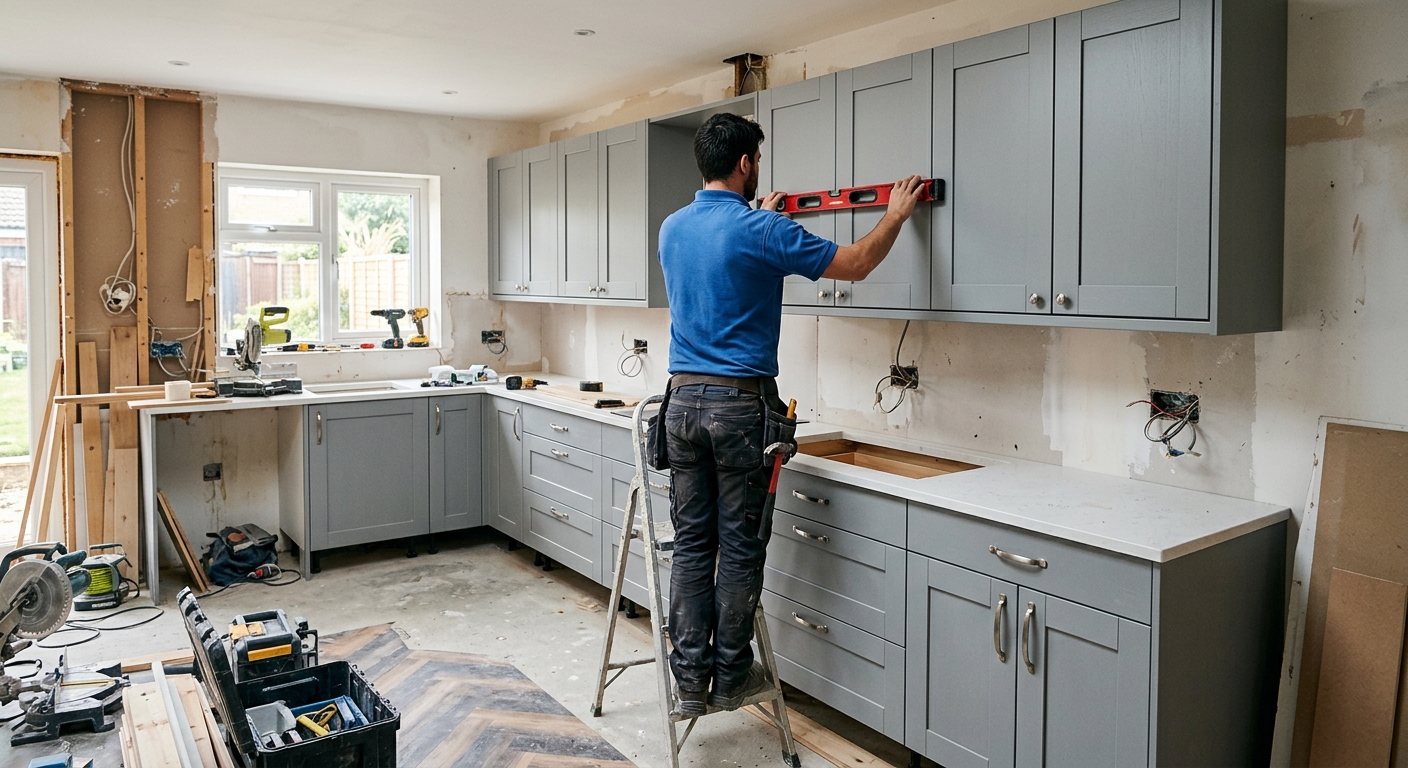
Bedminster kitchen renovation prices by scope — 2026
Bedminster stands out for its high rate of owner-occupied single-family homes, with a homeownership rate of 92.6% and a median household income of $137,500 (U.S. Census Bureau, ACS 2024). That translates to residents who plan their kitchens for their long-term needs and often look for design upgrades, not just resale value. Most kitchen remodels happen in homes built after 1960, especially in Lower Bucks, where smaller galley kitchens are converted to more open layouts. Here, many kitchen projects involve not just a surface refresh but updating a cramped or dated design—exactly where budgets creep up.
The biggest hit to budgets comes when homeowners price a simple cabinet swap and end up moving walls or appliances. Think through scope carefully: a cosmetic overhaul is one price class, but layout changes put you into another. Below is what a typical project costs in Bedminster as of 2026.
| Scope |
What's included |
Duration |
Price range |
| Full gut remodel, same layout |
cabinets, counters, appliances, flooring, lighting, fixtures |
6–10 weeks |
$35,500–$142,500 |
| Gut plus layout change |
all of the above plus moved plumbing, electrical, walls |
10–16 weeks |
$77,000–$142,500 |
| Cabinet replacement (stock to semi-custom) |
remove and install cabinets, hardware, patching |
1–3 weeks |
$8,300–$35,500 |
| Cabinet refacing |
new doors and drawer fronts, veneer, hardware |
3–6 days |
$8,300–$23,500 |
| Countertop replacement only |
template, fabricate, install, reconnect sink |
1–3 weeks |
$4,700–$19,000 |
| Kitchen flooring only |
remove existing, install new flooring |
3–6 days |
$5,900–$23,500 |
Estimates for a typical Bedminster kitchen. Cabinet grade and whether the layout changes move these figures more than square footage.
Permits and inspections for a Bedminster kitchen
In Bedminster, and Bucks County in general, most kitchen renovation work that doesn’t involve changing the structure, plumbing, or electrical—like painting, cabinet refacing, or new countertops in the same footprint—won’t require a permit. Where homeowners run into issues is when new electrical branch circuits, moved plumbing, or any wall modification is involved: at that point, a permit is triggered. For projects changing structural walls or relocating plumbing fixtures, plan review will also be required before you can start work.
Electrical inspections are most often handled by third-party agencies, such as Tri-County Inspection Company, rather than the local township. This is unique to the area and often catches people off guard, especially if they’re used to dealing directly with a municipal inspector. Scheduling can be slower, given the higher demand for finish-trade labor in Bucks County.
By Pennsylvania law, any home improvement contract over $500 requires a contractor registered with the Home Improvement Contractor registry (verify at hic.attorneygeneral.gov). Workers’ compensation is mandatory for all employers, and coverage can be checked through WCAIS (wcais.pa.gov). If your contractor can’t show both, look elsewhere.
Unpermitted work is the number-one hang-up at resale in this region. Title companies—and buyers—will flag kitchens missing required permits, so skipping this step is never worth the risk.
Cabinets: reface, stock, semi-custom or custom
Cabinets shape not just your kitchen’s look but its price tag. Most Bedminster remodels fall into one of four approaches: refacing, stock, semi-custom, or full custom. Refacing can give you a new appearance for less, but only makes sense if the cabinet boxes are solid, square, and the layout works for your needs. It can’t make an inefficient galley kitchen more workable or expand storage.
Stock cabinets are premade in fixed sizes—fine if your kitchen matches catalog dimensions. But many local homes, especially in post-1960 suburban tracts, have walls that aren’t quite standard or walls that have shifted over time, making semi-custom a common choice even when budgets start in the “stock” range. Semi-custom allows for made-to-fit sizing and finishes, with a wider range of options. Custom cabinets mean any material, size, or configuration, but add time and cost.
Quality matters more than label: look for plywood box construction over particleboard, dovetail-joined drawers instead of stapled, and full-extension, soft-close hardware. Frameless cabinets (Euro-style) maximize access, while traditional face-frame cabinets suit classic designs but eat up a fraction more space.
| Option |
Cost |
Best when |
Limitation |
| Painting existing cabinets |
$1,200–$3,500 |
boxes and doors sound, tight budget |
no layout or style change |
| Refacing |
$8,300–$23,500 |
boxes square and layout works |
storage unchanged |
| Stock cabinets |
$8,300–$35,500 |
standard dimensions fit |
filler strips, limited finishes |
| Semi-custom |
$23,500–$35,500 |
non-standard walls or finishes |
6–12 week lead time |
| Full custom |
$23,500–$35,500 |
unusual layout or high-end design |
longest lead, highest cost |
General contractor, kitchen firm, or manage it yourself?
Every remodel comes down to three choices: hire a design-build kitchen firm, use a general contractor, or manage each part yourself. A kitchen firm bundles design, cabinetry, construction, schedules, and warranties under one agreement. This is the most hands-off model and the costliest, but it gives you a single party responsible for the result. A general contractor coordinates all trades—carpenters, electricians, plumbers—and relies on you or a separate designer to supply a layout and finish specs. This model fits most Bedminster projects, balancing cost and homeowner effort.
Managing a kitchen remodel yourself—finding, hiring, and scheduling every trade—can save money, but it is a massive undertaking, especially with Bucks County’s tight finish-trade labor market. Availability is limited, so chasing down trades for exact dates and coordination is more stressful than most owners expect. If your project needs permits or involves moving walls, plumbing, or electrical, and you work a full-time job, self-managing is rarely worth it.
Homeowners with simpler projects and flexible timelines may pull it off. But for major renovations, the stress, delays, and risk if trades walk off or overlap—never mind inspections—typically cost more in the long run than any savings.
Quartz, granite, laminate or butcher block
The right countertop comes down to use, not just looks. Quartz is an engineered material, non-porous and easy to clean, but can be scorched by hot pans—never rest a fresh baking sheet on its surface. Granite brings natural color variation and will tolerate heat, but needs annual sealing to keep stains at bay. Laminate is returning for good reason: it resists stains, stands up to moderate heat, and, for many Bedminster homes, fits a rental or starter kitchen perfectly well at a far lower cost.
Butcher block feels warm, looks great when oiled, and can be sanded if you stain or scratch it, but it needs regular maintenance and is prone to water damage by sinks. Solid surface—like Corian—can be seamlessly repaired, and many owners appreciate the look and flexibility.
On the fabrication side, edge profile and number of cutouts for sinks or cooktops change the price. Templating—when a fabricator visits and makes a physical template rather than just measuring—is typical for stone and solid surfaces to ensure accuracy and fit, especially with older out-of-square walls common in Bedminster.
Don’t let anyone sell you an expensive stone top if you only need laminate—there’s no shame in making practical, durable choices that suit your house and budget. Save your dollars for what matters in your kitchen, not for a brag-worthy slab if it stretches you elsewhere.
Allocating a kitchen budget
Most Bedminster kitchen budgets go out of balance because homeowners fixate on appliances or countertops, overlooking where the real money goes. On a typical full remodel—using the $35,500–$142,500 range—cabinetry is the largest single expense, often the first 25–35% of your spend, and also sets your project’s schedule. Labor, especially if you’re moving walls or updating old wiring, can be nearly as much.
Countertops, appliances, and flooring each take a bite, but lighting, plumbing, and fixtures also add up fast in older homes with outdated systems. The two lines that most homeowners forget: a contingency for whatever is found inside the walls (water damage, old electrical runs, or code violations) and soft costs for permits, design, delivery, and demolition waste.
If you’re trying to keep a handle on overall cost, an extra thousand dollars spent on cabinet upgrades or drawer organizers will return more in daily function than stretching for high-end appliances in a kitchen where everything else is basic. Spend on what you touch and use every day—hardware, organizers, lighting—before splurging on brand names.
| Category |
Share of budget |
Notes |
| Cabinetry |
25–35% |
the largest line and the longest lead time |
| Labour and installation |
20–30% |
rises sharply if the layout changes |
| Countertops |
8–15% |
material choice drives the swing |
| Appliances |
10–20% |
widest range of any category |
| Flooring |
5–10% |
|
| Lighting and electrical |
5–10% |
higher in older homes needing circuits |
| Plumbing and fixtures |
4–8% |
|
| Permits, design, disposal |
3–6% |
usually forgotten in early budgets |
| Contingency |
10–15% |
not optional in a pre-1980 house |
Layout changes and the cost cliff
The biggest price cliff in a Bedminster kitchen renovation comes when you cross from “replace in place” to “move things around.” Moving the sink, range, or fridge means shifting plumbing supply and drain lines. In houses with slabs or finished basements, getting the fall (downward slope) right for drains often means opening floors or ceilings—never a small cost. Relocating electrical work means adding new circuits, and whether your electric panel can handle new loads is a real question in houses from the 1960s–80s. Removing any wall means determining if it’s structural, which means engineer reports and municipal permits, not just a bigger sledgehammer.
Venting a range hood in a new location requires cutting through an outside wall—simple in theory, but rife with complications in brick or stone exteriors. Every move away from your existing stack or panel adds unanticipated expense, and the jump to a new layout is not proportional to the distance (“just four feet” is rarely under $10,000 extra after trades finish running lines and patching finishes).
The honest talk: before moving the plumbing, squeeze the last bit of function from your current layout. In Bedminster, where many kitchens started as tiny galley spaces, sometimes the move is unavoidable. But for every owner who spends big to move the sink for looks alone, there’s another who saves tens of thousands just working smarter within the existing footprint—and ends up just as happy.
Frequently asked questions — kitchen renovation in Bedminster
How does Bedminster's housing stock affect cabinet fit?
Most homes in Bedminster are owner-occupied single-family houses, and about 36.9% were built before 1980 (U.S. Census Bureau, ACS 2024). Older homes are likely to have kitchens with non-standard wall lengths, out-of-square corners, or previous remodels that didn't follow today's cabinet sizing. This often makes stock cabinets tough to fit without leaving wide filler strips or awkward gaps. That's why semi-custom—or at least careful planning—becomes necessary, even for owners who thought stock would work. If you want a seamless look or maximize storage, you might be pushed toward a higher price band, even if you started budgeting for stock. For reference, semi-custom cabinet projects in Bedminster typically fall between $23,500–$35,500.
Do I need to change my kitchen layout?
Changing the layout isn’t always necessary. In Bedminster’s many post-1960 homes, plenty of kitchens are classic galley styles—compact but functional. If the workflow and appliance locations suit your needs, you might get the transformation you want with new finishes, better lighting, or smart storage instead of moving plumbing or walls. Once you touch layout, you enter another cost class, with full gut-and-layout-change projects usually well above $77,000. Most owners are better off pushing the existing layout to work harder unless there’s no way around it—like needing a second oven, an island, or improved accessibility.
Should I hire a general contractor or a kitchen firm?
For Bedminster, the choice depends on your scope and tolerance for headache. A kitchen firm specializes in handling the full process—from design and cabinets through construction. This costs more, but also insulates you from trade delays and the finish-trade labor shortages common in Bucks County. General contractors manage the trades but lean on you for design and selections. This can save money, but is best for involved and organized homeowners. If your project is complex or needs to move fast, a kitchen firm’s single point of contact is worth the premium. For reference, a full kitchen gut remodel handled by pros typically comes in at $35,500–$142,500.
What does a quartz countertop cost in Bedminster?
Quartz countertops in Bedminster usually range between $4,700–$19,000, with most kitchens coming in at the lower half of that for moderate sizes and standard edges. That includes measurement, templating, fabrication, and professional installation. The final price depends on slab manufacturer, color (more unique = higher cost), number of cutouts (sink, cooktop, soap dispenser), and the type of edging you want. If you’re swapping an old laminate top for quartz, factor in the plumbing reconnect as well. Quartz is a popular upgrade for a reason, but before jumping in, consider if you cook in a way that takes advantage of its specific benefits—otherwise, a quality laminate is still a good call.
Can I over-improve for my Bedminster neighbourhood?
Yes—it happens more than many people think. With a median household income of $137,500 (U.S. Census Bureau, ACS 2024), Bedminster is a relatively affluent area but still part of the Bucks County market. If yours is one of the mid-range single-family homes, dropping the very top budget for a kitchen—think $142,500—can outpace what buyers expect compared to your neighbors, especially for finishes or appliances. Improvements beyond what fits the rest of the house or street are less likely to return their full value when it’s time to sell. Aim to bring your kitchen up to the local norm, not above the neighborhood ceiling.
Should I choose plywood or particleboard cabinet boxes?
Plywood boxes are stronger, lighter for installers, and hold up to moisture better than particleboard. In Bedminster, where some older kitchens have unpredictable plumbing or the risk of slow leaks, plywood is the safer (and more expensive) choice. Particleboard is fine for stock cabinets in a lower-budget or rental kitchen—especially if humidity is well controlled—but take care with spill-prone areas. If you’re spending in the typical cabinet replacement band of $8,300–$35,500, the upcharge to plywood is usually worth it for longevity and resale.
How far ahead should I book a contractor in Bedminster?
With Bucks County’s tight labor market for finish trades, you should plan to book your contractor at least 3-6 months before you want work to start, especially for larger or specialty-scope projects. Scheduling delays are common, and a reputable firm or general contractor will already have work lined up. If you expect to finish a gut remodel between $35,500–$142,500 on your own timeline, start conversations early and be realistic on material lead times—especially for semi-custom or custom cabinetry.
Do I need a permit for a kitchen renovation in Bedminster?
In Bedminster, permits are typically required if you plan to change or add electrical branch circuits, move plumbing, alter walls, or touch structural elements. If you’re just swapping cabinet doors or countertops, and not altering the kitchen’s footprint, most projects can be done without a permit. Always check with your local township and consider resale implications—unpermitted work is a deal-breaker for buyers. Standard scopes like a gut remodel with layout changes (costing $77,000–$142,500) always need permits and inspections, often including electrical checked by agencies like Tri-County Inspection Company.
How much more does moving the sink and range cost?
Moving major fixtures like a sink or range in a Bedminster kitchen isn’t just a small bump—it’s a major cost jump. Expect layout-change projects to start at about $77,000, versus keeping everything in place at the lower end ($35,500–$142,500). Labor to open up floors or ceilings for plumbing drains, run new electrical circuits, patch walls and finishes, and update venting all add up fast. Unless the current layout is truly unworkable, work with what you have before taking on these additional costs—you’ll have more budget left for things you use and see every day.