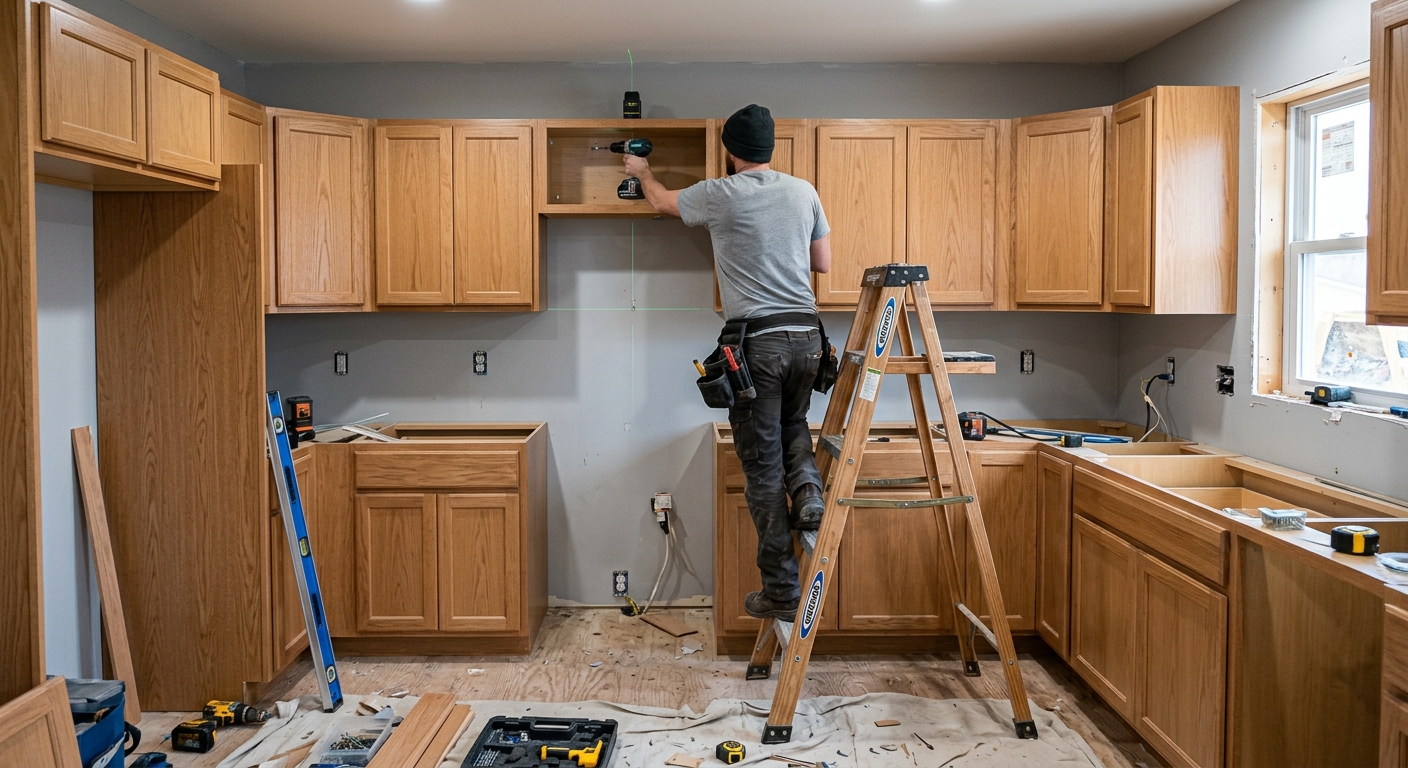
Duquesne kitchen renovation prices by scope — 2026
In Duquesne, kitchen renovation costs span a wide range, reflecting diverse homeowner needs and a unique local housing stock. With a homeownership rate of just 44.6% and a median household income of $40,969 (U.S. Census Bureau, ACS 2024), choices about kitchen investment are practical and value-driven. Most homes in Duquesne were built before 1980, so the majority of kitchens either date to mid-century layouts or earlier compact footprints, requiring more extensive updates than simply replacing finishes. Large pre-1940 housing stock in Pittsburgh creates frequent kitchen gut-renovations to reconfigure small, compartmentalized rooms., which directly applies to Duquesne’s similar vintage of housing.
One warning: most kitchen budget overruns start with pricing out a cabinet replacement, then drifting into a layout change, which triggers a much higher cost tier. Being clear on scope up front matters more than square footage in Duquesne’s kitchens.
| Scope |
What's included |
Duration |
Price range |
| Full gut remodel, same layout |
cabinets, counters, appliances, flooring, lighting, fixtures |
6–10 weeks |
$28,000–$113,000 |
| Gut plus layout change |
all of the above plus moved plumbing, electrical, walls |
10–16 weeks |
$61,000–$113,000 |
| Cabinet replacement (stock to semi-custom) |
remove and install cabinets, hardware, patching |
1–3 weeks |
$6,600–$28,000 |
| Cabinet refacing |
new doors and drawer fronts, veneer, hardware |
3–6 days |
$6,600–$19,000 |
| Countertop replacement only |
template, fabricate, install, reconnect sink |
1–3 weeks |
$3,800–$15,000 |
| Kitchen flooring only |
remove existing, install new flooring |
3–6 days |
$4,700–$19,000 |
Estimates for a typical Duquesne kitchen. Cabinet grade and whether the layout changes move these figures more than square footage.
Layout changes and the cost cliff
The largest single jump in any Duquesne kitchen project is the move from a straightforward gut remodel with the same layout to a project where you open up walls, relocate a sink, or move major appliances. Keeping all the plumbing, electrical, and main appliances in place lets you control costs, but moving any of these—even just a few feet—moves the project up to the next price tier. These increases are not gradual: taking out a load-bearing wall, shifting a drain, or running a new circuit usually triggers both structural work and permitting, resulting in a substantially higher total.
Why is this such a cliff? Relocating a drain line is not just about running pipe; drain lines require specific slopes for proper flow, which is complicated in slab construction or if there's a finished ceiling below—the kind of detail that is common in older Duquesne homes. New circuits may seem simple, but the existing electrical panel may lack capacity, especially in pre-1940 homes. Removing a wall means determining whether it’s load-bearing, which means you’ll need an engineer and will almost always require a building permit. Venting a new range hood out the exterior means penetrating old brick or block walls, which is a cost and mess many do not anticipate.
In Pittsburgh and surrounding boroughs, including Duquesne, relocating plumbing or electrical lines in a kitchen is what typically triggers a building permit and, in some places, a plan review by the permits office. Comparing cost bands: sticking with a same-layout gut remodel is typically $28,000–$113,000, while a full gut with layout changes jumps to $61,000–$113,000. Unless your current kitchen layout is genuinely dysfunctional, it’s worth thinking twice before paying thousands to move a sink or range.
Practical survival during the work
Living through a Duquesne kitchen renovation will disrupt daily routines more than most homeowners expect. The first reality: plan a temporary kitchen space before demolition starts. Most people move the fridge to the dining room or a hallway, set up a microwave or an electric kettle on a folding table, and rely on a laundry or bathroom sink for anything needing water. Disposable plates and cutlery ease cleanup, but food costs usually go up—eating out for even six to eight weeks quickly becomes a larger budget item than the flooring, and is rarely accounted for at the start.
Dust is not just a nuisance; older Duquesne homes shed layers of plaster, and floors can be laden with construction debris. Expect contractors to install plastic sheeting or zip walls to keep dust out of other areas—insist on this, especially if you have bedrooms near the kitchen. Material staging and dumpsters will need a spot, often in your driveway or yard, and these are realities in lots averaging the size found in Duquesne's neighborhoods.
If you have pets, remember the front or side door is often open during the day for weeks. Demolition is the messiest phase, and some homeowners choose to move out for that week if breathing silica dust or living among debris is a concern. Plan for these inconveniences—they’re as much a part of the true renovation cost as a new appliance or fixture.
Why the electrical line grew
Many older Duquesne homes—over 93% built before 1980—were wired to meet standards that are minimal by today’s code. Large pre-1940 housing stock in Pittsburgh creates frequent kitchen gut-renovations to reconfigure small, compartmentalized rooms., which also exposes undersized panels, two-wire circuits with no ground, and sometimes even aluminum branch wiring. Today’s electrical code expects each kitchen to have multiple dedicated small-appliance circuits (usually two 20-amp countertop circuits), GFCI protection on all countertop outlets, receptacle spacing so no point on the counter is more than two feet from an outlet, a separate circuit for the dishwasher, a separate for the disposal, another for the microwave, and sometimes a 240-volt circuit for electric ranges.
Once the walls are opened, inspectors expect the remodeled area to be brought up to current code, which is not optional. Homeowners are often surprised to learn their panel can’t support the extra circuits, and that running new protected wiring is more complicated in old wall framing. Even late 1990s kitchens often lack the required circuit count or GFCI protection.
Bringing a typical Duquesne kitchen up to modern electrical code can cost anywhere from $4,700–$19,000—a wide range depending on the current wiring, the need to upgrade the panel, and patching old plaster. Plan for this: it causes more mid-project sticker shock than any other line item.
What requires a permit in a kitchen renovation
Not every kitchen project in the Duquesne area requires a permit. Surface-level work—painting, hardware swaps, cabinet refacing, even replacing a countertop in place—typically does not. However, any work that involves installing new or moved electrical circuits, upgrading or moving plumbing, removing or moving walls, or installing ductwork for a new range hood usually triggers the need for a permit, especially in Pittsburgh and its surrounding boroughs. If you’re planning a major remodel that changes the kitchen layout or modifies structure, expect to need plan review and permits before work begins.
Who inspects the work depends on your exact municipality. In Pittsburgh, electrical inspections are performed by the City Department of Permits, Licenses, and Inspections, while nearby suburbs often use approved third-party inspection agencies. This can catch homeowners by surprise at resale if work was unpermitted or not inspected by the right party—unpermitted work is the most common reason for hiccups during home sales.
Contractors handling a Duquesne kitchen job over $500 must be registered via the Pennsylvania Home Improvement Contractor (HIC) system, which you can verify at hic.attorneygeneral.gov. They must also provide proof of workers’ compensation insurance, verifiable on WCAIS (wcais.pa.gov). Jobs over $500 require a written contract by law, and you have three business days to cancel, per state consumer protection requirements. Skipping permits is false economy—it can sabotage your refinance, insurance, or resale.
Why appliance selection comes first
The sequence of decisions in a kitchen remodel matters more than most people realize. Cabinets are built and installed to fit each appliance, not the other way around. If you select appliances after ordering cabinets, you risk discovering your fridge sticks out, your range does not fit, or your dishwasher door bumps a cabinet. In Duquesne’s mix of narrow and older kitchens, these mistakes are especially likely.
Choosing between a standard and counter-depth refrigerator, for example, will change how deep your cabinet run needs to be. A slide-in range requires finished sides for the opening, while a freestanding range does not. If you switch from gas to induction, you may have to upgrade your electrical service. Panel-ready dishwashers demand precise cutouts and special panel fabrication. For range hoods, venting outdoors is always preferred; recirculating models are quieter but ineffective at actually clearing moisture and cooking odors, which matters in older brick homes.
Professional-grade appliances mostly deliver on aesthetics and feel, but not always on performance-to-cost. They are a visual upgrade, but it is the utility that matters most to most Duquesne homes. And whether you choose basic or high-end, remember that appliance lead times—especially for certain ranges and built-ins—can now exceed cabinet delivery times, making early selection even more critical.
The real timeline for a Duquesne kitchen
Most Duquesne homeowners underestimate the real duration of a kitchen renovation. The process starts with detailed design, measurement, and, in many cases, engineering if you’re considering a layout change. Next comes cabinet selection and ordering—this is where delays stack up, particularly in Allegheny County’s saturated contractor and supplier market, where trade labor and finish materials are in continuous demand.
Once cabinets are ordered, the actual on-site work begins with demolition. Rough-in of plumbing and electrical follows (often requiring inspections before walls are closed), then cabinets are installed. No matter how much you plan, countertops cannot be measured for fabrication until cabinets are completely and correctly installed—which adds at least a week to the schedule, often more when local fabricators are backlogged. After countertop templating, there’s fabrication (one to two weeks), then install, and only then come backsplashes, flooring, and small finishing touches.
The unavoidable gap between cabinet installation and countertop templating is rarely discussed up front. Homeowners are surprised by the dead period of a week or more with half a kitchen and no counters—there’s no shortcut here. With typical lead times (6–12 weeks for cabinets and 2–3 weeks for stone tops), the whole process is best measured in months, not weeks. Order cabinets before you tear out anything; waiting until demolition is finished simply extends your period without a usable kitchen.
Frequently asked questions — kitchen renovation in Duquesne
What does a quartz countertop cost in Duquesne?
Quartz countertops for Duquesne kitchens generally run between $3,800–$15,000, with the middle of that range covering most homes in this area (typically around $8,500). The total cost depends on how many seams you need, the edge profile, backsplash height, and whether the sink is included or cut on-site. In older Duquesne homes with uneven walls or quirky layouts, some additional labor can push the install toward the higher end of the range. If you’re only swapping counters and keeping the base cabinets, expect the job to fall in the lower half. Always ask your fabricator where in this range your project lands before signing a contract.
What are cabinet lead times in Duquesne right now?
In Duquesne and the greater Allegheny County area, expect cabinet lead times to be at least 6–12 weeks for most stock to semi-custom lines, sometimes longer for painted finishes or custom colors. High local demand and supply chain holdovers continue to slow delivery. Because this is a dense, urban market with many simultaneous remodels, you want your cabinet order locked in before demolition starts; otherwise, your kitchen will sit empty waiting for boxes and fronts. This timing can directly impact your project costing in the $6,600–$28,000 range for cabinet replacement. Plan ahead and verify the manufacturer’s estimated delivery, not just your contractor’s guess.
Why are kitchen quotes in Duquesne so far apart?
Quotes for kitchen projects in Duquesne can feel all over the map because each contractor prices labor, materials, warranty, and overhead differently, and houses here come with unique challenges. Most homes were built before 1980 and often have surprises behind the walls—old wiring, plaster, uneven framing—which add cost unpredictably. Labor is tight in Allegheny County compared to surrounding areas, pushing some bids to the top of their bands: $28,000–$113,000 for a gut-remodel isn’t unheard of for a tricky layout. Make sure each quote spells out exactly what is and isn’t included—and choose a contractor for clarity and fit, not just a low number.
Do I need to change my kitchen layout?
In most Duquesne homes, especially those built before 1940, the kitchen layout feels dated or cramped. But layout changes are expensive—jumping your project from around $28,000–$113,000 for a gut renovation with the same layout, up to $61,000–$113,000 if you move plumbing, electrical, or walls. Plus, more invasive changes require permits and city or borough review. If your current kitchen works for your needs (even if it’s not trendy), you can save tens of thousands by leaving the layout in place and focusing on finishes and lighting instead.
Should I renovate before selling or let the buyer do it?
In Duquesne, with a relatively low homeownership rate and a middle-of-the-road median home price, fully gutting a kitchen before listing almost never pays off dollar-for-dollar. Most buyers here prefer a clean, functional kitchen, but not everyone wants high-end finishes. Sometimes a basic update—like new counters or simple cabinet refacing in the $6,600–$19,000 range—makes sense. If your kitchen is unsafe or nonfunctional, address the basics, but otherwise, let the next owner make big layout changes to their taste. Don’t overspend for resale.
What is a change order and how should it work?
A change order is a written agreement altering the original renovation contract—needed when you ask for something new that wasn’t included in the bid, or when the contractor hits a hidden condition, like bad wiring. In Pennsylvania, any job over $500 requires a written contract and any changes should also be documented in writing for both parties’ protection under the Home Improvement Consumer Protection Act. Each change order should spell out the extra cost (for example, adding a backsplash might add $3,800–$15,000), the time involved, and impact on the project’s finish date. Never accept a vague verbal agreement; keep all changes in writing, signed by both sides.
What countertop material is best for a family kitchen?
For most Duquesne families, quartz is the top choice—durable, non-porous, available in lots of styles, and easy to clean. It falls safely in the $3,800–$15,000 range for typical kitchens. Granite is also tough, but needs ongoing sealing, and marble can stain or etch under real-world use, especially with kids. Laminate is affordable and lower maintenance today than decades ago, but can feel less substantial, especially in homes undergoing a larger renovation. Solid surface is another good option. Consider how you use the space and whether you’ll keep up with maintenance before choosing.
Can I cancel a renovation contract in Pennsylvania?
Yes—if your kitchen project in Duquesne (or anywhere in Pennsylvania) is over $500, state law mandates that your written contract must include a clear right to cancel within three business days of signing. This Home Improvement Consumer Protection Act rule protects homeowners from rushed decisions. If you want out after the three-day window, you might forfeit your deposit (especially if materials were custom ordered). For big-ticket jobs in the $28,000–$113,000 range, be sure you’re comfortable with the scope, schedule, and contractor before signing—and always read the fine print on cancellation terms.
Do older Duquesne homes need electrical upgrades for a kitchen?
Almost always, yes. With over 93% of Duquesne’s homes built before 1980, most kitchens lack the circuits or safety features required by the current Pennsylvania Uniform Construction Code. Once you open the walls, inspectors will expect modern electrical—dedicated appliance circuits, GFCI outlets, and service panel upgrades as needed. Bringing your kitchen up to code typically runs from $4,700–$19,000 in Duquesne, sometimes more if the main electrical panel is undersized or you discover aluminum wiring. Don’t budget as if you can skip this—old wiring is the single most common hidden cost in older Allegheny County houses.