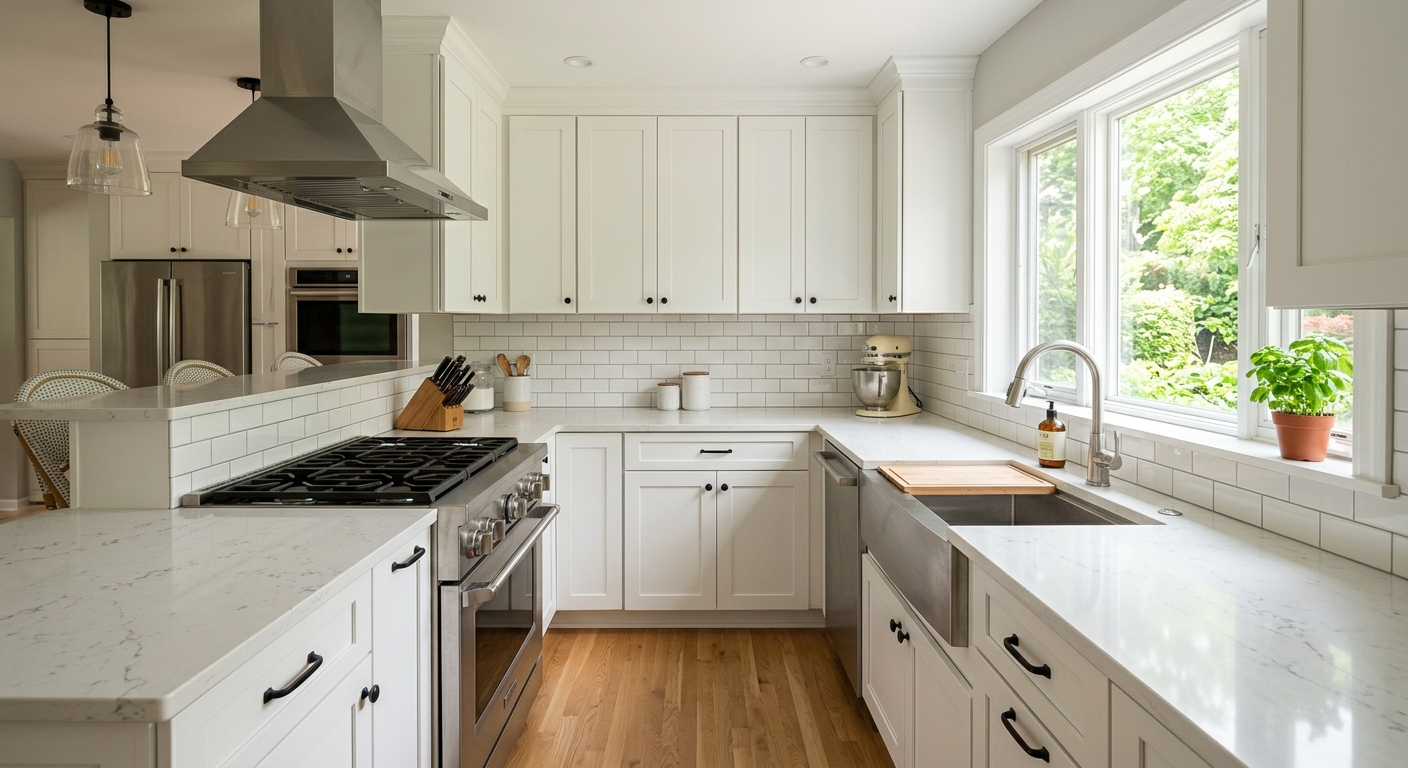
McKees Rocks kitchen renovation prices by scope — 2026
In McKees Rocks, most kitchens are overdue for a significant update, because nearly 88.4% of local homes were built before 1980 (U.S. Census Bureau, ACS 2024). Many kitchens are still the small, closed-off rooms typical of the pre-1940 Pittsburgh building boom, challenging today’s expectations for family use and storage. That’s why gut-renovations—especially those opening up walls—are far more common here than in markets with mostly newer homes.
With a median household income of $33,958 (U.S. Census Bureau, ACS 2024) and a homeownership rate under 50%, most owners plan for durable, mid-range renovations and focus spending where it will see daily use. It’s vital to match the scope to the reality of your house and budget. The fastest way to blow your budget is to look at prices for cabinet replacement or refacing but then start moving walls and relocating plumbing or electrical.
| Scope |
What's included |
Duration |
Price range |
| Full gut remodel, same layout |
cabinets, counters, appliances, flooring, lighting, fixtures |
6–10 weeks |
$28,000–$113,000 |
| Gut plus layout change |
all of the above plus moved plumbing, electrical, walls |
10–16 weeks |
$61,000–$113,000 |
| Cabinet replacement (stock to semi-custom) |
remove and install cabinets, hardware, patching |
1–3 weeks |
$6,600–$28,000 |
| Cabinet refacing |
new doors and drawer fronts, veneer, hardware |
3–6 days |
$6,600–$19,000 |
| Countertop replacement only |
template, fabricate, install, reconnect sink |
1–3 weeks |
$3,800–$15,000 |
| Kitchen flooring only |
remove existing, install new flooring |
3–6 days |
$4,700–$19,000 |
Estimates for a typical McKees Rocks kitchen. Cabinet grade and whether the layout changes move these figures more than square footage.
Does a kitchen renovation pay back in McKees Rocks?
It’s tempting to hope that every dollar you put into a McKees Rocks kitchen renovation will return at resale, but the truth is more complicated. A well-done kitchen renovation definitely helps a house sell faster and can make it stand out in a market full of pre-1980 homes, but it rarely recoups the full investment—especially at the high end of spend.
For owners staying put, the best value is found by renovating for how you want to use the space, without thinking about resale. Prioritize durable surfaces, appliance upgrades, and the layout that works for your family, as you’ll get years of daily enjoyment.
If you are renovating mostly to sell, the most cost-effective approach is a cosmetic refresh using mid-range materials and classic, neutral finishes. In McKees Rocks, with a median household income of $33,958 (U.S. Census Bureau, ACS 2024), it’s almost impossible to recover the cost of a high-end custom kitchen on resale—the market simply won’t support it. Overspending relative to the neighborhood just leaves you with a loss at closing.
Focus on what buyers here expect: clean lines, up-to-date surfaces, and fully functional appliances. Save the custom cabinetry and imported tile for homes in higher-priced areas.
Electrical work in an older McKees Rocks kitchen
Bringing a McKees Rocks kitchen up to current electrical standards is where many renovations go over budget, especially in homes built before 1980—which is most of them (U.S. Census Bureau, ACS 2024). In the Pittsburgh area, pre-1940 kitchens often have only one or two circuits serving the entire room, no grounding, and sometimes outdated knob-and-tube or aluminum wiring.
Modern electrical code sets clear requirements: your kitchen should have at least two dedicated 20-amp small-appliance circuits for countertop outlets, GFCI protection at all counter outlets, receptacles spaced so no point along the counter is more than 24 inches from a plug, separate dedicated circuits for the dishwasher, garbage disposal, and microwave, and a 240-volt line if you want an electric range. Most kitchens from earlier eras don’t have the panel capacity or wiring to support this.
If your project exposes the kitchen walls, the inspector will expect to see these brought to code. There’s no way around it. For older McKees Rocks homes, you should budget $6,600–$19,000 to fully update the kitchen wiring, including new service from the panel if needed. In a newer 1980s or 1990s home, you might need only a few new lines, bringing the low end closer to $3,800. But in this market, the higher figure applies more often.
Appliance choices and the decisions they force
Appliances determine the rest of the kitchen layout—ignore this and you may end up with a fridge that sticks out or a range gap nobody can solve. In McKees Rocks, where many kitchens are tight and oddly shaped, appliances should always be selected and sized before you order cabinets.
Standard refrigerators are deeper than cabinets and will project into the room, while a counter-depth fridge sits flush but costs more and cuts a bit of volume. Slide-in ranges require cabinet cutouts along the sides; freestanding ranges do not, but slide-ins give a cleaner built-in look. Switching from gas to induction—or vice versa—has real implications: induction needs a 240-volt circuit and might not be possible without a panel upgrade in an older home.
Panel-ready dishwashers let you match cabinetry, which is increasingly popular but must be planned from the start. Range hood venting, too, is a make-or-break decision: ducting to the outdoors gives real performance and removes grease and smoke, while recirculating hoods are just a filter in a box—fine for code in most of McKees Rocks, but weak in heavy-use kitchens.
“Professional” appliances add premium style and some extra features, but most of the price jump is for the look and brand. Actual cooking performance for the average home cook rarely justifies $10,000 appliances. Also: many popular appliance models now have lead times longer than for custom cabinets, so always lock these in early.
The real timeline for a McKees Rocks kitchen
Almost every homeowner underestimates how long a kitchen renovation in McKees Rocks will take, especially given the market density and high contractor demand in the Pittsburgh metropolitan area. The real bottleneck is never demolition or even the work itself—it’s the sequence of parts that can’t be rushed.
Here’s how it actually goes: design and measure (a week or more), order and wait for cabinets (4–12 weeks depending on brand and market demand), schedule demolition once cabinets are scheduled, rough-in new plumbing and electrical (1–2 weeks), pass inspections (variable), install cabinets (1 week), then and only then can the countertop be templated. Stone fabricators cannot use plans or guesses; they must measure off installed cabinets, which locks in a 1–3 week fabrication window—no exceptions.
That period between cabinet install and countertop is where most kitchen projects stall, and no one warns you about it. Flooring, tile, paint, and trim often happen while waiting on countertops, but appliances and sinks can’t go in until those slabs are set.
Given tight finish-trade labor in the area, always order cabinets before you start demolition and lock in your fabricator and appliance delivery schedules early. Rushing this sequence guarantees extra expense and mistakes.
Who should run your McKees Rocks renovation
In McKees Rocks, your choice of project delivery model has more impact on cost and headaches than any material you could select. A design-build kitchen company will handle everything—layout, cabinet supply, trades, and install—with the highest up front price but the lowest homeowner involvement. For anyone with a full-time job and a demanding schedule, this is often the only realistic option, given how saturated and busy the finish-trade labor market is in Allegheny County.
A general contractor model brings costs down, as you or your designer source cabinets and finishes while the GC schedules trades like electrical, plumbing, flooring, and manages daily work. This means more involvement, more decisions, and more time spent—but also more flexibility in materials and sometimes a lower total bill.
Owner-managed projects are cheapest in theory, because you hire and schedule every trade directly. But unless you have construction experience and unlimited daytime availability, this almost always turns into delays, miscommunication, and unexpected costs. Even in straightforward jobs, the tight labor market around Pittsburgh means a no-show or delay by one trade can add weeks before the others are available again.
If your scope touches electrical, plumbing, or walls—anything that would trigger a permit—self-managing is a risk unless you have serious time and local contacts.
Code requirements for McKees Rocks kitchens
In McKees Rocks and the rest of Allegheny County, the rules on kitchen permits are clear where it matters: cosmetic upgrades like new paint, hardware, or even a refaced cabinet front do not trigger a building permit. The line gets sharp when you move or add electrical or plumbing lines, alter structural walls, or install a new vented appliance—these changes almost always require a permit and inspection under the Pennsylvania Uniform Construction Code, enforced by your local borough.
If the work involves changing the kitchen’s layout, moving walls, or rerouting plumbing or major electrical, expect a plan review and a permit requirement. For a simple cabinet swap without layout changes, most Allegheny County boroughs—including McKees Rocks—let you proceed without a permit.
Electrical inspections are usually managed by the local code office, but some suburbs will use a third-party inspection agency—this catches homeowners off guard during resale when uninspected or undocumented work turns up in a buyer's check.
Any contractor running a kitchen renovation over $500 must be registered with the Pennsylvania Office of Attorney General (verify at hic.attorneygeneral.gov), and all employers are required to carry workers’ compensation coverage (check via WCAIS at wcais.pa.gov). Skip these steps, and you risk having work that can’t be defended at resale, or worse, an insurance company denying a claim for unpermitted work.
Frequently asked questions — kitchen renovation in McKees Rocks
Do I need to change my kitchen layout?
Most McKees Rocks kitchens were built before 1980, so the existing layout is often a narrow galley or small enclosed space that doesn’t suit modern needs. If you want more openness, better light, or room for an eat-in area, changing the layout—moving walls or relocating plumbing and electrical—can make a world of difference. But keep in mind that moving the layout jumps the project into a much higher budget range, starting near $61,000 for layout changes rather than simple cabinet swaps. If you’re happy with the footprint and can work with the current appliance arrangement, keeping the layout saves a lot of time, cost, and complexity. Talk with your contractor about what makes sense for your specific house and your long-term plans. In houses with lower ceilings or structural walls, not every change will pay off.
Do older McKees Rocks homes need electrical upgrades for a kitchen?
In most McKees Rocks homes—about 88.4% built before 1980—it’s almost guaranteed you’ll need at least some electrical upgrades if you’re gutting the kitchen or adding appliances. Modern kitchens require dedicated circuits for each major appliance and GFCI outlets at every counter area by code. Many old kitchens have only one or two circuits for the entire room, often without proper grounding, meaning new wiring from the panel is needed. This comes up mid-project often, adding both cost and several days or even weeks if you need panel work. Expect to budget between $6,600–$19,000 for a full rewire if the walls are open. It’s money well spent for safety and to avoid disappointment at resale, since unpermitted or sub-code wiring is a deal-breaker for many buyers in Pennsylvania.
What are cabinet lead times in McKees Rocks right now?
Cabinet lead times in McKees Rocks average about 4 to 12 weeks, depending on what you select and how saturated the Pittsburgh-area market is at the time. Stock cabinets tend toward the shortest wait, while semi-custom or custom options push closer to the high end of that window. Because the finish-trade labor market here is tight, you should order cabinets before starting demolition; waiting until after slows the whole schedule. Remember, your countertop templating and appliance installation can’t happen until cabinets are installed, so any delay at this stage has knock-on effects. For a typical project, plan for overall job duration of 6–10 weeks—but delays in cabinet delivery are the most common source of project creep.
Should I hire a general contractor or a kitchen firm?
In McKees Rocks, this depends on your budget, tolerance for hassle, and the size of your project. A dedicated kitchen firm will cost the most but requires the least from you and wraps everything—design, cabinets, trades—into one contract. A general contractor brings the cost down and offers some flexibility, but you’ll need to coordinate on finishes and make more decisions. If you’re on a tight budget, owner-managing might seem tempting, but with high labor demand in Allegheny County, it’s risky—delays are common and mistakes can get expensive, especially for code-triggering work. For gut remodels, plan for $28,000–$113,000 with a pro handling everything. If your job is cosmetic, a GC might fit your needs and budget.
What adds the most resale value in a kitchen?
For McKees Rocks, mid-range kitchen renovations that make daily use easier—new cabinets, solid-surface counters, updated lighting, and modern appliances—always add more resale punch than luxury custom details. Buyers generally don’t pay extra for imported tile, custom hood vents, or built-in espresso machines. Instead, focus on top priorities: a layout that makes sense, plenty of outlets, and a look that’s clean and neutral. Spending up to $19,000 on new cabinets or around $8,500 on counters usually delivers the best balance between recouped cost and appeal, especially since home prices here are anchored by the local median income.
What does a quartz countertop cost in McKees Rocks?
Quartz countertops in McKees Rocks generally run from $3,800–$15,000, with most kitchens falling close to the typical figure of $8,500. This includes templating, fabrication, professional install, and a new sink reconnected after the tops go down. Pricing swings with color, edge detail, and the specific fabricator. Some local shops are more competitive, but the best deals often go to those who can wait out lead times. If your existing cabinets are decent and you just want to swap the counters, you’ll usually be on the lower half of the range. If seams, corners, or special cutouts are needed, expect to be at the higher end.
Is induction worth it over gas?
Induction brings precise temperature control, easy cleaning, and excellent speed—which many McKees Rocks cooks appreciate, especially in tighter or older kitchens where heat and ventilation are a concern. Induction is safer and more energy-efficient than gas, and Pennsylvania winters don’t affect performance. However, you do need cookware that’s magnetic, and your kitchen must have a 240-volt circuit—something older houses here often lack. Upgrading the circuit not only adds cost but may require a service upgrade, landing you in the $6,600–$19,000 electrical update range. If you love cooking and want faster boil times and instant control, induction is worth the investment, but don’t expect it to add resale value beyond the wow factor.
How do I verify a kitchen contractor in Pennsylvania?
Any contractor working on your McKees Rocks kitchen for over $500 must be registered with the Pennsylvania Office of Attorney General under the Home Improvement Contractor program. You can verify their current registration at hic.attorneygeneral.gov. For any job with employees, state law also requires them to carry workers' compensation insurance—always ask for a certificate and check through WCAIS at wcais.pa.gov. A legitimate contractor will give you a written contract, lay out your 3-day right of cancellation, and will never offer to waive your homeowners insurance deductible (that’s illegal in Pennsylvania). Professional, transparent paperwork is the norm on jobs over $6,600 in this area.
Why are kitchen quotes in McKees Rocks so far apart?
Kitchen remodel quotes in McKees Rocks vary for a few reasons: first, the scope might look the same on paper, but some contractors include patching, disposal, and higher-grade fixtures by default, while others quote bare minimums. Labor rates are higher in Allegheny County because contractor demand is strong around Pittsburgh—meaning outfits with better finish carpenters or consistent tradespeople cost more but deliver fewer callbacks. Also, lead times and appliance sourcing can affect price, as some firms pay more to guarantee short waits. Finally, quotes skyrocket when clients cross unseen lines—specifying structural changes or moving three appliances when they budgeted for cabinet refacing. For a gut remodel, the spread runs from $28,000–$113,000 depending on design, labor, and what’s hiding inside the walls.