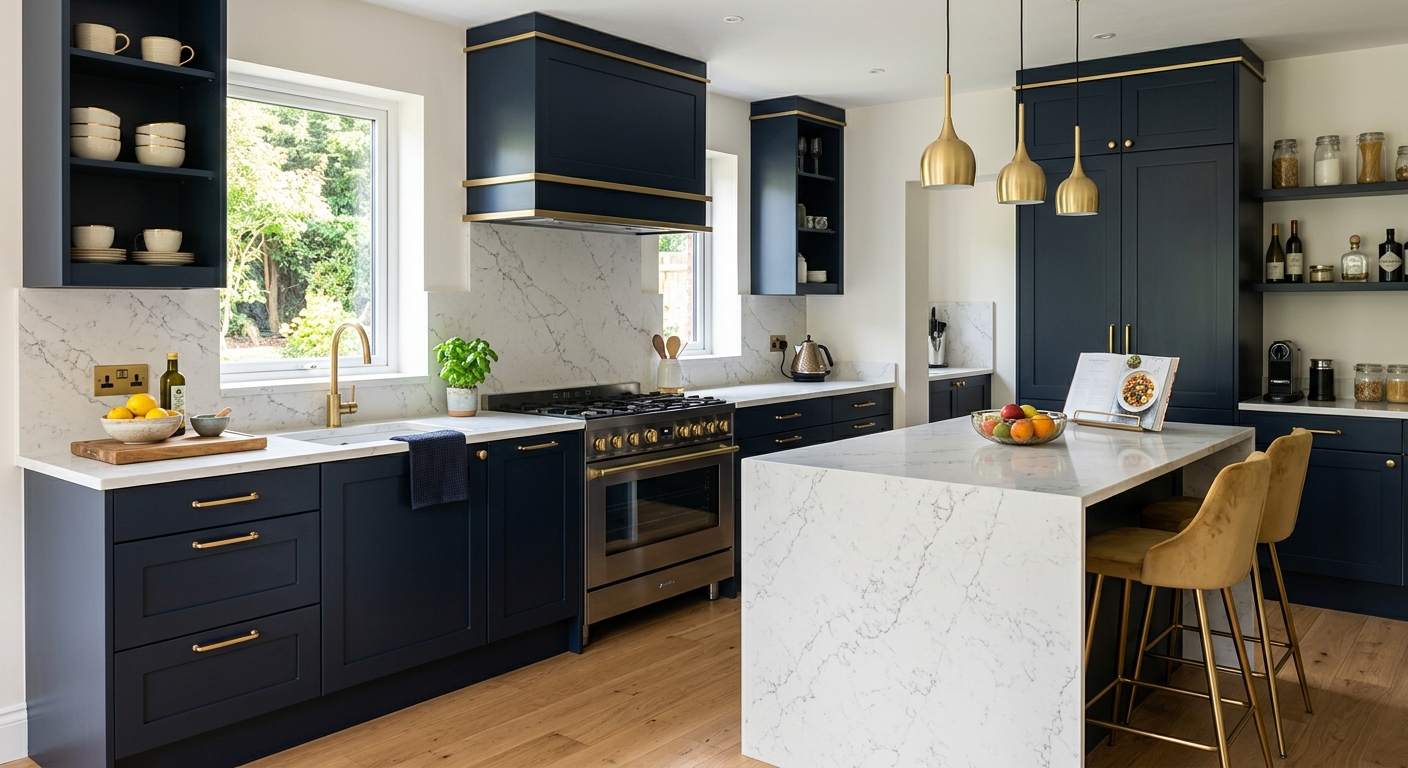
What a kitchen remodel costs in Honey Brook
In Honey Brook, kitchen renovation budgets vary widely and are shaped by the age of your home, the era of construction, and how you plan to use your kitchen. With a median household income of $74,402 and a homeownership rate of 72.7% (U.S. Census Bureau, ACS 2024), most homeowners here are planning projects with a long-term view, aiming to upgrade both function and value. Many homes in the surrounding Chester County area—including those in West Chester and Phoenixville—were built from the 1960s through the 1980s. This means common projects involve transforming closed-off, outdated kitchens into larger, more open layouts. Older layouts can require substantial wall changes and utility updates, while post-1990s homes often just need surface improvements.
A common way budgets go off track is by starting with a price for basic upgrades but then choosing more costly options mid-project (moving the sink, higher-end appliances, or custom cabinets). Setting a clear scope—and sticking to it—matters more than counting square feet. Below is a realistic budget table for Honey Brook homeowners.
| Scope |
What's included |
Duration |
Price range |
| Full gut remodel, same layout |
cabinets, counters, appliances, flooring, lighting, fixtures |
6–10 weeks |
$33,000–$132,000 |
| Gut plus layout change |
all of the above plus moved plumbing, electrical, walls |
10–16 weeks |
$71,500–$132,000 |
| Cabinet replacement (stock to semi-custom) |
remove and install cabinets, hardware, patching |
1–3 weeks |
$7,700–$33,000 |
| Cabinet refacing |
new doors and drawer fronts, veneer, hardware |
3–6 days |
$7,700–$22,000 |
| Countertop replacement only |
template, fabricate, install, reconnect sink |
1–3 weeks |
$4,400–$17,500 |
| Kitchen flooring only |
remove existing, install new flooring |
3–6 days |
$5,500–$22,000 |
Estimates for a typical Honey Brook kitchen. Cabinet grade and whether the layout changes move these figures more than square footage.
Appliance choices and the decisions they force
If you're planning your Honey Brook kitchen, make your appliance choices first. The cabinets will be built and installed around your appliance dimensions—and this sequencing trip-up is how homeowners end up with a refrigerator that sticks out or a range that just doesn't fit. Standard-depth refrigerators are deeper and protrude past the counter; counter-depth models sit virtually flush but often offer less storage, requiring cabinetry to be set accordingly. Slide-in ranges provide a seamless look but need a precise cabinet cutout, while freestanding models are more forgiving for replacements up the road.
If you're considering gas versus induction cooking, be aware: gas ranges require venting and often an upgraded gas line, while induction ranges nearly always need a dedicated 240V circuit—sometimes more capacity than older service panels in Honey Brook homes can deliver without an upgrade. Panel-ready dishwashers let you match cabinetry, but they require careful cabinet design and a longer appliance lead time.
Range hood venting is another junction for cost and performance. Ducted hoods that exhaust outdoors are best at removing smoke and moisture, but need the ductwork in place. Recirculating hoods filter and blow air back into your kitchen; they’re a compromise that’s only worth considering if ducting outside truly isn’t possible.
Professional-style appliances often deliver more on appearance than function; in most Honey Brook kitchens, you’re paying for looks and brand. It’s worth noting that for some refrigerator and range models, delivery lead times now run as long or longer than the cabinetry—so plan before you order anything.
Electrical work in an older Honey Brook kitchen
Bringing an older Honey Brook kitchen up to current electrical code is the most common, and most expensive, surprise that causes local projects to run over budget. Current Pennsylvania Uniform Construction Code expects every kitchen to have dedicated small-appliance circuits (typically two 20-amp), GFCI protection at every countertop outlet, outlets every four feet along the counters, and dedicated circuits for the dishwasher, disposal, and microwave. An electric range requires its own 240-volt circuit.
But most Honey Brook houses—like many in West Chester and Phoenixville—were built between 1960 and the 1980s, so nearly a third of homes (U.S. Census Bureau, ACS 2024) were wired before these requirements existed. Typical issues you run into: two-wire ungrounded circuits, a single shared circuit for the whole kitchen, a panel that has no extra space for new breakers, and sometimes even aluminum branch wiring. As soon as you open walls, inspectors will require the new kitchen wiring to meet current standards—it isn’t optional, and rarely makes it onto early cost estimates.
For a Honey Brook kitchen, upgrading wiring to code—including new circuits, outlets, GFCIs, and panel work—typically falls between $7,000–$16,000. The lower end covers the basics in a compact layout; homes with undersized or obsolete panels, or layouts that are changing, will see higher costs. Even late-1990s kitchens may only have the bare minimum circuits required by code at the time, not the current expectations, so don’t assume the electrical is “close enough.”
How a Honey Brook kitchen budget breaks down
Seeing the real breakdown of a kitchen budget in Honey Brook resets most people’s priorities. Cabinetry is by far the largest single cost—both in materials and the time you’ll wait—followed by labor and installation. Countertops, appliances, then flooring, lighting/electrical, and plumbing take lesser shares. Many homeowners forget two essential budget lines: the “what’s behind the wall” contingency, especially critical for pre-1980 homes, and the soft costs (permits, design, delivery, and disposal) that are inevitable here in Chester County.
Spending extra often pays off on labor or cabinetry—where every additional thousand dollars buys noticeably smoother operation and visual appeal. It buys the least on high-end appliances, which add little if the rest of the kitchen is basic or dated. In Honey Brook, a wise service1 budget of $71,500 might put $17,000–$25,000 to cabinetry, allowing you room for better hardware or storage features. Scrimping on contingency or labor is a bad bet: those corners are where things can go seriously sideways.
| Category |
Share of budget |
Notes |
| Cabinetry |
25–35% |
the largest line and the longest lead time |
| Labour and installation |
20–30% |
rises sharply if the layout changes |
| Countertops |
8–15% |
material choice drives the swing |
| Appliances |
10–20% |
widest range of any category |
| Flooring |
5–10% |
|
| Lighting and electrical |
5–10% |
higher in older homes needing circuits |
| Plumbing and fixtures |
4–8% |
|
| Permits, design, disposal |
3–6% |
usually forgotten in early budgets |
| Contingency |
10–15% |
not optional in a pre-1980 house |
Living through a kitchen renovation
A kitchen remodel in Honey Brook turns daily life upside down for weeks—but planning ahead takes the edge off. Most people set up a temporary kitchen: a folding table for a microwave and kettle, space in a laundry room or garage for the fridge, and a big stash of paper plates. Washing up happens in a laundry or bathroom sink. This is not the moment to take up elaborate cooking; expect takeout, meal kits, and higher grocery bills.
Dust is a bigger deal than most expect. Expect your contractor to use plastic sheeting and zip walls, and to contain demolition debris as best as possible. Material staging and dumpsters need a driveway or side yard clearout. If you have pets, plan for workers leaving doors open, which will be a daily event.
For major gut projects, moving out during demolition may make sense—especially if you’re sensitive to noise or mess, or if the project is running anywhere near the 10–16 week mark for a full gut and layout change. Budget accordingly: eating out for two months is often a larger line item than the flooring, with $2,000–$4,000 spent quickly by a family of four. Don't be surprised if you end up valuing the paper plate phase more fondly in hindsight than the chaos of day one.
General contractor, kitchen firm, or manage it yourself?
Honey Brook homeowners have three real choices for running a kitchen remodel. The kitchen design-build firm is the highest cost but the lowest management hassle: one contract covers design, cabinetry, construction, and follow-through. You’ll pay for the privilege, but you get a single point of accountability.
A general contractor coordinates the trades—demolition, electrical, plumbing, flooring, cabinetmakers—and executes your vision. This path is a bit less expensive; you (or your designer) pick appliances, finishes, and handle some troubleshooting. There’s still a safety net, but be prepared to check in regularly and make decisions quickly if an unexpected wall or wiring is uncovered.
Managing each trade yourself is cheapest but is a full-time job until it’s done. You’ll chase sub-trades, line up deliveries, ensure inspections are passed, manage the schedule, and be responsible when an installer is delayed and pushes everyone else’s timeline. For anyone with a day job, or for any job needing a permit, the burden usually outweighs the savings, especially in Chester County, where trade labor is both busy and in short supply compared to Lancaster County.
The structure you choose swings both the cost and the headache, and in this labor market, tradesmen rarely wait for a DIY scheduler.
Code requirements for Honey Brook kitchens
In Honey Brook as in the rest of Chester County, most cosmetic kitchen work—painting, swapping out cabinet hardware, refacing cabinet doors, or replacing countertops without shifting the sink—does not trigger permit requirements. You’re free to proceed with these updates if you’re not moving the layout or touching utilities.
Permits are typically required when a kitchen project involves adding or moving electrical circuits, relocating or running new plumbing lines, changing structural walls, or a new mechanical appliance such as a ducted range hood. In West Chester and nearby townships, plan review is required if your project alters any structural or mechanical, electrical, or plumbing system. If your project crosses that line, expect a documentation and inspection process to follow.
In many Chester County municipalities, electrical inspections are performed by third-party agencies such as United Inspection Agency, not the township itself. This often surprises homeowners, especially at final inspection or when resale demands proof of closed permits.
Every contractor overseeing more than $500 in work must have an active Home Improvement Contractor (HIC) registration through the Pennsylvania Office of Attorney General (check at hic.attorneygeneral.gov), and every employer must carry workers' compensation, verifiable via WCAIS (wcais.pa.gov). Unpermitted work can create expensive headaches at resale—especially in a high-ownership community like Honey Brook—so skipping permits may save time now but cost far more later.
Frequently asked questions — kitchen renovation in Honey Brook
Does a kitchen renovation increase home value in Honey Brook?
A well-executed kitchen remodel typically does increase the value of a Honey Brook home, especially since nearly three-quarters of local households are owner-occupied (U.S. Census Bureau, ACS 2024). With many homes dating back to the 1960s–1980s, a modern kitchen is often a significant selling point and regularly recoups a large share of investment at resale. Appraisers and buyers notice code-compliant layouts, new cabinetry, and updated electrical systems. However, don't go straight to the deep end—a moderate project in the $33,000–$71,500 range will deliver most of the value without over-improving for the neighborhood. Be realistic about the market, set your budget by what’s selling on your street, and don’t assume every dollar spent comes back at resale. Some features—like luxury appliances—have less impact on appraisal than on day-to-day enjoyment.
Do I need to change my kitchen layout?
Not every Honey Brook kitchen needs a layout change. If your existing kitchen already suits your daily use and traffic flows, updating cabinets and finishes is usually enough. Many older homes in West Chester and Phoenixville (which share Honey Brook’s housing stock patterns) started with closed-off or galley layouts that people now find restrictive, so opening up walls and relocating plumbing or electrical lines is common. But moving things around quickly pushes budgets from $33,000–$71,500 to $71,500–$132,000. Unless you’re facing real functional issues—tight spaces, poor sightlines, or safety hazards—consider an updated finish over a full reworking. Consult with your contractor before deciding; sometimes a small tweak unlocks a big improvement.
Are Honey Brook kitchens typically small galley layouts?
In Honey Brook, you’ll see both older small galley kitchens—especially in pre-1978 properties—and more generously sized layouts in homes built from the late 1980s onward. About one-third of homes were built before 1980, meaning galley kitchens are still common and are often the target of gut-and-expand projects. If you’re considering a remodel, it's likely your project is driven by a desire to open up a cramped, older footprint. Full gut remodels to address this usually start around $71,500, especially if walls or plumbing are on the move. For newer homes, a refresh may be all that’s needed to bring finishes up to date.
How much more does moving the sink and range cost?
Moving a sink or range in a Honey Brook kitchen adds both cost and complexity, because it triggers new plumbing and electrical work, possible floor patching, and plan review if structural walls are involved. You can expect the overall budget to jump from the “same layout” level of $33,000–$71,500 up to the “layout change” range—$71,500–$132,000. The price swing comes from opening up walls, rerouting pipes and wires, getting permits, and covering more labor hours. If the layout fundamentally doesn’t work, it’s worth the investment. But if budget is tight, try to work within existing placements and upgrade finishes instead.
Can I cancel a renovation contract in Pennsylvania?
Yes, in Pennsylvania—including Honey Brook—you have the legal right to cancel a home improvement contract within three business days of signing for any job over $500, under the Home Improvement Consumer Protection Act (HICPA). This cooling-off period is designed to protect homeowners from high-pressure sales or second thoughts. The law covers any signed contract for renovation, from basic cabinet replacements in the $7,700–$33,000 range to full gut remodels. Make sure your written contract clearly spells out this right and that it’s provided before any demolition or ordering of materials. Always review contracts carefully and don’t hesitate to ask questions before you sign.
What does a quartz countertop cost in Honey Brook?
For homeowners in Honey Brook, quartz countertop replacements typically cost between $4,400–$17,500, with most jobs falling close to $9,900 for a mid-sized kitchen. That price includes templating, fabrication, installation, and reconnecting your sink; changes to plumbing or additional finish work could add a bit more. Compared to granite, quartz offers a wider range of colors and a more consistent pattern. It’s also less prone to staining, which makes it a popular choice for families. Be sure to choose a fabricator familiar with local cabinetry and backsplash heights, as older houses in Honey Brook may not have perfectly level surfaces—professional installation makes a real difference.
Should I order cabinets before demolition?
In Honey Brook, always finalize your design and appliance selections before you order cabinets—but wait for demolition to finish before giving the green light on actual cabinet production or scheduling delivery. Older homes here often have hidden surprises: unplumb walls, odd soffits, or unforeseen pipes behind drywall. If cabinets arrive and don’t fit because of a field condition discovered during demo, you’ll lose time and money fast. Most projects—especially cabinet replacements in the $7,700–$33,000 range—go smoother when you dry-fit and measure in a cleared space. Agree with your contractor on when to trigger the order. The slight delay saves far more headache than it causes.
Is induction worth it over gas?
Induction cooktops are gaining popularity in Honey Brook and throughout Pennsylvania. They’re faster and more responsive than standard electric and offer better efficiency than gas, with almost no ambient heat or combustion byproducts. One catch: you’ll need magnetic cookware and a 240V circuit—another cost if you’re upgrading an older kitchen, but most full remodels already include electrical work in the $7,000–$16,000 range. Gas still wins for certain styles of cooking, but induction is better for safety, easier cleaning, and is often more practical given local permitting. Unless you have a personal or culinary preference for gas, many Honey Brook homeowners find induction “worth it” for daily use.
Should I hire a general contractor or a kitchen firm?
In the Honey Brook market, most homeowners are best off with either a general contractor or a specialist kitchen design-build firm, unless you have experience running projects and plenty of time. A kitchen firm covers design, cabinetry, and installation in one contract; the price is higher but management is easier and faster. General contractors cost less and are a good middle ground—they handle the trades, but you are more involved picking out finishes and appliances. The labor market in Chester County is tight and reputable trades book up early. Owner-managing the job looks cheaper, but if your project is more than a simple update or requires permits, the risk of scheduling mistakes and cost overruns outweighs the savings. For most jobs in the $33,000–$132,000 range, professional management makes a real difference.