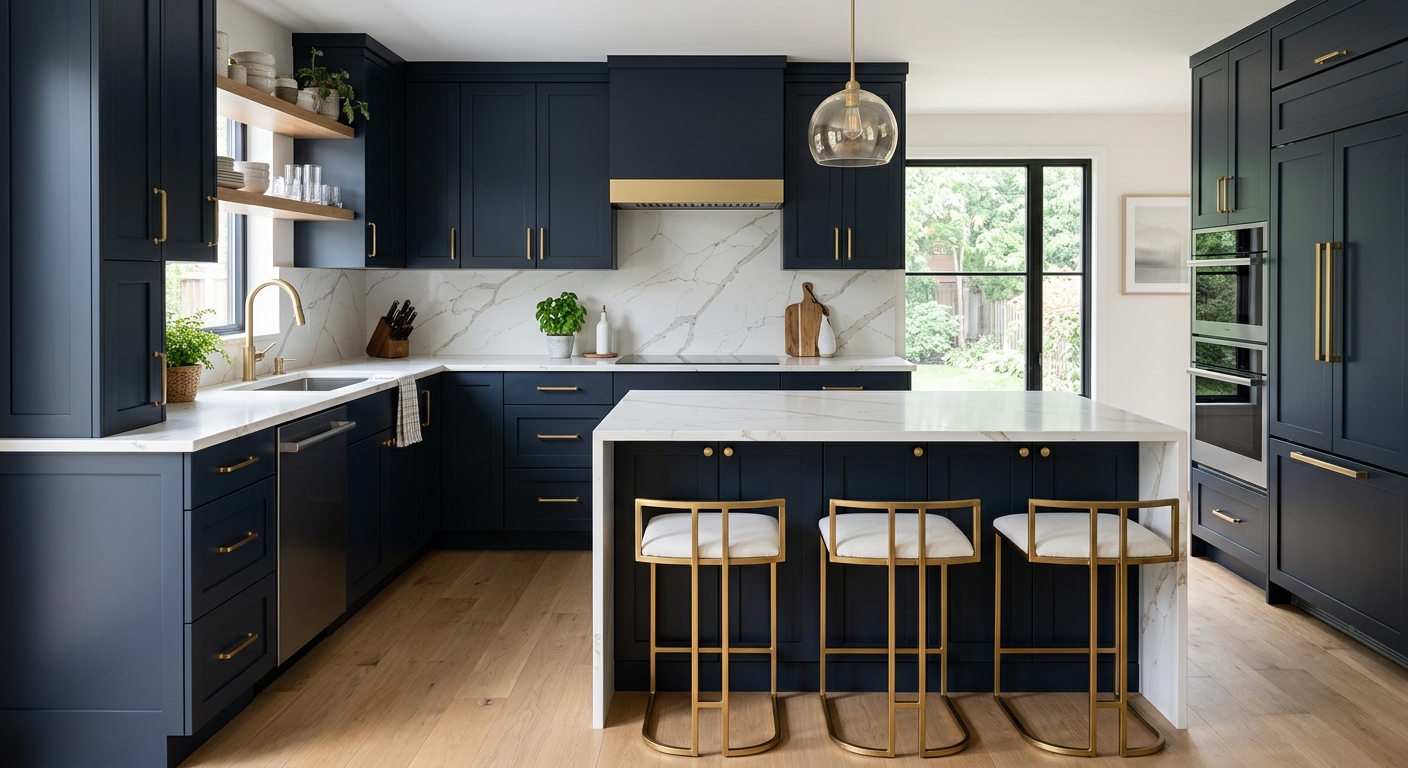
Collegeville kitchen renovation prices by scope — 2026
Most Collegeville kitchen renovations land in a wide price band. With a median household income of $99,271 and a homeownership rate over 73.3% (U.S. Census Bureau, ACS 2024), homeowners here tend to plan their projects carefully and expect modern layouts, especially where homes date from that post-1945 building boom seen in nearby Abington and Upper Dublin. In these homes, you find both 1950s galley kitchens that need walls opened up, and 1990s layouts where only the finishes are dated—your budget and appetite for construction mess determine which route makes sense.
The single biggest cause of overbudget projects isn’t size: it’s planning for a simple cabinet and counter facelift, but then falling for the upsell to full layout rework—where the plumbing moves, the walls come down and the costs multiply. Below are realistic 2026 figures specific to Montgomery County so you can compare scope bands before committing.
| Scope |
What's included |
Duration |
Price range |
| Full gut remodel, same layout |
cabinets, counters, appliances, flooring, lighting, fixtures |
6–10 weeks |
$32,000–$129,000 |
| Gut plus layout change |
all of the above plus moved plumbing, electrical, walls |
10–16 weeks |
$70,000–$129,000 |
| Cabinet replacement (stock to semi-custom) |
remove and install cabinets, hardware, patching |
1–3 weeks |
$7,500–$32,000 |
| Cabinet refacing |
new doors and drawer fronts, veneer, hardware |
3–6 days |
$7,500–$21,500 |
| Countertop replacement only |
template, fabricate, install, reconnect sink |
1–3 weeks |
$4,300–$17,000 |
| Kitchen flooring only |
remove existing, install new flooring |
3–6 days |
$5,400–$21,500 |
Estimates for a typical Collegeville kitchen. Cabinet grade and whether the layout changes move these figures more than square footage.
Eight weeks without a kitchen
A full kitchen renovation in Collegeville typically means six to ten weeks of living with bare subfloors and no working appliances. It’s not just the meal prep that gets upended. Collegeville’s family homes often have room to set up a temporary kitchen—this means moving your refrigerator nearby, clearing space for a microwave and electric kettle on a folding table, and planning to rinse dishes in the laundry or bathroom sink. Disposable plates and utensils simplify things, but the reality is your food budget will jump, likely surpassing the cost of most flooring jobs. Many families end up eating out much more than planned, which, for eight weeks, can easily run higher than $5,400–$21,500.
Dust is relentless. Plastic sheeting and temporary zip walls are not optional—they’re critical for protecting the rest of your home from demolition debris and tile saw slurry. If your contractor doesn’t use these, expect to clean every surface weekly. Plan for where the crew will park their dumpster and stage materials (Collegeville driveways are easy if you coordinate ahead). Bear in mind that workers often need to prop open a door for hours, so secure pets accordingly.
If possible, consider spending demolition week elsewhere—power tools, constant foot traffic, and a destroyed kitchen can make the house truly unpleasant. For the rest of the project, staying put is manageable as long as you set up your backup kitchen and lower expectations for home cooking until the job’s wrapped up.
Quartz, granite, laminate or butcher block
For Collegeville homeowners, countertop choice comes down to durability, maintenance, and day-to-day stress. Quartz is fully engineered; it's non-porous, resists staining, and never needs sealing. The drawback is that engineered quartz doesn’t handle hot pots or pans well—prolonged high heat can discolor or crack it. Granite, by contrast, is natural stone: it needs periodic sealing to stay stain-resistant and is less vulnerable to heat, but it can chip and the seams are usually more visible due to the pattern.
Laminate isn’t what it was thirty years ago. Modern laminate comes in hard-wearing finishes and can even imitate stone patterns and edge profiles. It’s a viable, budget-conscious choice, especially for rentals, galley kitchens, or when refreshing a functional but modest space. Don’t dismiss it if your whole kitchen doesn’t warrant stone—some Collegeville renovations combine premium counters in one zone and laminate elsewhere to stretch the budget.
Butcher block brings warmth and is easily repaired by sanding, but it’s the highest-maintenance choice. Spills must be wiped quickly, and regular oiling is non-negotiable. Solid surface (like Corian) gives you repairability but can scratch, and it dislikes high heat.
Fabrication costs depend on layout and details: fancier edge profiles, sink and cooktop cutouts, long seam-free stretches, and whether measurement is done by laser template (more precise, more cost) or simply by tape measure all affect your price. For a straightforward replacement, expect the installed cost in Collegeville to be in the $4,300–$17,000 range, with highly customized stone near the top. If you’re handling a modest update, laminate is a sound decision, full stop.
What moving the sink really costs
Keeping to your current kitchen layout—plumbing, stove, and sink right where they are—saves real money in Collegeville. It’s tempting to imagine shifting the sink a few feet will just cost a few dollars. Instead, you’re crossing from a “gut remodel, same layout” (in the $32,000–$129,000 band) to “gut plus layout change,” jumping the baseline cost and triggering more trades, longer timelines, and building permits in townships like Lower Merion.
Relocating any drain line isn’t simply moving pipes—the new location must slope correctly to the main stack. If you’re over a finished basement ceiling or a slab, rerouting means demo, patching ceilings, and sometimes creative (expensive) plumbing. Electrical goes the same way: adding outlets or lighting in new spots may mean running new circuits back to your panel—and if your panel is full, it’s a big add-on. Removing or opening walls means you need to decide if they’re load-bearing, which requires both a structural engineer and a permit (plan review is part of the package in some municipalities listed in Montgomery County). For a hood vent, you may need a new hole through an exterior wall, which can impact the building envelope and siding.
If your kitchen doesn’t truly demand a new layout, leave things where they are and spend your budget on better cabinets and counters. Many Collegeville kitchens only look dated because of finishes—what feels like a space problem goes away with brighter paint, better lighting, and clever base cabinets. Reserve a full layout change for where it genuinely solves a problem, and expect the minimum cost to jump to at least $70,000–$129,000 for substantial rework.
Surprises in an older Collegeville home
More than half the homes in Collegeville are older than 1980 (U.S. Census Bureau, ACS 2024), and that’s a recipe for mid-project discoveries. First, out-of-plumb walls and unlevel floors plague many postwar kitchens—cabinet installation becomes a shimming and scribing marathon, which can add days of labor. With electrical, finding two-prong outlets, aluminum wiring, or undersized circuits is common, leading to upgrades that cost mid four figures. Plumbing surprises include galvanized supply lines, which should be replaced entirely, or cast iron drains needing spot repairs. Sometimes an exterior wall has no insulation, requiring an upgrade before closing things up.
Watch out for previous unpermitted fixes hiding under old drywall or underlayment. These can add cost and must be rectified before continuing. In homes built before 1978, the federal EPA Lead RRP Rule applies—a certified contractor must test for lead paint before disturbing painted surfaces. If found, containment and extra steps are mandatory, and that adds both time and cost. For flooring in the right age band, asbestos may be a concern, and pause for testing before demolition.
On the newer suburban side, you’ll run into builder-grade shortcuts: particleboard cabinet boxes at end of life, laminate counters swelling at the seams, and a low count of electrical circuits that don’t meet modern appliance loads. Many Collegeville renovations turn up the need for system upgrades all at once as every original finish ages out together.
Allowances, exclusions and change orders
The most confusing part of kitchen remodeling pricing in Collegeville is comparing apples to apples. The main culprit is the “allowance”—an estimated placeholder for items you haven’t picked yet, such as tile or lighting. Two bids can look identical, but if one sets a realistic tile allowance and the other puts $250 in as a placeholder, you’re in for a surprise later. Always review allowance lines before comparing bottom lines, and make sure you understand what quality is actually specified, right down to cabinet brand and countertop material, thickness, and edge.
Look for itemized quotes naming the cabinet manufacturer and line, exactly what’s included for countertops (stone, thickness, seams), lighting and electrical details (will you get more outlets? GFCIs?), and how issues discovered during demolition are handled and approved. Change orders—any alteration to contract scope or product—should always require written homeowner signoff before extra work begins. Payment schedules should be tied to job milestones, not arbitrary dates, with a modest deposit and progress payments only on completion of defined phases. Subcontractor lien waivers protect you from mechanics’ liens after payment.
Pennsylvania’s Home Improvement Consumer Protection Act (HICPA) requires a written contract on projects over $500 and gives you a 3 business-day window to cancel. Get everything in writing.
| Line item |
What to look for |
Red flag if… |
| Allowances |
realistic amounts, itemised |
round numbers with no basis |
| Cabinetry |
brand, line, box construction |
'quality cabinets' |
| Countertops |
material, thickness, edge, seams |
material name only |
| Electrical |
circuits to be added, GFCI scope |
'as needed' |
| Unforeseen conditions |
how they are priced and approved |
not addressed |
| Change orders |
written approval before work |
verbal |
| Payment |
milestone-based, modest deposit |
front-loaded |
| Lien waivers |
from subs at each payment |
not offered |
Code requirements for Collegeville kitchens
In most Collegeville kitchen renovations, cosmetic updates like repainting, replacing hardware, refacing cabinets, or swapping out countertops in place don’t trigger municipal permitting. If you start moving electrical circuits, plumbing, or walls—or planning new ductwork for a range hood—you’re in permit territory. In townships like Lower Merion, removing a structural wall or changing the kitchen’s layout always requires a building permit, and often a building plan review as well, especially for mechanical and structural changes.
Code enforcement in Collegeville depends on your exact municipality. If you’re in Norristown, the municipal office handles code questions and electrical inspections themselves. In many Montgomery County townships, an accredited third-party inspection agency reviews electrical work—this often takes homeowners by surprise, as you’ll need to schedule those inspections ahead of closing up the walls.
Your contractor must be registered with the Pennsylvania Office of Attorney General for work over $500—check their registration at hic.attorneygeneral.gov—and carry workers' compensation insurance, verifiable through the WCAIS system. Don’t just take their word for it. If you skip permits where required, you risk getting shut down during the job and hitting delays (or costs) at resale when the next buyer’s inspector flags unpermitted work. Make sure your contractor pulls the proper paperwork every time the job scope goes beyond a simple finish update.
Frequently asked questions — kitchen renovation in Collegeville
What is a change order and how should it work?
A change order is a written agreement to alter the original contract for your kitchen project—this could mean adding new work (like extra outlets), substituting materials, or resolving something found after demolition. In Collegeville and elsewhere in Pennsylvania, a proper change order should spell out the scope, price, and timeline effect, and it requires your signature before any new work begins. Verbal changes are a recipe for confusion and disputes. You should never feel rushed; good contractors expect some change orders and will price them clearly, referencing your contract’s original rates for added labor or materials. Remember that small changes can add up—especially if you move from a “cabinet replacement” (which might be $7,500–$32,000) to additional work like moving walls or wiring. Insist on written change orders, and keep copies for your records.
What does a quartz countertop cost in Collegeville?
In Collegeville, quartz countertops installed typically run from $4,300–$17,000 depending on color, thickness, edge treatments, and the number of cutouts for sinks or cooktops. Most homeowners spend closer to $9,700 for a straight swap in an average kitchen. Factors that drive up cost include having an island, complex seams, waterfall ends, or high-end designer colors. Simpler edge profiles and smaller square footage keep you toward the lower end of the range. Fabrication and installation are always bundled prices locally. Quartz is prized for being low-maintenance and resistant to stains, but be mindful not to place hot pans directly on the surface.
Should I order cabinets before demolition?
In Collegeville, it’s generally best to finalize your cabinet layout and place the order before any demolition starts. This is because lead times for stock and semi-custom cabinets can be several weeks, and delays in ordering can stretch your “living without a kitchen” time well beyond the quoted six to ten weeks of a full gut remodel (which averages $70,000). Unexpected discoveries in demolition—like out-of-plumb walls or irregular dimensions—can sometimes call for field adjustments, but most reputable contractors will field-measure twice: before demo to order, and after demo to confirm. This keeps your schedule tight and avoids gaps between phases, minimizing the mess and disruption to family life.
What adds the most resale value in a kitchen?
For Collegeville homeowners, updated cabinets and upgraded countertops yield the biggest return at resale—especially when they modernize a 1950s or 1960s tract kitchen. Buyers in this area respond to new finishes, soft-close doors, and durable counters like quartz, which doesn’t demand maintenance. Flooring and new lighting make a strong second tier. Almost no appraiser assigns value to boutique fixtures or ultra-high-end appliances unless the rest of the home matches. A full remodel (in the $32,000–$129,000 range) recoups the most in a tired layout, but modest investments in the right materials can go a long way in Collegeville’s owner-occupied, suburban housing stock.
Are Collegeville kitchens typically small galley layouts?
Collegeville’s housing stock is a mix. Because post-1945 suburban tract homes are common in Montgomery County, you’ll find plenty of compact “starter” galley-style kitchens in older neighborhoods, but also 1980s and 1990s layouts with more open designs. The size and layout often reflect when the home was built. Smaller kitchens push many homeowners toward partial remodels—like cabinetry or countertop replacement in the $7,500–$32,000 range—instead of full structural overhauls. For those in tight galleys, careful planning (and sometimes removing a wall) can be a worthwhile upgrade, but not every kitchen needs to go open-plan to function well.
Can I cancel a renovation contract in Pennsylvania?
Yes. In Collegeville and anywhere in Pennsylvania, the Home Improvement Consumer Protection Act (HICPA) gives you a three-business-day right to cancel any home improvement contract signed in your home when the contract is over $500—most kitchen jobs easily qualify. This “cooling-off” period applies even after you’ve given a deposit (like those for a $7,500–$32,000 cabinet replacement). The contractor is required to inform you in writing of your cancellation rights, and you must provide written notice within that three-day window. If they don’t supply this information, you may have longer to cancel. Always read your contract thoroughly before signing or issuing payment.
What countertop material is best for a family kitchen?
For most Collegeville families, quartz is the easiest countertop to live with: it resists staining, doesn’t need sealing, and cleans up with mild soap and water. It’s not invulnerable—a hot pan can damage it—but for parents and busy homeowners, the low maintenance is hard to beat. Granite offers more natural beauty and some additional heat resistance, but needs regular sealing. If your kids are still young or you rent your property, laminate is the toughest to beat on value—much improved over the old versions and far more forgiving on damage and cost (with replacements starting at $4,300). Choose the material that matches your use habits and expectations, not just what’s trending.
Do I need to change my kitchen layout?
Not always. In Collegeville, many kitchens from the post-1945 boom still work fine with their original layouts if you update finishes and improve lighting. Moving walls, plumbing, or adding new circuits will dramatically raise your costs—taking you from a straightforward remodel in the $32,000–$129,000 band up to $70,000 and higher if structural work is involved. If the existing kitchen isn’t cramped, consider investing in better storage, taller cabinets, or lighter colors. Only opt for a full layout change if you truly can’t function in the current space—it’s a big leap in cost, complexity, and timeline.
How much does a kitchen renovation cost in Collegeville?
Renovating a kitchen in Collegeville typically falls into the $32,000–$129,000 band for a full gut remodel with layout unchanged. Cabinet replacements are usually $7,500–$32,000; refacing, $7,500–$21,500. Countertop-only jobs are most often $4,300–$17,000. Layout changes or moving structural walls can take the price to $70,000–$129,000. Your total depends on kitchen size, cabinet grade, and whether plumbing or walls move. Remember that the single biggest driver of budget jumps is moving from a simple replacement to a full reconfiguration. Plan your scope carefully before you start.