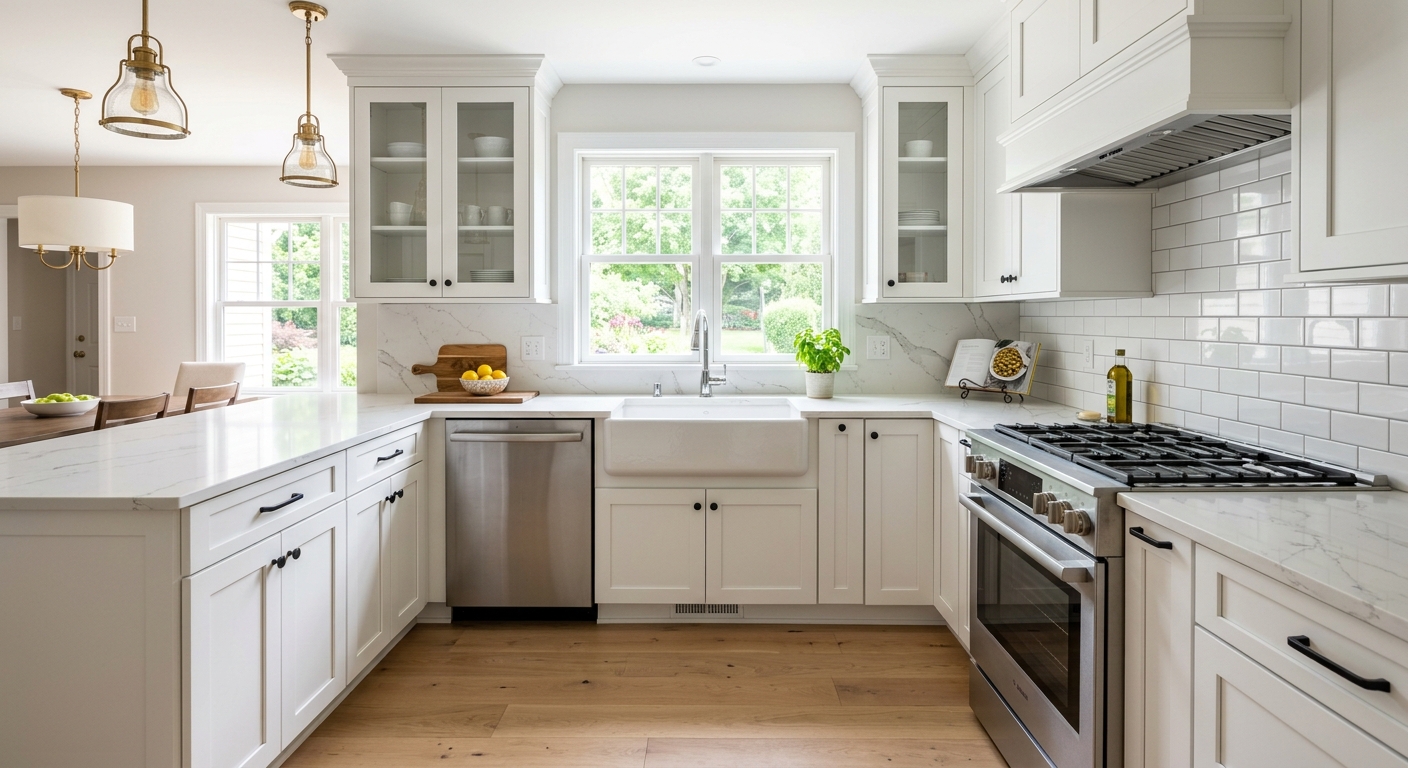
Kitchen renovation costs in Center — 2026
In Center, Butler County, kitchen renovation costs span a wide range depending on scope and finish. This area, with a median household income of $87,036 and a homeownership rate of 82.7% (U.S. Census Bureau, ACS 2024), tends to see owners focus on long-term value rather than rental-friendly makeovers. Many homes in Center date to periods before 1980, but you’ll also find 1990s and early 2000s builder-grade kitchens from the Cranberry Township subdivision boom—which means a full gut might be either a wall-moving job or a straightforward refinish, depending on the house.
The main driver of blown kitchen budgets is planning for one level of work—say, a simple cabinet swap—then adding items from the next tier up, such as removing walls or moving plumbing, partway through. Know your scope from the outset and keep your decisions inside that fence.
| Scope |
What's included |
Duration |
Price range |
| Full gut remodel, same layout |
cabinets, counters, appliances, flooring, lighting, fixtures |
6–10 weeks |
$30,500–$123,000 |
| Gut plus layout change |
all of the above plus moved plumbing, electrical, walls |
10–16 weeks |
$66,500–$123,000 |
| Cabinet replacement (stock to semi-custom) |
remove and install cabinets, hardware, patching |
1–3 weeks |
$7,200–$30,500 |
| Cabinet refacing |
new doors and drawer fronts, veneer, hardware |
3–6 days |
$7,200–$20,500 |
| Countertop replacement only |
template, fabricate, install, reconnect sink |
1–3 weeks |
$4,100–$16,500 |
| Kitchen flooring only |
remove existing, install new flooring |
3–6 days |
$5,100–$20,500 |
Estimates for a typical Center kitchen. Cabinet grade and whether the layout changes move these figures more than square footage.
Three ways to organise the project
In Center and across Butler County, homeowners have three real options for running a kitchen renovation—each suited to a different level of free time, budget, and appetite for hands-on management.
The first is hiring a design-build kitchen company. Here, one firm handles design, cabinets, and installation start to finish. This approach carries the highest price tag but offers the smoothest ride—if something goes wrong, there’s no finger-pointing between cabinet supplier and contractor. This saves stress, especially where dozens of decisions have to be locked in before a single wall comes down.
The second route is hiring a general contractor. This is common in Center, where kitchens often need more structural or electrical work than just new cabinets. The GC lines up their own trades, manages the schedule, and keeps you in the loop for finish selections. Price lands in the middle, and this model needs a committed, communicative contractor since you’re trusting their skill in both scheduling and quality control. With Butler County’s finish-trade labor tighter than Allegheny County, lining up reliable trades takes experience.
The third is self-managing—hiring trades and sequencing the work yourself. This can be cheapest but is rarely worth it for anyone with a full-time job or a kid at home, especially if permits are triggered. Most headaches in Center households who try this come from trades ghosting or changing timelines at the last minute. Unless your project is purely cosmetic, this model is high-stress and full-risk.
Code requirements for Center kitchens
Most kitchen cosmetic updates in Center—painting, swapping hardware, refacing cabinets, or replacing a countertop without moving plumbing—proceed without a permit. Where issues crop up is when owners move appliances, add electrical circuits, or knock down walls. In most Butler County townships, permits are required for work that alters electrical, plumbing, or structure; Cranberry Township is particularly strict and requires formal plan review before issuing permits for layout changes or new plumbing and structural work.
Inspections are typically handled by the municipal building office in Butler and Cranberry Township, including electrical. In more rural Butler County townships, third-party inspectors may review the work. Always confirm before work begins, since electrical and building sign-off may come from someone sent by your township—or an independent agency if you’re outside the big population centers.
Any contractor you hire in Pennsylvania for over $500 in work must hold the Home Improvement Contractor (HIC) registration from the Pennsylvania Office of Attorney General. You can (and should) confirm a company’s registration at hic.attorneygeneral.gov. All employers must carry workers’ compensation insurance; check compliance via the WCAIS system.
Skipping permits or the proper contractor registration means trouble in Center at resale, when missing paperwork or unapproved electrical work will almost always be caught during sale prep or municipal resale inspection.
Planning appliances before cabinets
Appliances set the constraints for kitchen design, yet many projects in Center get derailed by picking cabinets first and appliances second—leading to out-of-place ranges, fridges sticking out into traffic lanes, or dishwashers that need custom filler panels. Cabinets must be sized and spaced around the actual appliance models you’re ordering. If you swap a standard-depth refrigerator for a counter-depth, you’ll gain space but may need a filler panel or deep cabinet above. A slide-in range and a freestanding range require different cuts and cabinetry on either side.
For ranges, going from gas to induction means checking your panel for the right amperage and maybe running a new circuit—work that can push you into permit territory in some Butler County townships. “Panel-ready” dishwashers blend in with your cabinets but must be specified early so panels will fit precisely. When it comes to range hoods, ducting to the outside is required by code in most cases and always works better than recirculating models, which capture little grease or odor and aren’t a good compromise in tight Center layouts.
Professional-style appliances rarely return their price in actual food quality; the gain is mainly aesthetic and “feel,” not cooking performance, except in heavy-use households. And with today’s supply conditions, some popular appliances have lead times as long as cabinets—so lock in your orders early, or risk holding up the whole job.
Four kinds of kitchen project, four budgets
In Center, asking “how much to remodel a kitchen?” covers four very different scopes, each with its own budget implications. Deciding your tier first is the most important step—it’s what lets you judge whether a contractor’s number fits your expectations.
A cosmetic refresh includes new paint, hardware, backsplash, and perhaps updated lighting—no cabinets or layout changes. This is strictly a surface update for newer homes or those where the function works but the finish feels tired.
The next level is “pull and replace”—installing new cabinets and countertops in the existing footprint, leaving plumbing and wiring where they are. Most post-1990s homes in Center fit well into this category, and the cost is much lower since nothing messy gets relocated.
The cliff comes as you move to a full gut—everything stripped to the studs, layout staying the same, and all services updated in place. This is needed when old wiring or plumbing push you beyond a simple swap. Once walls, floors, and services are open, you’re paying for a more skilled crew, a longer timeline, and more inspections.
Change the layout—moving walls, relocating the sink or range—and both the price and complexity jump sharply. These changes activate permit requirements in most Butler County townships and bring in plan reviews and municipal or third-party inspections.
Pick your scope before you call a contractor. No honest renovation company in Center will give a meaningful number until you’ve narrowed it down—and “remodel” alone doesn’t mean enough.
Eight weeks without a kitchen
Even basic gut-and-replace kitchen jobs in Center routinely mean six to eight weeks without access to your kitchen. Experienced homeowners set up a temporary cooking and eating area—usually a folding table with a microwave and kettle near a bathroom or laundry sink. Move your fridge to a dining room or hallway, and expect to rely on paper plates and prepared foods. It’s smart to budget extra for groceries and eating out during this phase; for a family, the increase may exceed what you’re spending on new flooring.
Dust control can’t be overstated. Heavy plastic sheeting and zip walls between the kitchen and the rest of your first floor matter much more than most people expect, especially since Butler County winters keep windows closed. Ask where your crew will place their dumpster and stage materials—driveways and yards in Center are sometimes small, so clear this in advance.
If you have pets, plan on the door standing open at least part of every workday, and tell your crew in advance. Some homeowners do opt to move out for demolition week—if your home is especially tight, this is worth considering. Either way, count on increased noise, dust, and unavoidable daily inconvenience—planning ahead matters.
Allowances, exclusions and change orders
If you line up three kitchen bids in Center, every line may read the same but the bottom lines are rarely comparable. The biggest culprit: allowances. An allowance is a placeholder price for materials you haven’t chosen yet—floor tile, lighting, hardware, appliances. One bid may write $2,500 for counters, while another writes $7,500: the first expects laminate, the second granite or quartz. Compare allowance numbers line by line before judging totals.
Ask for the cabinet brand, series, and box construction by name. See exactly what countertop material, thickness, and edge style are included. Check electrical work: which circuits and GFCIs are planned, and where? Unforeseen site conditions—like old wiring or rot—should be priced by a specific method, not “as needed.” Any change order should require a written approval before work continues. Payments are safest when tied to project milestones (demolition, cabinets in, counters installed) rather than dates, with modest upfront deposits. And always require lien waivers from subcontractors; this ensures everyone gets paid and no mechanic’s lien lands on your home later.
For any contract over $500 in Pennsylvania, the Home Improvement Consumer Protection Act requires a written contract and gives a three-day right of cancellation. If a contractor dodges these, walk away.
| Line item |
What to look for |
Red flag if… |
| Allowances |
realistic amounts, itemised |
round numbers with no basis |
| Cabinetry |
brand, line, box construction |
'quality cabinets' |
| Countertops |
material, thickness, edge, seams |
material name only |
| Electrical |
circuits to be added, GFCI scope |
'as needed' |
| Unforeseen conditions |
how they are priced and approved |
not addressed |
| Change orders |
written approval before work |
verbal |
| Payment |
milestone-based, modest deposit |
front-loaded |
| Lien waivers |
from subs at each payment |
not offered |
Frequently asked questions — kitchen renovation in Center
Should I reface or replace my kitchen cabinets?
Refacing is worth considering if your kitchen layout works well and your cabinet boxes are structurally sound—common in Center homes built after the 1990s subdivision boom. Refacing changes doors, drawer fronts, and exposes surfaces for an updated look at lower cost and faster turnaround (usually done in 3–6 days). In this area, a cabinet refacing project costs $7,200–$20,500, while full replacement with stock to semi-custom cabinets runs $7,200–$30,500. If the cabinets are warped, rotting, or the layout doesn’t suit your needs, full replacement is the better option. For older, pre-1980 kitchens with odd dimensions or failing boxes, replacement is often more cost-effective in the long run.
How should renovation payments be scheduled?
Payment in Center kitchen renovations should strongly favor milestone completion—not fixed dates. Typically, contractors request a modest deposit (often 10%), then further payments at defined milestones—after demolition, after cabinet delivery, or after countertop install, for example. Tying payments to progress keeps everyone on pace, and it’s supported by the Home Improvement Consumer Protection Act. A front-loaded schedule (heavy deposit, little after work finishes) is a red flag. On a typical Center full-gut remodel running $30,500–$123,000, never put down more than is needed to reserve your materials and labor. Require lien waivers from subcontractors with each payment to protect yourself from liens if anyone goes unpaid.
Does replacing cabinets require a permit?
In most Center Township homes, simply swapping cabinets with no layout change, wall movement, or new electrical doesn’t require a permit. However, in Cranberry Township or if you’re relocating major appliances, moving plumbing, or adding circuit capacity, permits can be required—and plan review may be necessary before work can begin. Cabinet refacing and like-for-like replacements typically proceed permit-free throughout Butler County, but always check for your specific municipality before ordering or demo. Not pulling permits when needed can lead to expensive corrections at resale, when missing records or unsafe wiring get flagged by municipal or third-party inspectors.
What are cabinet lead times in Center right now?
Cabinet lead times in Center can run from three to ten weeks, depending on whether you choose stock, semi-custom, or custom lines. Stock cabinets are quicker but less flexible for older homes with irregular wall layouts; semi-custom gets you more finish and fit options at a modest wait. If you’re doing a full-gut kitchen remodel (budget: $30,500–$123,000), factor in cabinet delivery at the start, as delays hold up every subsequent stage—flooring, counters, appliances, and finishing work. Appliance lead times can be just as lengthy, so order both as early in the process as possible.
Why are kitchen quotes in Center so far apart?
Local Center kitchen remodel quotes can differ by tens of thousands, even for similar-size kitchens. The reason isn’t greed but scope, finish, and “allowances”—the placeholder sums contractors use for not-yet-picked items. One bid might include builder-grade cabinets and laminate counters, another semi-custom cabinets and quartz. Labor is also less specialized here than in core Pittsburgh, so workmanship and scheduling vary. For a basic “pull and replace” scope, the price sits between $7,200–$30,500, but once layout changes or premium finishes enter, numbers climb quickly. Always read allowance lines closely and confirm what brands, thicknesses, and grades are included before comparing totals.
Is lead paint a concern in Center kitchen renovations?
For homes in Center built before 1978 (over half the stock per census estimates), lead paint is a real concern during kitchen remodels. The EPA Lead RRP rule applies, requiring contractors to be certified to disturb painted surfaces—especially when cutting, sanding, or demoing old kitchen walls, trim, or cabinets. If your project is a full gut (a budget of $30,500–$123,000), insist on EPA-certified crews. If your home is newer, this is less of a concern, but always verify build year and contractor certifications to protect household health.
What is a realistic contingency for a Center kitchen?
In Center kitchen renovations, set aside 10–15% of your total project cost as a contingency for surprises—hidden plumbing issues, unplanned electrical fixes, or moisture behind cabinets. For a cabinet replacement job budgeted at $20,500, keep at least $2,000–$3,000 extra on hand. Older homes in the area, especially those built before 1980, tend to present more surprises once walls are open. Building in this cushion avoids tough choices or stalled work if something major appears after demolition.
Should I renovate before selling or let the buyer do it?
In Center and throughout Butler County, renovating before sale only pays off for kitchens that are functionally obsolete or in poor repair. Most buyers expect dated finishes but working appliances. For a home in good condition, a cosmetic refresh (paint, hardware, possibly counters for $4,100–$16,500) is almost always more cost-effective than a full remodel right before listing. Letting the buyer handle a $66,500 full-gut means your sale price might dip, but you avoid risking a major investment that doesn’t match buyers’ taste. Discuss with your agent before spending.
What countertop material is best for a family kitchen?
In most Center kitchens, quartz is the low-maintenance family favorite—it’s nonporous, stain- and chip-resistant, and comes in a wide variety of looks. Granite remains popular but requires sealing; laminates are most affordable and still practical, especially for tight budgets in one of Center’s many builder-grade houses now due for their first serious update. Good stone or engineered tops run $4,100–$16,500 installed. For kids who are rough on surfaces, skip marble; it stains and etches easily. With a lot of local families renovating 1990s–2000s kitchens, the safe bet is a neutral, mid-tone quartz or sturdy, sealed granite.