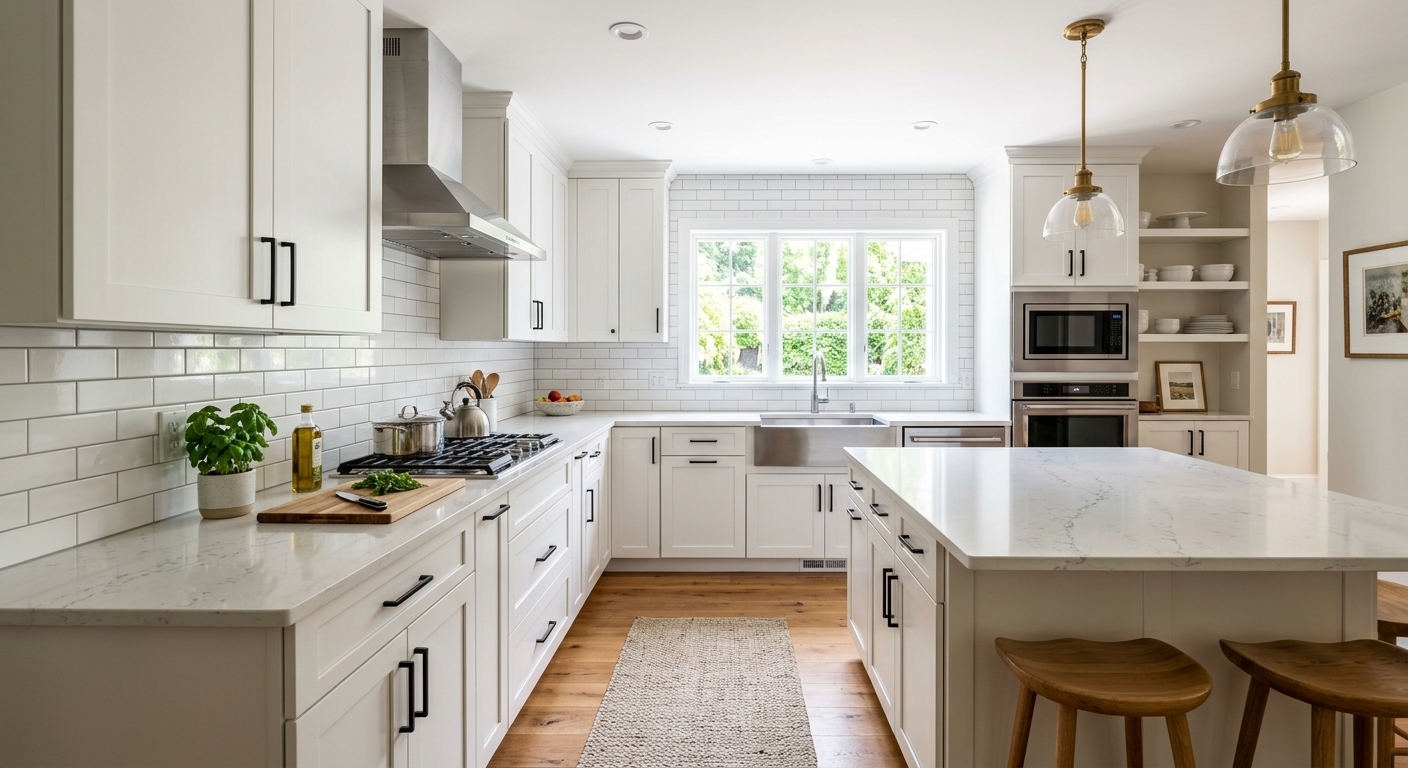
Millcreek kitchen renovation prices by scope — 2026
Kitchen renovation in Millcreek comes with a wide range of price tags, shaped by both your choices and the nature of your house. The typical Millcreek homeowner—earning a median household income of $77,400 with a homeownership rate of 71.6% (U.S. Census Bureau, ACS 2024)—is likely to plan carefully, since kitchen spending in this market closely tracks what homes are actually worth. A renovation in a postwar ranch looks very different from what might be needed in one of the many pre-1950 homes here, where legacy wiring or irregular framing are common surprises once walls open up. Older kitchens are often compact galley-style layouts, but not always; shifting the layout entirely costs much more than updating within the same footprint.
The line that governs every budget: most blown kitchen budgets come from pricing for only new cabinets, counters, and flooring, then deciding midway to move walls or gut the space. That’s where labor, permits, and hidden conditions can double your outlay. Here’s what Millcreek homeowners should expect in 2026:
| Scope |
What's included |
Duration |
Price range |
| Full gut remodel, same layout |
cabinets, counters, appliances, flooring, lighting, fixtures |
6–10 weeks |
$29,500–$119,000 |
| Gut plus layout change |
all of the above plus moved plumbing, electrical, walls |
10–16 weeks |
$64,500–$119,000 |
| Cabinet replacement (stock to semi-custom) |
remove and install cabinets, hardware, patching |
1–3 weeks |
$6,900–$29,500 |
| Cabinet refacing |
new doors and drawer fronts, veneer, hardware |
3–6 days |
$6,900–$20,000 |
| Countertop replacement only |
template, fabricate, install, reconnect sink |
1–3 weeks |
$4,000–$16,000 |
| Kitchen flooring only |
remove existing, install new flooring |
3–6 days |
$5,000–$20,000 |
Estimates for a typical Millcreek kitchen. Cabinet grade and whether the layout changes move these figures more than square footage.
Resale value and kitchen spending
A kitchen renovation helps a home sell in Millcreek, but it is rare for a project to recover its full cost at resale—especially at the higher end. The true value comes in salability: a dated or failing kitchen can make a house linger on the market or drag down offers, but an over-the-top remodel does not add dollar-for-dollar value above what Millcreek’s real estate market will bear. With a median household income of $77,400 (U.S. Census Bureau, ACS 2024), there is a point beyond which spending will not come back even when you sell.
How you approach the project matters: renovating to live in and renovating to sell are two different projects. If you are planning to stay, then spend where it makes daily life better—storage solutions, layout improvement, lighting that works for you. Resale thinking, by contrast, comes down to neutral finishes, a mid-range spend, and no structural changes. Mid-range projects tend to recover a higher share at sale than luxury work, simply because most buyers in Millcreek are not shopping for a high-end kitchen when the neighborhood does not support it.
Spending $64,500–$119,000 on a kitchen in a house where neighboring kitchens typically refresh at $29,500–$64,500 will rarely pay off, even if you pick the finest materials and appliances. If you’re thinking in terms of return, keep your choices comfortably within the range buyers expect here. Renovate for resale only when you’re truly selling; otherwise, make the space serve you, not a hypothetical future buyer.
Layout changes and the cost cliff
The fastest way to send a Millcreek kitchen remodel over budget is to move from a simple update into layout change territory. Keeping the plumbing and electrical where they are, and working within the existing walls, keeps you in one cost class—a full gut with no layout changes remains in the $29,500–$119,000 bracket. But as soon as the plan calls for moving the sink, fridge, or range to new locations, or demolishing a wall, costs jump sharply—and not at all in proportion to how far those items move.
Why? Relocating drain lines means maintaining proper slope, which can be complicated or impossible if you’re on a slab or over a finished basement ceiling. New circuits are often needed when you shift appliances, and that triggers a review of panel capacity and older wiring that is common in Millcreek’s pre-1950 homes. Removing or cutting into a wall starts the discussion around whether it is load-bearing, which brings an engineer into the permitting process and extra construction cost. Moving a range or adding an island can easily mean a new exhaust duct to the exterior, which requires an exterior wall or roof penetration—a job with its own set of code requirements in this climate.
The honest advice: look at whether the layout is truly unworkable or just dated. Moving the sink four feet or chasing an open floor plan usually costs far more than homeowners estimate, when the big gains sometimes come from storage solutions and better lighting. For anyone keeping the original kitchen footprint, you stay well within a predictable bid range. Once plumbing, electrical, or walls move, the project will be in the $64,500–$119,000 range, with more surprises along the way—and in Millcreek’s older homes, those surprises multiply.
Permits and inspections for a Millcreek kitchen
In Millcreek, homeowners rarely need a permit if they are upgrading surfaces—painting walls, changing cabinet hardware, or replacing countertops in place. But any moved or new electrical circuits, plumbing alterations, removal of walls, or structural changes will trigger a permit requirement under the Pennsylvania Uniform Construction Code (UCC), which Millcreek enforces locally. The City of Erie Department of Codes and Permits handles inspection and enforcement within its jurisdiction. Mechanical work like venting a new range hood may also require permits, especially if new penetrations or circuits are involved.
Home improvement contractors working on contracts over $500 must hold a Home Improvement Contractor (HIC) registration from the Pennsylvania Office of Attorney General. You should verify any contractor at hic.attorneygeneral.gov. If your contractor has employees, Pennsylvania law requires workers’ compensation coverage—check this through WCAIS at wcais.pa.gov. Not all plumbing or electrical work needs a state license, but municipal rules apply, so ask your contractor about their local credentials if your project is in a neighboring township.
Unpermitted work may not only bring problems with municipal code authorities, but will create headaches at resale—title companies and buyers could spot improvements that lack permits, especially if electrical or structural work was completed. The best path in Millcreek: clarify upfront whether your project will need inspection and sign a written contract, as required under Pennsylvania’s Home Improvement Consumer Protection Act (HICPA).
Countertop materials compared
Countertop choice makes a daily impact, and the differences rarely come down to looks alone. Quartz (engineered stone) is popular in Millcreek kitchens—its non-porous surface resists staining and never needs sealing, but it’s vulnerable to heat from pots and pans. Granite provides a unique natural look and excellent heat and scratch resistance, but demands periodic sealing and can chip if hit along the edge. Laminate countertops, often dismissed, have improved greatly in durability and appearance; for modest kitchens or Millcreek rentals, they’re practical, affordable, and easy to keep clean, though they won’t stand up to direct cuts or extreme heat.
Butcher block offers warmth and a beautiful work surface, especially for those who cook daily—but it requires regular oiling and will show knife marks. Solid surface (like Corian) can be seamlessly joined, sanded if scratched, and offers a warmer feel than stone, but isn’t as heat tolerant and may show seams in certain configurations.
Fabrication details impact both price and function: edge profiles (like ogee or bullnose), extra sink or cooktop cutouts, and planning where seams land in your workspace can shift fabrication costs up. Some materials require a template visit for a precise fit; others may be measured more simply. Seam visibility is real with stones, less so with solid surface, and often obvious with laminate.
Choosing laminate for a standard Millcreek kitchen—or a rental—makes sense and is not a compromise. A well-finished laminate, cared for, will give years of reliable service, especially when paired with updated fixtures and lighting.
Allocating a kitchen budget
Most people are surprised by how their kitchen budget breaks down in practice. The single biggest share is nearly always cabinetry—even before installation, finish choices or hardware are added. Labor is next, often representing a quarter or more of the typical Millcreek kitchen budget, especially if you modify the layout or run into the quirks of pre-1950 framing and wiring. The rest is split among countertops, appliances, flooring, lighting, and plumbing fixtures.
But two lines get missed: contingency for what’s behind the walls (think hidden water damage, legacy wiring, odd framing dimensions), and the soft costs—permit fees, design help, delivery, and disposal. In Millcreek’s older homes, skipping these means under-budgeting—and it’s the rare job where nothing is found behind the wall to slow work or cost extra.
Your best value for an extra thousand dollars? Upgrading hardware to full-extension soft-close, or upgrading lighting. Your worst? A luxury appliance package in a kitchen with basic cabinets—it unbalances both function and resale. Anchor your allocation to the standard gut-remodel in this market: for $29,500–$119,000, here’s how the percentages tend to fall:
| Category |
Share of budget |
Notes |
| Cabinetry |
25–35% |
the largest line and the longest lead time |
| Labour and installation |
20–30% |
rises sharply if the layout changes |
| Countertops |
8–15% |
material choice drives the swing |
| Appliances |
10–20% |
widest range of any category |
| Flooring |
5–10% |
|
| Lighting and electrical |
5–10% |
higher in older homes needing circuits |
| Plumbing and fixtures |
4–8% |
|
| Permits, design, disposal |
3–6% |
usually forgotten in early budgets |
| Contingency |
10–15% |
not optional in a pre-1980 house |
The biggest line item in your Millcreek kitchen
Cabinet decisions will affect more than half your renovation experience—timeline, budget, and daily use. Homeowners in Millcreek face four main options.
Refacing is not a band-aid solution; it’s an economical way to transform look and feel when the current cabinet boxes are solid, square, and arranged as you want. It does not increase storage or alter layout, but saves thousands compared to full replacement. Painting cabinets is lower still on the cost ladder—a good choice for sound cabinetry, but doesn’t solve worn or outdated doors.
Stock cabinets offer the lowest replacement cost; they come in fixed sizes and require filler strips where your kitchen doesn’t match catalog dimensions—common in Millcreek’s older houses. Semi-custom lines allow you to adjust sizes and finishes for a better fit and more polished look, but expect lead times of 6–12 weeks. Full custom gives you total control, fitting odd corners and using any finish, but at the highest cost and with the longest wait.
Quality matters at every tier: look for plywood box construction, dovetail drawers, full-extension soft-close slides, and durable finishes. In older Millcreek homes—where non-standard wall dimensions and quirks behind the plaster are routine—owners often find themselves choosing semi-custom or custom, even if stock was the original plan. Here’s how your cabinet options stack up:
| Option |
Cost |
Best when |
Limitation |
| Painting existing cabinets |
$1,200–$3,500 |
boxes and doors sound, tight budget |
no layout or style change |
| Refacing |
$6,900–$20,000 |
boxes square and layout works |
storage unchanged |
| Stock cabinets |
$6,900–$29,500 |
standard dimensions fit |
filler strips, limited finishes |
| Semi-custom |
$20,000–$29,500 |
non-standard walls or finishes |
6–12 week lead time |
| Full custom |
$20,000–$29,500 |
unusual layout or high-end design |
longest lead, highest cost |
Frequently asked questions — kitchen renovation in Millcreek
Why is there a gap after cabinets are installed?
It’s common to spot small gaps above or beside new cabinets after installation in Millcreek homes—especially in houses built before 1950, where walls rarely run perfectly square or plumb. Most older kitchens have irregular framing behind the plaster or drywall, so installers often have no choice but to leave a small gap to keep cabinets level and functional. These are typically covered with trim, crown molding, or scribe strips for a finished appearance. In rare cases, such gaps are left visible when the homeowner plans to install additional tile or specialty trim. It’s not a sign of poor workmanship; it is a practical response to the realities of older construction. Custom or semi-custom cabinets (starting at $20,000–$29,500) can be ordered to fit out-of-square spaces more precisely, but for stock cabinets, some fill is almost always necessary.
What flooring works best in a kitchen?
In Millcreek’s climate, with long winters and the potential for snow and water tracked inside, durable flooring choices matter. Luxury vinyl plank and tile, sheet vinyl, and ceramic or porcelain tile are all sound options for kitchens—they handle moisture, clean up easily, and withstand spills and dropped pots. Site-finished hardwood can work, but only if carefully maintained and sealed; many historic homes here started with wood but now need to balance durability with maintenance. For households who cook heavily or have pets, resilient flooring like luxury vinyl is hard to beat and fits the budgets from $5,000–$20,000 for standard installations. Laminate flooring has improved but still risks water damage along seams. Whatever the material, install a water-resistant underlayment, especially over an older structural floor, to avoid problems down the line.
Why are kitchen quotes in Millcreek so far apart?
Kitchen quotes in Millcreek can vary widely because of differences in scope, finish levels, labor costs, and what’s hiding behind your walls. Many homes here pre-date 1950, so once the demolition starts, contractors may uncover legacy wiring, old water lines, or irregular framing—all of which drive up labor and materials. The finish crew labor market is tight in Erie County, with most experienced tradespeople based in Erie or Millcreek. Whether you opt for stock, semi-custom, or full custom cabinets (ranging from $6,900–$29,500 and higher) affects the bottom line too, as does whether you’re simply updating finishes or moving the entire kitchen layout. Detailed, line-item quotes with allowances for contingencies are the best way to compare bids—not just the total at the bottom.
Does a kitchen renovation increase home value in Millcreek?
A kitchen renovation can make your home more appealing to buyers in Millcreek, especially if the original kitchen is dated, failing, or impractical—a common scenario here given the large share of homes built before 1980. While a full kitchen remodel ($29,500–$119,000) may help your home stand out and sell faster, it rarely boosts resale value by the full cost of the work, unless you keep finishes and configuration squarely in line with what buyers expect in the area. Millcreek’s median income and single-family home profile shape resale value; high-end features don’t always net their full dollar back. Renovate for your own use if you plan to stay, and keep resale-targeted updates modest and neutral.
Should I hire a general contractor or a kitchen firm?
For a full kitchen remodel in Millcreek, either a general contractor or a specialized kitchen renovation firm can handle the job, but the right choice depends on your project’s complexity. Kitchen-focused firms bring deep experience sourcing cabinets, countertops, and fixtures and can coordinate schedules tightly for projects in the typical $29,500–$119,000 range. A GC might be a better option if your project involves significant layout changes, structural work, or simultaneous renovations in other rooms. Always verify HIC registration with the Pennsylvania Office of Attorney General and ensure workers’ compensation coverage if employees are involved, as required in this jurisdiction. Ask about experience in older Millcreek homes—the quirks behind the walls are best handled by those who’ve seen them before.
What does a quartz countertop cost in Millcreek?
Quartz countertops are a popular upgrade in Millcreek kitchens due to their durability, non-porous surface, and contemporary finishes. The installed price for quartz falls within the local band for countertop replacement—typically $4,000–$16,000 depending on the size of your kitchen, edge profiles, number of cutouts, and specific brand selected. Fabrication costs rise with complex layouts, waterfall ends, or undermount sink cutouts. Quartz is strong against stains but susceptible to heat, so using trivets is advised. For smaller kitchen footprints typical in Millcreek’s older homes, a basic quartz install can often be done at the lower end of that range. When budgeting, ask your fabricator for a line-item bid that shows template, fabrication, and installation separately.
Do I need a permit for a kitchen renovation in Millcreek?
Whether you need a permit depends on the project’s scope. In Millcreek, cosmetic updates—painting, refacing cabinets, swapping out counters without changing the sink—usually do not require a permit. Once you’re moving or adding plumbing lines, running new electrical circuits or outlets, making structural changes, or installing new ventilation for an exhaust hood, a permit under Pennsylvania Uniform Construction Code will be needed. For anything more than a “pull and replace,” you should check with the City of Erie Department of Codes and Permits. It’s not worth skipping: resales in Millcreek often catch unpermitted work, and you may be required to correct or remove changes before closing. For a typical kitchen remodel ($29,500–$119,000), most projects trigger permits at some stage.
Do I need to change my kitchen layout?
Most Millcreek kitchens, especially in homes built before 1950, start with compact galley or U-shaped layouts. Whether you need to change yours depends on how well the workspace actually functions. Changing the layout—moving the sink, range, or refrigerator, or making structural changes—often doubles the cost compared to just replacing cabinets and finishes. Unless the existing flow truly blocks day-to-day cooking or hosting, it usually pays to keep plumbing and electrical runs where they are. Saving layout changes for genuinely broken spaces keeps your renovation in the $29,500–$64,500 range instead of shooting up to $64,500–$119,000.
Are Millcreek kitchens typically small galley layouts?
A large share of Millcreek’s housing stock was built before 1950, when the galley kitchen was standard for single-family homes. It’s common in these homes to find a compact, corridor-style kitchen with just enough room for one or two people. Later housing, built from the 1980s onward, may have more open or L-shaped kitchen layouts, but legacy wiring and wall framing quirks are still often present in older renovations. If you’re working with a small galley and aiming for stock or semi-custom cabinets ($6,900–$29,500), design decisions that maximize storage and minimize layout changes provide the best value for most owners.