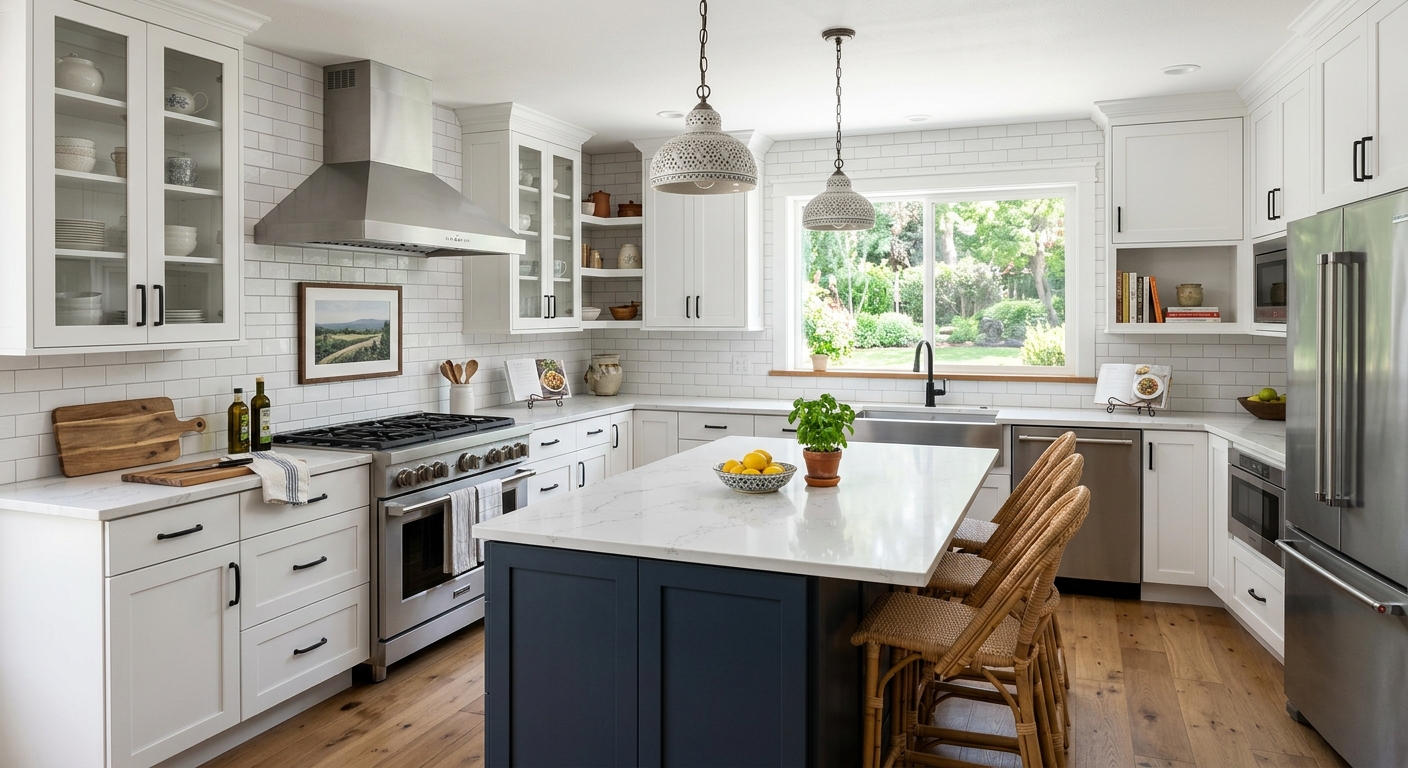
What a kitchen remodel costs in Hamilton
Hamilton’s kitchen renovation budgets tend to reflect the area’s high homeownership rate and above-average median household income for Franklin County (U.S. Census Bureau, ACS 2024). With 86.0% of Hamilton households owning their homes and a median income of $92,331, most upgrades are driven by owners who expect to enjoy the results—or realize them at resale. Franklin County’s housing is mostly post-1960 suburban homes along US‑11 and I‑81, so most projects are mid-life kitchen updates rather than repairs to antique layouts. If your kitchen was built after 1980, you likely have enough space and layout already; older homes from the 1940s and 1950s often need walls moved just to work by today’s standards, which can double your price band.
The biggest reason for blown budgets in Hamilton is pricing a “pull-and-replace” tier (all new finishes, same layout) and then getting quoted for a “gut and move layout” tier (all new systems, walls moved). That scope jump is what takes a project from $31,500 to $125,000. In Franklin County, travel surcharges and thin finish-trade labor can add lead time or cost, so always get your quote in writing before proceeding.
| Scope |
What's included |
Duration |
Price range |
| Full gut remodel, same layout |
cabinets, counters, appliances, flooring, lighting, fixtures |
6–10 weeks |
$31,500–$125,000 |
| Gut plus layout change |
all of the above plus moved plumbing, electrical, walls |
10–16 weeks |
$68,000–$125,000 |
| Cabinet replacement (stock to semi-custom) |
remove and install cabinets, hardware, patching |
1–3 weeks |
$7,300–$31,500 |
| Cabinet refacing |
new doors and drawer fronts, veneer, hardware |
3–6 days |
$7,300–$21,000 |
| Countertop replacement only |
template, fabricate, install, reconnect sink |
1–3 weeks |
$4,200–$16,500 |
| Kitchen flooring only |
remove existing, install new flooring |
3–6 days |
$5,200–$21,000 |
Estimates for a typical Hamilton kitchen. Cabinet grade and whether the layout changes move these figures more than square footage.
Appliance choices and the decisions they force
Appliances aren’t just a finishing choice in Hamilton—they determine how your kitchen is built. Dimensions matter: if you order cabinets before locking down appliance specs, you risk a fridge that sticks out or a range that doesn’t fit. For example, counter-depth refrigerators require slightly deeper cabinets for a seamless look, while standard-depth fridges stick out past the counter unless you design around them. Slide-in and freestanding ranges need different cabinet details; slide-ins often require open sides and rear filler, while a freestanding range can slip into almost any spot.
Choosing gas versus induction (or electric) is about the bones of your house in Franklin County. Switching from gas to induction will mean running a high-capacity 240V circuit, potentially pushing your panel to its limits. Always confirm panel capacity before specifying.
Panel-ready dishwashers and fridge fronts drive a more custom cabinet plan, plus higher cost, but deliver that “furniture” look. For range hoods, venting to the outside is always preferable in our climate, venting moist, greasy air out. Recirculating hoods are a compromise—acceptable if retrofitting is impossible, but less effective, especially in Hamilton’s post-1960 homes with tighter envelopes.
Professional-grade appliances like Sub-Zero and Wolf mainly bring cosmetic and brand cachet; true performance boosts are only felt by serious home cooks. A $7,000 range won’t improve the function of an awkward layout. The reality now is that some appliance models have longer delivery times than the cabinets—always order early and confirm arrival before demolition.
Three ways to organise the project
There are three ways to run a kitchen remodel in Hamilton, and your choice shapes your final price and your stress level just as much as the style you pick. Design-build kitchen firms do it all under one contract: they design, supply the cabinets, and handle installation. This is the top end for price, but you get a single point of accountability and can expect the lowest hassle, which is why busy owner households in Franklin County, where the labor market is tight and reliable trades are in demand, often go this route. Expect to pay for that certainty.
Hiring a general contractor means they’ll coordinate subs—plumber, electrician, tile, and so on—but usually you’ll handle material choices or bring in a designer. Costs are lower than design-build, but you need to make more decisions and there’s effort involved in picking finishes, scheduling suppliers, and reviewing work. Scheduling slip-ups fall somewhere between you and your contractor.
Owner-managed is cheapest on paper: you hire the trades, arrange the sequencing, and buy all the fixtures and materials yourself. This route works if you’re local, know trusted subtrades, and can drop in to solve problems. But in Hamilton, with longer lead times for skilled finish trades, self-managing is risky unless you genuinely have the bandwidth. If your scope needs a permit or involves trades that aren’t friends or family, do not try to self-manage if you have a day job. The hidden costs come in delays, callbacks, and mistakes nobody claims.
What requires a permit in a kitchen renovation
In Franklin County, including Hamilton Township, the line between what requires a permit and what does not is clearer than in many areas. No permit is typically needed for cosmetic changes: painting cabinets, swapping hardware, refacing doors, or even replacing countertops—so long as plumbing and electrical systems are untouched. Many Hamilton homeowners proceed with cabinet refacing and minor updates without a permit, which matches local practice for non-structural work.
A permit is typically needed if you move or add new electrical circuits, shift plumbing, alter walls, or change anything structural. Installing a new range hood vented outdoors—or anything that pierces an exterior wall—will nearly always pull a mechanical permit. In Chambersburg, building permits are standard when you change layout or relocate plumbing or electrical. If your project triggers a permit, plan for plan review, especially for changes involving utilities or walls.
Electrical inspections are commonly carried out not by municipal staff but by third-party agencies such as Approved Code Services or Commonwealth Code Inspection Service. Many homeowners are surprised by this, as the inspector who signs off on the electric may not work for the township itself.
Every contract over $500 with a renovation contractor must involve a Home Improvement Contractor (HIC) registered with the Pennsylvania Office of Attorney General—verify at hic.attorneygeneral.gov. Employers must carry workers’ compensation; you can look this up at WCAIS (wcais.pa.gov). Unpermitted work can derail your home sale and force expensive remediation, so check requirements before starting, especially in homes built before 1980.
Four kinds of kitchen project, four budgets
When someone says “kitchen remodel” in Hamilton, it covers a huge range. Understanding the four tiers saves you time and money:
- Cosmetic refresh: Paint, new knobs and pulls, updated backsplash, light fixtures—but cabinets and layout stay put. This is all surface work: fast and lower cost, typically no permit involved.
- Pull and replace: Swap cabinets and counters in the existing footprint. Plumbing and electrical stay where they are, but everything gets replaced. This is the most common project in Franklin County’s 1980s–2000s homes—update the look, no layout change, prices from $7,300–$31,500 for cabinets, $4,200–$16,500 for counters.
- Gut, same layout: Strip to studs, update wiring and plumbing in place, maybe insulate or re-drywall. The finish may be similar to a pull-and-replace, but with systems renewal; pricing jumps to $31,500–$125,000.
- Layout change: Move the sink, stove, or walls. This triggers permits and engineering, as well as the highest skilled labor. Expect $68,000–$125,000.
The cost cliff is between “gut, same layout” and “layout change”—moving services or structure racks up labor, permit, and material costs at a rate far above the distance being moved. Decide which tier suits your home and needs before calling contractors. A contractor can’t give you more than a wild guess until you decide if you’re keeping the layout or not—this is the difference between a smart bid and a waste of time for everyone.
When a Hamilton kitchen needs walls moved
Layout changes—removing or moving walls, relocating plumbing or appliances—are the dividing line between a moderate and a major kitchen budget in Hamilton. Keeping plumbing and electrical in place keeps you within the “gut, same layout” cost of $31,500–$125,000. The moment you move the sink, stove, or knock down a wall, you jump to $68,000–$125,000, and the difference is not just about a few feet of pipe.
Moving drain lines introduces challenges: drains need slope, so shifting a sink far from its current spot can mean creative (and costly) plumbing runs, especially on a slab or if you have finished ceilings below. New appliance locations often require additional circuits—panel capacity can stop a project cold if your panel is maxed out. Taking out a wall, especially in Franklin County homes with post‑1960 balloon framing, means figuring out if the wall is load-bearing. If so, you’re hiring an engineer and submitting plans for review, triggering a structural permit.
Even venting a range hood in a new spot is a major detail, as you’ll need to punch a new hole in an exterior wall and possibly deal with siding or brickwork. All of these changes—moving services or structure—demand inspection, plan review, and permission from your township or the Borough of Chambersburg if you’re inside borough limits.
Be honest with yourself: is your kitchen unworkable, or just stuck in another era? In Hamilton, moving the sink four feet could double your project cost and timeline. Spend time with tape and cardboard before making the leap.
What a kitchen quote should specify
Comparing kitchen quotes in Hamilton is all about the allowances. An allowance is a placeholder dollar amount for something not yet picked—say, tile, light fixtures, or even appliances. It’s where bids look similar on paper but one bid allows $2,000 for counters and the next only $500. So don’t just look at the grand total: compare the allowance lines, and ask what’s really included for every major item.
A good quote will specify the cabinet brand, construction, and finish—not just “quality cabinets.” Countertops should list the exact material and thickness, and note seam locations. Electrical lines should show how many circuits are being added or upgraded, especially if you’re pricing for induction. There must be a method for handling unforeseen conditions and a formal change-order process—written approval, not just a nod on site. Payments should be tied to milestones, not just calendar dates, and you should receive lien waivers to confirm that subs have been paid as you go.
Any contract over $500 must be in writing under Pennsylvania’s Home Improvement Consumer Protection Act, and you get a 3-business-day right of cancellation—don’t sign anything you’re not ready to live with.
| Line item |
What to look for |
Red flag if… |
| Allowances |
realistic amounts, itemised |
round numbers with no basis |
| Cabinetry |
brand, line, box construction |
'quality cabinets' |
| Countertops |
material, thickness, edge, seams |
material name only |
| Electrical |
circuits to be added, GFCI scope |
'as needed' |
| Unforeseen conditions |
how they are priced and approved |
not addressed |
| Change orders |
written approval before work |
verbal |
| Payment |
milestone-based, modest deposit |
front-loaded |
| Lien waivers |
from subs at each payment |
not offered |
Frequently asked questions — kitchen renovation in Hamilton
Why are kitchen quotes in Hamilton so far apart?
Hamilton sees a wide price spread on kitchen remodels because the local market includes both owner-operators and higher-end design-build firms, plus the size and scope of kitchens can differ between post-1960 developments and older farmhouses. Some quotes assume a surface-level refresh, while others build in all-new mechanicals or even moved walls. Labor shortages in finish trades can also increase some bids as companies factor in overtime or travel surcharges—this is true in Franklin County’s rural market between Harrisburg and Hagerstown. Finally, many “low” bids use unrealistic allowances for items like cabinets or countertops, so a project quoted at $31,500–$125,000 can easily jump in cost if those figures underestimate real-world selections. Always compare scope and allowance details before choosing.
What does a full gut kitchen remodel cost in Hamilton?
For a full gut kitchen remodel in Hamilton—down to the studs, with new cabinets, counters, flooring, appliances, and all finishes—expect to spend in the range of $31,500–$125,000. Most projects land near the typical mark of $68,000, especially for a standard-sized kitchen in a post-1980 suburban home. Costs push higher if you’re moving the sink, stove, or any walls because of the labor and permit requirements in Franklin County. Don’t be surprised by bids at the top end—it’s not just about finishes, but about updated wiring, plumbing, and meeting building codes enforced locally. Smaller Hamilton kitchens, or ones with no mechanical changes, can land toward the lower end of this range.
Can I live in the house during a kitchen renovation?
Most Hamilton homeowners do stay in their homes during kitchen renovations, but it’s a test of patience. For a pull-and-replace or cosmetic upgrade, the disruption is manageable—at worst, you’re setting up a microwave in the dining room for a week or two. For a full gut ($31,500–$125,000) or layout change project, expect real inconvenience: no water in the kitchen (sometimes for days at a time), dust, noise, and workers arriving early. Plan a temporary kitchen, expect delays from labor shortages, and coordinate especially closely if you have kids or work from home. If you’re sensitive to mess or have health considerations, a short-term rental may be a sanity saver.
Should I reface or replace my kitchen cabinets?
In Hamilton, with many kitchens dating to the 1980s and 1990s, cabinet refacing is a popular way to get a new look for less outlay—think $7,300–$21,000 versus $7,300–$31,500 for cabinet replacement. If your cabinet boxes are structurally sound and you’re happy with your current kitchen layout, refacing is smart. You’ll get new doors, drawer fronts, and external panels, and it’s done much quicker. However, if boxes are sagging, too shallow, or doors/drawers don’t function properly, go with full replacement. For older homes along US‑11 and I‑81, many homeowners opt to replace because the existing cabinetry is low-grade or out of square. Don’t spend on refacing if the structure is poor.
How far ahead should I book a contractor in Hamilton?
In Franklin County, there’s a thinner labor pool than in the Harrisburg area, and top kitchen remodelers book out further in advance—sometimes four to six months for large projects. Even cabinet installers or countertop fabricators serving Hamilton often build in travel times, which pushes out scheduling. If you want to break ground in spring or early summer, it’s smart to start design conversations and secure your slot before winter ends. For more modest projects under $10,000, a month or two’s notice may do, but anything in the full gut or layout change range ($31,500–$125,000) justifies early planning.
Are Hamilton kitchens typically small galley layouts?
Most Hamilton kitchens are not true small galley layouts, because the housing stock is dominated by post-1960 suburban homes with more open plans and larger kitchen footprints. Very tight galley kitchens are mainly found in homes built before 1980, which is about 44.5% of the local inventory (U.S. Census Bureau, ACS 2024). If you do have a narrow galley kitchen, layout changes get expensive quickly—it’s what moves you into the $68,000–$125,000 range, especially if knocking out a wall or shifting plumbing to open the space.
What flooring works best in a kitchen?
Hamilton’s freeze-thaw climate and the age of typical homes make waterproof, durable flooring a priority for kitchens. Luxury vinyl plank (LVP) is now the most common choice for both new remodels and replacements, as it handles moisture, is kind to dropped dishes, and stands up to our temperature swings and daily wear. Tile is still favored for those who want a hard surface, especially over radiant heat, but grout can be an ongoing cleaning nuisance. Hardwood is less common in Franklin County kitchens—water leaks and dropped pans can do damage, especially in older homes. Budget at $5,200–$21,000 for a full professional install, with material quality as the big variable.
Which upgrades are not worth the money?
In Hamilton, the upgrades I’ve seen least value for are built-in coffee centers, high-end wine fridges, and “smart” appliances with software that often goes unsupported. Another low-ROI item: imported tile backsplashes or statement lighting that can date quickly. Your resale value is far more driven by the core elements—layout, cabinetry, counters, and basic finish quality—than by a $4,000 imported sink. If you’re already hitting the $31,500–$125,000 budget for a gut remodel, skip the extras and focus on layout, usable storage, and durable surfaces.
Who inspects kitchen electrical work in Hamilton?
In Hamilton Township and the rest of Franklin County, kitchen electrical inspections are usually performed by third-party agencies, such as Approved Code Services or Commonwealth Code Inspection Service—not municipal staff. This is a surprise to many, especially those who expect borough or township inspectors. If your renovation involves new circuits or panel upgrades, you’ll coordinate inspection visits directly with whichever agency your township uses. For a moderate project, like cabinet replacement at $7,300–$31,500, you might avoid electrical entirely, but any “gut” job will trigger inspection—and you can’t get a certificate of occupancy or final sign-off without passing that inspection.