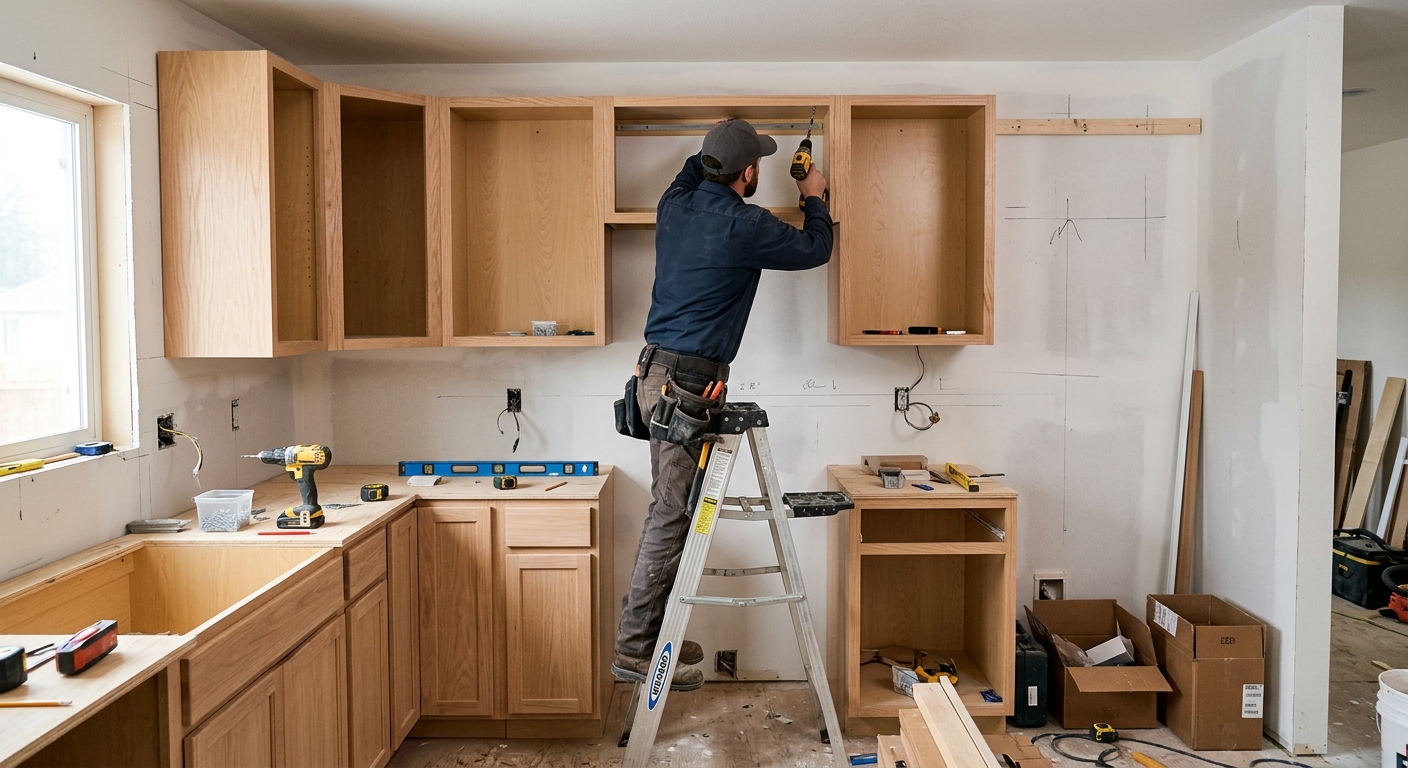
What a kitchen remodel costs in Scranton
Kitchen remodel costs in Scranton run a wide range, and it makes a difference whether you own or rent—just 50.3% of households here are owner-occupied, and the median household income is $48,776 (U.S. Census Bureau, ACS 2024). Most owners in Scranton and Carbondale are dealing with homes built between 1900 and 1940, meaning a gut renovation is more common than a simple refresh. That older housing stock is driving frequent kitchen projects to fix tight layouts, lack of outlets, and worn finishes. If your kitchen is an original 1930s galley, be ready for more dust and more cost than someone updating a 1990s job with newer wiring and no wall changes.
The wide spread in kitchen quotes comes down to scope. The biggest mistake homeowners make is pricing a “cabinet swap” but specifying a gut remodel or, worse, moving the layout. Every time you shift from a simple plan to adding new plumbing or tearing out walls, it’s a leap—not a step—in cost and time. Scranton renovation costs are driven more by what you ask to be changed than by the raw square footage.
| Scope |
What's included |
Duration |
Price range |
| Full gut remodel, same layout |
cabinets, counters, appliances, flooring, lighting, fixtures |
6–10 weeks |
$26,500–$106,500 |
| Gut plus layout change |
all of the above plus moved plumbing, electrical, walls |
10–16 weeks |
$58,000–$106,500 |
| Cabinet replacement (stock to semi-custom) |
remove and install cabinets, hardware, patching |
1–3 weeks |
$6,200–$26,500 |
| Cabinet refacing |
new doors and drawer fronts, veneer, hardware |
3–6 days |
$6,200–$18,000 |
| Countertop replacement only |
template, fabricate, install, reconnect sink |
1–3 weeks |
$3,600–$14,000 |
| Kitchen flooring only |
remove existing, install new flooring |
3–6 days |
$4,400–$18,000 |
Estimates for a typical Scranton kitchen. Cabinet grade and whether the layout changes move these figures more than square footage.
Defining your scope before you get quotes
One reason Scranton kitchen bids are so hard to compare is that “kitchen remodel” can mean anything from painting the walls to stripping the room to the studs and moving structural walls. The first step is to honestly place your project in one of four scope tiers:
- Cosmetic refresh — painting, new hardware, lighting, maybe a backsplash. No cabinet, counter, or layout change. Minimal dust and disruption.
- Pull and replace — new cabinets and counters, but everything stays in the same exact place. Existing plumbing and electrical stay put.
- Gut, same layout — everything is pulled down to the studs. New cabinets and finishes, old wiring and plumbing upgraded but left in the same locations. This is common in Scranton’s 1900–1940 homes.
- Layout change — walls moved, or appliances switched locations. You’re moving the sink or range, triggering new plumbing or electrical rough-ins and almost always a permit and plan review. Bigger crews and a longer process.
The steepest jump in both cost and time comes between a gut renovation with everything staying put and a full layout change. Moving even just the sink and stove takes you from a basic remodel into a project where engineering, municipal inspections, and trades coordination really add up. This turns a job from a few weeks to a few months, and the price follows.
Pick your tier before you even call a contractor. No experienced Scranton remodeler can give you a real number until you’re clear about whether you’re changing the layout, and any bid you get otherwise is just an estimate that is likely to balloon once real plans are made.
Eight weeks without a kitchen
Most Scranton homeowners aren’t prepared for what it truly means to lose a kitchen for the better part of two months. If you’re staying in the house, plan ahead. Put a small fridge and a microwave on a folding table in the dining or living room. Coffee makers, toasters, and kettles fill gaps, but expect to use the bathroom or laundry room sink for dishes. Disposable plates and cutlery are easy, but grocery bills go up—eating out even two meals a day adds up fast and can surpass what you’ll spend on kitchen flooring.
Job sites in Lackawanna County’s housing stock can’t always be sealed off neatly. Dust control matters more than people think, especially in older homes with plaster, lead paint potential, or just plain dirty demolition. Crews should use zip walls or plastic sheeting, but it isn’t perfect. Plan for steady noise and foot traffic. Ask where the dumpster and materials will be staged—usually the driveway, and it’s there for most of the project.
If you have pets or small children, know that doors will be open more, and the boundaries between “work” and “home” blur. For some, it pays to move out for the demolition week, especially with sensitive family or safety needs. In truth, the cost of living without a kitchen is a real budget item—budget for extra meals out and for lost time, not just what’s on the estimate.
What requires a permit in a kitchen renovation
In Scranton, not every kitchen project demands a permit, but it’s critical to draw the line. Cosmetic changes—painting, hardware swaps, refacing cabinets, even changing out a countertop in the existing footprint—typically don’t require permits in Scranton and Dunmore. Once your project touches new or relocated electrical circuits, moves plumbing, alters structure (like moving or removing a wall), or adds mechanical ventilation or a new range hood, you need a building permit. Scranton’s code office will also require a plan review for any kitchen remodel changing structural, plumbing, or electrical layouts.
For inspection, electrical work is commonly checked by third-party agencies such as Construction Code Inspectors, Inc., not directly by the city. This catches many people off guard, as you must schedule inspections with an outside group and sometimes coordinate timing with several trades.
Every contractor working on a job over $500 must be registered with the state as a Home Improvement Contractor—always verify at hic.attorneygeneral.gov before signing. All employers on your job must carry workers’ compensation insurance in Pennsylvania, which you can confirm through the WCAIS system. Unpermitted work can become a deal-breaker at resale, especially in older Scranton homes. Inspectors at closing can flag non-compliant renovations, leading to costly corrections or canceled sales. It’s never wise to skip the paperwork.
Where the money actually goes
Most homeowners are shocked at how quickly a kitchen remodel budget in Scranton is consumed by just one or two categories. Cabinetry typically eats up the biggest chunk—25% to 35% of the total—followed by labor and installation costs that rise sharply if you’re moving plumbing or walls. Countertops and appliances are the next largest lines, but they swing wildly depending on the material and brand you choose. Flooring, lighting, plumbing, and fixtures are real costs, but rarely break the bank.
Where many forget to budget is for contingency—older homes in Scranton almost always reveal something behind the walls, and without setting aside a cushion in advance, you’ll blow past the estimate. Another line often skipped is “soft costs”: design fees, permit costs, delivery, and disposal fees. These matter in Scranton, where permit and disposal rules differ town by town.
If you have a little extra money, spend it on cabinet quality and proper design up front—these set the stage for decades. Blowing a thousand dollars on a fancier oven but skimping on cabinetry is a poor play. Scranton’s older homes benefit more from solid boxes and good hardware than from flashy, brand-name appliances in an average setting. For a full gut remodel in Scranton, here’s how an $58,000 job actually splits by category:
| Category |
Share of budget |
Notes |
| Cabinetry |
25–35% |
the largest line and the longest lead time |
| Labour and installation |
20–30% |
rises sharply if the layout changes |
| Countertops |
8–15% |
material choice drives the swing |
| Appliances |
10–20% |
widest range of any category |
| Flooring |
5–10% |
|
| Lighting and electrical |
5–10% |
higher in older homes needing circuits |
| Plumbing and fixtures |
4–8% |
|
| Permits, design, disposal |
3–6% |
usually forgotten in early budgets |
| Contingency |
10–15% |
not optional in a pre-1980 house |
The real timeline for a Scranton kitchen
Most Scranton homeowners expect a kitchen remodel to be quick, but the real timeline is longer and depends on the sequence—not just labor hours. Here’s how it unfolds: first, design and measurement lock in your new plan. Then cabinets are ordered, which, in Lackawanna County’s tight finish labor market, can take anywhere from four to twelve weeks for delivery. Demolition only starts once you’re sure the new materials are coming in on time; waiting until after demo to order cabinets can add a month or more to the total downtime, especially during construction season.
Once the kitchen is gutted, rough-in for plumbing, electrical, and sometimes HVAC follows. City of Scranton permit rules trigger inspections for new circuits or plumbing moves, and those inspections must be scheduled—often with third-party inspectors for the electrical phase. After passing, the crew proceeds with drywall and priming. Cabinets are next, but here’s the step nobody warns you about: countertops can’t be templated until those cabinets are sitting in place. Fabrication of counters, even just laminate, takes another 1–2 weeks.
Only after counters go in can you schedule plumbing hook-ups, backsplash tile, flooring, and the finishing trim. The actual construction might run six to ten weeks for a full remodel, but planning, materials, and inspection lags can easily stretch the entire timeline to twelve weeks or more. In Scranton, with moderate suburban demand and older housing, order cabinets and major fixtures before demolition to shorten your time without a kitchen.
Surprises in an older Scranton home
If you’re renovating a kitchen in Scranton or Carbondale, odds are it was built before 1980—87.2% of the housing stock falls in that range (U.S. Census Bureau, ACS 2024). Once demolition starts, you should expect at least a few surprises that add cost and time. Out-of-plumb walls and out-of-level floors are almost standard in a 1930s house—cabinet installers have to shim and scribe everything to fit straight, which takes extra labor and skill. Electrical is another common headache: original wiring is often ungrounded or undersized, and may not meet today’s code, so full replacement is typical when the walls are open.
Old plumbing shows up as galvanized steel supply lines or cast iron drains, both at or past their normal life span. Swapping these out for copper or PEX, and PVC drains, can add several days and a few thousand dollars in a hurry. Insulation is usually missing from exterior walls, so adding fiberglass or foam is a must before you close up. Previous unpermitted work is a wild card—sometimes a patched-in vent, a mismatched circuit, or a mystery box in the wall adds time and risk.
For homes built before 1978, the EPA’s Lead RRP Rule applies—so any painted surface or old vinyl tile gets tested before disturbance. This is not optional; certified renovators do the testing, and it’s a safeguard, not red tape. By being ready for what’s likely behind your walls, you avoid the sticker shock—in Scranton, a 10–15% contingency should be part of every pre-1980 kitchen budget.
Frequently asked questions — kitchen renovation in Scranton
How much more does moving the sink and range cost?
Moving the sink or range goes beyond a simple kitchen refresh in Scranton—it’s a budget leap, not just a bump. Relocating these utilities means running new plumbing, electrical, and possibly gas lines, all triggering permits and usually a building plan review by the City of Scranton's code office. The upgrade from a “gut, same layout” to a “gut plus layout change” can add $10,000–$40,000 to your total cost, landing most jobs in the $58,000–$106,500 range. This isn’t just the labor—it’s electrician, plumber, patching, inspection fees, and more demolition. In older Scranton homes, costs skew high because additional work is often discovered once walls are open, like ungrounded wiring or old galvanized pipes. Decide early if you’re willing to take this on, or stick with the existing footprint to keep spending under control.
What does a quartz countertop cost in Scranton?
Quartz countertop pricing in Scranton varies by color, thickness, and edge style, but for most kitchens expect a total installed cost between $3,600–$14,000, with the average around $8,000. That figure includes template, fabrication, installation, cutouts for sinks, and reconnecting plumbing. Quartz is a popular upgrade for its durability and low maintenance, but local fabrication costs are driven more by layout complexity than by just square footage. Simple L-shapes are more affordable than U-shaped kitchens with seams and special installation conditions, which are common in Scranton’s older housing stock. Keep in mind—if cabinets need serious leveling or shimming, common in 1930s–1940s homes, it may cost more for countertop installation. Don’t forget to budget for a temporary sink setup, since you’ll be without running water for a bit during the swap.
What happens if previous work was unpermitted?
Unpermitted kitchen work is a chronic headache in Scranton, especially in homes dating to the early 1900s. If inspectors find non-compliant or non-permitted work during resale, expect delays or canceled sales. The city’s Office of Code Enforcement or closing inspectors may demand you bring the kitchen up to the current Pennsylvania Uniform Construction Code (UCC) standard, at your expense. This often means opening up finished walls, fixing unsafe wiring or plumbing, and then scheduling third-party inspections. The cost to fix these issues can easily land in the $6,200–$26,500 range, matching a low-end cabinet replacement, with uncertainty about what else might be uncovered. Always request documentation if your home’s prior owner did a kitchen upgrade—and be wary if the contractor cannot provide a copy of their state Home Improvement Contractor registration, or if workers’ compensation coverage is missing.
Can I over-improve for my Scranton neighbourhood?
Yes, over-improving is possible and, in Scranton’s older neighborhoods with modest home values, it happens more often than you’d think. Spending in the high end of the price band—upwards of $106,500 for a full kitchen remodel—rarely makes sense unless your home’s value in the area supports it. With the median household income at $48,776 and about half the city’s homes owner-occupied, a kitchen remodel should fit with local comparables. If most houses on your block have basic layouts and finishes, putting in luxury cabinets and pro-grade appliances won’t boost your resale in line with what you spend. Instead, focus your dollars where they hold value: solid cabinets, functional layout, and durable counters. Scranton buyers notice smart improvements, not brand names.
Is lead paint a concern in Scranton kitchen renovations?
Lead paint is a real concern for Scranton, where the vast majority of homes—87.2%—were built before 1980, with many dating back to 1940 or earlier. Federal law applies: for any house built before 1978, the EPA Lead RRP Rule requires testing for lead on painted surfaces before demolition or sanding. Certified contractors follow this rule, containing dust and using specific work practices. If lead is found, safe removal or stabilization is non-negotiable. Work costs more—a full gut with lead paint can fall in the $26,500–$106,500 range, typically on the higher side if abatement is needed. If your house is post-1978 or the paint has been fully encapsulated already, risk is much lower. It pays to ask your contractor up front if they’re EPA certified and how they’ll handle the issue.
Can I live in the house during a kitchen renovation?
You can live in your Scranton home during a kitchen renovation, and most owners do, but be ready for disruption. Setting up a temporary kitchen with a microwave, fridge, and coffee station in another room helps, but expect mess and inconvenience—especially during demolition and drywall work. Crews will use dust barriers as best they can, but dust and noise are inevitable in older housing where rooms are tight and old plaster crumbles. For jobs that go beyond three weeks, or if you have small children, pets, or allergies, it’s worth considering moving out for the demolition week. Also budget for eating out—over eight weeks, meal costs can rival or surpass minor building material lines, sometimes adding $4,400–$8,900 to your true outlay. Just plan for more daily disruption than you might expect.
Should I order cabinets before demolition?
Yes—always order cabinets before tearing into your kitchen, especially in Scranton and broader Lackawanna County, where finish cabinet lead times are running longer due to moderate demand and some labor tightness. Ordering after demolition is a guaranteed way to extend your kitchen downtime, often by another month or more. Cabinet lead times here can stretch from four weeks for basic stock to twelve weeks for semi-custom pieces. If your kitchen is gutted and cabinets are delayed, you’ll be without a kitchen well beyond the planned timeline. For a full remodel, this lag can add thousands to your meal and temporary living costs—sometimes more than a flooring line, at $4,400–$18,000. Ordering upfront is the simplest timeline hack in a Scranton kitchen project.
Should I choose plywood or particleboard cabinet boxes?
In Scranton’s older homes, I recommend plywood cabinet boxes if the budget allows. Plywood resists moisture and holds fasteners better—important in kitchens where humidity fluctuates and old floors aren’t always level. Particleboard is more affordable and standard on entry-level cabinets, but it’s prone to swelling if exposed to leaks or plumbing mishaps—a risk in 1900–1940 housing with older pipes. The price difference on a typical medium-sized kitchen might be $1,000–$2,500 out of a total cabinet budget of $6,200–$26,500. For row homes with less humidity fluctuation and tight budgets, particleboard is fine, but for lasting value—especially where floors and walls need heavy shimming—plywood is usually worth the extra spend.
Do I need to change my kitchen layout?
Not always—most Scranton kitchens don’t require a new layout, but many owners want one because prewar homes often have cramped, inefficient galley spaces. Changing the layout adds significant cost and time, moving you into the $58,000–$106,500 bracket for a gut plus layout change. If you’re happy with the flow and just want better storage and updated finishes, sticking to the same footprint is budget-smart and avoids extra permits or engineering. On the other hand, if the sink and stove placement make the kitchen unusable or you need to remove a wall for an open concept, the investment may be worth it for resale or quality of life. Always weigh cost, house value, and what really bugs you—sometimes better cabinets and lighting make more difference than shifting the walls.