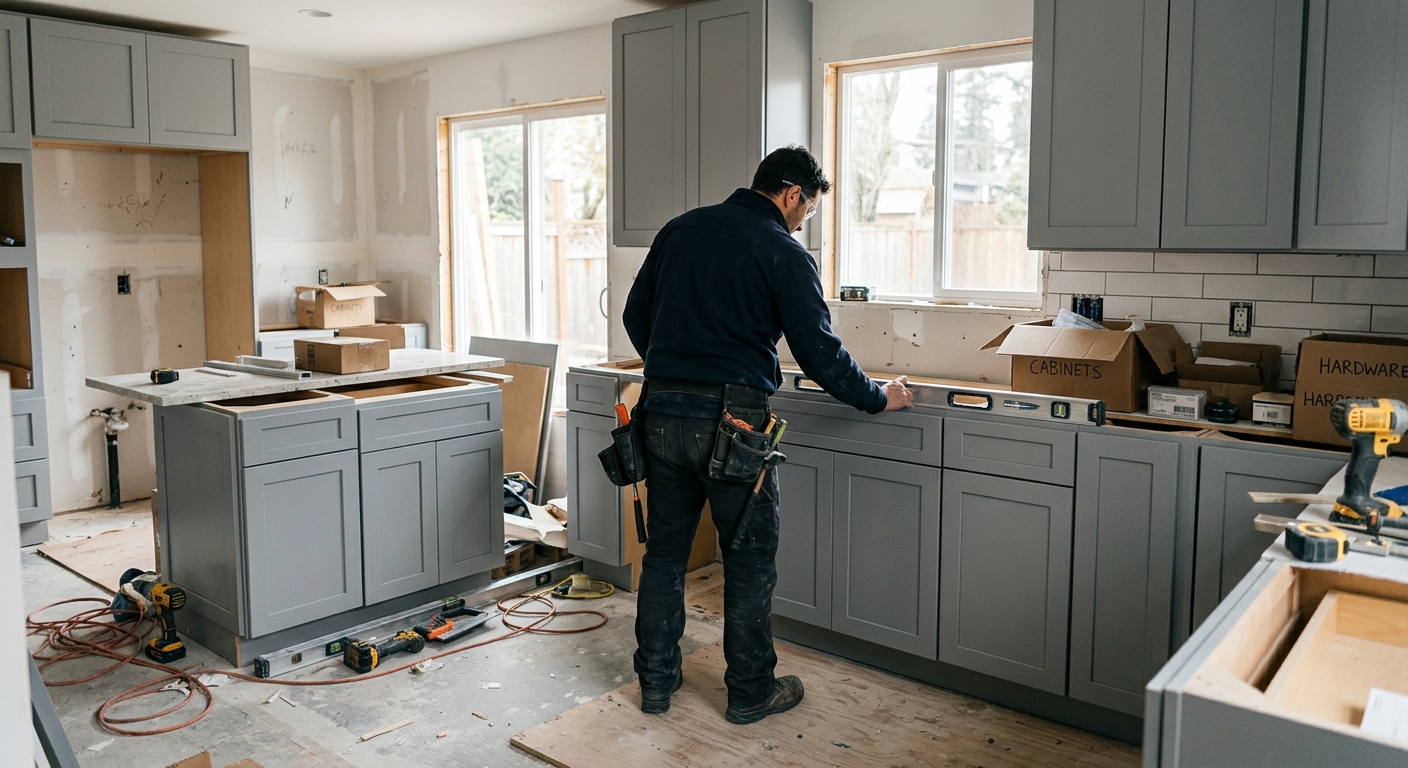
Kitchen renovation costs in Penn — 2026
Penn homeowners approach kitchen renovation projects with some of the highest median household incomes in Chester County and a homeownership rate near 74.0% (U.S. Census Bureau, ACS 2024). That demographic drives investment in layout modernization, especially for the many West Chester and Phoenixville homes built in the 1960s–1980s, where original kitchens often no longer fit modern living. In these houses, updating simply for style sometimes turns into a gut remodel with walls moved and utilities re-routed. By contrast, newer builds or more recent renovations may just need finishes or fixture upgrades.
The biggest trap for Penn residents is budgeting for a pull-and-replace project, then escalating to a new floor plan midstream. Each change in scope comes with a jump in price and timeline—what seems like a small layout shift pushes you into a completely different cost tier.
| Scope | What's included | Duration | Price range |
|---|
| Full gut remodel, same layout | cabinets, counters, appliances, flooring, lighting, fixtures | 6–10 weeks | $33,000–$132,000 |
| Gut plus layout change | all of the above plus moved plumbing, electrical, walls | 10–16 weeks | $71,500–$132,000 |
| Cabinet replacement (stock to semi-custom) | remove and install cabinets, hardware, patching | 1–3 weeks | $7,700–$33,000 |
| Cabinet refacing | new doors and drawer fronts, veneer, hardware | 3–6 days | $7,700–$22,000 |
| Countertop replacement only | template, fabricate, install, reconnect sink | 1–3 weeks | $4,400–$17,500 |
| Kitchen flooring only | remove existing, install new flooring | 3–6 days | $5,500–$22,000 |
Estimates for a typical Penn kitchen. Cabinet grade and whether the layout changes move these figures more than square footage.
Choosing a countertop for a Penn kitchen
When selecting a countertop in Penn, the real differences come down to how each material holds up to daily life—heat, stains, scratches, and cleaning—not just appearance. Quartz is the engineered workhorse: non-porous, resists stains, and easy to wipe, but its resin can scorch if you set down a hot pan. Granite is genuinely tough, handles heat, and each slab is unique, but it asks for regular sealing to avoid stains. Laminate isn’t just for rental units—modern versions resist stains, look far better than you may remember, and are the most forgiving on a budget. If you’re updating a modest kitchen or a rental, using laminate is a smart, defensible choice.
Butcher block brings unmatched warmth and is easy to repair with sanding, though it demands frequent oiling and can nick and stain. Solid surface (like Corian) is seamless and can be repaired when scratched or gouged—if you see a damaged section in Penn, it’s usually from a hot pan or chemical, not normal use. On granite, seams will almost always be visible, while solid surface hides them well; quartz is somewhere in between. The fabrication cost often swings on your choices: a fancy edge profile, extra sink or cooktop cutouts, or tight seam placement all add up. Unlike a big box estimate “by linear foot,” a real fabricator will template your space—physical templates are more accurate than just a measurement, especially in older Penn kitchens with walls that may not run square or level.
Living through a kitchen renovation
Renovating a Penn kitchen means a stretch—often weeks—of doing without a proper kitchen. The best solution is setting up a temporary kitchen in a dining room or basement. Plug the fridge into an accessible outlet, park a microwave and kettle on a folding table, and keep a supply of disposable plates. A laundry sink works for washing up, but a bathroom sink will do in a pinch, though it’s awkward. No matter how you slice it, expect to spend on takeout—many homeowners in Penn report the food bill for eight weeks runs larger than new flooring. Some shop at the grocery deli counter just to survive the stretch.
Dust is another reality. Contractors will hang plastic sheeting, zip walls, and seal vents, but fine dust finds its way to adjacent rooms. This matters, especially with open floor plans common in West Goshen and West Chester homes. Think up front about where the dumpster will live—driveways often get blocked for weeks, and you’ll want clear access for deliveries and trash out. Pets need extra care; the door will be propped open more weeks than you’d like. For gut jobs, especially if you’re opening walls, many Penn families choose to move out during active demolition. Count the cost honestly: a takeout-and-coffee routine in Penn can outpace the cost of even a sizable flooring job.
Code requirements for Penn kitchens
In Penn, most straightforward kitchen upgrades—paint, swapping out knobs, replacing a countertop in place—don’t trigger permits. But once you move or add walls, alter plumbing or electrical, or make mechanical upgrades, a permit is typically required. In West Chester, permits are specifically triggered by structural wall changes or the addition of new electrical circuits during a kitchen renovation. Any remodel that touches the kitchen’s bones or layout will also get a plan review if you’re within the borough.
After plans are submitted, electrical work inspections are most often handled by third-party agencies like United Inspection Agency, rather than the borough or township code office. This can surprise homeowners expecting the municipal inspector to show up.
Contractors on any project over $500 must be registered as Pennsylvania Home Improvement Contractors, which you can verify at hic.attorneygeneral.gov. All employers, including renovation contractors, must carry workers’ compensation insurance—always ask for proof, and verify via WCAIS at wcais.pa.gov. Skipping permits or using an unregistered contractor can lead to problems at resale. Most Penn buyers and agents will spot unpermitted improvements, and in this market, it will come up at closing.
Why the contingency exists
About one in five Penn homes predate 1980, and what’s inside the walls of those kitchens tells the story. Demo often uncovers out-of-plumb walls or out-of-level floors, which mean extra labor and some cost in shimming cabinets for a tight fit—usually $750–$2,000. Discovering original or ungrounded wiring means calling in an electrician and running at least one new circuit, which snowballs to $1,500–$4,000. Galvanized plumbing or cast iron drains may need to be replaced entirely, and running new supply or drain lines typically adds another $2,500–$7,000. If there are no signs of insulation on an exterior wall, it’s worth adding during the open wall phase, about $1,800–$4,200 for a modest kitchen. Unpermitted work from decades past—think jerry-rigged range hood vents or homemade subpanels—usually bumps inspection and remediation costs further.
On homes built pre-1978, the federal EPA Lead RRP Rule requires renovation firms to be certified and follow lead-safe work practices; this means testing and containment before wall or cabinet demolition. If asbestos floor tile or mastic is found, leave it undisturbed or have it tested before removing. Most homes built since 1980 escape these hazards, but 1980s–1990s tract homes in Penn often come with builder-grade shortcuts: particleboard cabinet boxes near the end of life, minimal countertop electrical circuits, and original laminate countertops that are ready for replacement—usually all due within the same decade.
Appliance choices and the decisions they force
In Penn kitchens, appliance choice drives the design more than most expect. Cabinets are measured and built for appliance dimensions; order them after, and you risk dishwashers that don’t slide in or a fridge that sticks out. Standard-depth fridges project past the counter, eating up the walkway; counter-depth models cost more but sit flush and fit better in tight kitchens. Slide-in ranges give a cleaner look and prevent crumbs down the side, but require your countertop cut to fit. Freestanding ranges are more forgiving on cabinet fit, but less seamless visually.
If you’re considering gas versus induction, know that induction almost always requires a 40-amp circuit, and older Penn kitchens rarely have electrical panels sized for that. Swapping from gas to induction upgrades electrical but might save on venting. Panel-ready dishwashers demand precise cabinet opening sizes—no fudge factor. When it comes to venting, ducted range hoods perform far better than recirculating types; recirculating is only a fallback when wall or roof penetrations aren’t possible, and in humid Penn summers, venting out is worth the effort.
Top-end appliances look great and sometimes cook a little better, but most of their premium is in style and feature set, not build. In 2026, appliances on some popular models can take longer to arrive than cabinets; sequence accordingly to avoid project delays.
What moving the sink really costs
Moving water and electric is the cliff that divides a pull-and-replace kitchen remodel from a full gut: keeping everything in the same spot lets you stay closer to $33,000–$132,000 for a full renovation, but relocating a sink, dishwasher, or range jumps the project into the $71,500–$132,000 tier. The cost isn’t proportional to the distance—it’s about the complexity. Drain lines require careful slope; if your kitchen sits on a slab or above a finished ceiling, getting the right pitch means significant work, sometimes involving floor demolition or chasing through finished space below.
New outlets or circuits mean checking for spare capacity in a main panel, and if you’re already close, it could involve a costly panel upgrade. Taking down a wall to open up the kitchen is another layer: you need to verify if it’s load-bearing, often requiring an engineer’s sign-off and triggering a full permit review. If the new plan puts a range hood somewhere different, you’re paying for an exterior vent through brick, siding, or stone—a job not to skimp on in Penn’s humid climate.
Before moving utilities or walls, think honestly about whether the plan is unworkable as-is or just dated. Many Penn homeowners spend thousands chasing a more open look when minor tweaks would do. In West Chester, permits are triggered by structural and utility changes—there’s no skipping this step if you’re making moves. The budget jump to relocate a sink or range is often larger than the benefit unless the current layout is truly holding you back.
Frequently asked questions — kitchen renovation in Penn
How do I set up a temporary kitchen?
Setting up a temporary kitchen in Penn starts with choosing a spot—most often a dining room, basement, or garage. Move your refrigerator, plug in a microwave and a coffee maker, and set up a folding table as your food prep surface. Use a laundry sink if available; otherwise, a bathroom sink will suffice for rinsing dishes, though it’s cramped. Stock up on paper plates and plastic utensils, which cut down on washing and keep things manageable. Even with this setup, expect to spend more on takeout and groceries—Penn homeowners often see this food bill go higher than the flooring cost, sometimes matching a $5,500–$22,000 expense over two months. If you have pets, plan on them being spooked by dust or door traffic, so create a safe zone away from the work site. Good dust containment—ask your contractor about plastic barriers—will make living in your house during construction far more tolerable.
How much do new kitchen cabinets cost in Penn?
For most Penn homeowners, replacing old cabinets with new stock or semi-custom units runs between $7,700–$33,000, with the typical project landing near $22,000. This range covers removal, installation, patching any damage, and installing new hardware. Cabinet costs in Penn are driven by door style, finish, and storage upgrades (pullouts, organizers). Labor here is more expensive than in Lancaster County but still more negotiable than in city markets, thanks to the high contractor density along the Main Line. Don’t mistake refacing for a total replacement: refacing—new doors, drawer fronts, and veneer—can run $7,700–$22,000 and is often indistinguishable until you open the box. Always ask your contractor if the old boxes are worth keeping—sometimes swapping just the faces gives a like-new look for thousands less.
Do I need to change my kitchen layout?
In Penn, the answer depends on both the house and your daily use. Many West Chester and Phoenixville homes have 1960s–1980s layouts—closed-off rooms or galley kitchens that may not suit how families live today. If your kitchen is fundamentally cramped, with poor workflow, or guests constantly crowd the cook, a layout change may be justified. This typically costs $71,500–$132,000, a premium over a same-layout gut remodel. However, if your space just feels dated rather than dysfunctional, keeping your current layout and investing in better cabinets, lighting, and storage can produce results that feel new for less. In Penn, opening up a wall or moving major utilities brings more permitting and cost. Think critically: a fresh look is powerful, but not worth spending double unless the existing footprint simply doesn’t work for you.
Do I need a permit for a kitchen renovation in Penn?
Most cosmetic kitchen work in Penn—like painting, changing hardware, or replacing countertops in the same spot—doesn’t require a permit. Permits become necessary with changes to electrical circuits, plumbing, moving or altering walls, or significant appliance upgrades (like vented range hoods). In West Chester, for example, permits are triggered by new circuits or structural changes, and if your adjustments alter utilities or walls, the plan review process with the borough kicks in. Electrical inspections are most often carried out by third-party agencies, such as United Inspection Agency. Skipping permits may save time early, but it risks future problems if you sell—a buyer or their agent will likely realize unpermitted work was done, which can complicate closing or require expensive retroactive fixes.
Which upgrades are not worth the money?
In Penn and most of Chester County, the mistakes come from prioritizing upgrades that don't deliver daily value. Going for pro-grade appliances will quickly raise your budget into the $71,500–$132,000 bracket but, for most, the actual day-to-day improvement over high-quality consumer models is marginal. Similarly, relocating the sink or major layout shifts bring costs that are very rarely recouped in resale—especially if the kitchen already works for your family. Spend your money on good lighting, quality cabinets, and durable counters before splurging. Laminate countertops in a rental or modest kitchen are a smart choice in Penn—those dollars are better left in your pocket than in marble you never use fully.
How much more does moving the sink and range cost?
Moving the sink or range in a Penn kitchen launches your project out of the regular price band and into a more involved—and far costlier—scope. Staying with your original layout means costs around $33,000–$132,000 for a gut remodel. Once you move plumbing or gas/electric lines for a new sink or range location, you’re looking at $71,500–$132,000. This jump isn’t just for the materials; it’s the labor to run new lines, repair flooring and walls, and, especially in older Penn homes, resolve surprises like outdated wiring or tricky drain slopes. Even a four-foot move can easily add $8,000–$20,000, so it’s worth asking if the new location is truly necessary for your daily use or just a “want.”
Is lead paint a concern in Penn kitchen renovations?
Lead paint comes into play for Penn homes built before 1978, which covers a little over 20% of local stock. The federal EPA Lead Renovation, Repair and Painting (RRP) Rule requires any contractor working in these homes to be certified and to follow specific safety practices—including testing, containment, and cleaning—when disturbing painted surfaces during demolition. If walls, windows, or trim are being removed or sanded in a pre-1978 home, expect extra steps and possibly added cost to keep the process safe for your family and workers. Always ask for contractor certification, and don’t skip these steps—compliance is required by law, verified at certifiedrenovatorsearch.epa.gov, and gets checked at resale.
Is induction worth it over gas?
In Penn, induction cooktops have become a serious competitor to gas, especially for families seeking a cleaner, safer kitchen. Induction delivers fast heat, precise control, and is much easier to clean than a traditional gas range. However, it requires a 40-amp dedicated circuit, which can mean a pricey electrical upgrade in older homes—a change which, in a remodel, might push the project from the regular band near $33,000–$132,000 into higher territory if the panel is undersized. Induction is worth it if you’re looking for speed, energy efficiency, and minimizing indoor air pollution. Still, if you already have gas and like it, the upgrade cost in a Penn kitchen isn’t always worth it unless your whole cooking routine is changing as well.
Why is there a gap after cabinets are installed?
Gaps above or beside cabinets are common in Penn kitchens—especially in the many West Chester and Phoenixville homes built in the 1960s–1980s—because few walls and ceilings are perfectly straight or level. Houses settle, and original framing wasn’t always square. Installers use shims and fillers to get cabinets plumb and level; even so, you might end up with small gaps, especially if crown molding or fillers weren’t part of the plan. For most kitchens, these are closed up with scribe molding or caulk for a clean look. If you're paying near the top of the $7,700–$33,000 cabinet replacement range, expect a more seamless fit, but some gaps are simply the cost of working in real houses rather than showrooms.