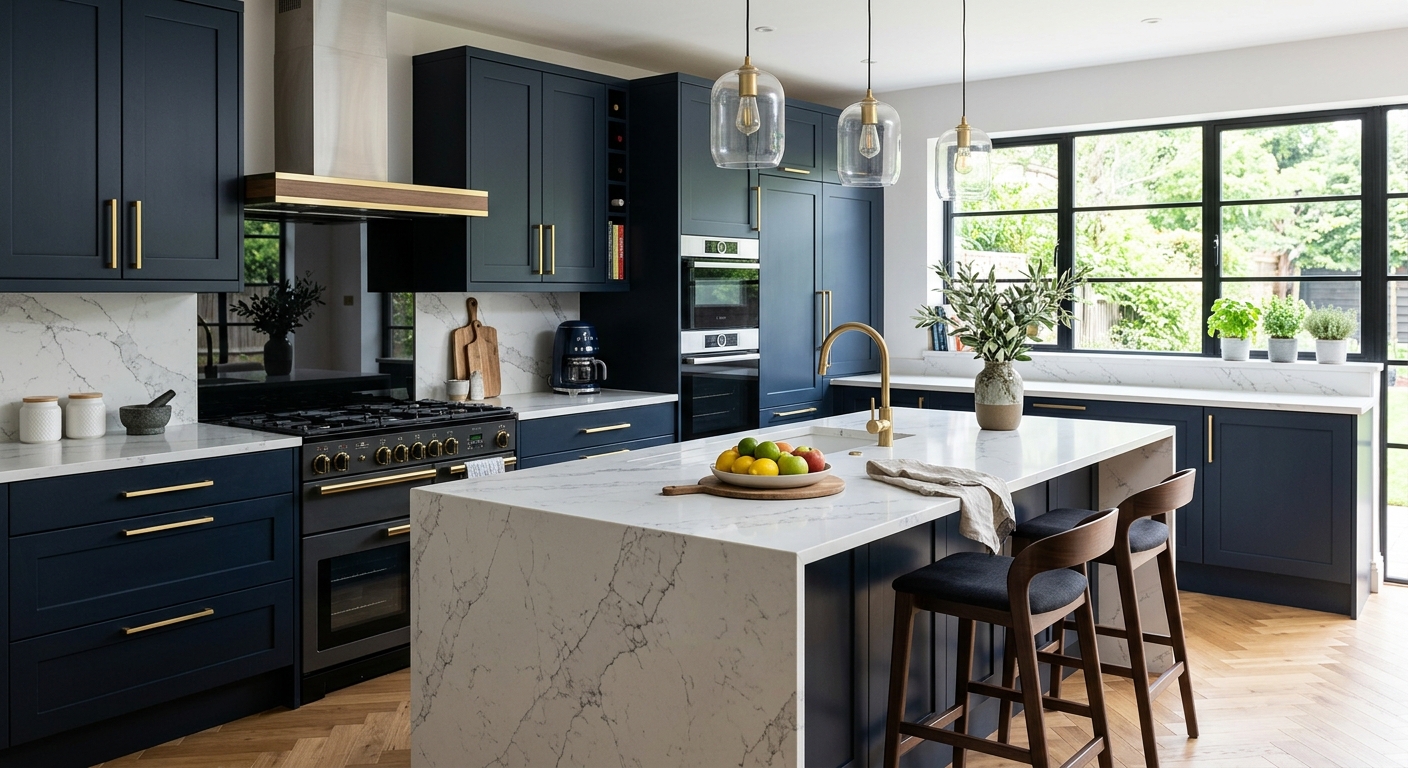
Kitchen renovation costs in Washington — 2026
In Washington, Westmoreland County, most homes are owner-occupied, with a homeownership rate of 86.8% (U.S. Census Bureau, ACS 2024), and a median household income of $74,840. Many kitchens here were built during the 1960s–1980s suburban boom, so current renovation projects often involve updating outdated layouts and upgrading electrical services to meet present code. This matters for budget planning, because older homes usually require more work behind the walls than newer ones—particularly for electrical and plumbing—whereas late-1990s kitchens might need only new finishes and appliances.
Where most kitchen budgets go off the rails: homeowners price a stock cabinet pull-and-replace and then add layout changes, high-end appliances, or custom cabinetry, which can double the cost. Before starting, define whether you want cosmetic changes or a full gut renovation, and whether your appliances will stay put. The table below provides real budget ranges for the Washington area—don’t expect national averages to match up here.
| Scope |
What's included |
Duration |
Price range |
| Full gut remodel, same layout |
cabinets, counters, appliances, flooring, lighting, fixtures |
6–10 weeks |
$29,500–$118,000 |
| Gut plus layout change |
all of the above plus moved plumbing, electrical, walls |
10–16 weeks |
$64,000–$118,000 |
| Cabinet replacement (stock to semi-custom) |
remove and install cabinets, hardware, patching |
1–3 weeks |
$6,900–$29,500 |
| Cabinet refacing |
new doors and drawer fronts, veneer, hardware |
3–6 days |
$6,900–$19,500 |
| Countertop replacement only |
template, fabricate, install, reconnect sink |
1–3 weeks |
$3,900–$15,500 |
| Kitchen flooring only |
remove existing, install new flooring |
3–6 days |
$4,900–$19,500 |
Estimates for a typical Washington kitchen. Cabinet grade and whether the layout changes move these figures more than square footage.
Resale value and kitchen spending
Renovating your kitchen in Washington will make your house more appealing to buyers, but it won’t guarantee you get every dollar back. Most renovated kitchens in Westmoreland County help homes sell faster, but rarely return full cost at resale—especially on top-end projects. Mid-range jobs often recoup a larger share than high-dollar remodels, so if your home’s value is similar to the neighborhood’s median household income of $74,840, over-investing in a luxury kitchen won’t see that extra money come back.
If you’re renovating to sell, stick to neutral finishes and spend in the mid range—usually new cabinets and worktops, refreshed appliances, and modest lighting. Skip custom layouts and premium appliances. On the other hand, if you’re upgrading to live in for years, the return isn’t about resale—it’s about daily use. Invest only in what improves your life: better workflow, smart storage, quality counters. Don’t let the notional “investment” drive you to over-spend.
The single biggest mistake in Washington is building a kitchen that outpaces your home’s value, because buyers here are value-focused. Gut renovations pushing $64,000–$118,000 make sense only for forever homes—not for short-term flips. If your plans are resale-driven, smaller projects tend to be safer financially.
Code requirements for Washington kitchens
Most cosmetic kitchen changes in Washington, like painting, hardware swaps, refacing cabinets, or swapping countertops without moving the sink, do not require a permit. However, in Greensburg and other nearby municipalities, as soon as your kitchen renovation involves a structural wall, adding or relocating plumbing pipes, or new electrical circuits, you typically need a building permit. For example, in Greensburg, removing a wall or moving plumbing lines in a kitchen remodel is a sure permit trigger—and formal plan review applies for anything involving structural or electrical upgrades.
Electrical inspections are commonly handled by certified third-party agencies, such as Code.sys, rather than the city itself, especially in Greensburg and Hempfield Township. This often surprises homeowners expecting city inspectors. Wherever you live in Westmoreland County, verify whether your municipality runs its own code enforcement—this affects the permitting process and inspections.
Contractors working on projects over $500 must hold a Home Improvement Contractor (HIC) registration, issued by the Pennsylvania Office of Attorney General. You can and should confirm any contractor’s registration at hic.attorneygeneral.gov. Contractors are also required to carry workers’ compensation insurance—verify this through the WCAIS system (wcais.pa.gov).
Unpermitted work makes resale difficult—home inspectors and real estate agents routinely flag missing permits in Washington and broader Westmoreland County, forcing sellers to catch up (usually at higher cost and hassle).
Why appliance selection comes first
The order of decisions matters: appliance selection always comes before ordering cabinets. In Washington, starting with cabinets first is how people end up with a refrigerator that blocks a doorway or a range that doesn’t fit the cutout. For every planned kitchen, cabinet installers need the exact appliance sizes—standard-depth versus counter-depth refrigerators call for different panel runs, and a slide-in range with front controls needs a finished countertop behind it, while a freestanding range does not.
Your choice between gas, electric, or induction matters for both electrical and cabinet planning. New induction or high-powered electric ranges require a dedicated 240-volt circuit—and most 1960s–1980s kitchens around here will need a panel upgrade to handle it. Panel-ready dishwashers and refrigerators—if you like a seamless look—also require custom front panels and must be planned up front. Hoods matter: a ducted range hood, vented to the exterior, removes real odors and moisture, while recirculating hoods simply filter and return air back to the room. In kitchens with limited vent runs, people sometimes settle for recirculating—this is a compromise, not a best practice.
While the looks and performance of professional-grade appliances appeal, much of the premium is aesthetic. Actual cooking performance only matters at the high end if you cook daily. Lead times for some appliances, particularly premium brands, can now be as long or longer than the cabinets—get your appliances ordered first.
Four kinds of kitchen project, four budgets
The term “kitchen remodel” in Washington covers everything from swapping a backsplash to a full gut renovation. Understanding your project tier is the most important early decision—before you call any contractor or vendor. Here’s how projects break down:
- Cosmetic refresh: Paint, hardware, lighting upgrades, backsplash, sometimes new faucets or fixtures. No cabinet work, counters stay, no plumbing or layout change.
- Pull and replace: Replacing all cabinets and countertops in the existing locations. Plumbing, outlets, and appliances don’t move. Most common—budget and timeline are most predictable.
- Gut, same layout: Down to studs. New cabinets, counters, flooring, lighting, all wiring/plumbing updated—but everything goes back in the same spot. Good choice for homes where electrical or plumbing are old but kitchen flow is acceptable.
- Layout change: Walls, plumbing, or structure move. May involve engineering, new windows, moving the sink or range, or creating new openings. Permit, inspections, and professional design are mandatory.
The cost cliff lies between tier three and four. The minute you move the sink or stove, you jump to a different project—the project gets more complex, triggers detailed inspections and requires a different kind of contractor. Decide on your scope tier before shopping or meeting with any professional; until you do, no one can give you numbers that mean anything.
General contractor, kitchen firm, or manage it yourself?
How you structure your kitchen renovation in Washington matters as much as what materials you pick.
A full-service kitchen firm handles design, cabinetry, and installation under one roof. This option costs the most, but it offers the least hassle and the most predictable results. If you’re after a coordinated look and minimal legwork, this is for you—but expect to pay for that convenience.
A general contractor works with your architect or designer (or sometimes just off your notes), then lines up demolition, trades, and finish installs. This is the middle ground in cost and responsibility. You’ll handle design direction, but won’t have to track down a plumber or schedule a drywaller yourself. Most busy professionals in Washington pick this model, especially since finish-trade labor is tighter here than in Pittsburgh—scheduling gets tricky fast.
Managing it yourself is the least expensive—hire and coordinate each trade (demo, plumbing, electrical, cabinets, tile, etc.) one by one. But unless you have experience with construction sequencing, vendor vetting, change orders, and municipal inspections, the risk of something going sideways is high. In Westmoreland County’s labor market, trade availability also means delays stack up without professional management. If you have a day job and your project triggers permits, skip self-managing—coordination is usually harder than people think.
Electrical work in an older Washington kitchen
Over half the homes in Washington were built before 1980 (66.6%, U.S. Census Bureau, ACS 2024), and this shows up in their kitchens. Many 1960s–1980s kitchens were built with just two or three circuits, sometimes with no dedicated wiring for today’s loads. Modern code requires multiple small appliance circuits, GFCI protection at all countertop outlets, dedicated circuits for dishwasher, disposal, and microwave, and a 240-volt line for electric ranges or double wall ovens.
It’s not uncommon to find two-wire ungrounded circuits, a whole kitchen on a single breaker, or a service panel already near maxed out. Some late 1980s or even 1990s kitchens here still come up short for today’s code, especially for big appliances. Once your walls are open, any inspector—especially third-party agencies used in Greensburg and Hempfield—expects everything exposed to be brought up to standard. Skipping this isn’t an option and often surprises budget planners who were just aiming for new cabinets and counters.
Bringing kitchen electrical up to current code in Westmoreland County typically runs $6,900–$19,500 for a standard kitchen. This includes new circuits, updated panel if required, and full GFCI/ARC-fault protection. Electrical is the main reason kitchen remodels in older Washington homes run over—plan for it early.
Frequently asked questions — kitchen renovation in Washington
Do I need to change my kitchen layout?
For most Washington homes, especially those built in the 1960s–1980s, the original kitchen layout is often inefficient by current standards. Galley kitchens or boxed-in U-shapes were popular, but if the main complaint is just appearance—dated cabinets, worn counters—a layout change isn’t necessary. Sticking to the existing footprint can keep your project to $29,500–$118,000 instead of the higher cost (and longer permit process) for moving walls or major plumbing. Consider changing the layout only if workflow, sightlines, or storage present daily headaches. If you plan to stay for years, layout changes might be worth it—but they always cost more and take longer.
What flooring works best in a kitchen?
In Washington, where freeze-thaw cycles and heavy use are realities, durable flooring is a must. LVP (Luxury Vinyl Plank) and high-end tile lead for water resistance, ease of cleaning, and ability to withstand heavy foot traffic. Solid hardwood looks great but isn’t as immune to moisture and seasonal changes in Westmoreland County’s climate. Newer engineered products outperform old sheet vinyl or laminate, which often fails in the seam near the sink or dishwasher. Expect professional installation for kitchen flooring to cost between $4,900–$19,500 in this area. Always prioritize water resistance and ease of cleaning over trendy looks.
How do I set up a temporary kitchen?
While your main kitchen is out of service—a process that usually lasts between one and ten weeks, depending on scope—you’ll want to create a basic prep space elsewhere in your Washington home. Set up a folding table near running water for essentials: coffee maker, microwave, toaster oven, and fridge if possible. Use disposable plates or a utility sink for washing up. Plan freezer-friendly and grill meals; avoid anything requiring a stovetop. If you’re doing a full gut remodel (often $29,500–$118,000), remove pantry items well ahead of time so your work site stays clear for the trades. Expect more dust and interruption than you think (especially with open plans or layout changes).
Does a kitchen renovation increase home value in Washington?
Renovating your kitchen almost always helps your home sell faster in Washington. But you’re unlikely to get every dollar back—especially if you spend at the top end or choose unique finishes. In Westmoreland County, where median household income sits at $74,840, kitchens renovated for daily use tend to be a better investment in comfort and satisfaction than for pure resale. A mid-range kitchen upgrade (think new cabinets and counters in the same footprint, typical cost $19,500–$29,500) yields a larger return at sale than a total gut. Overimproving—putting a deluxe chef’s kitchen into a basic split-level—does not recover the difference.
Does replacing cabinets require a permit?
In much of Westmoreland County, including Hempfield Township, simply removing and replacing cabinets does not require a permit as long as you don’t move appliances or plumbing connections. Paint, hardware, and new cabinet boxes can all be installed without triggering municipal review. However, in areas like Greensburg, as soon as you remove a wall, change appliance locations, or move plumbing, a permit is required and formal plan review is likely. If your project stays within the “pull and replace” band ($6,900–$29,500), permitting is usually minimal. Always check with your municipal code office before work starts to prevent resale snags later.
Should I order cabinets before demolition?
Don’t start demolition in your Washington home until all cabinets are on site and checked for damage or missing parts. Lead times for semi-custom cabinets in Westmoreland County can run eight weeks or more, and backorders are common. If your kitchen will be down completely—as it will during a full remodel in the $29,500–$118,000 price range—it’s simply not worth living in chaos if product delivery slips. Verify every critical measurement after appliances are finalized, then order. Only after cabinets arrive and are inspected should you schedule major demo—this will keep your project downtime to a minimum.
How much more does moving the sink and range cost?
Moving fixtures like your sink or range jumps your kitchen project to a new scope entirely, triggering both higher labor and permit costs in Washington. Relocating plumbing and adding new electrical or gas lines can add up quickly, especially in older homes with outdated infrastructure. Expect a typical “gut with layout change” renovation to cost between $64,000–$118,000, compared to $29,500–$118,000 if you keep fixtures put. Plumbing and electrical upgrades, structural work, permit fees, and extended timelines all hit your bottom line. If function demands a move, factor this major jump into your initial planning—not after design is underway.
Why are kitchen quotes in Washington so far apart?
The broad range in quotes—sometimes from $29,500–$118,000 for a full gut—usually comes down to scope, materials, and whether layout or mechanicals are changing. In Westmoreland County, the housing stock is so varied—from original 1960s tract homes to remodeled late-1980s splits—that one kitchen may simply need new cabinets while the next needs a full panel upgrade or wall removal. Labor availability here is tighter than in Pittsburgh, so firms booking far in advance may also price in for longer lead times. Always insist on a written, itemized quote that spells out exactly what’s included before you sign.
Is lead paint a concern in Washington kitchen renovations?
If your home in Washington was built before 1978—a real possibility in Westmoreland County where 66.6% of homes are pre-1980—lead paint during kitchen renovation is a genuine safety issue. Federal law requires contractors to follow the EPA’s Lead RRP Rule when disturbing painted surfaces in pre-1978 homes. This adds steps and cost (for example, a cabinet replacement can run $6,900–$29,500), but protects your household during demolition and cleanup. Always verify your contractor is EPA Lead RRP Certified. Don’t let anyone skip this—it’s required for your health and to avoid headaches at resale. You can check certifications directly with the EPA database provided in Pennsylvania’s consumer regulations.