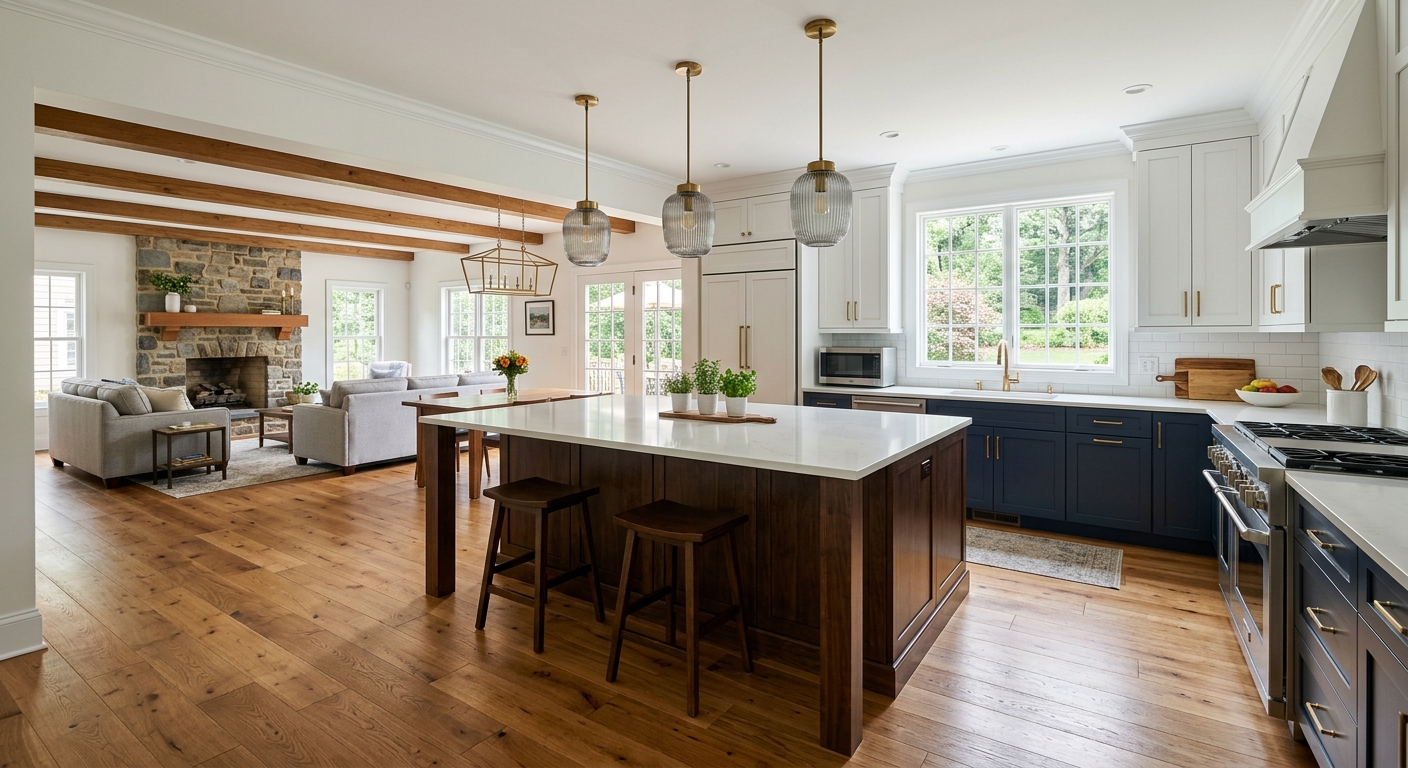
What a kitchen remodel costs in Montgomery
In Montgomery, kitchen remodel budgets are shaped by two facts: a high homeownership rate (90.4%) and a median household income of $122,194 (U.S. Census Bureau, ACS 2024). Most owners here want a kitchen that supports daily life, lasts, and adds value to their home. The housing stock in Montgomery’s Abington and Upper Dublin townships is dominated by post-1945 suburban tract homes. That means many kitchens are either tight 1950s galley layouts prime for a full rework, or larger but dated 1990s spaces that mostly need surface updates. These factors set the baseline for what gets remodeled, and how.
The biggest risk for homeowners in Montgomery is pricing out the cost of a straightforward remodel—new cabinets, counters and appliances in the same layout—then adding scope (like removing a wall or switching to custom cabinetry) late in the design. That jump is not linear: moving plumbing or electrical, or changing the footprint, typically costs thousands more than people expect. The right starting point is to define the scope, price that band, and stick to it, adjusting only with full knowledge of the financial step-up.
| Scope |
What's included |
Duration |
Price range |
| Full gut remodel, same layout |
cabinets, counters, appliances, flooring, lighting, fixtures |
6–10 weeks |
$34,000–$136,500 |
| Gut plus layout change |
all of the above plus moved plumbing, electrical, walls |
10–16 weeks |
$74,000–$136,500 |
| Cabinet replacement (stock to semi-custom) |
remove and install cabinets, hardware, patching |
1–3 weeks |
$8,000–$34,000 |
| Cabinet refacing |
new doors and drawer fronts, veneer, hardware |
3–6 days |
$8,000–$23,000 |
| Countertop replacement only |
template, fabricate, install, reconnect sink |
1–3 weeks |
$4,600–$18,000 |
| Kitchen flooring only |
remove existing, install new flooring |
3–6 days |
$5,700–$23,000 |
Estimates for a typical Montgomery kitchen. Cabinet grade and whether the layout changes move these figures more than square footage.
How a Montgomery kitchen budget breaks down
Most Montgomery kitchen remodels follow a pattern: cabinetry is easily the largest cost, often eclipsing every appliance, counter and fixture line item combined. Labour and installation come next, climbing steeply if you change the layout. Countertops, flooring and lighting matter, but rarely move the total cost by more than a few percent unless rare materials or complex patterns are specified.
Two budget items many owners overlook are soft costs (permits, delivery, design, debris removal) and a contingency for hidden issues—especially in homes built before 1980, which make up a significant share in the area. Tapping into an extra $3,000–$4,000 as a rainy-day fund is not optional if you want to avoid pause-and-panic moments mid-job. For most kitchens here, an extra thousand dollars buys the most when invested in cabinet and drawer hardware, pullouts, or undercabinet lighting—each improves daily use. It buys the least when used to stretch for a high-end fridge in a kitchen with basic cabinetry: the return, visually and functionally, isn’t there.
Applied to a gut remodel at $74,000, the Montgomery budget typically breaks down as follows:
| Category |
Share of budget |
Notes |
| Cabinetry |
25–35% |
the largest line and the longest lead time |
| Labour and installation |
20–30% |
rises sharply if the layout changes |
| Countertops |
8–15% |
material choice drives the swing |
| Appliances |
10–20% |
widest range of any category |
| Flooring |
5–10% |
|
| Lighting and electrical |
5–10% |
higher in older homes needing circuits |
| Plumbing and fixtures |
4–8% |
|
| Permits, design, disposal |
3–6% |
usually forgotten in early budgets |
| Contingency |
10–15% |
not optional in a pre-1980 house |
When a Montgomery kitchen needs walls moved
Most kitchens in Montgomery, especially the older homes from Abington and Upper Dublin, started life as narrow galley spaces. Many owners want open plans or islands, but shifting plumbing or tearing out walls isn’t a tweak—it's a budget cliff. Keeping everything in place means your remodel falls in the $34,000–$136,500 full-gut band. The moment you move the sink, stove, or open up a load-bearing wall, you step into the higher $74,000–$136,500 range. The difference looks like a layout change, but it's really about the work behind the scenes.
Relocating plumbing means finding space and slope for drain lines—easy over an unfinished basement, much harder over a finished ceiling or a slab. Electrical changes? If your panel is near maxed out (not uncommon in postwar tract homes), new circuits may require a costly service upgrade. Want to remove a wall? You need to know if it’s load-bearing. If it is, a structural engineer’s involvement and a municipal permit are mandatory. In Lower Merion Township, this work triggers a building permit and requires a plan review. Relocating a range hood to a new wall means cutting a new vent through the exterior, with implications for both building envelope and permitting.
Before moving boundaries, ask yourself: is the existing kitchen unusably cramped, or just dated? Spending an extra $40,000 to move a sink four feet will rarely bring a matching increase in value. Scrutinize whether the improvement justifies the permanent, substantial jump in total cost, and don't let HGTV-style plans cloud a sound budget.
Code requirements for Montgomery kitchens
Montgomery kitchen projects fall under the Pennsylvania Uniform Construction Code (UCC), drawn from the IRC, but enforcement happens at the municipal level. In Lower Merion Township, for example, any project touching structural walls or reconfiguring the kitchen layout requires a building permit and plan review. Cosmetic updates—like painting, hardware swaps, and direct replacement of cabinet fronts—typically proceed without a permit both in Norristown and most surrounding townships.
Once you move utilities, add outlets, or replace floorplans, expect a permit requirement and municipal inspection. In Norristown, electrical inspections are handled directly by municipal inspectors. Many other Montgomery townships contract electrical inspections to third‑party agencies—owners are often surprised when a non-municipal inspector shows up to check wiring before drywall goes up.
Any contractor taking on your job for more than $500 must be registered with the Pennsylvania Office of Attorney General (verify at hic.attorneygeneral.gov) and all firms employing workers need workers’ compensation insurance, which you can check at the state WCAIS portal (wcais.pa.gov). Skipping these steps risks problems at resale—unpermitted or uncertified work frequently stalls real estate transactions when the buyer’s title company cross-checks local permits.
The biggest line item in your Montgomery kitchen
The cabinets determine your final bill in almost every Montgomery kitchen remodel. You’ll be weighing four choices. Refacing—new doors, drawer fronts, and veneer over solid, square, existing boxes—delivers a sharp transformation at a fraction of new cabinet cost. It doesn’t expand storage or correct a flawed layout, so it’s only smart if the current setup truly works for you. Painting is the lowest cost but can’t solve storage, layout, or durability issues.
Stock cabinets are mass-produced, come in fixed sizes and limited finishes, and require filler strips wherever your kitchen’s dimensions don’t quite match. Semi-custom broadens those dimensions and finish options, a practical necessity in Montgomery’s patchwork of postwar homes where wall spacing and corners are rarely plumb or standard. Full custom fits literally anything and comes with both the highest price and the longest waits, often reserved for showpiece kitchens or those with highly unusual layouts.
Regardless of price, look under the hood: plywood boxes outlast particleboard, dovetail drawers outlast stapled ones, full-extension and soft-close hardware improve daily use more than any upgrade splash out elsewhere. Frameless (Euro) cabinets give wider drawer openings and a cleaner look, but are less forgiving to install in older homes with out-of-square walls, a common scene in this county. Expect to land in the semi-custom zone—a reality for most owners in Abington, Upper Dublin and similar 1940s–1970s homes, whether or not the initial budget was that high.
| Option |
Cost |
Best when |
Limitation |
| Painting existing cabinets |
$1,200–$3,500 |
boxes and doors sound, tight budget |
no layout or style change |
| Refacing |
$8,000–$23,000 |
boxes square and layout works |
storage unchanged |
| Stock cabinets |
$8,000–$34,000 |
standard dimensions fit |
filler strips, limited finishes |
| Semi-custom |
$23,000–$34,000 |
non-standard walls or finishes |
6–12 week lead time |
| Full custom |
$23,000–$34,000 |
unusual layout or high-end design |
longest lead, highest cost |
Appliance choices and the decisions they force
In Montgomery, sequencing appliance choices is critical. Your cabinets are built around your appliances—if you order cabinets before finalizing appliance models, you’ll either have gaps or appliances that simply don’t fit. Standard-depth fridges save money, but jut forward into the kitchen. Counter-depth models run pricier but sit flush, changing both function and the look of your cabinetry wall. Slide-in ranges require countertop overlap; freestanding models don’t and are more forgiving if you change models later.
Choosing induction or a high-powered gas range in an Abington or Upper Dublin tract home often means new electrical circuits (sometimes pushing a service upgrade) or new gas runs—each more involved than in a newer development. Panel-ready dishwashers can deliver a fully built-in look, but measure carefully; their hinges need room. For range hoods, venting to the outside is always better—recirculating models keep grease and heat in the kitchen and only filter odors. Ducting outside may require a new wall penetration, which can trigger municipal review if not already present.
Professional-grade appliances deliver commercial looks and slightly tougher build, but the big upgrades are often in style and statement, not durability or function for most families. Some appliances now have longer lead times than cabinets—plan ordering as soon as your layout is set, or risk the infamous “hole in the cabinets” problem while waiting for an overdue range or refrigerator.
General contractor, kitchen firm, or manage it yourself?
Montgomery County sits in a saturated renovation market—there are plenty of qualified trades, but scheduling is competitive and finish-trade labor is tighter than in central Philadelphia. Your choice of project management deeply affects your cost, risk, and headache level.
Design-build kitchen firms handle design, procurement, installation, and all trades under one roof. It’s the highest upfront price, but comes with the lowest personal stress and a single point of accountability. For homeowners who want minimal involvement and a warranty that sticks, this is the route.
A general contractor can be less costly. They coordinate the plumbers, electricians, cabinet installers and inspectors, but you or your designer set the vision and specify materials. You'll need to communicate changes, but you won’t be handling scheduling or vetting trades directly. This model is best for owners with some remodeling experience or the ability to make a few decisions each week.
Owner-managed remodels mean you hire and schedule every trade. This can cut margin costs out of the project and is sometimes the only way to make a slim budget work, but it's a real job—project management, procurement, inspections and solving issues when trades overlap. For anything requiring a permit or more than three trades, owners with day jobs will quickly find it overwhelming and the risk of costly mistakes or delays rises fast. Most Montgomery homeowners are better off hiring a professional unless they truly have time in the calendar to manage trades and inspect work as it unfolds.
Frequently asked questions — kitchen renovation in Montgomery
What are cabinet lead times in Montgomery right now?
Lead times for kitchen cabinets in Montgomery are mostly governed by manufacturer and material. Stock cabinets can deliver in as little as three to four weeks, but for semi-custom—often necessary in postwar suburbs like Abington and Upper Dublin—plan for six to twelve weeks from order to delivery. Full custom is rarely less than twelve weeks and can stretch longer during building booms. If your remodel is targeting the busy spring/summer season, backorders or material shortages can push schedules out. Plan timing around those dependencies, not just contractor availability. If you’re working within a typical budget of $23,000 for good-quality cabinets, commit to your selections early and expect installation scheduling to hinge directly on when those cabinets land on site.
Is laminate countertop a bad choice?
Laminate countertops still make sense for plenty of Montgomery kitchens, especially for those watching total cost. They cost much less than stone—starting at $4,600 installed—and modern laminates can closely resemble stone or wood, with improved edge options. Laminate is easy to clean and stands up to common spills but it can be damaged by direct heat or standing water near seams. In higher-end renovations in areas like Lower Merion, buyers may expect stone or engineered surfaces for resale, but for midscale remodels, laminate can free funds for better cabinetry or lighting. Unless your kitchen sees heavy baking or chopping on bare counters, there’s no reason to rule out laminate if it keeps the rest of your budget balanced and priorities right.
How should renovation payments be scheduled?
In Montgomery and throughout Pennsylvania, kitchen renovation contracts over $500 require a written contract under the Home Improvement Consumer Protection Act. Standard payment schedules begin with a modest deposit (never more than one-third up front) to secure your place on the schedule and order materials. Subsequent payments track major milestones—delivery of cabinetry, rough-in completion, countertop installation—and the final 10% is paid upon completion and final inspection. For a mid-level Montgomery kitchen at $74,000, you might pay about $24,000 as a deposit, then installments as each phase finishes. Never pay 100% up front, and hold the last payment until every punch list item is addressed. Verify the contractor’s HIC registration and insurance before signing any contract.
How much does a kitchen renovation cost in Montgomery?
A full kitchen gut remodel in Montgomery, keeping the same basic layout, typically falls between $34,000–$136,500, with most homeowners landing around $74,000. Prices for purely cosmetic changes or single trades—like countertop or flooring swap—are much lower (as little as $4,600), while moving walls, plumbing, or reconfiguring layouts can easily push costs toward the upper band. The construction era is a factor. Many local homes still have 1950s-70s kitchens, and those needing layout modernization or code-required upgrades for electric and plumbing will quickly see the bigger number. Always align the scope with both your goals and your local market’s typical upgrade.
What adds the most resale value in a kitchen?
In Montgomery, upgrading cabinetry and counters delivers the most impact for resale, especially when paired with a modest floorplan improvement (like opening a galley layout, if feasible). Buyers prize new, semi-custom or custom cabinets, fresh countertops, and adequate lighting over pro-grade appliances. For most homes, putting $20,000 or $30,000 into better cabinets and surfaces yields a stronger impression than the same amount spent on higher-end appliances. For example, a cabinet upgrade in the $23,000–$34,000 range is often more visible and “move-in ready” than a $10,000 range in a dated setup. Prioritize what buyers see and touch at walk-through.
Can I renovate a kitchen in stages?
Staging a kitchen renovation is possible, especially in Montgomery where permitting isn’t always triggered by cosmetic work. Replacing countertops now and cabinets next year, or painting cabinets before upgrading appliances is common with tight budgets. The risk is compatibility: future cabinet installation may force new countertops again, or appliance upgrades could require new electrical runs or filler work. Your total spend could approach or exceed a one-time gut job—sometimes over $34,000—without the efficiency or polish of a single-phase project. If you’re staging, plan the sequence carefully and consult your contractor to avoid doubling up on labor and delivery costs.
Who inspects kitchen electrical work in Montgomery?
Inspection authority for kitchen electrical work in Montgomery depends on your municipality. In Norristown, the municipal inspectors handle electrical sign-offs, while many surrounding townships contract third-party inspection agencies to cover permits. Before drywall closes up, expect inspection of wiring, circuits, and outlets to confirm compliance with the Pennsylvania Uniform Construction Code as locally enforced. On a gut kitchen project with extensive new circuits (which may run $74,000–$136,500 for a full job), line up inspections early—any missed sign-off will stall final approvals and can complicate selling your home in the future.
Are Montgomery kitchens typically small galley layouts?
Many homes in Montgomery, especially those built in the booming post-1945 era in Abington and Upper Dublin, do have smaller galley or closed layouts. Full-open concepts became common only in the late 1980s and 1990s. If you’re considering remodeling a tight, walled-off kitchen, opening up the space can boost utility and appeal—but it’s a significant cost divider. A gut remodel that keeps the walls can stay in the $34,000 range, while knocking down a wall easily doubles the budget. Review your actual needs before committing to major structural work; not every layout needs to be open plan to serve well.
Why are kitchen quotes in Montgomery so far apart?
Kitchen renovation quotes in Montgomery often vary by thousands, even for similar square footage. This comes from three things: scope clarity, finish-trade labor costs (which are tight in this county), and how each contractor handles permit triggers and risk. A bid that includes moving walls, all new circuits, and semi-custom cabinets will be far higher than a cosmetic refresh. Some low quotes miss contingency for hidden issues—common in homes built before 1980—or ignore proper permitting, which catches up at resale. Realistically, a range from $34,000–$136,500 says more about what’s included and how well your contractor plans for local requirements than it does about square footage alone.