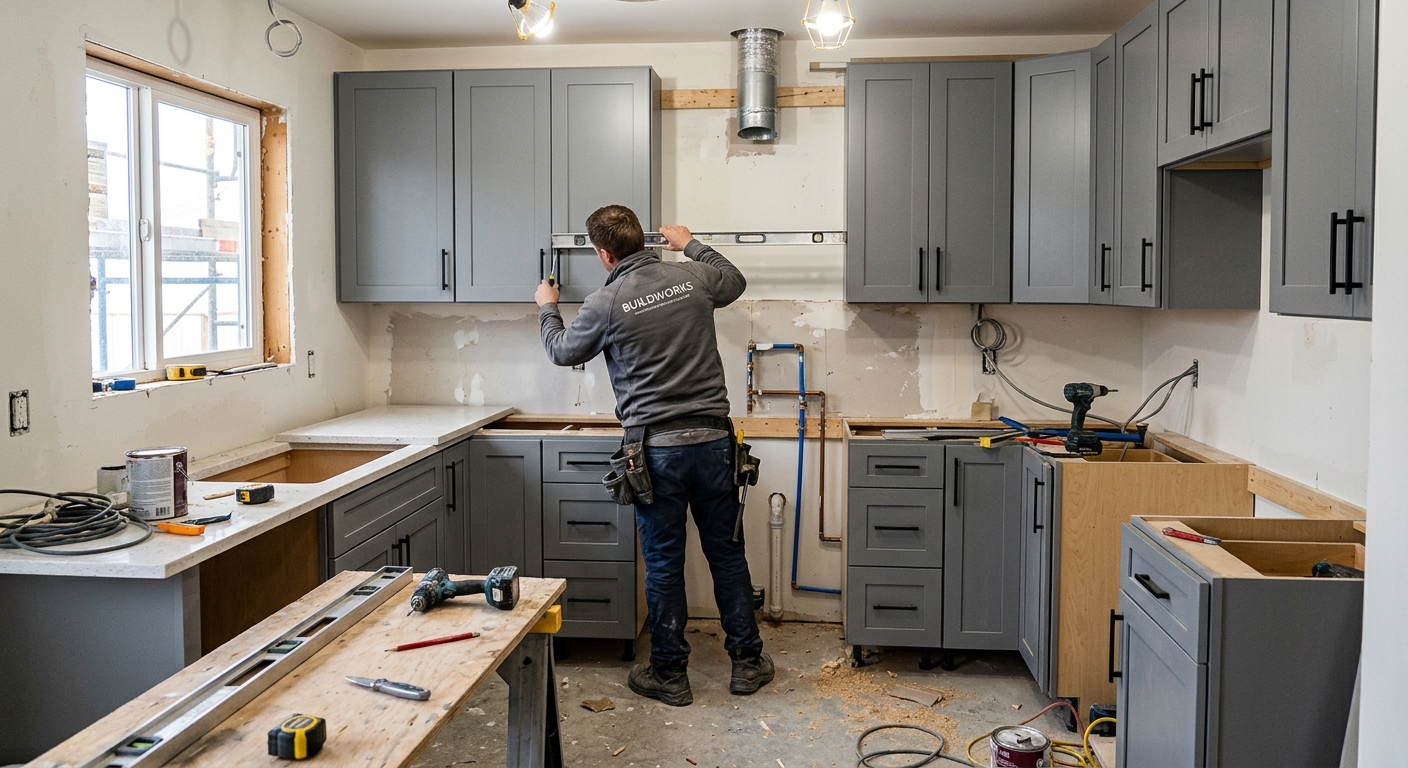
Kitchen renovation costs in Ross — 2026
Ross homeowners face a wide span of kitchen renovation options, and costs are shaped by the mix of older houses and local demand. With a high homeownership rate of 76% and a median household income of $86,716 (U.S. Census Bureau, ACS 2024), most Ross kitchen projects are planned by owners expecting to stay and use the new space, rather than quick-fix flips. The prevalence of homes built before 1980 means many kitchens start with outdated layouts or utilities and require more than just a cosmetic upgrade.
The most common reasons for cost overruns here are mismatches in project scope. Homeowners price a straightforward "replace what’s there" job, then end up moving walls or utilities—jumping to a higher price band without revising the budget. Pittsburgh’s nearby pre-1940 stock often requires gut renovations to open up cramped, compartmentalized rooms, driving up both the cost and the need for detailed planning.
| Scope |
What's included |
Duration |
Price range |
| Full gut remodel, same layout |
cabinets, counters, appliances, flooring, lighting, fixtures |
6–10 weeks |
$30,500–$122,500 |
| Gut plus layout change |
all of the above plus moved plumbing, electrical, walls |
10–16 weeks |
$66,500–$122,500 |
| Cabinet replacement (stock to semi-custom) |
remove and install cabinets, hardware, patching |
1–3 weeks |
$7,200–$30,500 |
| Cabinet refacing |
new doors and drawer fronts, veneer, hardware |
3–6 days |
$7,200–$20,500 |
| Countertop replacement only |
template, fabricate, install, reconnect sink |
1–3 weeks |
$4,100–$16,500 |
| Kitchen flooring only |
remove existing, install new flooring |
3–6 days |
$5,100–$20,500 |
Estimates for a typical Ross kitchen. Cabinet grade and whether the layout changes move these figures more than square footage.
Renovating to live in versus renovating to sell
Homeowners in Ross who renovate only for resale may not see a dollar-for-dollar return on a full kitchen gut. A new kitchen certainly makes a house more appealing and can help it sell faster, but you should expect to recover part—never all—of a major renovation’s cost. The best returns in Ross typically come from a mid-range project: updating dated cabinets, choosing durable, neutral finishes, and limiting layout changes. This avoids overspending relative to neighborhood values and makes the property move-in ready without venturing into luxury territory.
Compare this with a renovation done for your own long-term use. If you cook daily, like entertaining, or foresee staying in your home for years, tailoring the kitchen to your habits—whether that means a higher-end stove or moving walls—can be worthwhile, even if resale payback is uncertain. Just know that if you take your kitchen well above what’s typical for Ross’s $86,716 median income neighborhood, that extra spend stays with you, not the next owner.
In summary, renovations for resale should be practical, timeless, and moderate. Updates that reflect your own priorities, on the other hand, should follow what adds value to your life—regardless of what an appraiser may return later. The two goals don’t coexist well in the same project, so pick one before opening your wallet.
What a kitchen quote should specify
Getting comparable quotes is the hardest part of hiring for a Ross kitchen. The source of confusion is almost always the “allowance,” a placeholder amount for things you haven’t chosen yet—like backsplash tile, cabinet hardware, or lighting. If one contractor uses a low-ball allowance for, say, countertops, and another prices a more realistic slab, their totals may look similar but your real cost won’t be.
Always scrutinize allowances: Are they itemized? Are they in line with what you plan to select? Demand branded cabinet lines, countertop specs by material and thickness, and clarity on what happens if hidden faults are found—especially in older stock. Your quote should spell out the written change-order process and state that no extra work begins without signed approval. The payment schedule should tie to milestones—deposit, demolition finished, cabinets delivered—not calendar dates.
On legal protection: For any Ross kitchen over $500, Pennsylvania requires a written contract, and you’re entitled to a 3-business-day right of cancellation by law. Don’t accept any contractor waiving insurance deductibles or refusing to provide lien waivers from subcontractors with each payment.
| Line item |
What to look for |
Red flag if… |
| Allowances |
realistic amounts, itemised |
round numbers with no basis |
| Cabinetry |
brand, line, box construction |
'quality cabinets' |
| Countertops |
material, thickness, edge, seams |
material name only |
| Electrical |
circuits to be added, GFCI scope |
'as needed' |
| Unforeseen conditions |
how they are priced and approved |
not addressed |
| Change orders |
written approval before work |
verbal |
| Payment |
milestone-based, modest deposit |
front-loaded |
| Lien waivers |
from subs at each payment |
not offered |
Choosing cabinetry
Cabinet decisions are what make or break both the appearance and price of kitchen remodels in Ross. Refacing—keeping the existing cabinet boxes but adding new doors, drawer fronts, veneer, and hardware—can save thousands, but it only works if the boxes themselves are solid, square, and in a layout you’re satisfied with. Storage or configuration can’t be changed this way, but for well-built, well-laid-out kitchens, it’s a smart compromise.
Stock cabinets, limited to fixed sizes and finishes, are the budget pick but often leave gaps on walls that aren’t standard lengths—a regular occurrence in Ross’s older homes. Semi-custom steps up with more size, finish, and trim options, often necessary for non-standard rooms from the pre-1940s or mid-century periods. Custom cabinets can match any odd angle, maximize every inch, and follow high-end designs, but lead times and prices climb fast.
Box construction matters at any price: plywood beats particleboard for longevity and moisture resistance; dovetailed drawers last longer than stapled ones; full-extension and soft-close hardware should be a given. Frameless (European) cabinets look cleaner and provide more accessible space, while face-frame (traditional American) cabinets are more forgiving with old walls.
| Option |
Cost |
Best when |
Limitation |
| Painting existing cabinets |
$1,200–$3,500 |
boxes and doors sound, tight budget |
no layout or style change |
| Refacing |
$7,200–$20,500 |
boxes square and layout works |
storage unchanged |
| Stock cabinets |
$7,200–$30,500 |
standard dimensions fit |
filler strips, limited finishes |
| Semi-custom |
$20,500–$30,500 |
non-standard walls or finishes |
6–12 week lead time |
| Full custom |
$20,500–$30,500 |
unusual layout or high-end design |
longest lead, highest cost |
Electrical work in an older Ross kitchen
Electrical updates are the most common and least predictable source of extra cost once a Ross kitchen wall is open. Today's code in Pennsylvania expects every kitchen to have multiple dedicated small appliance circuits, GFCI outlets at all countertop receptacles, evenly spaced outlets, and separate circuits for appliances like the dishwasher, disposal, microwave, and any electric range or oven. This is true under the Uniform Construction Code enforced by local governments in Allegheny County.
But houses built before 1980 in Ross—over three-quarters of the stock—often have two-wire, ungrounded kitchen circuits, single circuits handling multiple rooms, panes with no space for added breakers, and, occasionally, legacy aluminum wiring. When these conditions appear, you can’t legally patch the old wiring; inspector signoff generally means bringing the kitchen up to current code. Even in late-1990s builds, it’s rare to find the five or six dedicated circuits now required.
Budget at least $4,100–$16,500 for a comprehensive kitchen electrical upgrade in an older Ross home—less if the panel and service are adequate, more if heavy rewiring or service upgrades are needed. These are real costs, not optional extras, triggered by the scope of your remodel and the age of your wiring.
Cabinets are the critical path
For a Ross kitchen project, be ready for a timeline dominated by cabinetry. The sequence runs like this: design and measurement, cabinet order (with deposit), site prep and demolition, electrical and plumbing rough-in, municipal inspection, cabinet installation, countertop template (cannot occur before cabinets are set), fabrication, countertop installation, then flooring, tile, and final trim.
The sticking point for most jobs in Allegheny County’s busy market is cabinet production. Even semi-custom units carry a 6–12 week lead time; custom can stretch longer, regardless of demand. Do not expect to survive on showroom displays or catalog timeframes—your kitchen will be “on hold” until cabinets arrive. The countertop shop cannot template or start fabrication until cabinets are fixed in place, so there will be a built-in one- to two-week gap after cabinet installation, even when schedules run flawlessly. It’s a phase most homeowners underestimate or aren’t warned about.
Demand for finish-trade labor in Ross and nearby Pittsburgh is high, so earlier ordering reduces idle time. Always finalize and order cabinets before demolition begins—you want cabinets in hand before any sledgehammer swings, not after. Skipping ahead on demo or finishes only guarantees your new kitchen will sit half-finished, waiting for what’s still on a truck or in a shop.
Permits and inspections for a Ross kitchen
In Ross and Allegheny County, permits are usually required when you move or add electrical circuits, re-route plumbing, change structural walls, or take down/load-bearing partitions as part of your kitchen job. Cosmetic upgrades—painting, hardware swaps, cabinet refacing, direct countertop replacement—generally don’t trigger municipal permits, reflecting common practices in area boroughs. But the moment your scope includes layout changes or any new utilities, an inspection and potentially a plan review will be necessary.
In Pittsburgh proper, the Department of Permits, Licenses, and Inspections oversees plan reviews, especially for full gut renovations or layout changes, and conducts their own electrical inspections. In Ross and other suburbs, code offices may use municipal inspectors or third-party agencies for electrical signoffs—a surprise for some homeowners, but consistent with how boroughs in Allegheny County operate.
Pennsylvania demands that any kitchen remodel over $500 have a Home Improvement Contractor (HIC) registration, which homeowners can verify at hic.attorneygeneral.gov. Employers must also hold workers’ compensation insurance, verifiable at wcais.pa.gov. If you skip permits, the most common problem won’t appear until resale—unpermitted work in kitchens is a red flag for buyers, lenders, and insurers, and disclosure is required once you list.
Frequently asked questions — kitchen renovation in Ross
How far ahead should I book a contractor in Ross?
In Ross and the surrounding Allegheny County area, reputable kitchen contractors often book out three to six months—sometimes longer for high-demand finish-trade labor. This reflects a market where urban and close-in suburban demand remain high year-round. If you plan an involved remodel (anything beyond a simple cabinet swap), reserve your contractor as soon as your design is settled. Even for smaller projects like a countertop replacement at $4,100–$16,500, waiting until “just after the holidays” will likely land you behind other homeowners who signed contracts early. The earlier you line up your contractor, the more likely you are to control your schedule and have a real pick of available teams.
Can I over-improve for my Ross neighbourhood?
Absolutely. Ross has a median household income of $86,716, which sets a practical ceiling for kitchen spending. If you push your kitchen renovation aggressively above the area’s typical range—say, aiming for the upper tier of a full gut remodel at $122,500—it’s highly unlikely to return that investment at resale. In Allegheny County, buyers are quick to walk away from houses that price themselves out of their block or neighborhood. Unless you simply want a magazine-grade kitchen for yourself, target a renovation compatible with what homes near you appraise for and actually sell at. Spend on what matters for your enjoyment, but understand you may be paying for a lifestyle, not an investment.
How much do new kitchen cabinets cost in Ross?
In Ross, stock to semi-custom cabinet replacement for a standard-sized kitchen typically runs between $7,200–$30,500. Your end cost depends on the room’s dimensions, whether you choose stock lines or need semi-custom solutions (as is common in older homes), and construction details like plywood versus particleboard boxes. Custom cabinets, especially in non-standard pre-1940s layouts, push into the upper tier. Installation, soft-close hardware, and finish upgrades all add up quickly. For owners in houses with unusual walls or small compartmentalized rooms—a common Ross issue—expect to need at least some semi-custom work.
What flooring works best in a kitchen?
For Ross kitchens, durability and resistance to our heavy freeze-thaw cycles matter—even inside, floors face more grit and shifting than you might expect on clay and shale subgrades. Luxury vinyl plank (LVP) and tile are most popular, balancing resilience and ease of cleaning. Engineered wood works but must be well-sealed. Budget between $5,100–$20,500 for new kitchen flooring depending on material and area. Avoid unfinished hardwood on slab or at exterior doors, which is prone to buckling. If your kitchen sits over a vented crawlspace, always ask about moisture mitigation before you pick flooring.
What happens if previous work was unpermitted?
Unpermitted work in a Ross kitchen is a liability—especially at resale. When you list your house or it’s inspected by a buyer’s lender, you are required to disclose any known unpermitted renovations. Discovery can delay or sink a sale, and some insurers may exclude claims related to uninspected work. The cost of bringing an old job up to code varies, but even an apparently minor electrical change can force a full update—budget at least $4,100–$16,500 if the wiring needs correction. Obtaining retroactive permits is harder than getting them up front and often means opening walls again.
How do I set up a temporary kitchen?
During a Ross kitchen remodel, expect to lose access to your main kitchen for anywhere from a week (countertop swap) to over two months (full gut). Most homeowners set up a temporary kitchen using a folding table, microwave, toaster oven, and fridge in the dining room or basement. Plan your timeline carefully—cabinet lead times of 6–12 weeks are common, so downtime is hard to avoid. If your project is limited to new flooring, you might only need to shift large appliances for $5,100–$20,500. Stock up on disposable dishware and set aside a sink for cleanup; consider slow cookers and outdoor grilling for variety. Communicate with your contractor to minimize disruption and get a clear daily work schedule.
Should I reface or replace my kitchen cabinets?
In Ross, where many kitchens still have solid, well-built cabinets from the mid-century or later, refacing is often an excellent move—when your boxes are sturdy, square, and in a layout you like. Refacing costs $7,200–$20,500 and updates only doors, fronts, and veneers. It can’t solve poor storage, bad layout, or water damage. If your boxes are flimsy, not level, or you want to open up a compartmentalized room (a frequent issue in Ross’s older homes), full replacement at $7,200–$30,500 may be the smarter investment for long-term function and resale.
What is a realistic contingency for a Ross kitchen?
In Ross, especially with a heavy pre-1980 housing stock, a realistic contingency is 10–20% of the total remodel budget. If a gut job is expected to cost $66,500, that means setting aside an extra $6,500–$13,000 for unknowns. Most surprises involve electrical or plumbing upgrades, level floors, or addressing hidden water damage. Skimping on contingency is risky—labor and material demand in Allegheny County means costs for add-ons can escalate quickly if your job hits a snag mid-project.
Are Ross kitchens typically small galley layouts?
Many Ross homes—especially those built before 1940—feature small, closed-off kitchens, often in a galley or U-shaped configuration. Even homes built through the mid-century period leaned toward compartmentalized rooms rather than open-concept layouts. This pattern drives frequent full gut remodels and layout changes, with costs from $66,500–$122,500. Renovations here often begin by removing a wall to create a more open, functional space. If your house was built after the 1980s, there’s a higher chance of a more modern footprint, but anything older may require major layout work to meet today’s expectations.