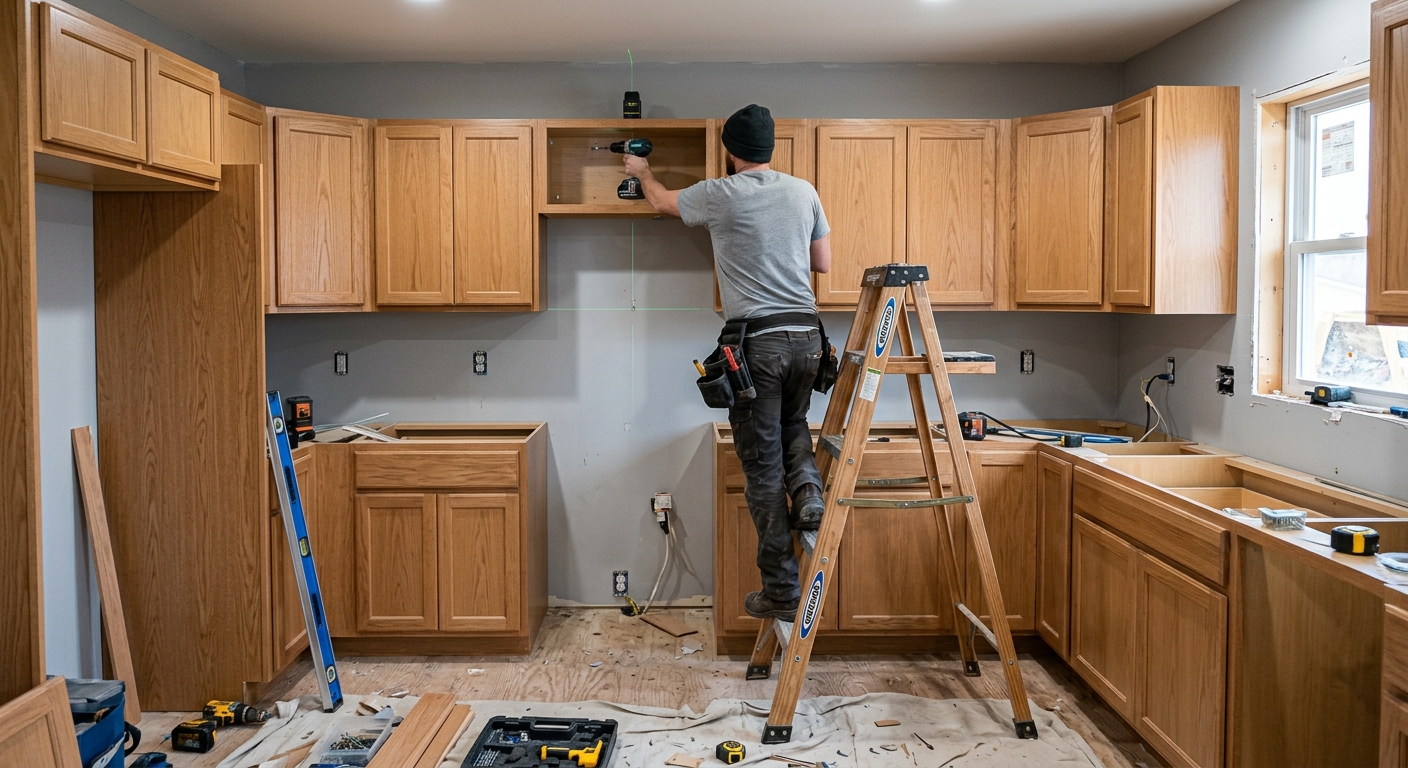
Springfield kitchen renovation prices by scope — 2026
If you own in Springfield, kitchen renovation spending is typically higher than national averages, tracking local home values and the township’s high homeownership rate of 93.5% (U.S. Census Bureau, ACS 2024). With a median household income of $132,500, many Springfield residents budget for more than just cosmetic updates—and a lot of them are working with kitchens built before 1980. Most homes here were built between 1920 and 1960, meaning the classic galley kitchen is still common, and a renovation may require layout changes, not just new finishes.
The most common financial mistake is to budget for a flooring or cabinet swap, then start adding moved walls or rerouted plumbing and electrical late in the process. The costs escalate quickly once layout changes are introduced, and contingency money for hidden surprises is essential. If you are customizing every surface, your budget looks nothing like that for a surface-level update. A realistic cost-out beats wishful thinking every time.
| Scope |
What's included |
Duration |
Price range |
| Full gut remodel, same layout |
cabinets, counters, appliances, flooring, lighting, fixtures |
6–10 weeks |
$34,000–$135,500 |
| Gut plus layout change |
all of the above plus moved plumbing, electrical, walls |
10–16 weeks |
$73,500–$135,500 |
| Cabinet replacement (stock to semi-custom) |
remove and install cabinets, hardware, patching |
1–3 weeks |
$7,900–$34,000 |
| Cabinet refacing |
new doors and drawer fronts, veneer, hardware |
3–6 days |
$7,900–$22,500 |
| Countertop replacement only |
template, fabricate, install, reconnect sink |
1–3 weeks |
$4,500–$18,000 |
| Kitchen flooring only |
remove existing, install new flooring |
3–6 days |
$5,600–$22,500 |
Estimates for a typical Springfield kitchen. Cabinet grade and whether the layout changes move these figures more than square footage.
Permits and inspections for a Springfield kitchen
In Springfield, kitchen cosmetic projects—painting, swapping hardware, cabinet refacing, and replacing countertops in place—are generally completed without building permits. The point where a permit is triggered is clear: add or relocate electrical circuits, move plumbing, reconfigure walls, or install new mechanical systems, and you enter permit territory. Plan reviews apply when plumbing, electrical, or structural changes are part of the remodel.
Electrical inspections are often handled by third-party agencies approved by the township, not always the township inspectors themselves. Many homeowners are surprised by this, especially coming from Philadelphia where the system differs. It means your contractor needs to schedule inspections at the right intervals and with the right agency or risk major delays.
Pennsylvania requires any contractor performing a home improvement job over $500 to hold an active Home Improvement Contractor (HIC) registration, issued by the Office of Attorney General. You can verify this at hic.attorneygeneral.gov. Employers are required to carry workers’ compensation insurance and homeowners should confirm coverage via WCAIS (wcais.pa.gov) if the contractor brings employees on site.
The cost of skipping required permits is real: unpermitted work can halt a home resale in its tracks and make insurance claims problematic. Always ask your contractor what scope triggers a permit, and require that documentation be included in your contract.
Resale value and kitchen spending
Redoing your Springfield kitchen will always help a house sell faster, but it won’t necessarily pay you back dollar for dollar—especially if the renovation cost is out of step with typical values in the township. With a median household income of $132,500 (U.S. Census Bureau, ACS 2024), the sensible play for resale is a mid-range spend that addresses obvious deficiencies and updates finishes but doesn’t over-improve with luxury wares.
If your aim is resale, resist the urge to personalize with bold colors or nontraditional materials. Keep things neutral, avoid extensive layout changes, and focus spending on cabinets, counters, and lighting. Don’t move the sink or range unless the existing layout is a major liability. These choices boost appeal but recoup a higher percentage at closing compared to a top-end custom overhaul.
Renovating for your own use is a different story. Now you can spend where you’ll actually notice it every day, whether that’s on cabinetry, smart storage, or the best appliances your cooking deserves. In both cases, beware of over-spending: even an immaculate kitchen won’t return the excess if it runs far above the rest of Springfield’s homes. This “over-improvement” is especially easy to do in a township with stable, upper-middle home values—plan accordingly.
Surprises in an older Springfield home
Most Springfield homes—over 90%—were built before 1980 (U.S. Census Bureau, ACS 2024), which means starting a kitchen remodel here is always a bit of a treasure hunt. Once plaster comes down or cabinets are pulled, you commonly find out-of-plumb walls and out-of-level floors, making cabinet installation a slow shimming process; expect to add $1,000–$2,500 in labor for extensive adjustments. Electrical is another wild card: many mid-century kitchens still have undersized or ungrounded wiring that must be fully replaced ($4,500–$12,000 to rewire a kitchen to current code).
Old galvanized supply lines are notorious for reducing water pressure and typically need replacement ($1,200–$3,500), while cast iron and clay drains may present fractures or slow clogs that become visible only after demolition. Insulation on exterior kitchen walls is often missing—especially in pre-1950 structures, meaning you’ll want to add batts or foam as part of the rebuild. Previous unpermitted renovations, like mystery framing or amateur wiring hidden behind walls, often force corrective work. Kitchens in homes built before 1978 fall under the federal EPA Lead Renovation, Repair and Painting (RRP) Rule, so any disturbance requires testing and careful handling of dust and demolition debris.
Newer kitchens dodge some (but rarely all) of these, but even late 1990s Springfield kitchens sometimes suffer from minimal builder-grade circuit counts, at-end-of-life laminate counters, and particleboard cabinets showing their age together.
Circuits, GFCI and code compliance
Updating a Springfield kitchen often means opening up walls for new cabinets or appliances, and that’s when electrical issues drive up the budget. Current code, as enforced by township inspectors or third-party agencies in Delaware County, calls for at least two dedicated small-appliance circuits at kitchen counters, GFCI protection for every countertop receptacle, a fixed spacing for outlets (no point along the counter more than 24 inches from a plug), and independent circuits for the dishwasher, disposal, and microwave. An electric range requires a 240-volt supply, which is sometimes missing from homes built 1920-1960.
Once walls are open in a house built before 1980—which describes most of Springfield—inspectors will expect any affected circuitry to come up to modern standard. This means replacing any remaining two-wire or ungrounded circuits (which can’t support modern GFCI outlets), upgrading the panel if there’s no spare capacity, and, less often, dealing with legacy aluminium branch wiring. Even modest kitchens often turn out to be running on a single old circuit, and “just swapping outlets” no longer flies under current enforcement. This can tack on $4,500–$12,000 if panel and full rewiring are required, or $2,500–$6,500 for smaller updates. Budget for it up front if your home is older.
Allocating a kitchen budget
Many Springfield kitchen budgets are set first by wish lists and only mapped to actual costs later, which leads to disappointment. Here’s how a full gut remodel in the $34,000–$135,500 range typically breaks down. Cabinetry will almost always be your largest ticket item (consider $8,500–$47,400). Labor and installation, closely behind ($6,800–$40,650), rises sharply if your project involves moving walls or major reconfiguration.
Countertops next—materials swing from good laminate to full slab quartz or stone, occupying 8–15% of total cost ($2,700–$20,300). Appliances also occupy a wide band, because Springfield homeowners replace them all at once about half the time, putting $3,400–$27,100 into the total. Flooring, lighting, and plumbing are smaller but can spike when older conditions are uncovered. Two forgotten lines that should never be omitted: contingency (10–15%) for what’s lurking in the walls, and soft costs—permits, design, delivery, and disposal.
Spend your upgrade budget on cabinets and lighting long before hitting high-end appliances. The visual and daily impact is far greater, and a Viking fridge next to builder-grade cabinets looks out of place. Each extra thousand on layout or lighting usually returns more than squeezing in another premium appliance.
| Category |
Share of budget |
Notes |
| Cabinetry |
25–35% |
the largest line and the longest lead time |
| Labour and installation |
20–30% |
rises sharply if the layout changes |
| Countertops |
8–15% |
material choice drives the swing |
| Appliances |
10–20% |
widest range of any category |
| Flooring |
5–10% |
|
| Lighting and electrical |
5–10% |
higher in older homes needing circuits |
| Plumbing and fixtures |
4–8% |
|
| Permits, design, disposal |
3–6% |
usually forgotten in early budgets |
| Contingency |
10–15% |
not optional in a pre-1980 house |
Three ways to organise the project
How you run your Springfield kitchen renovation matters more for your sanity than almost any materials choice. The first option is a design-build kitchen firm: they handle every detail from layout plans to installation with a single contract. This is the highest-cost route but requires the least from you and provides one point of contact if issues arise. If speed and convenience matter and budget is flexible, this is strong value for many Springfield homeowners, especially since finish-trade availability in western Delaware County—including Springfield—is tighter than in downtown areas.
The general contractor route lands in the middle: you hire a GC, they bring in and manage the subs (plumbers, electricians, finish carpenters), and you or your designer make product selections. This is the most common model for a full remodel in Springfield and lets you compare bids without micromanaging every step. Effort and risk land in the middle—sometimes scheduling or communication requires follow-up, but the management is out of your hands.
The owner-managed path is cheapest in absolute dollars up front, but it is not for the faint of heart. You are in charge of hiring subs, ordering (and storing) materials, scheduling each trade, and keeping permit paperwork in order. Unless you have substantial experience or a highly flexible schedule, most homeowners in Springfield will find that the possible savings evaporate in the face of contractor delays, inspection holds, and warranty headaches.
Frequently asked questions — kitchen renovation in Springfield
Who inspects kitchen electrical work in Springfield?
In Springfield and much of Delaware County, most kitchen electrical inspections are performed by third-party agencies that have been approved by your township. This surprises many homeowners who expect a municipal inspector at every step, especially if they have experience in Philadelphia. It means that your contractor or electrician should be scheduling inspections with a private firm designated by the township—if they miss this, you could lose days or weeks to rescheduling. Make sure any contractor working in your Springfield kitchen is familiar with these requirements and that electrical work is permitted and inspected before drywall or tile go back up. For a straightforward kitchen rewire to meet code, count on spending $4,500–$12,000 in total, which includes all required inspections in this market.
How much does a kitchen renovation cost in Springfield?
The cost of a kitchen renovation in Springfield varies significantly by scope. A full gut remodel—new cabinets, appliances, flooring, and more—in a typical home runs from $34,000–$135,500. Staying within the existing layout is on the lower end, but if you move walls or reroute plumbing, expect to be closer to the top. Smaller projects, such as only replacing countertops, generally fall between $4,500–$18,000. The era of Springfield’s housing (most pre-1980) means surprises can and do add to the final total. Plan for at least 10% contingency to handle what’s found after demo begins.
Is lead paint a concern in Springfield kitchen renovations?
Yes, lead paint is still a concern in Springfield, especially in homes built before 1978. Federal EPA Lead Renovation, Repair and Painting (RRP) rules require lead safety procedures during any demolition, including dust control and proper debris disposal. Most Springfield homes were built in the 1920–1960 window, so it’s not just a theoretical risk. Before any demolition, professional testing is required anytime paint layers will be disturbed. If lead is present, the cost to handle safe removal and cleanup typically adds a few thousand—plan for an added $2,000–$4,000 if multiple trades must follow RRP protocols. A qualified contractor will know and handle this as a matter of course.
How much more does moving the sink and range cost?
Moving plumbing for a sink and the gas or electric line for a range adds real complexity and cost to a Springfield kitchen remodel. The moment you shift these fixtures, the job requires new water supply, drain lines, and electrical or gas outlets—plus patching and permits. In most Springfield homes, which were built before open layouts were the norm, moving a sink across the room or into an island quickly adds $7,000–$20,000 depending on length of new runs and the state of existing plumbing and joists. Keep your sink and range in place if you are watching costs. For price-conscious updates, keeping the footprint as-is is the best move.
What is an allowance in a renovation quote?
An allowance is a placeholder dollar value in your renovation contract for items not yet selected—cabinets, countertops, or fixtures. For example, if you haven’t picked out your countertops, your contractor may write in a line with an allowance of $10,000 (which is typical for Springfield). If you decide on a material above or below that figure, your final bill adjusts accordingly. Allowances are useful but can be a source of frustration if set too low, resulting in ‘extras’ at the payout. Make sure your allowances match the actual cost of what you want, or clarify early so there are no unwelcome surprises mid-renovation.
What is the difference between stock and semi-custom cabinets?
Stock cabinets are mass-produced and come in predetermined sizes and finishes. They’re the fastest and least expensive option (think the lower end of $7,900–$34,000 for a Springfield kitchen). Semi-custom cabinets, by contrast, are built to order within a standard set of options—greater flexibility for sizes, finishes, and features, but at a moderate upcharge. Most Springfield homeowners end up choosing semi-custom to get around the quirks of walls in older homes (uneven, out of square) or to maximize available storage. Full custom isn’t included in these ranges—it commands a much steeper premium and is rarely needed except in irregular spaces or high-end historic work.
Can I over-improve for my Springfield neighbourhood?
Absolutely. With a median household income of $132,500 and a high homeownership rate in Springfield, major upgrades can be attractive, but there is an upper limit. Spending at the top end of the full remodel range ($135,500) when surrounding homes are not comparable is seldom recovered at resale. Mid-range spends tend to see the best return here—updating cabinets, counters, and lighting, but avoiding luxury appliances or expensive layout changes unless you plan to stay put long-term. Ask yourself: will the finished kitchen match the rest of the house and the block? If not, scale back high-end materials to avoid parking money you don’t get back at sale time.
What is the cheapest way to update a Springfield kitchen?
The most cost-effective updates in Springfield kitchens are paint, new cabinet hardware, and resurfaced or refaced cabinets—these are often done without a permit and can transform a space for well under $10,000. Direct countertop replacements and new lighting are also smart, high-visibility changes that don’t require moving walls, opening up old wire runs, or adding circuits. Stay away from moving plumbing or walls if your goal is value. If your cabinets are in good shape, just replacing doors and drawer fronts (refacing) can yield a near-brand-new look for half the price of full replacement. Always align upgrade spending with the current state and era of your Springfield kitchen.
What are cabinet lead times in Springfield right now?
Springfield homeowners should expect standard stock-to-semi-custom cabinet lead times in the range of 3–8 weeks after finalizing selections and approving drawings. Demand in Delaware County tracks with the broader Philadelphia metro market, but west-of-city suburbs like Springfield can face sporadic delivery slowdowns, especially if installers are juggling several projects. If you are considering more customized cabinetry, allow extra time—not only for the build but also for measuring and plan revisions that are often needed in older, out-of-plumb Springfield kitchens. Plan your renovation sequencing backwards from this date; don’t demo your kitchen until you have a confirmed delivery schedule. A delay on cabinets can halt your entire project, making punctual delivery worth every dollar, even if it puts you on the higher side of a $7,900–$34,000 cabinet budget.