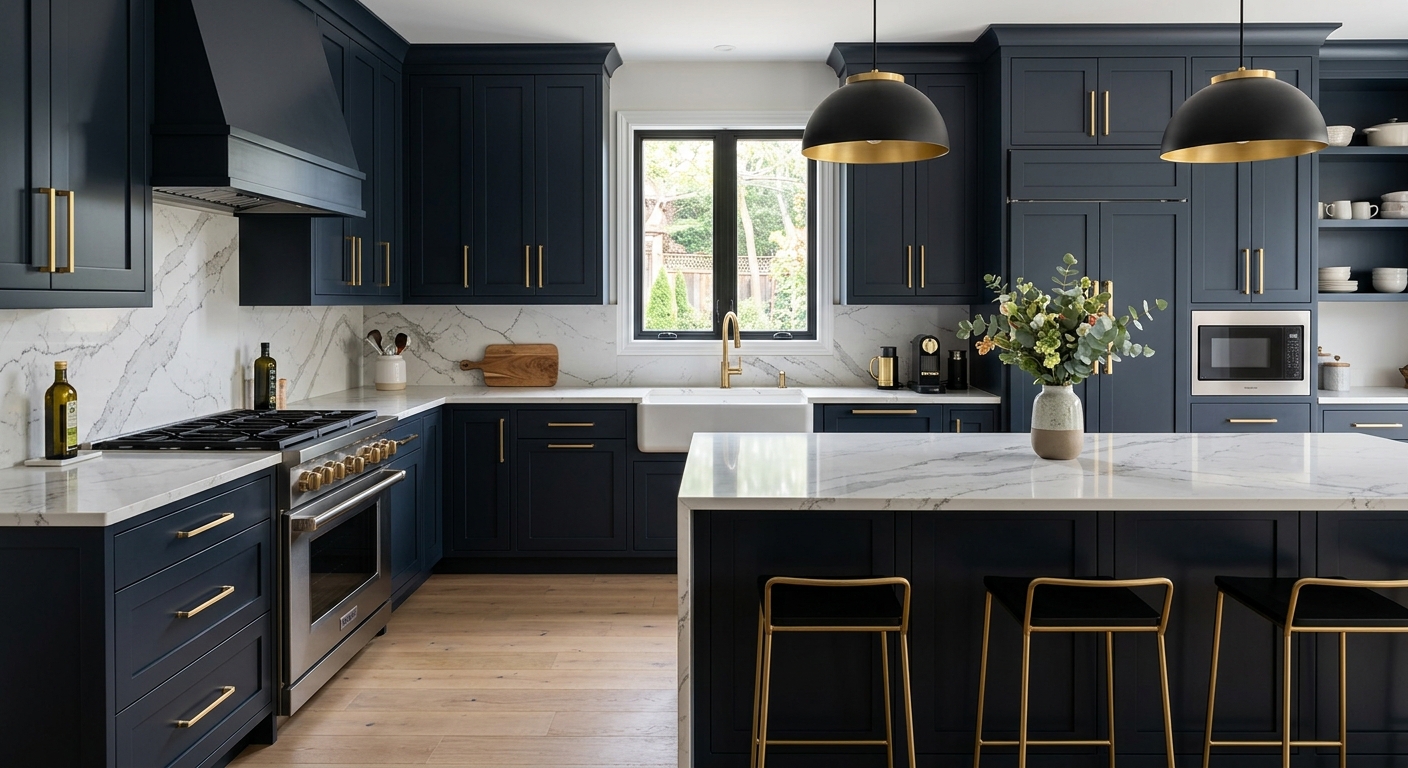
Kitchen renovation costs in Archbald — 2026
Archbald’s kitchen renovation costs reflect the area’s mostly owner-occupied, single-family homes and a median household income of $72,964 (U.S. Census Bureau, ACS 2024). With a homeownership rate of 73.2%, most residents are planning long-term and looking for practical upgrades, not quick fixes. Given that Scranton and Carbondale have a dominant 1900–1940 housing stock, many kitchens need more than modern finishes—they often require new wiring or changes to cramped layouts you wouldn't find in a newer home. Budgeting for a kitchen remodel in Archbald means facing decisions about scope: most blown budgets come from pricing out a simple pull-and-replace but then choosing a full gut and layout change once you see what's possible.
If you’re budgeting for 2026, here’s what different kitchen scopes in Archbald typically cost:
| Scope |
What's included |
Duration |
Price range |
| Full gut remodel, same layout |
cabinets, counters, appliances, flooring, lighting, fixtures |
6–10 weeks |
$29,500–$117,500 |
| Gut plus layout change |
all of the above plus moved plumbing, electrical, walls |
10–16 weeks |
$63,500–$117,500 |
| Cabinet replacement (stock to semi-custom) |
remove and install cabinets, hardware, patching |
1–3 weeks |
$6,900–$29,500 |
| Cabinet refacing |
new doors and drawer fronts, veneer, hardware |
3–6 days |
$6,900–$19,500 |
| Countertop replacement only |
template, fabricate, install, reconnect sink |
1–3 weeks |
$3,900–$15,500 |
| Kitchen flooring only |
remove existing, install new flooring |
3–6 days |
$4,900–$19,500 |
Estimates for a typical Archbald kitchen. Cabinet grade and whether the layout changes move these figures more than square footage.
Allocating a kitchen budget
Most Archbald homeowners are surprised when they see how much of the kitchen budget goes to cabinetry—often $7,375–$41,125 on a full gut remodel. Labor is the next largest line, taking up another $5,900–$35,250, especially if you’re changing the layout. Countertops, appliances, flooring, and lighting follow, but between old walls and patchwork wiring in local houses, soft costs and contingencies add up fast.
The two lines few plan for but absolutely need in Archbald: a contingency (problems show up once you’re inside the walls in 64.8% of pre-1980 homes) and soft costs—permits, design, delivery, and debris removal. Adding $2,950–$17,625 for the unexpected saves your budget when water lines, knob-and-tube wiring, or uneven subfloors are found.
A thousand dollars goes much further in upgrading cabinetry hardware or lighting than it does in shifting cabinet construction from particleboard to plywood. Don’t pour extra budget into a pro-style appliance if the cabinets and counters don’t match—balance counts. At the other end, scrimping on lighting or countertop edges often leads to regret.
| Category |
Share of budget |
Notes |
| Cabinetry |
25–35% |
the largest line and the longest lead time |
| Labour and installation |
20–30% |
rises sharply if the layout changes |
| Countertops |
8–15% |
material choice drives the swing |
| Appliances |
10–20% |
widest range of any category |
| Flooring |
5–10% |
|
| Lighting and electrical |
5–10% |
higher in older homes needing circuits |
| Plumbing and fixtures |
4–8% |
|
| Permits, design, disposal |
3–6% |
usually forgotten in early budgets |
| Contingency |
10–15% |
not optional in a pre-1980 house |
Quartz, granite, laminate or butcher block
In Archbald, countertop decisions come down to durability and daily habits more than just the showroom look. Quartz is engineered—non-porous, easy to keep clean, and stain-resistant, but it will discolor or crack under a hot pan, so trivets are mandatory. Granite is natural and handles heat better, but it is porous, needs to be sealed every year, and can show oil stains if maintenance lapses. Laminate is much tougher than its 1980s reputation: it resists almost everything but deep scratches and burns, installs quickly, and is a perfectly smart choice for rental units or budget kitchens—especially in a market where many kitchens still use laminate and hold up fine for years. Butcher block adds warmth and is fully repairable with sanding, but demands periodic oiling and is prone to water staining near the sink. Solid surface materials can be seamlessly patched and sanded, but they are susceptible to heat and aren’t as hard as stone.
Fabrication cost depends on the number of seams, choice of edge profile (simple square edges are cheaper; ogee and bullnose add cost), the number of cutouts (every sink, cooktop, or drop-in fixture costs extra), and whether a templater comes to make a precise pattern or relies on loose field dimensions. Seam placement matters—a busy pattern or strong color contrast can make seams more visible, especially in L-shaped kitchens. For most kitchens, especially those where quick turnaround and durability matter more than wow factor, laminate does not mean “cheap”—it means functional and sensible. Save the big spend for spaces that see daily heavy prep, or if the kitchen anchors an open living space where appearance matters most.
Why the electrical line grew
Electrical upgrades are one of the most common—and expensive—surprises during a kitchen remodel in Archbald’s older homes. Today’s code expects dedicated small-appliance circuits at every countertop, Ground Fault Circuit Interrupter (GFCI) protection for all countertop outlets, strict spacing of receptacles (no more than 4 feet apart), and separate circuits for the dishwasher, garbage disposal, and microwave. An electric range demands its own 240-volt service. These changes aren’t “nice to have”—they’re code, and inspectors won’t pass work that falls short.
The reality in much of Scranton, Carbondale, and the surrounding areas is that kitchens built between 1900 and 1940 (the dominant local housing era) often have only one shared, sometimes ungrounded, 15-amp circuit for the whole kitchen. Knob-and-tube wiring, lack of spare panel capacity, or even aluminum branch wiring from mid-century additions are common. Once walls are open for any significant scope, Pennsylvania Uniform Construction Code (UCC) enforcement means new wiring must bring the whole kitchen up to standard—partial fixes almost never fly in Lackawanna County, especially if inspected by a third-party agency. Even late '90s kitchens may lack enough circuits for today’s appliance loads, especially if the panel is maxed out.
Bringing electrical in an older Archbald kitchen fully to code typically adds $5,900–$17,625, depending on how far you end up going, and is a cost you don’t want to skimp on. Make sure this line is visible in your budget before demolition starts.
The biggest line item in your Archbald kitchen
Cabinet decisions drive both cost and function in a kitchen renovation, especially in Archbald’s older homes where few rooms are built to standard modern dimensions. The four main options:
Refacing keeps your existing cabinet boxes, replacing only the doors, drawer fronts, and applying a new veneer. It's a practical choice only if the boxes themselves are square, free of rot, and laid out in a sensible way for your workflow. Refacing costs far less than new cabinets ($6,900–$19,500) but cannot add storage or alter the floor plan.
Stock cabinets are factory-made in fixed sizes and finishes—if your kitchen is a standard L or U and the walls are straight, these work fine (often at $6,900–$29,500), but filler strips may be needed. Semi-custom goes further, letting you tweak cabinet width, height, and choose finishes—they’re the norm for Archbald’s older, non-standard kitchens, even where owners weren’t expecting to spend extra.
Full custom means just that: any size, any finish, any layout, but with a long lead time and top price. In Archbald’s older homes, semi-custom and custom are the only ways to fit around odd walls, boiler bump-outs, and sag in the old floors and ceilings.
Construction matters at every tier: plywood boxes are stronger and last longer than particleboard, dovetail drawer construction beats stapled, and full-extension soft-close hardware is worth the upgrade. Frameless cabinets maximize storage in tight spaces but need precise installation.
| Option |
Cost |
Best when |
Limitation |
| Painting existing cabinets |
$1,200–$3,500 |
boxes and doors sound, tight budget |
no layout or style change |
| Refacing |
$6,900–$19,500 |
boxes square and layout works |
storage unchanged |
| Stock cabinets |
$6,900–$29,500 |
standard dimensions fit |
filler strips, limited finishes |
| Semi-custom |
$19,500–$29,500 |
non-standard walls or finishes |
6–12 week lead time |
| Full custom |
$19,500–$29,500 |
unusual layout or high-end design |
longest lead, highest cost |
Code requirements for Archbald kitchens
In Archbald, most kitchen projects like painting cabinets, changing hardware, refacing, or swapping countertops do not require a building permit. But the moment you move or add electrical circuits, change the plumbing layout, or touch anything structural, you’ll typically need a permit—especially true if you remove walls or add ventilation. The Pennsylvania Uniform Construction Code (UCC) governs these requirements, and enforcement happens at the municipal level. For any remodel in Scranton that affects structure, electrical, or plumbing, be prepared for plan review before work can begin.
Electrical inspections are often the domain of third-party UCC agencies in Scranton and Dunmore, such as Construction Code Inspectors, Inc.—meaning your project may not be inspected by the town itself. This can surprise homeowners who expect a municipal inspector and may delay final approvals if caught off guard.
Any contract for work over $500 must be with a contractor registered via the Pennsylvania Office of Attorney General’s Home Improvement Contractor (HIC) registration; check their status before signing. Pennsylvania also requires that any contractor with employees carry workers’ compensation insurance, verifiable through the WCAIS system.
Unpermitted work isn’t just a risk during construction—in Archbald, it’s a frequent source of failed closings at resale. Make sure permit lines are clear with your contractor up front.
Four kinds of kitchen project, four budgets
When starting a kitchen project in Archbald, define your tier before collecting bids—the range between a cosmetic refresh and a full-layout gut is enormous. Here’s what each scope means locally:
Cosmetic refresh: Paint, new hardware, maybe a backsplash or updated lighting—no layout or cabinet changes. It’s the right tier if you’re prepping for resale, or if the bones of the kitchen are acceptable. Spend here when the cabinet boxes are still solid.
Pull and replace: Replaces all cabinets, counters, maybe appliances, but everything stays where it is—plumbing and electrical are left as existing. Typical for late ‘90s homes or kitchens that just look tired. Lower risk, but hidden surprises are still possible, especially in homes built before 1980.
Gut, same layout: Complete demolition down to the studs and subfloor, with all new services installed to code, but the walls, plumbing, and wiring stay in the same locations. This is common in Archbald’s older homes where knob-and-tube wiring or failing plaster is exposed during demolition.
Layout change: Anything that moves the sink, range, or knocks down walls triggers a permit, engineering, and the highest level of contractor skill. It’s a big jump in cost, in both time and dollars—expect $63,500–$117,500 versus under $63,500 if you keep the footprint. These are transformative but demand careful budgeting.
Contractors need to know your tier before offering any kind of realistic price. The more ambiguity in scope, the wider the estimate—and the greater the chance of budget overrun once demolition reveals what’s really in your walls.
Frequently asked questions — kitchen renovation in Archbald
Should I reface or replace my kitchen cabinets?
Refacing your kitchen cabinets in Archbald makes sense if your cabinet boxes are still solid, square, and the current layout generally works for your needs. Refacing involves replacing just the doors, drawer fronts, and visible surfaces, freshening up the style at a fraction of full replacement cost—typically $6,900–$19,500. However, if your boxes are sagging, water-damaged, or if you want to add storage or change the layout, replacement becomes the better choice. Many Archbald kitchens, especially in older homes, end up exceeding the limits of refacing simply because the structure behind the doors is past its life. We recommend an honest assessment before deciding—sometimes new stock cabinets at $6,900–$29,500 are a better investment than reskinning worn-out boxes.
Do older Archbald homes need electrical upgrades for a kitchen?
Nearly always. Most houses in Archbald and surrounding Lackawanna County towns were built before 1980—many before 1940. These kitchens were never wired for today’s appliance loads. It’s common to find only a couple of circuits for the entire space, sometimes ungrounded and out of code. Current Pennsylvania Uniform Construction Code (UCC) demands GFCI protection, more circuits, AFCI protection, and dedicated lines for major appliances. Once you open walls, almost every inspector will expect a full electrical update, and this will typically add $5,900–$17,625 to the project. Don’t skip this—outdated electrical is the top reason for safety issues and failed code inspections in old Archbald homes.
Should I hire a general contractor or a kitchen firm?
In Archbald, the choice depends on both project scale and complexity. A general contractor is usually the right call for a full gut or layout change—anything involving multiple trades, permits, or custom work. They handle the schedule, subs, permits, and inspections. A kitchen-only firm (cabinet dealer/installer) is fine for straight pull-and-replace work with no changes to layout or services. Be aware that a project over $500 requires a written contract from a registered Home Improvement Contractor (HIC) per Pennsylvania law. If your project even hints at moving plumbing or electrical, opt for a GC with experience in Lackawanna County’s older housing stock.
What is the difference between stock and semi-custom cabinets?
Stock cabinets are made in fixed dimensions, finishes, and styles—they’re fast and budget-friendly, but need filler strips if your walls aren’t square or standard. Semi-custom lets you adjust width, height, and select from more finish options. In Archbald, where older homes rarely have standard dimensions, semi-custom is often necessary to avoid awkward gaps and maximize storage. For instance, a stock cabinet install might run $6,900–$29,500, while semi-custom tends to fill the higher end of that range but saves on future frustration. If your house is over 60 years old, measure carefully or talk to a contractor before going all-in on stock.
Can I cancel a renovation contract in Pennsylvania?
Yes. Under the Pennsylvania Home Improvement Consumer Protection Act (HICPA), you have 3 business days after signing a contract over $500 to cancel without penalty. This cooling-off period applies anywhere in the state, including Archbald. Make sure your contract spells this out up front—by law, it must include the right to cancel. This protects homeowners from high-pressure sales tactics and gives you time to reconsider if you feel rushed. After three days, standard contract terms take over, so read the cancellation and refund policies closely before you sign. No reputable contractor will object to this rule—it’s enforceable statewide.
What does a full gut kitchen remodel cost in Archbald?
A full gut remodel in Archbald, with everything down to the studs, new cabinets, counters, appliances, updated electrical, and flooring—but keeping the same layout—typically runs between $29,500–$117,500, with most projects landing around $63,500. Gutting plus changing the layout or moving services sharply increases cost to $63,500–$117,500. Why is the range so broad? Much depends on cabinet choice, finishes, and what you discover inside the walls—Lackawanna County homes built before 1940 surprise even seasoned contractors. Plan for a generous contingency.
Which upgrades are not worth the money?
In Archbald, don’t spend big on premium appliances if you’re pairing them with basic cabinets or skipping structural upgrades where the house needs them. Pro-level ranges in a kitchen with laminate counters and stock cabinets rarely recover their cost. Decorative extras—like ornate cabinet trim or specialty organizational inserts—should never come at the expense of proper lighting, durable counters, or electrical upgrades. For many homes, refacing tired but solid cabinets for $6,900–$19,500 is a smarter investment than chasing luxury features that won't improve day-to-day living. Focus the budget on function and reliability; aesthetics alone rarely pay off at resale in this market.
How far ahead should I book a contractor in Archbald?
You’ll usually need to book a kitchen contractor in Archbald at least 2–6 months in advance, especially during spring and fall when lead times run longest. The finish-trade labor market in Lackawanna County is tighter than some metro areas, so reputable contractors fill their schedules quickly. If you’re after semi-custom or custom cabinets—often necessary in older homes due to odd dimensions—add another two months for fabrication. For a full gut remodel or layout change in the $63,500–$117,500 range, early planning isn’t optional. Start conversations as soon as you have a clear project tier and budget.
What is a realistic contingency for a Archbald kitchen?
A healthy contingency for kitchen renovations in Archbald is between 10–15% of your total project budget—so $2,950–$17,625 on most full gut jobs. With 64.8% of local homes built before 1980, you can almost count on discovering hidden leaks, subfloor issues, or outdated electrical and plumbing once demolition begins. These aren’t just minor overages—in some cases, they’re show-stopping surprises that must be addressed to pass inspection. Plan for it from the start. Adding a proper contingency up front means you’re prepared for the realities of Lackawanna County’s older housing stock, and you avoid panic when an unexpected repair pops up.