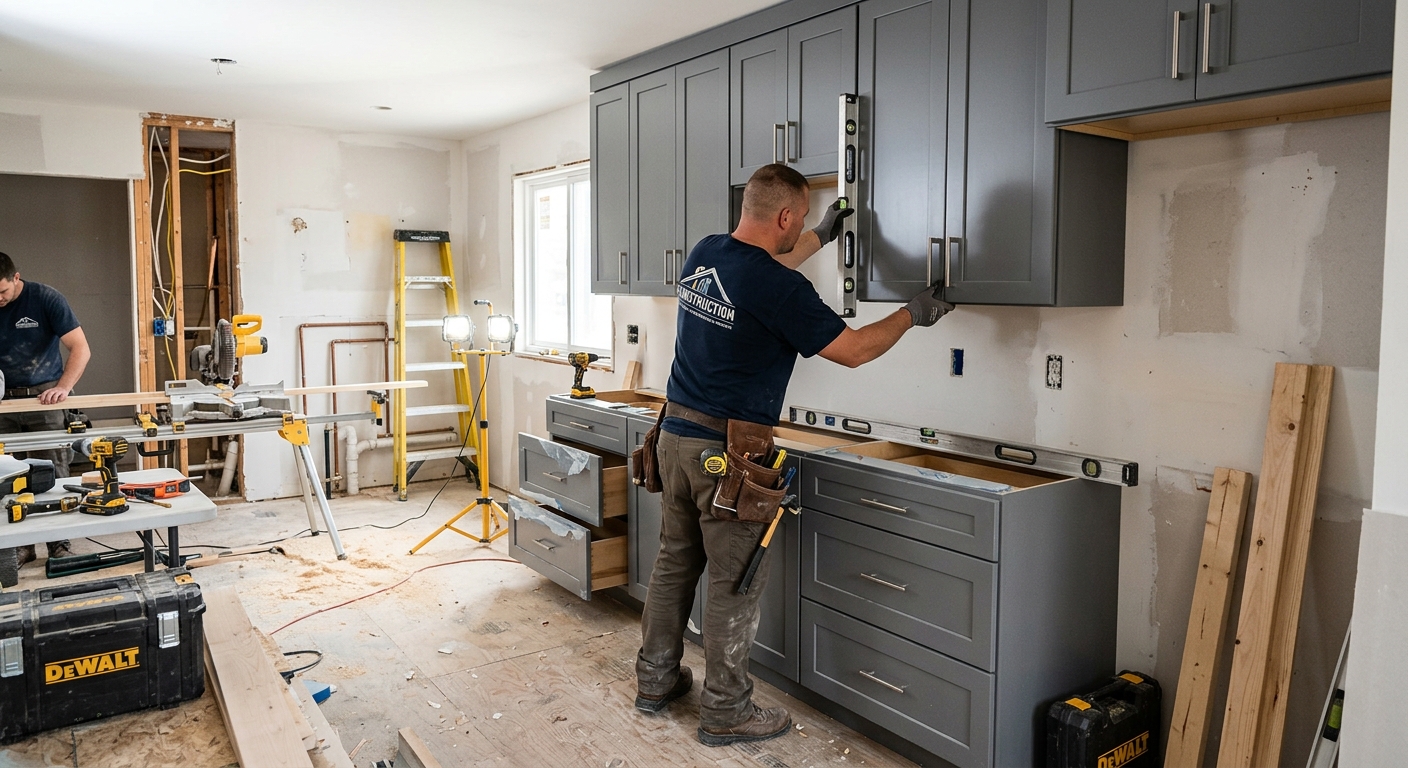
Perkasie kitchen renovation prices by scope — 2026
In Perkasie, where the median household income is $95,319 and nearly 70% of homes are owner-occupied (U.S. Census Bureau, ACS 2024), kitchen renovations often reflect both long-term utility and readiness for resale. Most projects here aren’t aimed at short-term flips — owners are planning for comfort, daily practical use, and reliability. Kitchen budget priorities and project scopes track directly with the age and layout of the housing stock: much of Lower Bucks County developed after 1960, originally built with compact galley layouts that today’s homeowners often find restrictive for modern needs. This era of construction drives frequent full gut-and-replace projects, especially when opening up the space—or at least moving walls—is on the table.
The main reason kitchen project budgets get blown in Perkasie is simple: pricing the project as if it’s a “pull and replace” but then specifying upgrades—like moving plumbing, opting for semi-custom cabinets, or adding new circuits—that belong in the next cost tier up. Realistic planning means defining your scope early and understanding what is included at each tier.
| Scope |
What's included |
Duration |
Price range |
| Full gut remodel, same layout |
cabinets, counters, appliances, flooring, lighting, fixtures |
6–10 weeks |
$32,500–$129,500 |
| Gut plus layout change |
all of the above plus moved plumbing, electrical, walls |
10–16 weeks |
$70,000–$129,500 |
| Cabinet replacement (stock to semi-custom) |
remove and install cabinets, hardware, patching |
1–3 weeks |
$7,600–$32,500 |
| Cabinet refacing |
new doors and drawer fronts, veneer, hardware |
3–6 days |
$7,600–$21,500 |
| Countertop replacement only |
template, fabricate, install, reconnect sink |
1–3 weeks |
$4,300–$17,500 |
| Kitchen flooring only |
remove existing, install new flooring |
3–6 days |
$5,400–$21,500 |
Estimates for a typical Perkasie kitchen. Cabinet grade and whether the layout changes move these figures more than square footage.
The real timeline for a Perkasie kitchen
Homeowners in Perkasie are often surprised at how much of a kitchen renovation timeline is spent waiting. While the visible part—demolition and installation—might move quickly, it’s the hidden timelines (cabinet production and countertop fabrication) that set the pace here, especially with finish-trade labor in Bucks County running tighter and schedule bottlenecks more common than the city.
Here’s how a typical project unfolds: design and measurement comes first. Once the layout and appliances are confirmed, cabinet orders should be placed. Do not wait until after demolition. Out here in Bucks County, typical lead times for semi-custom cabinets run from 5 to 10 weeks, and since the market is saturated with Philadelphia-metro firms, popular cabinet lines are often backlogged.
With cabinets ordered, demolition can begin. After removing the old kitchen, mechanical rough-ins—plumbing and electrical—are run and will need inspections before walls are closed up. Only once cabinets are fully installed can the countertop fabricator template the surfaces. No reputable fabricator will template off a plan or before cabinets are anchored. Fabrication then usually takes one to two weeks. During this period, flooring, tile, and trim work can be sequenced, but the overall timeline is set by cabinets and countertops—the true critical path.
That dead period between cabinet install and countertop template catches nearly everyone by surprise, easily adding a week or more while nothing visible happens. The key takeaway for Perkasie: order cabinets before you touch a crowbar, and build extra time for countertop fabrication into your plan.
Allocating a kitchen budget
Few things open a homeowner’s eyes faster than seeing a kitchen budget breakdown on paper. In Perkasie, like the rest of Bucks County, the largest share by far goes to cabinetry, which typically takes up 25–35% of the budget for a full remodel—translating to $8,200–$45,300 on a project in the $32,500–$129,500 range. Labour and installation follow as the next largest line—especially if the project moves walls or adds circuits—before counters, appliances, and finishes.
The two categories homeowners most often forget: a contingency fund for things found behind the walls (absolutely mandatory in any pre-1980 Perkasie house) and “soft costs” (permits, design, delivery, debris removal). Skipping these can throw a wrench into even the tightest plan.
An extra thousand dollars buys the most impact when put toward cabinetry and lighting—both high-visibility, daily-use items. On the other hand, spending for high-end pro appliances but settling for bottom-tier stock cabinets rarely adds value. Avoid this mismatch.
| Category |
Share of budget |
Notes |
| Cabinetry |
25–35% |
the largest line and the longest lead time |
| Labour and installation |
20–30% |
rises sharply if the layout changes |
| Countertops |
8–15% |
material choice drives the swing |
| Appliances |
10–20% |
widest range of any category |
| Flooring |
5–10% |
can often be installed over sound subfloors |
| Lighting and electrical |
5–10% |
higher in older homes needing circuits |
| Plumbing and fixtures |
4–8% |
updates may be required by code |
| Permits, design, disposal |
3–6% |
usually forgotten in early budgets |
| Contingency |
10–15% |
not optional in a pre-1980 house |
Why the electrical line grew
If you own a home in Perkasie built before 1980 (which is most of them), you can expect kitchen electrical to be a surprise line item. Current Pennsylvania Uniform Construction Code (UCC) requires dedicated small-appliance circuits, GFCI protection at all kitchen countertop outlets, proper spacing of receptacles (no more than 4 feet between), and dedicated lines for each major appliance—dishwasher, garbage disposal, microwave, and a 240-volt circuit for electric ranges.
The reality in many Perkasie homes: two-wire ungrounded circuits, just one or two circuits feeding the whole kitchen, and sometimes a panel without spare capacity. Post-1960, lots of Bucks County tract homes were wired minimally to code at the time. Even late-1990s homes sometimes only have two or three kitchen circuits, which is not enough by today’s standards. Some houses even have aluminum branch wiring that must be remediated for safety.
Once you open the walls, inspectors expect everything exposed to be updated to meet current code. This is not optional, and rarely budgeted for at the start. For a kitchen renovation, you should expect to spend $5,000–$15,000 to bring kitchen wiring up to code—more if the panel needs upgrading or circuits must be run long distances. The earlier this is planned, the better the outcome.
Four kinds of kitchen project, four budgets
In Perkasie, the words “kitchen remodel” can mean anything from a hardware swap to tearing everything back to studs. Knowing which tier you’re targeting makes all the difference for planning, budgeting, and what a contractor can (honestly) tell you up front.
- Cosmetic refresh: Paint, new hardware, swapping out the lighting, maybe a tile backsplash. No cabinet, counter, or appliance changes. Can be tackled over a weekend and often for well under $7,600. No permits, minimal disruption.
- Pull and replace: Replacing cabinets and countertops in the same footprint, leaving plumbing and electrical in place. This is your standard “make it look new” renovation, usually $7,600–$32,500. Permits aren’t usually needed unless you’re adding new circuits or moving plumbing.
- Gut, same layout: Everything down to the studs, replacing old wiring and plumbing, improving insulation. Plumbing and outlets stay put. Avg. cost is $32,500–$129,500. Permits pretty much always required.
- Layout change: Taking out or moving walls, relocating the sink or range, changing room size. This is the “cost cliff”—once you move a fixture or knock out a (possibly structural) wall, you’re in for permits, engineering, and a different class of contractor. Expect $70,000–$129,500 and a longer timeline.
Decide your tier before you call anyone. Without it, a contractor can’t give more than a vague range. The difference between tier three and four isn’t just cost—permits, engineering, and complexity rise fast. You’ll save time and money by narrowing your scope first.
Planning appliances before cabinets
Avoid the most common trap in Perkasie kitchen renovations: picking appliance models after cabinetry is ordered. Every cabinet supplier—stock or custom—builds to appliance dimensions. Order of operations matters. If you change your mind late and go for a 36" fridge or commercial range, your new cabinets simply won’t fit, and that’s a pricy fix.
A few specifics: Counter-depth refrigerators give a clean look and require less clearance, but must be planned for from the start, or they’ll stick out awkwardly. Slide-in ranges need cabinetry on both sides for a flush fit—standard freestanding ranges do not, so switching late is a headache. Gas versus induction: induction now often demands a heavy 40-amp circuit; if your panel lacks capacity, factor in upgrade costs. Panel-ready appliances are a high-end look but require precise cabinet sizing. Lastly, range hood venting: true ducted hoods work best, venting outside. Recirculating fans are allowed here but are a compromise in performance and code compliance.
Be aware that appliance lead times can exceed cabinet lead times for some finishes or features. Professional-grade appliances over-deliver in build quality more than raw cooking power, but in a typical Perkasie kitchen, the premium is mostly aesthetic and rarely recouped at resale. Plan appliances first and save yourself significant cost, delay, and hassle.
What requires a permit in a kitchen renovation
In Perkasie and throughout Bucks County, most cosmetic kitchen work—painting, swapping handles, cabinet refacing, or straight countertop replacement—does not require a permit. A permit comes into play when you’re moving or adding electrical circuits, relocating plumbing, or changing the kitchen’s structural layout. If you’re opening up a wall, adding a window, or switching the footprint, expect to go through municipal plan review and inspections. In particular, any work involving new branch circuits in Bensalem Township requires a permit, and all layout changes that touch plumbing fixtures or walls will trigger both plan review and inspection requirements. Electrical inspections are typically performed by third-party agencies such as Tri-County Inspection Company, which is a surprise to homeowners used to municipal inspections.
Contractor registration is another point where people get tripped up: for any job over $500, Pennsylvania requires Home Improvement Contractor (HIC) registration—always verify at hic.attorneygeneral.gov. All employers must carry workers’ compensation coverage, which you can confirm yourself at wcais.pa.gov. Skipping permits or hiring unregistered contractors may save time upfront but will often delay or even endanger resale: unpermitted work turns up in disclosures or home inspections, causing deals to fall apart or forcing costly remediation down the line.
Frequently asked questions — kitchen renovation in Perkasie
What adds the most resale value in a kitchen?
A well-balanced renovation allocates money where buyers notice most: new cabinets, quartz or granite counters, and upgraded lighting usually drive the highest returns in Perkasie. Since nearly 70% of homes are owner-occupied (U.S. Census Bureau, ACS 2024), buyers here look for a move-in ready kitchen more than a professional stove or the latest tech. Importantly, basic functional upgrades—GFCI protection, ample circuits, and good layout—hold more resale value than high-end appliances in homes with builder-basic cabinets. For maximizing value, a gut remodel in the range of $32,500–$129,500, executed cleanly with no unfinished details, typically returns more than spending solely on individual upgrades.
What is a change order and how should it work?
In Perkasie, a change order is a written agreement, signed by both you and your contractor, to alter the scope, cost, or timeline of your existing kitchen renovation contract. Most often, change orders crop up when something unexpected turns up behind the wall—common in pre-1980 homes—or if you decide to upgrade finishes or fixtures during the project. Pennsylvania’s Home Improvement Consumer Protection Act requires that any change to the written contract over $500 be documented and agreed to by both parties. If your kitchen reno started at $21,500, adding a second sink or moving a wall could result in a substantial change order. Confirm scope, budget, and whether it affects the completion date before signing. Avoid verbal or handshake agreements.
Is laminate countertop a bad choice?
Laminate remains a practical, budget-friendly choice for many kitchens in Perkasie. It’s not the top choice for resale, but a modern, durable laminate can refresh a kitchen for a fraction of the cost of stone, with a typical installation at $4,300–$9,700. While it is less heat and scratch resistant than quartz or granite, newer patterns and edge treatments look much better than the laminates of decades past. If your budget is tight or your home isn’t a high-end property, laminate can be an appropriate allocation of funds—especially if cabinets and lighting are also due for an upgrade. If long-term durability or luxury resale is your primary goal, quartz or stone deserve a closer look.
Should I order cabinets before demolition?
Yes—order your cabinets before tearing out your old kitchen. Bucks County, including Perkasie, has a competitive renovation market; still, cabinet lead times frequently run 6–10 weeks for semi-custom lines, especially during busy periods. Waiting to order until after demolition can leave you with an unusable kitchen and no set installation schedule. Most contractors will template and finalize measurements before ordering, but nothing—electrical, plumbing, countertop, flooring—can go forward until the cabinets arrive. For a typical cabinet replacement in the $7,600–$32,500 range, this simple sequencing step will save time, money, and frustration.
Can I renovate a kitchen in stages?
You can absolutely renovate a Perkasie kitchen in well-planned stages—many homeowners do, especially to fit the project into family schedules or distribute costs. Common phasing is to do cabinets first, then appliances and flooring, and leave counters and backsplash for last. The trade-off: staged work often increases labor costs and can mean paying for extra delivery or trip charges. Certain steps, like countertop replacement ($4,300–$17,500), require existing cabinets to be fully installed first, so project sequencing requires careful planning. Permitting may also get complicated if electrical or plumbing changes happen in a later phase. Work closely with your contractor to map out what can realistically be staged and what must be done in sequence so you don’t end up doubling work.
What does a full gut kitchen remodel cost in Perkasie?
A full kitchen gut remodel in Perkasie—where everything goes down to the studs, all plumbing and wiring are updated, and every surface is new—will fall into the $32,500–$129,500 range, with the median job around $70,000. The wide range reflects differences in cabinet quality, finishes, and especially whether the layout changes (moving plumbing, adding walls). If you’re in a post-1960’s Lower Bucks tract home, gutting is common practice—these kitchens weren’t built for today’s open plans, and electrical upgrades alone can swing the budget substantially. Always get a fixed written contract, not a verbal estimate, before proceeding.
Are Perkasie kitchens typically small galley layouts?
Many Perkasie homes, especially those built in the post-1960 Lower Bucks housing expansion, have compact or full galley kitchen layouts. These were designed for efficiency, often at the expense of openness and traffic flow. As a result, gut-and-replace projects to open up or reconfigure these galley kitchens are among the most frequent renovation types in the area. Homeowners aiming to move or remove a wall to break out of the galley layout should budget for the higher end of the spectrum—$70,000–$129,500—because layout changes add substantial permitting, engineering, and construction expense.
How much does a kitchen renovation cost in Perkasie?
Kitchen renovation costs in Perkasie vary significantly based on scope. For cosmetic upgrades without altering cabinets or layout, you might spend as little as $7,600. Most full replacements, including new cabinets and counters in the existing footprint, land in the $21,500–$32,500 band. A full gut renovation, especially if you are updating wiring and plumbing, starts around $32,500 and can reach $129,500 with high-end finishes or when big layout changes are involved. Choosing appliances and finishes wisely—and planning for contingency—makes all the difference between a budget-friendly refresh and a project that spirals out of control.
Does replacing cabinets require a permit?
In Perkasie, simply replacing kitchen cabinets within the existing layout does not typically require a permit. Most municipalities in Bucks County do not require permits for direct replacement of cabinet doors, drawer fronts, or boxes where layout and wiring are unchanged. However, if cabinet work involves new electrical circuits, moving outlets, or altering the kitchen’s footprint—especially in townships like Bensalem—permits and plan reviews are required. For a straightforward cabinet replacement costing $7,600–$32,500, confirm with your township before you start, as unpermitted changes can come back to haunt you at resale.