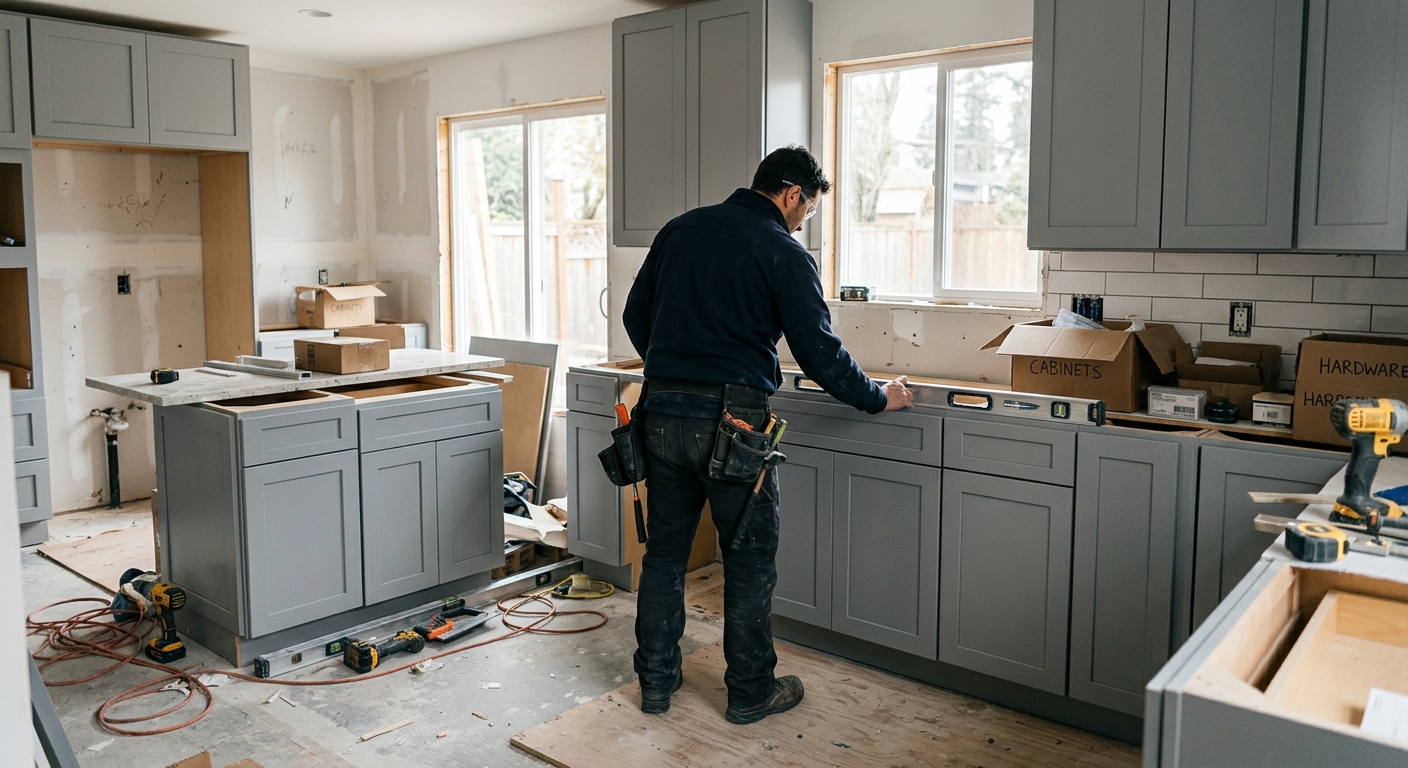
What a kitchen remodel costs in West View
West View’s steady homeownership (70.2%) and a median household income around $75,054 (U.S. Census Bureau, ACS 2024) mean most residents approach a kitchen remodel as something done for their own use, not as a quick turnaround for resale. If your home is part of the region’s large older housing stock—typical of the North Hills and Pittsburgh—your kitchen layout likely keeps you hemmed in by a wall or two from the pre-1940 era. These kitchens often need full gut renovations merely to catch up to modern expectations, not just cosmetic updates.
The biggest reason kitchen projects in West View go over budget is mismatched scope. A homeowner prices out new cabinets and paint, then adds moving a wall or relocating major appliances—quickly running into costs typical for a gut-to-the-studs remodel, with code-triggered upgrades on plumbing and electrical. Choose your level of intervention first, or you will see the numbers run.
| Scope |
What's included |
Duration |
Price range |
| Full gut remodel, same layout |
cabinets, counters, appliances, flooring, lighting, fixtures |
6–10 weeks |
$29,500–$118,000 |
| Gut plus layout change |
all of the above plus moved plumbing, electrical, walls |
10–16 weeks |
$64,000–$118,000 |
| Cabinet replacement (stock to semi-custom) |
remove and install cabinets, hardware, patching |
1–3 weeks |
$6,900–$29,500 |
| Cabinet refacing |
new doors and drawer fronts, veneer, hardware |
3–6 days |
$6,900–$19,500 |
| Countertop replacement only |
template, fabricate, install, reconnect sink |
1–3 weeks |
$3,900–$15,500 |
| Kitchen flooring only |
remove existing, install new flooring |
3–6 days |
$4,900–$19,500 |
Estimates for a typical West View kitchen. Cabinet grade and whether the layout changes move these figures more than square footage.
Does a kitchen renovation pay back in West View?
A kitchen renovation in West View will help your home attract buyers—no one is queuing up to move into a place with worn-out cabinetry or 1980s laminate everything. But “payback” is a complex word. Most projects, even when well planned, do not return their full cost in resale. You might recover more from a mid-range renovation with classic finishes than an expensive overhaul that outpaces local values.
Renovating to sell? Keep your spend to the middle of the market—think $29,500–$64,000—and go with neutral materials that appeal to the broadest group. Skip layout changes unless you’re correcting a genuine flaw that prevents practical use. Layout moves and high-end materials rarely win their cost back, especially when West View’s median income is $75,054 (U.S. Census Bureau, ACS 2024); buyers are not expecting a luxury kitchen in an average, solid home here.
Renovating to live in is a different discipline. This is the time to choose what you’ll use every day, whether that’s storage tailored to your cooking habits or a drawer microwave instead of a basic hood. In this case, recovery means personal value, not a return in dollars at closing. Over-improving for the area leads to disappointment at resale, so budget for your needs but don’t expect every upgrade in a $118,000 kitchen to come back to you when you sell.
Surprises in an older West View home
With more than 84% of homes in West View built before 1980 (U.S. Census Bureau, ACS 2024), renovation uncovers surprises. The most common are out-of-plumb walls and floors—expect a day or two of shimming and leveling for cabinets, adding a few hundred to a few thousand dollars if the room is especially far off. Electrical surprises are next: undersized panels, no grounding, or circuits that aren’t up to code often mean new wiring and sometimes a subpanel, which can run $2,000–$7,500 depending on what’s needed.
Older supply lines may be galvanized steel, and drains are often cast iron—both approaching failure after 60+ years. Full replacement back to a main stack or shutoff could add $1,500–$4,000. Insulation is often missing on exterior kitchen walls, so plan to add it when walls are open. Plenty of work done over the decades may not have been permitted or inspected, especially in homes last remodeled in the 1970s or 1980s.
Regarding lead and asbestos: any home built before 1978 is subject to the federal EPA Lead RRP Rule, so lead-safe practices are mandatory (verify renovator status at certifiedrenovatorsearch.epa.gov). Asbestos floor tiles or insulation are sometimes uncovered, especially in pre-1960s homes. Legitimate contractors will discuss testing and safe removal before disturbing these materials.
What requires a permit in a kitchen renovation
In most West View projects—like cabinet swapping, painting, countertop changes, or floor replacement—a building permit is not typically required unless the layout remains unchanged and existing systems stay in place. But the minute you move electrical or plumbing lines, alter a structural wall, or change the kitchen’s footprint, a building permit is commonly needed. In larger Allegheny County boroughs and especially Pittsburgh itself, both plumbing and electrical upgrades or new appliances with different requirements (such as gas-to-induction ranges) trigger not just permits but may also undergo plan review first.
Electrical inspections in Pittsburgh are performed under the authority of the Department of Permits, Licenses, and Inspections. In West View or surrounding suburbs, third-party inspection agencies are often used—this surprises many homeowners who expect a municipal inspector every time.
Every contractor on a job over $500 must hold a Home Improvement Contractor (HIC) registration, issued by the Pennsylvania Office of Attorney General—verify at hic.attorneygeneral.gov. All employers must carry workers’ compensation, verifiable via WCAIS (wcais.pa.gov). Skipping permits or hiring unregistered contractors often results in headaches during resale: unpermitted work can derail a sale or force expensive corrections when it comes time for disclosure.
The biggest line item in your West View kitchen
Cabinet decisions set both your budget and your kitchen's outcome. Here are the real choices:
- Refacing—A good solution if your boxes are solid, square, and you like the current layout. New doors, drawer fronts, and fresh veneer give the look of a remodel for a fraction of the cost. But: you can’t add storage or change the footprint. It is genuinely worth it if the basics are right.
- Stock cabinets—Prebuilt in standard sizes (usually 3" increments), these are cost-effective but require filler strips in older West View homes where walls aren’t straight or square. Fewer finish and door options but solid value for straightforward layouts.
- Semi-custom cabinets—The local favorite for houses with irregular dimensions—especially relevant here because older, pre-1940 homes in the Pittsburgh/West View area rarely have perfectly plumb walls. Semi-custom bridges the gap between stock and truly custom, letting you fill an odd nook or line up with an out-of-square wall.
- Custom cabinets—Best when you have an unusual kitchen, want exact finishes, or are after a distinctive design. They come at the highest cost and longest lead time.
Build quality matters as much as price tier: plywood boxes hold up better than particleboard, dovetail drawers are stronger than stapled, soft-close hardware is the new baseline, and the frameless (Euro-style) versus face-frame design shifts both appearance and access.
| Option |
Cost |
Best when |
Limitation |
| Painting existing cabinets |
$1,200–$3,500 |
boxes and doors sound, tight budget |
no layout or style change |
| Refacing |
$6,900–$19,500 |
boxes square and layout works |
storage unchanged |
| Stock cabinets |
$6,900–$29,500 |
standard dimensions fit |
filler strips, limited finishes |
| Semi-custom |
$19,500–$29,500 |
non-standard walls or finishes |
6–12 week lead time |
| Full custom |
$19,500–$29,500 |
unusual layout or high-end design |
longest lead, highest cost |
Why appliance selection comes first
It’s easy to fall into the sequencing trap in a West View kitchen: ordering cabinets before appliances means your “standard” range or fridge may not actually fit. All cabinet plans should be shaped around appliance dimensions—never the other way around. If you want a counter-depth fridge, specify it before the cabinet drawings; otherwise, your shiny new refrigerator will jut out awkwardly. Choosing between freestanding and slide-in ranges matters for countertops, as slide-ins need counter lips and different cutouts.
Gas versus induction isn’t just about preference—switching to induction typically means running a new, dedicated high-amp circuit, a detail that can require a permit and a bigger panel. Panel-ready dishwashers are great for a seamless look, but you must confirm cabinet depth and panel specs ahead of time. As for venting, a ducted range hood is best—most vent outside in West View, but if you’re landlocked on interior walls, a recirculating hood works, though it’s noisier and less effective for real cooking.
Luxury appliances deliver better simmer control and finish quality, but the price premium is often aesthetic, not performance, especially in a mid-sized kitchen. Know that lead times for some appliances (especially higher-end models) can stretch longer than cabinets—order early if you don’t want delays.
Quartz, granite, laminate or butcher block
Countertop choice in West View kitchens is about practicality, not magazine appearances. Quartz is loved for its non-porous, stain-proof surface and uniform look, but it is sensitive to high heat—dropping a hot pan can scorch it. Granite brings one-of-a-kind character, handles heat well, but requires sealing every year or so. Laminate counters have come a long way: modern versions shrug off most stains, cost less, and get mistaken for stone at a glance. They do scratch and can be damaged by water if seams open up, but for many rental or starter kitchens, it’s the smart option.
Butcher block provides unmatched warmth and is easy to refinish, but needs regular oiling and accepts scratches as part of its character. Solid surface (like Corian) is seamless and completely repairable; scratches can be sanded out, but it’s less heat-tolerant than stone.
On the installation side, what you’ll pay depends on more than square footage: edge profiles, sink and cooktop cutouts, seam placement, and backsplashes all drive the price. Most stone and solid surface counters are templated on-site after cabinets go in—so expect a week or two between measure and install.
If you’re choosing for long life and low fuss, quartz and granite win. If you’re managing a budget in a West View rental or smaller home, laminate is still a good call, not a compromise.
Frequently asked questions — kitchen renovation in West View
How much more does moving the sink and range cost?
Moving a sink or range in a West View kitchen almost always means relocating plumbing or gas/electric lines—which triggers code upgrades and a permit. Basic moves within a few feet can add $4,000–$7,500 to a project, more if opening walls reveals old wiring or pipes that require full replacement (very common in the area’s older homes). Costs rise fast with structural changes, such as shifting a wall to make space for a new layout. In pre-1940 homes, moving fixtures can expose other issues, like ungrounded wiring or no insulation, and those problems have to be corrected to meet code. Relocating these services should only be attempted when you plan to stay long enough to benefit—otherwise, you’re unlikely to recover the full cost at resale in the West View market.
What flooring works best in a kitchen?
For West View kitchens, the top flooring choices are luxury vinyl plank, tile, and site-finished hardwood (if already in good shape). Vinyl plank is durable, resists spills, and is easier on the feet—popular for homes with kids or pets. Tile lasts forever and shrugs off water, but it’s cold and can be slippery, especially in winter (and West View gets real winters). Hardwood offers warmth but needs a proper finish to handle spills. In a typical kitchen, new flooring installation runs $4,900–$19,500 depending on material and size. Avoid basic laminate—it doesn’t tolerate water as well as modern options, and with the area’s climate and freeze-thaw, seams can open up over time. Always use underlayment for moisture.
Who inspects kitchen electrical work in West View?
If your kitchen renovation in West View calls for new circuits, lighting upgrades, or rewiring, the electrical work must be inspected. In Pittsburgh, inspections are handled by the Department of Permits, Licenses, and Inspections. In West View and nearby boroughs, the inspection is typically done by a third-party agency approved by the municipality—not by the borough staff directly. This can catch homeowners off guard, so verify your contractor pulls the required permit and schedules the inspection. Passing inspection is mandatory for selling your home later—if the work isn’t signed off, unpermitted changes will cause issues during disclosure. Don’t risk a failed inspection holding up the sale of your $29,500–$64,000 renovation.
How long does a kitchen renovation take in West View?
A full kitchen gut remodel in West View usually stretches 6–10 weeks if the layout stays the same, and 10–16 weeks if walls or plumbing move. Material lead times are a wildcard—cabinets and appliances can easily add weeks to the job. For basic cabinet replacements or refacing, expect 1–3 weeks of actual on-site work. Most smaller jobs—countertop-only or flooring-only—wrap up in under a week. Older homes can extend the timeline if concealed surprises crop up (typical for local stock built pre-1980), and delays in inspection can happen if using a third-party agency. Build in some padding; if your entire kitchen is offline, try to plan for the longer end of these ranges. A $29,500–$118,000 job isn’t just about scope—it’s also about the wait.
Do I need to change my kitchen layout?
You don’t have to—plenty of West View kitchens get by with updating what’s already there. Layout changes are smartest when the current plan is unworkable—think a fridge blocking a doorway, or a stove wedged in a corner. Most of the local pre-1940 stock was designed for different appliances and family sizes, meaning gut renovations with wall removal often make sense. Still, changing the layout adds both cost and time: a “gut plus layout change” runs $64,000–$118,000 compared to a simpler remodel. If you like your workflow and just need better finishes and storage, stick with your current footprint and invest elsewhere. Only change the layout for quality-of-life gains you’ll use every day.
What is a realistic contingency for a West View kitchen?
In West View, where so many homes predate 1980, a proper contingency fund means being ready for what’s hiding under old floors, behind plaster, or inside soffits. For most full kitchen projects, set aside 10%–20% of the total cost—if your job is $64,000, that’s $6,400–$12,800. Older kitchens especially need this buffer, since out-of-level floors, dated wiring, or plumbing surprises are more rule than exception here. If none of these are found, you’ll finish under budget—or have room for an upgrade you wanted. In newer houses, you may get away with less, but most West View homeowners are glad to have the extra margin.
Does a kitchen renovation increase home value in West View?
A well-executed kitchen renovation definitely helps a West View home sell faster and for a better price, but don’t expect a $1-for-$1 return. Mid-range investments—$29,500–$64,000—recover a larger share because buyers see the value without you overspending for the neighborhood. Over-the-top upgrades, especially fancy materials or big layout changes, rarely bring back their extra cost at sale time given local income and housing prices. A smart renovation still brings softer returns: fewer days on the market, more interested buyers, and less haggling. If you plan to stay for years, that daily enjoyment is its own payoff.
Is lead paint a concern in West View kitchen renovations?
Yes, it’s a real consideration for West View, where over 84% of homes were built before 1980. Any home built before 1978 falls under the federal EPA Lead Renovation, Repair and Painting (RRP) Rule. Disturbing painted surfaces during demolition, cabinet removal, or window updates can release lead dust, even if the top coat looks fine. All legitimate contractors will verify their EPA certification (you can check at certifiedrenovatorsearch.epa.gov) and explain dust containment and cleanup procedures. Handling lead properly adds a few hundred dollars to your bid—but skipping it risks fines and, more importantly, health hazards. In most kitchen projects, lead-safe work is non-negotiable, especially if you have children or plan to sell. For a $29,500–$64,000 renovation, demand documentation that your crew is lead-aware.
What is a change order and how should it work?
A change order is a written document altering the scope, price, or timeline of your kitchen project after the original contract is signed. In Pennsylvania, the Home Improvement Consumer Protection Act (HICPA) mandates a clear, written contract on all jobs above $500, and any changes mid-project should be described, signed, and priced before the work happens. In West View, change orders come up if demolition uncovers bad wiring, hidden water damage, or you decide on extra upgrades. Expect an updated price—say, for bringing 1960s wiring up to code, which could tip your job from $29,500 toward $64,000 depending on severity and choices. Never approve a change order verbally or pay for extra work without documentation. Legitimate contractors won’t push surprises to the end of the bill.