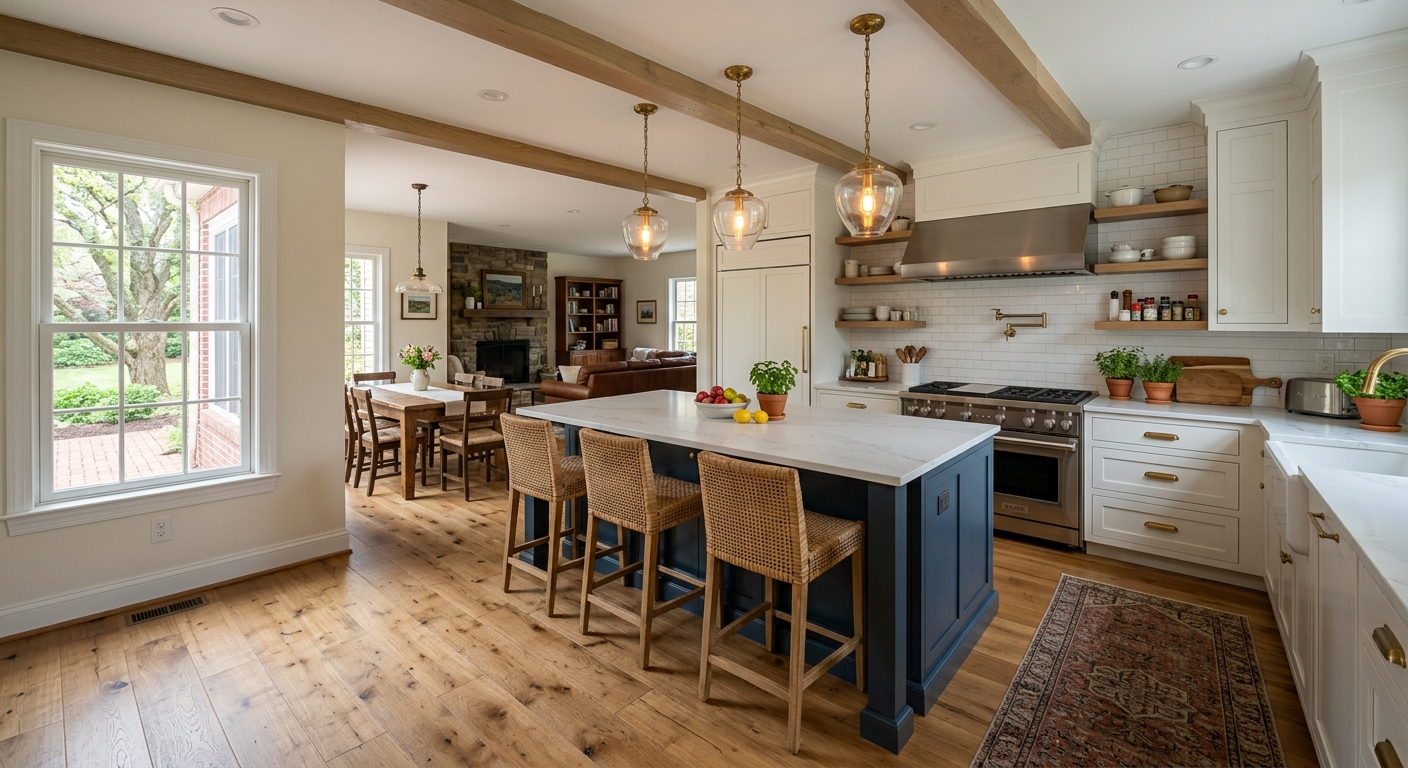
What a kitchen remodel costs in Carnegie
Carnegie’s kitchen renovation costs reflect Allegheny County’s older housing and typical homeowner priorities. With a median household income of $61,875 and owner-occupants making up 56.3% of households, most kitchen budgets here track realistically with what can be recouped—and what feels livable in everyday use. In Carnegie and surrounding Allegheny County boroughs, more than 83% of homes were built before 1980 (U.S. Census Bureau, ACS 2024). That means plenty of small, compartmentalized kitchens from the pre-war and mid-century period, which often drive full gut renovations, wall removals, and new layouts instead of simple surface updates. Remodeling costs in this market are less about square footage and more about whether you’re reworking a 1950s galley or a newer space with a workable footprint.
The most common budget mistake comes from pricing a modest “remove and replace” while specifying the upgrades and layout changes that belong in a full gut renovation—driving costs much higher, fast. Being clear on scope at the start avoids disappointment, sticker shock, and mid-project overruns.
| Scope |
What's included |
Duration |
Price range |
| Full gut remodel, same layout |
cabinets, counters, appliances, flooring, lighting, fixtures |
6–10 weeks |
$28,000–$113,000 |
| Gut plus layout change |
all of the above plus moved plumbing, electrical, walls |
10–16 weeks |
$61,000–$113,000 |
| Cabinet replacement (stock to semi-custom) |
remove and install cabinets, hardware, patching |
1–3 weeks |
$6,600–$28,000 |
| Cabinet refacing |
new doors and drawer fronts, veneer, hardware |
3–6 days |
$6,600–$19,000 |
| Countertop replacement only |
template, fabricate, install, reconnect sink |
1–3 weeks |
$3,800–$15,000 |
| Kitchen flooring only |
remove existing, install new flooring |
3–6 days |
$4,700–$19,000 |
Estimates for a typical Carnegie kitchen. Cabinet grade and whether the layout changes move these figures more than square footage.
What requires a permit in a kitchen renovation
The majority of kitchen work in Carnegie and the rest of Allegheny County is governed by the Pennsylvania Uniform Construction Code (UCC), with each borough or township enforcing code through their local office. Typically, no permit is needed for straightforward cosmetic work like countertop replacement, painting, cabinet refacing, or simply swapping out fixtures—so long as the layout isn’t changing and walls stay where they are. However, a permit is nearly always required if your project involves moving or adding electrical or plumbing lines, relocating walls, or significant mechanical changes such as installing a new range hood duct that requires cutting through the exterior wall.
If you’re in the City of Pittsburgh, structural changes or re-routing plumbing or electrical in a kitchen will trigger the permit process through the Department of Permits, Licenses, and Inspections, and you may face plan review. In smaller Allegheny County boroughs, replacing kitchen cabinets without layout changes usually does not require a building permit, but once you change wall or fixture locations, it almost certainly does. Electrical inspections within Pittsburgh are directly handled by the city, but some suburbs use approved third-party inspection agencies, which surprises many homeowners.
Every kitchen contractor working on contracts over $500 must carry Home Improvement Contractor (HIC) registration from the Pennsylvania Office of Attorney General and should provide proof—verify at hic.attorneygeneral.gov. Workers’ compensation coverage is mandatory for all employers and can be confirmed through WCAIS (wcais.pa.gov). Skipping required permits may cause problems when you eventually sell your home, as unpermitted work can be flagged during resale or by lenders.
What's behind the walls in a Carnegie kitchen
In Carnegie, more than 83% of homes were built before 1980, and this impacts nearly every kitchen renovation. Starting demolition often reveals framing that’s out-of-plumb and floors that aren't level, making new cabinet installation much more involved—shimming, scribing, and carpentry hours add both time and cost. These issues alone can increase prep labor by $1,200–$4,000 depending on the severity and the size of the space.
Wiring in pre-1980 kitchens is frequently undersized or ungrounded, especially in homes from the large pre-1940 stock. Updating kitchen electrical to code—with proper circuits and grounding—typically adds $2,000–$7,500 to gut renovation costs. Original galvanized water lines and cast iron drains, once exposed, often require replacement: figure another $1,500–$5,000 if found, but this can vary by length and access.
Many Carnegie kitchens lack sufficient insulation on exterior walls, an issue not addressed until the 1980s. Upgrading exterior walls to current insulation standards during a gut remodel is smart and typically costs $600–$2,400 for a mid-size kitchen. Federal EPA Lead RRP Rule applies to any kitchen work disturbing paint in pre-1978 homes; surface testing by a certified renovator is required before demolition. Asbestos flooring—often buried under layers—may be present in mid-century houses, and safe removal can add cost and require a specialty contractor.
Previous unpermitted work isn’t uncommon in older Allegheny County homes. If found, this almost always needs to be corrected to current code, especially for electrical and plumbing—so having a buffer in your budget is prudent.
What moving the sink really costs
In Carnegie and the rest of Allegheny County, the most abrupt jump in kitchen renovation budgets comes from moving plumbing or electrical. Keeping everything in its current location is far less expensive: for a full gut remodel in the same layout, you’re looking at $28,000–$113,000. As soon as you want to move a sink, range, or refrigerator—even just a few feet—you step into the next cost tier, where the starting figure for gut remodels with layout changes is $61,000–$113,000. The price difference isn’t about distance; it comes from what’s involved in changing the bones of the space.
Relocating a sink or dishwasher means new plumbing lines and correctly sloped drains. In homes where the kitchen sits over a finished ceiling, or with shallow crawlspaces, this can require opening ceilings or floors in adjacent rooms. That complexity can add several thousand dollars, and must be planned for up front. Moving outlets or adding new circuits means bringing all work up to current code; if your panel is full, a subpanel or new service may be needed, quickly stacking more cost.
If a wall needs to come down to open up a galley kitchen (common in Carnegie’s older stock), you’ll need to determine if it’s load-bearing. If so, that requires an engineer’s input and a building permit. Range hood venting—a frequent modernization—may also require drilling through brick or block for a new exterior duct run.
This is where honest planning matters. Make sure the existing layout is truly unworkable before you start rearranging plumbing and walls. Many kitchens function well with a finish and fixture upgrade alone, saving tens of thousands of dollars.
Renovating to live in versus renovating to sell
It’s tempting to look at a kitchen renovation as an investment that will be “paid back” at resale. The reality in Carnegie is more nuanced—a new kitchen will help your house sell faster and for more money than one in original condition, but it won’t reliably return every dollar spent. In fact, mid-range kitchen remodels generally have a stronger payback than high-end jobs, which often outpace the price ceiling the neighborhood can support.
The smart approach is to match your investment to your long-term plans. If you plan to stay for years, renovate to suit your lifestyle: invest in materials and features you’ll use daily, and don’t worry about the next owner. If you’re renovating to sell, focus on neutral finishes, skip major layout changes, and target a project at the middle of the pack cost-wise—think durable cabinets and quartz or solid-surface countertops. In Carnegie, where the median household income is $61,875 (U.S. Census Bureau, ACS 2024), spending above the local range (for instance, designing an $80,000 custom kitchen in a neighborhood where typical remodels land closer to $28,000–$61,000) usually means you’ll only recover part of that extra spend.
Bottom line: renovate to sell or renovate to live in—but don’t confuse the two or expect a luxury spend to pencil out on resale.
Why appliance selection comes first
One of the most common mistakes in kitchen renovation—especially in Allegheny County’s older homes—is ordering cabinets before appliances are chosen. Cabinets are measured and built for specific appliance sizes. If you pick a refrigerator or range with odd dimensions after cabinets are ordered, you either get a bad fit or pay for rework.
Standard-depth versus counter-depth refrigerators need very different cabinet planning around them. Slide-in ranges need a lower counter portion at the back, while freestanding ranges don’t. Choosing between electric, gas, or induction for your cooktop dictates wiring or gas pipe requirements and sometimes panel upgrades. Panel-ready dishwashers and refrigerators must be factored into cabinet dimensions from the start. Range hoods should be selected based on whether you’ll vent to the outside—a code-compliant, healthier choice—or settle for recirculating models, which are a compromise in performance and air quality.
Professional-grade appliances offer heavy-duty hardware, more cooking capacity, and often a distinctive “look,” but their price tags are steep. In most Carnegie homes, unless you’re after a specific appearance or feature, mainstream models offer reliability at a more reasonable cost. Finally, be aware: certain appliance models now have longer lead times than cabinets, especially specialty sizes or finishes, so making selections early keeps your project on track.
Cabinets are the critical path
Among all kitchen components, cabinets control the timeline. In Carnegie and the broader Allegheny County area, the renovation market is busy and lead times for cabinets—especially semi-custom and higher-end—regularly exceed expectations, sometimes stretching eight weeks or more. That’s before your contractor can even demo the old kitchen.
The process starts with finalized design and measurements. Cabinet orders are placed first, since accurate sizing is needed for nearly all other trades. Once cabinets are in the manufacturer’s queue, demolition of the current kitchen starts. Plumbing and electrical rough-in follows, but inspectors (city or third-party) need walls open to check everything before closing up. After inspection, walls are finished, and then cabinets are installed. Here’s the piece nobody warns you about: countertops can’t be templated until cabinets are set and secured. The result is an inevitable “dead period”—usually at least a week—between cabinet install and countertop template, then another 1–3 weeks for counter fabrication and install.
Flooring, backsplash tile, and final trim usually follow the countertop install. Expect delays if you try to order cabinets after demolition; you’ll be living with a torn-up kitchen for much longer. In a dense contractor market like Allegheny County’s, proactive planning and early product selection minimize your downtime and frustration. Always order cabinets before any demolition starts.
Frequently asked questions — kitchen renovation in Carnegie
Do I need to change my kitchen layout?
In Carnegie, whether you should change your kitchen layout depends mostly on the age and condition of your home. Many homes here were built before 1980, so small, separate kitchens are common. If your kitchen feels cramped or has a dysfunctional flow, a layout change may be worthwhile. However, you’ll want to weigh the jump in cost: keeping the layout and updating cabinets and finishes lands you in the $28,000–$113,000 bracket, while moving walls, plumbing, or large appliances jumps to $61,000–$113,000. If the existing footprint works but looks dated, updating finishes can go a long way without major expense. Most Carnegie homeowners opt for layout changes only when the old setup is truly unusable.
How far ahead should I book a contractor in Carnegie?
In the saturated Allegheny County market, it’s wise to start contacting contractors at least three to six months ahead of your desired project start—especially for a full kitchen gut or a layout change. Lead times on cabinets and appliances can be long, and finish-trade labor is in high demand here. For straightforward projects like cabinet replacement ($6,600–$28,000), booking a couple of months out might be enough, but anything involving design or permitting requires more advance notice. Planning early locks in your spot and makes sure your selections (cabinets, appliances) are available when you need them, minimizing frustrating delays.
Can I over-improve for my Carnegie neighbourhood?
Yes, it’s possible to over-improve in Carnegie. A high-end kitchen at the top of the price range—say, over $80,000—won’t necessarily increase your home’s value by the same amount if most local remodels are closer to $28,000–$61,000. With the median household income at $61,875, there’s a ceiling to what buyers expect to see in this market. Upgrades beyond what’s typical in the area—like imported tile, custom cabinetry, or luxury appliances—become more about personal satisfaction than return on investment. Keep resale expectations grounded; most of the time, you’ll recover more of your spend on a well-executed mid-range renovation.
Is lead paint a concern in Carnegie kitchen renovations?
Absolutely—more than 83% of homes in Carnegie were built before 1980, and any home built before 1978 falls under the federal EPA Lead Renovation, Repair and Painting (RRP) rule. Before disturbing any painted surfaces in an older kitchen, a certified renovator must test for lead, and if found, proper containment and removal practices must be followed to protect your family and workers. These precautions add cost, but skipping them is unsafe and illegal. Expect to see this reflected in quotes for full gut remodels, where the band is $28,000–$113,000. Most reputable Carnegie contractors are Lead RRP certified—always ask for proof if your home is of the right era.
Why are kitchen quotes in Carnegie so far apart?
Kitchen quotes in Carnegie often vary by tens of thousands of dollars, which feels bewildering to many homeowners. The range—from a basic cabinet swap at $6,600–$28,000 to a full gut job (possibly with layout changes) at $61,000–$113,000—is mostly driven by scope. Older homes hide surprises, and one bid may include code-required electrical or plumbing work while another may assume it’s not needed. Labor cost is also higher in densely populated contractor markets like Allegheny County. Be wary of ultra-low bids: they often miss line items or cut corners on code compliance, potentially leading to headaches at resale or inspection time.
Can I cancel a renovation contract in Pennsylvania?
Yes, Pennsylvania’s Home Improvement Consumer Protection Act gives you the right to cancel a signed home improvement contract—covering kitchen renovations—within three business days. This applies to any project over $500 in total value. Contracts must be in writing and include notice of your cancellation rights. If you’ve second thoughts on a kitchen remodel (say, after committing to a $19,000 cabinet replacement), you can withdraw in writing within that window without penalty. Always read your contract carefully and make sure cancellation terms are clearly spelled out, as required by state law.
How should renovation payments be scheduled?
In Carnegie and across Pennsylvania, reputable kitchen contractors typically ask for an initial deposit (often 10–30%) upon contract signing, then progress payments tied to clear milestones—such as cabinet delivery, countertop installation, or completion of electrical rough-in. For example, on a cabinet replacement at $6,600–$28,000, your contractor should never demand full payment upfront. The balance is held until the job is complete and all punch-list items are addressed. Scheduling payments this way protects both parties; always insist on a written contract detailing the payment schedule to comply with state law and avoid misunderstandings.
How much do new kitchen cabinets cost in Carnegie?
New kitchen cabinets in Carnegie—using stock to semi-custom lines—run from $6,600–$28,000, with a typical full replacement landing near $19,000 for most average-size homes. Costs move up if you select tall wall cabinets, specialty finish options, or custom dimensions to fit out-of-plumb walls common in our area’s older homes. If you’re on a tighter budget, refacing—installing new doors and veneer on existing boxes—sometimes fits between $6,600–$19,000 and achieves a major visual upgrade at lower cost, provided your cabinet boxes are sturdy and well laid out.
What is the difference between stock and semi-custom cabinets?
Stock cabinets are pre-manufactured in set sizes and limited finishes. They’re the fastest and least expensive way to upgrade a kitchen in Carnegie, and work best in spaces with simple dimensions. Semi-custom cabinets offer more flexibility—additional sizes, upgrades like soft-close hardware, and many more finish choices. They’re especially useful in older homes, which often have uneven walls or unique layouts that stock cabinets can’t fit well. You’ll pay more—typically closer to the upper end of the $6,600–$28,000 range—but the result is a cleaner, more fitted installation, and better function in tricky spaces.