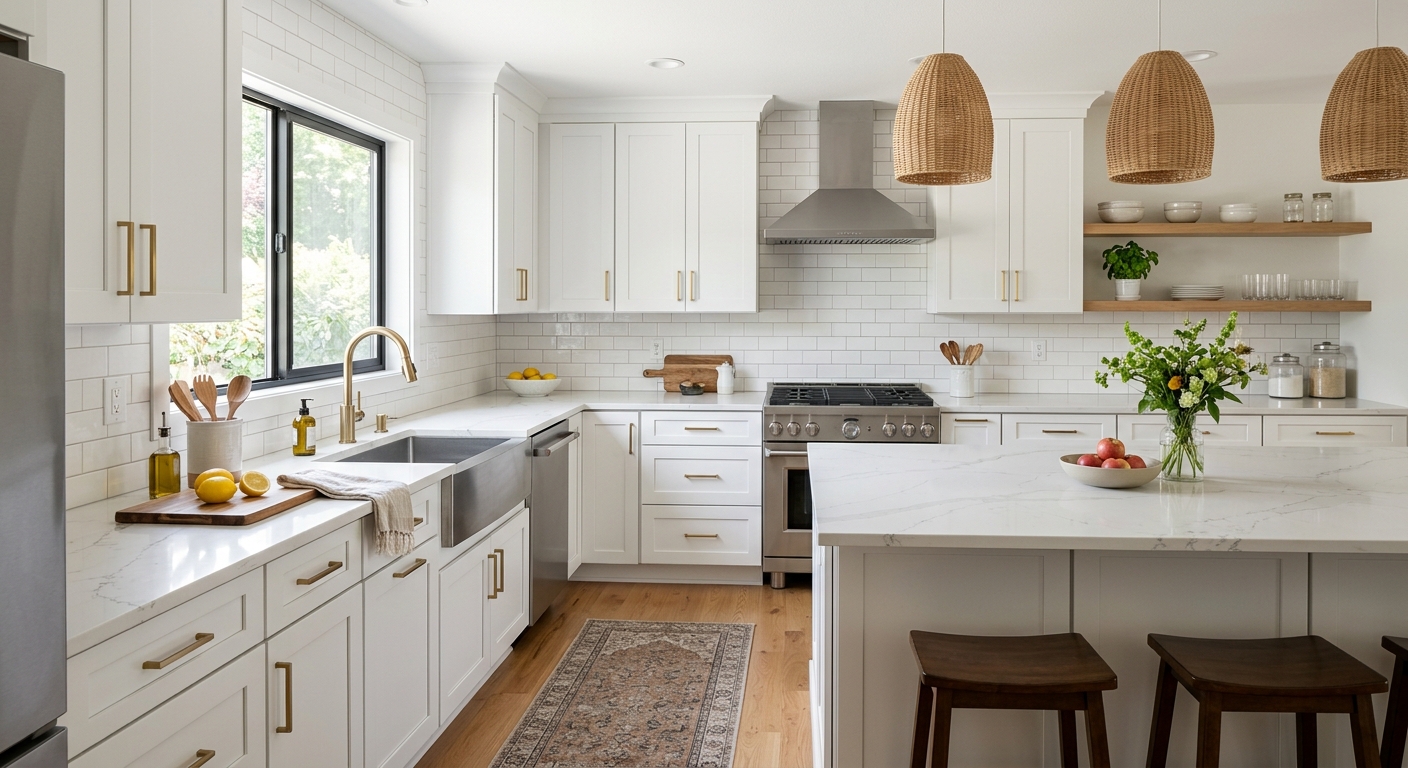
Kitchen renovation costs in Wyomissing — 2026
Wyomissing’s kitchen renovation costs are shaped by both its housing stock and its homeowner profile. With a homeownership rate of 67.8% and a median household income of $86,786 (U.S. Census Bureau, ACS 2024), most kitchen projects here are planned by the people living in the house — not out-of-town landlords. Berks County’s suburban homes are mostly mid-20th-century construction, so many original kitchens are compact, galley-style layouts. These often call for more than just cosmetic upgrades, especially if you want to open up space or bring the kitchen in line with how families use the space today.
Most kitchen budgets go off track when the initial scope is set at a simple update but then slides into a full remodel — for example, when a plan to keep the layout as-is turns into moving plumbing, taking down a wall, and upgrading the panel. Costs are not linear: moving service points or changing the footprint can jump a Wyomissing kitchen from the lower to the very top end of local price bands. Below is a summary of what to expect at each level, based on 2026 cost estimates for this market:
| Scope |
What's included |
Duration |
Price range |
| Full gut remodel, same layout |
cabinets, counters, appliances, flooring, lighting, fixtures |
6–10 weeks |
$30,500–$122,500 |
| Gut plus layout change |
all of the above plus moved plumbing, electrical, walls |
10–16 weeks |
$66,500–$122,500 |
| Cabinet replacement (stock to semi-custom) |
remove and install cabinets, hardware, patching |
1–3 weeks |
$7,200–$30,500 |
| Cabinet refacing |
new doors and drawer fronts, veneer, hardware |
3–6 days |
$7,200–$20,500 |
| Countertop replacement only |
template, fabricate, install, reconnect sink |
1–3 weeks |
$4,100–$16,500 |
| Kitchen flooring only |
remove existing, install new flooring |
3–6 days |
$5,100–$20,500 |
Estimates for a typical Wyomissing kitchen. Cabinet grade and whether the layout changes move these figures more than square footage.
What requires a permit in a kitchen renovation
In Wyomissing and throughout Berks County, most kitchen updates that are strictly cosmetic—like painting walls, swapping hardware, refacing cabinets, or replacing a countertop without moving plumbing—don’t require a permit. But the instant you touch any structural element, change the kitchen’s layout, add or move plumbing or electrical lines, or install new mechanical appliances like a range hood, a building permit is typically required. In Reading, for example, any remodeling involving those systems or moving walls triggers a municipal permit and may go through plan review before work begins.
Electrical inspections in Wyomissing’s area—including Reading and Muhlenberg Township—are often performed not by the township but by third-party agencies such as Approved Code Services. That can be a surprise if you’re used to township inspectors. Plumbing and electrical licensing is handled municipally in Pennsylvania, so requirements can shift between neighboring townships.
By law, any contractor working on a kitchen job over $500 in Pennsylvania must be registered under the Home Improvement Contractor (HIC) program, issued by the Pennsylvania Office of Attorney General. Always verify their status at hic.attorneygeneral.gov. All employers must carry workers’ compensation, which you can check via the WCAIS system (wcais.pa.gov). For projects in pre-1978 homes, federal EPA Lead RRP rules also apply—check for certified firms before disturbance.
Unpermitted changes can cause headaches when you sell a home. If the work required a permit but none was pulled, you risk fines, difficulty closing, and even forced removal of finished improvements. It is rarely worth skipping this step.
Layout changes and the cost cliff
There’s a steep cost cliff in Wyomissing kitchen renovations when you move from a “replace in place” project to a layout change. As long as you keep plumbing and electrical where they are, your project stays in the lower price ranges, avoiding major disruption. But the second you need to move a sink or an appliance across the room, costs jump—not in proportion to the distance moved, but due to the knock-on effects and code requirements.
Relocating drain lines is not just about rerouting pipe. Drains require slope, and when a kitchen is on a slab or above a finished ceiling, making these changes means concrete demo or patching the ceiling below. Likewise, moving appliances often means you’ll need new dedicated circuits, which brings up electrical panel capacity and possibly a main service upgrade. Removing walls—very common in Berks County’s mid-century galley kitchens—means figuring out if the wall is load-bearing. If it is, you’re looking at engineering, a building permit, and a heavier-duty project. Relocating a range hood? The vent needs to penetrate an exterior wall, which can be straightforward or a multi-day affair in brick or stone.
The honest advice: unless your kitchen’s current footprint is truly dysfunctional for how you live, do everything you can within its existing “wet wall” and layout. It’s not just about moving a sink four feet. With a layout change, the price can jump from $30,500–$122,500 for a gut remodel that holds the line to $66,500–$122,500 if you change the plumbing, electrical, or walls—even slightly. Having to get a permit and plan review just for relocating a dishwasher (as per Reading requirements) is not rare. Think hard before crossing this line.
Surprises in an older Wyomissing home
With 68.1% of Wyomissing homes built before 1980 (U.S. Census Bureau, ACS 2024), most kitchen renovators run into surprises behind the walls. First, expect uneven floors and wavy walls. This means extra effort—sometimes a full day—shimming base cabinets and adjusting wall cabinets, easily adding a few hundred dollars just in labor. Old wiring is common: ungrounded circuits or too few dedicated lines for today’s appliances, pushing you toward a panel upgrade in the $2,000–$6,000 range if new circuits tip you over. Galvanized water lines or cast iron drains, typical of mid-20th-century Berks County stock, don’t play nicely with modern fixtures. Swapping those out can add $1,200–$3,500 in a kitchen-sized project.
No or minimal insulation is another headache on exterior walls, with higher energy bills and noticeably cold winter floors. Previous unpermitted work is common and may require undoing “creative” plumbing or electrical runs before you can move forward—budget time and patience for this. In homes built before 1978, the federal EPA Lead RRP Rule comes into play for any work that will disturb painted surfaces; always test for lead before demolition. Asbestos is not uncommon in vinyl flooring or tile underlayers in these eras, and while licensed abatement isn’t a state requirement, following industry standards is expected and keeps everyone safe.
In newer suburban stock, expect the opposite: builder-grade cabinets sagging or swelling, laminate counters chipping, and not enough circuits for today’s microwaves or induction ranges. Often, these wear out together and drive up project scope when owners see issues compound all at once.
Practical survival during the work
Living through a kitchen renovation in Wyomissing isn’t easy, but planning ahead will save you headaches. Set up a temporary kitchen in your dining room, basement, or even the garage. Keep your refrigerator plugged in nearby, put a microwave and an electric kettle on a folding table, and have a stash of paper plates and utensils ready. Use a laundry tub or bathroom sink for dishwashing—don’t count on having a working kitchen sink at any point during most renovations. This isn’t the week to try new recipes with lots of pans.
Dust is the enemy, especially in older homes where sanding, demolition, and drywall work send fine debris everywhere. Good contractors will hang plastic sheeting and use zip walls, but seal valuables and electronics in adjacent rooms just in case. Your contractor will need to stage materials and will bring in a dumpster—usually parked on your driveway or curb. Plan for limited access and let neighbors know in advance.
Pets are a major consideration; doors being open and strange workers in the house mean escapes happen if you’re not careful. If possible, consider boarding your pets or at least keeping them shut in a quieter part of the house during the messiest days. Many Wyomissing clients choose to move out during demolition week, especially for gut jobs—it’s not extravagant, it’s often just practical. And don’t forget: eating out for eight weeks usually costs more than a new kitchen floor, so factor that reality into your budget.
Lead times, sequencing and why it takes longer
One of the biggest surprises for Wyomissing homeowners is the actual duration of a kitchen renovation, especially when compared to online timelines. The Berks County finish-trade labor market is stretched, so even a straightforward project can take longer than expected. Here’s why: every phase depends on the one before.
Start with design and measurements—which can take a week or two, longer if you’re juggling work schedules. Once you finalize, you’ll order cabinets (and this can be a four-to-eight-week wait for semi-custom options in our market). If you delay this until demolition is underway, your project will stall. Demolition and rough-in (plumbing, electrical, HVAC) follow, but each rough-in needs to be inspected—sometimes by third-party agencies, which adds coordination.
Only after inspections are signed off can flooring and cabinets go in. Here is the pain point: countertop companies will not template from a drawing, only from installed cabinets. That means you wait—usually seven to ten days—for templating, then wait again (often two to three weeks) for fabrication before installation. It’s a dead period that frustrates homeowners the most, especially since the kitchen looks nearly finished but is still unusable.
In the Wyomissing area, order cabinets before demo, not after. The lean labor market in Berks County means good contractors are often booking months ahead, and a lull due to a missed cabinet delivery window is avoidable with planning. Countertops and cabinets are your real critical path; don’t let anyone tell you otherwise.
Choosing a countertop for a Wyomissing kitchen
A countertop’s real-world performance, not its showroom look, is what matters most in a Wyomissing kitchen. Quartz is now the most popular choice locally: it’s engineered, non-porous, resists staining, and needs no sealing—but be aware it can discolor or crack if you put hot pans directly on it. Granite is durable and tolerates heat well, but since it’s a natural stone, it needs periodic sealing to stay stain-resistant, and seams are often more visible. Laminate, for all its bad reputation, has come a long way; it’s easy to clean, resists most stains, deals with everyday knocks, and remains an excellent option for rentals or modest kitchens—don’t be talked out of it by salespeople pushing margin.
Butcher block feels great underhand, is forgiving to glassware, and brings warmth. But it stains easily, requires oiling, and is not for hands-off users. Solid-surface counters like Corian can be renewed with sanding and offer inconspicuous seams, but are less heat-tolerant than stone. Price differences aren’t just about material. More complex edge profiles, under-mount sink cutouts, and seam minimization all add to fabrication costs, as does the precision of the template—usually a physical visit with digital or wood templates, not just measurements from a plan.
The honest advice: if you’re updating a midgrade kitchen or rental in Wyomissing, laminate is a defensible, practical choice and often a better use of money than stretching for entry-level stone. Where you invest—edges, sink details, and cutout quality—matters as much as the slab you pick. Know who is fabricating and installing, and ask what is covered if you need a repair down the line.
Frequently asked questions — kitchen renovation in Wyomissing
How should renovation payments be scheduled?
In Wyomissing, kitchen renovation payments typically follow a milestone schedule outlined in the Home Improvement Consumer Protection Act (HICPA), which governs all projects over $500. Reputable contractors never ask for the entire sum upfront. Expect to pay a modest deposit to secure your spot on the schedule—often 10–20%—with further payments due at the start of demolition, when cabinets arrive, and substantial completion. Each payment should match a clear project milestone, not arbitrary percentages. For example, on a cabinet replacement in the $7,200–$30,500 range, a common breakdown could be 10% upfront, 40% at cabinet delivery, 30% after countertop installation, and the final 20% after punch list completion. Make sure each draw is detailed in a written contract, as required by Pennsylvania law, to protect both parties. If a contractor is pushing for large early payments above materials ordering, consider it a red flag—especially in this market.
Do older Wyomissing homes need electrical upgrades for a kitchen?
Many Wyomissing homes were built before 1980, with a sizeable portion dating to the mid-20th century. These houses often have fewer circuits than today’s kitchens demand—dishwashers, microwaves, induction cooktops, and multiple countertop appliances weren’t on the radar when most Berks County kitchens were wired. If your existing panel is maxed out or you have ungrounded wiring, an upgrade could be required just to pass inspection, especially after a gut remodel that moves appliances or adds lighting. Budget for at least several new circuits, and be prepared that a full service change might run an additional $30,500–$122,500 as part of an all-in kitchen renovation. Don’t overlook this: inspectors in Reading and other Berks County townships will check code compliance carefully, especially if the prior work wasn’t permitted.
Which upgrades are not worth the money?
Not every upgrade pays off in Wyomissing—both on resale and for daily use. Fancy cabinet inserts (like motorized lifts or massive spice racks) can add thousands with little functional return for most users. Same goes for moving a sink a few feet just for symmetry—costs jump massively if it triggers plumbing or slab work, potentially making your project leap to the $66,500–$122,500 tier when a simple update would suffice. High-end appliances can also be overkill unless you’re genuinely passionate about cooking or trying to match high-value neighborhood stock. The homes here are practical, and upgrades should focus on layout improvements, reliable cabinets, and durable countertops. Unless your needs are specialized, skip the luxury items and invest in fixes for old wiring, failing subfloors, or aging mechanicals instead.
Why are kitchen quotes in Wyomissing so far apart?
You’ll see a wide spread in kitchen bids across Wyomissing because of the mix of home ages, desired scopes, and labor market realities in Berks County. Finish-trade labor is tighter here than in nearby counties, so skilled crews charge a premium. Quotes can differ based on whether the contractor includes full permit compliance, higher cabinet grades, scope details (like moving service points), and how they handle surprises behind the walls. For example, a full-gut remodel with the same layout may range from $30,500–$122,500, depending on if it includes appliance upgrades and finishes or if you hit old wiring and need new circuits. Get apples-to-apples comparisons, ask about exclusions, and watch for lowball numbers that don’t allow for contingencies typical in older Berks County homes.
What does a quartz countertop cost in Wyomissing?
Quartz countertops are very popular in Wyomissing kitchens due to their durability and low maintenance, but price depends on both material and complexity. For a straightforward swap—removal of the old top, templating, fabrication, and installation—you are looking at a range of $4,100–$16,500, with most average-sized kitchens landing around the $9,000–$12,000 mark for mid-tier quartz and a basic edge profile. More aggressive patterns, mitered edges, and waterfall details push toward the top. Expect a two- to three-week fabricating window after templating. Unlike in big cities, local Berks County suppliers sometimes have better pricing but longer waits, so factor lead times into your planning.
How far ahead should I book a contractor in Wyomissing?
With finish-trade labor running lean in Berks County, lead times for reputable kitchen contractors in Wyomissing are often longer than you’d expect—three months out isn’t rare for a spring start. For a gut renovation in the $30,500–$122,500 class, you should be planning at least 4–6 months ahead, allowing time for design, cabinet ordering, permit applications, and material selections. If you wait to book until cabinets arrive, your project can stall for weeks while others leapfrog you in the schedule. Cabinet lead times and delays in countertop fabrication add more variables. Get on a contractor’s calendar with a signed HICPA-compliant contract and deposit as early as you can to avoid missing your hopeful window—especially if you’re aiming to finish before the holidays or major life events.
Do I need to change my kitchen layout?
Most older Wyomissing homes have small, galley-style kitchens. It’s tempting to knock out a wall or move appliances, but not always necessary. If your current layout works (good triangle, traffic flow, adequate storage), focus on updating finishes, cabinets, and lighting—saving you from the cost cliff that comes with relocating plumbing or electrical. As soon as you move a sink or change a wall, your project can jump into the $66,500–$122,500 band—and require full permitting and plan review in Reading or township offices. Only commit to a layout change if daily use is genuinely frustrating or if it materially improves resale. Sometimes, tweaks like open shelving, better lighting, or small cabinet modifications can deliver most of the benefit for far less money.
What is the difference between stock and semi-custom cabinets?
Stock cabinets in Wyomissing are mass-produced in set sizes, often available on short lead times and at lower prices, making them a fit for straightforward or budget-sensitive projects—usually on the lower end of the $7,200–$30,500 band. They come in limited door styles and finishes, and modifications (like filler strips or tall pantries) may be needed to fit older, non-standard kitchen dimensions. Semi-custom cabinets offer more flexibility in size, door style, wood species, and finish, but take longer to arrive and cost more per linear foot. They're often the best choice for spaces with odd walls or for homeowners wanting specific features. In Wyomissing’s mid-century homes, semi-custom can bridge the gap between expensive custom work and ill-fitting stock sizes, especially when the original kitchen dimensions don’t match modern options.
What happens if previous work was unpermitted?
If prior kitchen work in your Wyomissing home was done without a required permit, you can face trouble when you try to remodel or sell. Municipal inspectors (especially in Reading and surrounding Berks County townships) can require you to open up finishes for inspection or—at worst—completely redo work that does not meet the current Pennsylvania Uniform Construction Code (UCC). This can turn a cabinet replacement budget of $7,200–$30,500 into a full-scope gut job if wiring or plumbing behind the walls isn’t up to code. Unpermitted work also complicates closings, since appraisers and buyers are wary of hidden issues—delays, price reductions, or lost sales can result. If you suspect unpermitted work, fact-find before you start; retroactive permits are sometimes possible, but contractors may charge more for dealing with surprises and bringing old work up to code.