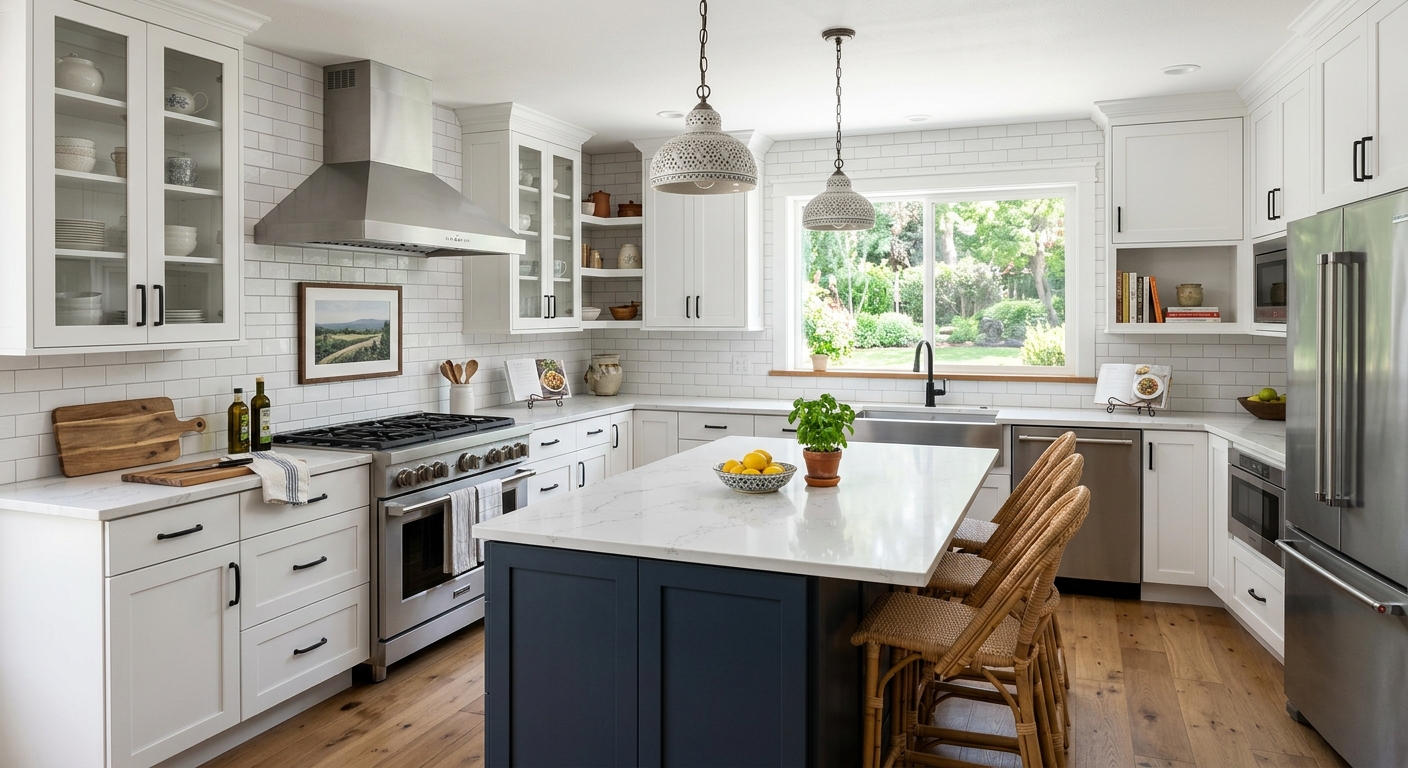
Palmyra kitchen renovation prices by scope — 2026
For Palmyra homeowners, kitchen renovation decisions are closely tied to practical budgets and long-term needs. With 51.5% of local households owner-occupied and a median income of $65,743 (U.S. Census Bureau, ACS 2024), most kitchen projects here are investments made by people intending to live in the space, not just turn a profit at resale. Palmyra’s housing stock is overwhelmingly mid-20th-century, with nearly 8 in 10 homes built before 1980, which means many existing kitchens are outdated — narrow galleys, tired finishes, and original electric and plumbing runs. You can’t set a budget based just on a wish list; the reality of local houses is that many need real infrastructure work, not just new doors and counters.
The classic budget pitfall in Palmyra is pricing a “facelift” — just new cabinets and counters — and then deciding midstream to move the sink, upgrade lighting, or take down a wall. These changes often double project cost, and are most common when the existing kitchen is a chopped-up 1950s design. On the other hand, if the bones are sound, a refresh stays much closer to the low end of the bands below.
| Scope |
What's included |
Duration |
Price range |
| Full gut remodel, same layout |
cabinets, counters, appliances, flooring, lighting, fixtures |
6–10 weeks |
$28,500–$114,000 |
| Gut plus layout change |
all of the above plus moved plumbing, electrical, walls |
10–16 weeks |
$61,500–$114,000 |
| Cabinet replacement (stock to semi-custom) |
remove and install cabinets, hardware, patching |
1–3 weeks |
$6,600–$28,500 |
| Cabinet refacing |
new doors and drawer fronts, veneer, hardware |
3–6 days |
$6,600–$19,000 |
| Countertop replacement only |
template, fabricate, install, reconnect sink |
1–3 weeks |
$3,800–$15,000 |
| Kitchen flooring only |
remove existing, install new flooring |
3–6 days |
$4,700–$19,000 |
Estimates for a typical Palmyra kitchen. Cabinet grade and whether the layout changes move these figures more than square footage.
Circuits, GFCI and code compliance
In Palmyra, the biggest source of unexpected cost in a kitchen remodel ‒ especially in the mid-project phase ‒ is updating the electrical system to meet current code. Lebanon County is full of homes from the mid-20th-century era, and with nearly 80% built before 1980, many kitchens still run on outdated and insufficient wiring.
Current Pennsylvania code, as enforced by Lebanon County municipalities, calls for at least two dedicated 20-amp small-appliance circuits, GFCI protection at all countertop outlets, receptacles no more than 4 feet apart along the counter, and individual circuits for major appliances like the dishwasher, disposal, and built-in microwave. If you install an electric range, you’ll also need a 240-volt dedicated line. Many existing kitchens in Palmyra — especially ones built before 1978 — still have two-wire, ungrounded outlets, too few circuits, and electrical panels lacking spare capacity. Sometimes you’ll even find aluminum branch wiring from brief windows in the late ‘60s or early ‘70s.
The moment you open up walls during a permitted renovation, an inspector will require that all new or altered wiring meet today’s code. This is not optional or negotiable, and it can’t be skipped just because nothing “looked wrong” before. For kitchen electrical brought up to current standards, plan for $4,700–$19,000 as a realistic range, depending on panel size, rewiring needs, and how much of the system is getting replaced. It’s where most surprise costs come from in Palmyra’s older homes.
The biggest line item in your Palmyra kitchen
Cabinet choices shape most Palmyra kitchen budgets. There are four real options, each with honest trade-offs. Refacing keeps your existing boxes but swaps in new doors, drawer faces, and applied veneer. It’s far less expensive than replacement, and the finished look is genuinely good—if your boxes are solid, square, and already laid out the way you want. Refacing cannot add storage, change the layout, or fix water-damaged boxes.
Stock cabinets are off-the-shelf sizes—cheapest in the store, but require filler strips and cannot always follow crooked old walls. Semi-custom means the manufacturer will adjust sizes and finishes, but not completely custom shapes. Full custom fits any dimension and any design, but has the longest lead and the highest cost.
Materials matter as much as cost tier: plywood boxes outlast particleboard, dovetail drawers are stronger than stapled ones, and full-extension, soft-close hardware should be standard at almost any price. Frameless (Euro-style) cabinets maximize storage in small galley kitchens, but require perfectly plumb walls—which many Palmyra homes, built mid-century, do not have without extra work.
Because Palmyra homes overwhelmingly date from an era before standard dimensions, semi-custom cabinets end up the common reality—even when owners didn’t plan on it—because they are the only way to fit non-standard walls and maximize storage in these older layouts.
| Option |
Cost |
Best when |
Limitation |
| Painting existing cabinets |
$1,200–$3,500 |
boxes and doors sound, tight budget |
no layout or style change |
| Refacing |
$6,600–$19,000 |
boxes square and layout works |
storage unchanged |
| Stock cabinets |
$6,600–$28,500 |
standard dimensions fit |
filler strips, limited finishes |
| Semi-custom |
$19,000–$28,500 |
non-standard walls or finishes |
6–12 week lead time |
| Full custom |
$19,000–$28,500 |
unusual layout or high-end design |
longest lead, highest cost |
What moving the sink really costs
In Palmyra, the decision to move a sink or range should never be taken lightly—this change alone determines which price tier your whole project lands in. Keeping plumbing and electrical where they are keeps your renovation in the lower cost bracket; moving them bumps the project solidly into gut-remodel territory.
Here’s why: relocating a sink or dishwasher means you need new supply and drain lines. Drains require the right slope by code, and if the kitchen’s over a finished basement—or worse, on a slab—running new pipe may require opening ceilings or jackhammering floors. Similarly, moving a range or adding an island always means rewiring: new home-run circuits, potential panel upgrades, and sometimes trenching through plaster walls. Knocking down a wall isn’t just drywall and paint—you need to verify it's not load-bearing, which in Lebanon city means an engineer’s letter, permit, and plan review. Even something as simple as moving the hood exhaust will require an exterior wall penetration.
In Lebanon County municipalities, a permit is commonly triggered by any plumbing, electrical, or layout change, so moving that sink usually means full municipal review and inspections.
The cost increment to move plumbing and electrical compared to a standard gut remodel can easily add $33,000–$52,500 (the difference between a basic gut at the low end and a layout-change gut at the high end). It is rarely worth it just to shift things a few feet. Most kitchens that feel dated are workable with new finishes—so make sure the current layout is truly unlivable before you pay for a new one.
General contractor, kitchen firm, or manage it yourself?
How you structure your Palmyra kitchen renovation matters as much as what you build. There are three main approaches. The design-build kitchen firm is a one-stop route—they handle design, cabinetry, installation, and subcontract all trades under a single contract. This is the highest cost, but it is also the most predictable route with the least work for you. A general contractor will coordinate all trades—demo, framing, electrical, plumbing, and finishes. You or a designer specify fixtures and finishes. This approach costs less than a specialty kitchen firm but still gives you a single point of contact.
Owner-managed is the cheapest way in direct dollars, but not in time or risk. You hire each subcontractor, order all the parts, and sequence the work. In Palmyra and Lebanon County, the finish-trades labor market is thin; good carpenters and tile setters are in high demand, and kitchen projects are often scheduled out for weeks. Owner-managed projects often bog down when a single sub can’t show up for ten days and the next tasks wait on them.
If your scope triggers permits or plan review (structural, new utilities, major layout changes), managing your own Palmyra kitchen job is high risk. Anyone with a day job is hard-pressed to keep a kitchen running smoothly without professional help. Time, stress, and the risk of overlaps or uncoordinated trades may outweigh what you save in labor cost.
Renovating to live in versus renovating to sell
In Palmyra, a kitchen renovation will help a home sell, but it does not guarantee that you recoup every dollar—especially if you overshoot what’s typical for the neighborhood. Middle-tier projects with practical upgrades and decent finishes recover a higher share of their cost at resale than ultra-high-end work.
This is especially important with the local median income at $65,743 (U.S. Census Bureau, ACS 2024). Spending at the upper end of the renovation spectrum—well north of $61,500—will not come back if your house isn’t already among the top values in Palmyra. Buyers look at comparable homes, and over-improvement is money out the door unless you plan to stay and enjoy it for years.
Think of it this way: renovating to sell is a different project than renovating to live in. If you’re selling soon, prioritize neutral finishes, mid-range cabinets and counters, and avoid unnecessary changes to layout or moving utilities. If you’re staying, spend the money where it will best serve your daily use, and don’t obsess about resale. Either way, know what your neighbors have and what comparable homes sell for before starting.
Code requirements for Palmyra kitchens
For Palmyra kitchen projects, the dividing line is clear: cosmetic updates like painting, new hardware, or refacing cabinets can usually be done without a permit. Replacing a countertop in its current configuration is also considered minor work in most Lebanon County municipalities. The moment you move a wall, rerun electrical or plumbing, or do structural work, a permit is typically triggered—and that’s non-negotiable, especially in the City of Lebanon, where plan review is common for major remodels involving changes to systems or layout.
Inspections are not always done by the city itself. In Lebanon County, most electrical inspections are performed by independent third-party agencies, not by municipal staff, and this can surprise homeowners who expect city inspectors. These third-party agencies will review that the work meets the Pennsylvania Uniform Construction Code (UCC), based on the IRC, and expect kitchen projects to meet national standards for safety and accessibility.
Any contract exceeding $500 must be handled by a Home Improvement Contractor (HIC) registered with the Pennsylvania Office of Attorney General (you can verify registration at hic.attorneygeneral.gov). If your contractor employs anyone, state law requires that their workers’ compensation policy can be verified via WCAIS (wcais.pa.gov). Unpermitted kitchen work often has to be disclosed and corrected at resale, with the risk of ripped-out finishes if caught, so do not skip this step.
Frequently asked questions — kitchen renovation in Palmyra
Is lead paint a concern in Palmyra kitchen renovations?
If your house in Palmyra was built before 1978—and with nearly 80% of local homes older than that, there's a strong chance—lead paint is absolutely a concern during a kitchen renovation. Federal law requires contractors to follow the EPA Lead Renovation, Repair and Painting (RRP) Rule, which means using dust-minimizing methods, special cleanup, and certified workers. This is not just for show; even small-scale demolition or sanding in cabinets or windows can spread hazardous dust throughout your house. To protect your family and stay legal, always verify that your contractor is EPA certified. Handling lead properly adds cost, but it's baked into most quotes around $28,500–$114,000 for a full remodel. It's the kind of thing you want handled correctly the first time, not discovered later.
What countertop material is best for a family kitchen?
For busy homes in Palmyra, granite and engineered quartz are the two most practical choices. Both are durable, resist staining, and handle pots and pans better than laminate or marble. Quartz is non-porous, so it resists bacteria and never needs sealing, which makes everyday cleanup easier if you’re cooking with kids. Granite looks great, especially in a classic older home, but will need resealing every few years. Prices for a professional countertop replacement run from $3,800–$15,000 installed, depending on material and size. You do not need to go high-end: spend on a practical surface for real use and reserve your budget for better hardware, task lighting, or storage.
What is the cheapest way to update a Palmyra kitchen?
In Palmyra kitchens where the original cabinets are still solid and mostly square, painting remains the most cost-effective update. With pro prep and good products, painting cabinets can run around $1,200–$3,500. New hardware and a backsplash often add just a few hundred dollars more. Refacing is the next step up if paint alone won't cut it, but the jump to replacing cabinets takes you solidly into five figures. Don't spend on structural or layout changes if the layout is functional; in our older homes, those dollars rarely come back. Focus on basics—paint, hardware, and lighting—before considering more ambitious (and disruptive) work.
Can I over-improve for my Palmyra neighbourhood?
Yes, it’s easy to overspend—especially in Palmyra, where the median household income is $65,743 (U.S. Census Bureau, ACS 2024) and the housing stock is modest. Dumping $90,000+ into a kitchen rarely pays off unless your home is one of the most valuable on the block. Buyers here are practical and look for well-finished, updated kitchens, not luxury or imported exotic materials. If your house is typical, there’s a ceiling to what you’ll get back at resale. Keep remodel choices in line with neighboring homes, and if you’re spending for personal use, do it for your own happiness—not for any imagined windfall at sale.
How much more does moving the sink and range cost?
In Palmyra, moving the sink, dishwasher, or range pushes a project out of “replace in place” territory and into full gut-renovation pricing. The jump isn’t small—moving utilities nearly always triggers new plumbing and electrical runs, which can mean opening more walls, upgrading the panel, and repairing finished spaces below. For many homes locally, moving the sink and range together typically adds at least $33,000–$52,500 over a base cabinet-and-countertop replacement. It’s often not about how far you move them, but about having to bring all plumbing and wiring up to current code—plus permitting and inspections. Unless the old layout is truly unworkable, think carefully before committing.
What is a change order and how should it work?
A change order is a written agreement between you and your contractor that alters the original kitchen project contract—usually because you add, remove, or change something after work starts. In Pennsylvania, under the Home Improvement Consumer Protection Act, every change order must be in writing and signed by both parties if the total contract is over $500 (which covers nearly every Palmyra kitchen). This protects both sides by spelling out cost, schedule, and scope differences. If your contractor produces a change order, make sure it lists the specific work, any extra cost (e.g., an additional $4,700–$19,000 for electrical upgrades), and the implications for timeline. Never accept a verbal promise alone.
Why are kitchen quotes in Palmyra so far apart?
Kitchen renovation quotes in Palmyra vary widely because homes here run the gamut—from tidy 1950s ranches that need finish updates to century-old houses with hidden electrical or plumbing issues. Some quotes only include cosmetic work, while others factor in required code upgrades or lead-safe procedures, especially with our older housing stock. Labor shortages in Lebanon County also mean subs may bump prices or require longer lead times. At the low end, a kitchen facelift might be $6,600–$19,000; a true gut with layout changes can easily be five times that. Always read the scope line-by-line and ask what’s excluded—often the “cheap” quote simply leaves out things required by current code.
What happens if previous work was unpermitted?
If kitchen work in your Palmyra home was done without the necessary permits, it can become a real headache when you go to sell, refinance, or remodel. Local code enforcement and most buyers’ inspectors will look for documentation. If new work touches old unpermitted wiring, plumbing, or altered floor plans, the municipality or their third-party inspector may require you to bring everything up to current code—at your expense—before issuing a new permit. That can mean opening walls, re-doing electrical to meet modern standards, and in the worst cases, ripping out finished work. At resale, undisclosed unpermitted work can stall or kill a transaction, and it’s sometimes more expensive to fix later than to do it right from the start. Even for a smaller update, like a $3,800–$15,000 countertop replacement, making sure previous work was legal is worth the peace of mind.
Should I order cabinets before demolition?
In Palmyra’s current market, especially with thin finish-trade labor and extended lead times for semi-custom cabinets, it’s usually smart to have cabinets delivered or at least confirmed as scheduled before starting demolition. This avoids having your kitchen out of commission for weeks longer than necessary. Stock cabinets may arrive quickly, but most semi-custom and all custom lines run 6-12 weeks. With a typical kitchen job running $6,600–$28,500 just for cabinetry, delays in the cabinet supply chain can create huge frustration. Demo should only happen once the kitchen plan is finalized, cabinets are either at hand or have a guaranteed delivery date, and all code questions are settled. This is the best way to avoid eating takeout for two months because one box is missing.