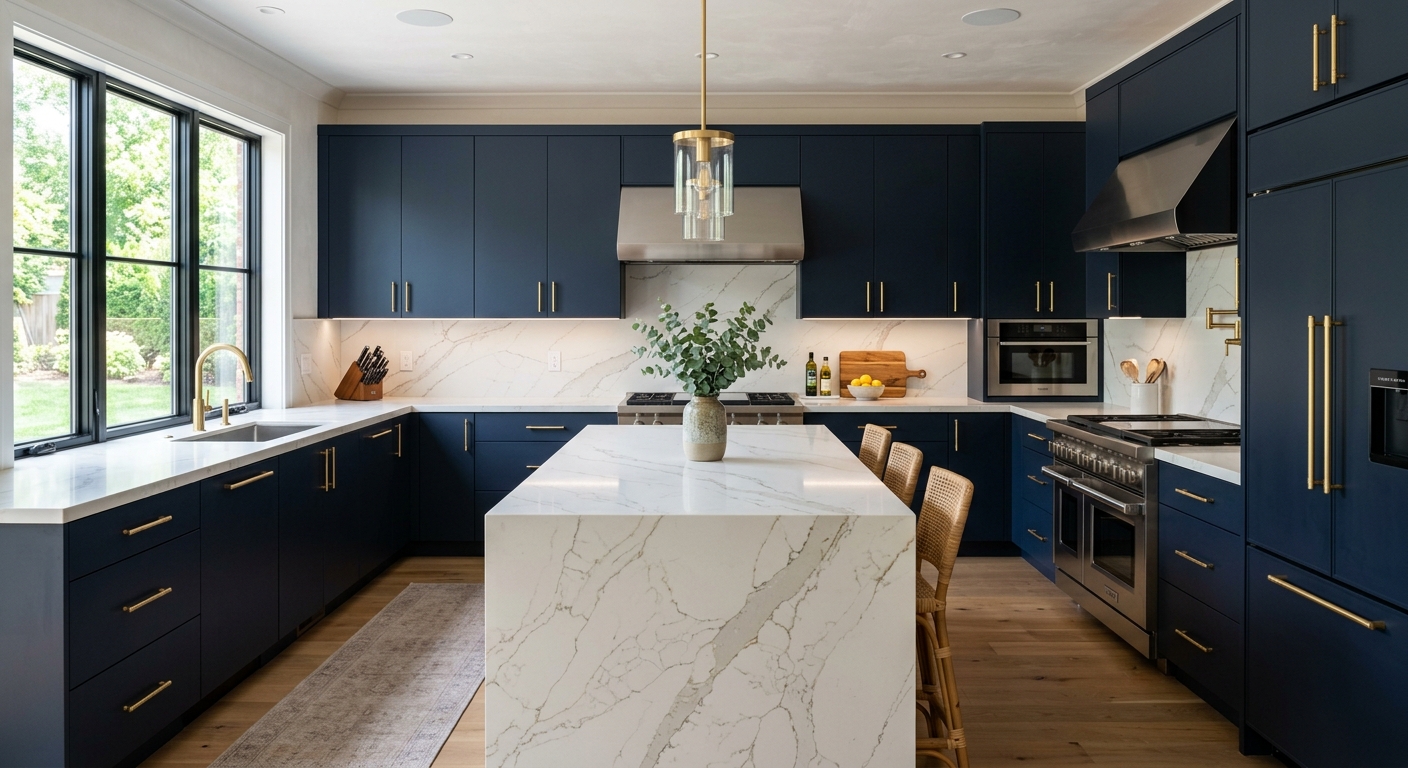
New Hanover kitchen renovation prices by scope — 2026
In New Hanover, kitchen renovation pricing lands all over the map, and for good reason. With a high homeownership rate — 98.7% here, much higher than most towns — people tend to renovate for themselves rather than for rental resale (U.S. Census Bureau, ACS 2024). Add to that a median household income of $126,352, and New Hanover kitchens tend to aim a bracket or two higher than in other Pennsylvania townships. At the same time, neighboring places like Abington and Upper Dublin are full of post‑1945 tract homes that are hitting their second or third round of kitchen modernization. If your house was built in the 1950s, you may be dealing with a cramped galley needing walls moved, but a 1990s New Hanover kitchen might just need new surfaces and brighter lighting.
The greatest risk to your remodel budget isn’t inflation. It’s starting with a number in mind from a lower scope tier — say, a "pull and replace" — then specifying a "gut and move the sink" project. That leap can more than double the price and triple the duration. Decide scope honestly, or you’re setting yourself up for surprises. Here’s a breakdown to show what to expect at each rung:
| Scope |
What's included |
Duration |
Price range |
| Full gut remodel, same layout |
cabinets, counters, appliances, flooring, lighting, fixtures |
6–10 weeks |
$34,500–$138,000 |
| Gut plus layout change |
all of the above plus moved plumbing, electrical, walls |
10–16 weeks |
$74,500–$138,000 |
| Cabinet replacement (stock to semi-custom) |
remove and install cabinets, hardware, patching |
1–3 weeks |
$8,000–$34,500 |
| Cabinet refacing |
new doors and drawer fronts, veneer, hardware |
3–6 days |
$8,000–$23,000 |
| Countertop replacement only |
template, fabricate, install, reconnect sink |
1–3 weeks |
$4,600–$18,500 |
| Kitchen flooring only |
remove existing, install new flooring |
3–6 days |
$5,700–$23,000 |
Estimates for a typical New Hanover kitchen. Cabinet grade and whether the layout changes move these figures more than square footage.
Countertop materials compared
The right countertop for your New Hanover kitchen isn’t simply about color or pattern. Start with performance: quartz is the current favorite because it’s engineered, non-porous, and never needs sealing, but it’s susceptible to heat damage if you set a hot pan down. Granite is still popular for its natural variation and heat resistance, but being porous, it needs periodic sealing to prevent staining. Laminate, dismissed unfairly in the past, holds up well for moderate use: it won’t handle a hot pan, but it’s affordable, easy to clean, and pays for itself in a rental or a kitchen not in daily hard use. Butcher block gives warmth like nothing else, but demands regular oiling and is easy to stain or scorch, and needs sanding if you scratch or nick it.
Solid surface (like Corian) sits between laminate and stone: it’s seamless, repairable, and warm to the touch, but can scratch or melt under high heat. All stone and engineered tops require a template visit (precise patterns taken once lower cabinets are installed), then digital or manual fabrication, which drives the price. More cutouts (sink, cooktop, pop-up outlets), fancy edge profiles, and long runs without seams add cost. Laminate can often be cut on-site and comes pre-fabricated in standard sizes, reducing labor.
It’s not a compromise to choose laminate in a modest kitchen or a rental — not in a place like New Hanover where function sometimes wins over flash. Saving thousands on counters and putting it toward lighting or appliances can be money better spent than a stone surface that isn’t needed.
Four kinds of kitchen project, four budgets
“Kitchen remodel” is a catch-all that masks the real issue: your budget depends almost entirely on scope. There are four tiers. First, a cosmetic refresh swaps out lighting, paint, new hardware, and backsplash — no cabinets, no walls, no services touched. Second, a pull and replace covers new cabinets, counters, and maybe appliances, while keeping everything in the exact same place. Gutting to studs and updating plumbing and electrical in the same layout comes next, and is the line most homeowners in New Hanover don’t cross unless absolutely necessary. The fourth tier is for major layout changes: moving walls, the sink, or the range, and rerouting plumbing or electrical.
The cost cliff is real and steep between tier three and tier four. Moving plumbing or knocking down walls means engineering, permits, and a bigger team. For example, a gut remodel in the same layout can start at $34,500, but opening up a room or relocating the sink can send you to $74,500 or higher. That jump isn’t about square footage. It’s because every professional involved — plumber, electrician, and, in some townships, a structural engineer — bills more both for labor and for the risk of the unknown. If you don’t have to move major services, don’t.
Figure out your tier before reaching out for quotes. No contractor in Montgomery County can give you a real number until the scope is settled, and playing “ballpark” games just wastes time on both sides.
Layout changes and the cost cliff
Keeping a kitchen’s plumbing and electrical in their existing locations isn’t just about convenience — it keeps your renovation in a whole different price bracket. Most of the dramatic budget leaps in New Hanover kitchen projects come from trying to move even one major piece. Relocating a drain isn’t as simple as running a new pipe; it must maintain a slope. That’s straightforward in an unfinished basement, but if you’re working over a finished space or a slab, it can become major surgery. New circuits for appliances? You may discover your electrical panel is out of capacity and needs an upgrade before you can add a single outlet.
Taking down a wall, especially in tract homes from the 1950s or 1970s, means someone has to determine if it’s load-bearing. That means an engineer’s stamp and a building permit, plus an extra inspection step. Moving a range hood creates the need for a new duct through the outside wall, which is more difficult in some Montgomery County subdivisions than in others.
Before diving into a major renovation, ask yourself if the original kitchen layout is truly unworkable or just stuck in the past. In the common situation where a homeowner moves the sink “four feet to the left,” the cost difference can easily exceed $40,000 against a base gut remodel at $34,500–$138,000. Most of that goes not just to materials, but to careful, code-compliant rerouting and project management. Unless the change is essential, it’s often not worth doubling the investment.
What requires a permit in a kitchen renovation
In New Hanover and elsewhere in Montgomery County, the difference between permitted and unpermitted work matters most when you go to sell your home. Cosmetic updates — painting, swapping cabinet hardware, refacing cabinet fronts, and countertop replacement without changing the sink or cooktop location — do not generally require a permit. But if you plan on moving plumbing, knocking down or moving a wall, or adding new electrical circuits, you’re now in “permit territory.”
In Lower Merion Township, for example, any kitchen renovation that removes a structural wall or changes the kitchen’s layout must get a building permit and usually triggers plan review. Conversely, in Norristown, simply replacing cabinet doors or freestanding appliances (as long as they plug in and hook up the same as before) can proceed without a permit — but adding a gas line or new circuit always needs approval and inspection. Electrical inspections are done by municipal inspectors in Norristown, but surrounding townships often contract third-party electrical inspection agencies. This can catch out homeowners who are new to the area.
A Pennsylvania kitchen contractor must hold Home Improvement Contractor (HIC) registration for jobs over $500 — check hic.attorneygeneral.gov for valid registration. You can also verify the contractor’s workers’ compensation coverage at WCAIS (wcais.pa.gov). If you skip required permits, the risk isn’t just code violation fines, but also trouble at resale, when an unpermitted layout or missing documentation can hold up closing.
Appliance choices and the decisions they force
Appliance planning isn’t something to leave for the end of your kitchen project in New Hanover. Cabinets are built around appliance sizes, not the other way around. Order a fridge after your cabinets are in and you’ll either have a gap, or worse, an appliance that won’t fit.
Standard-depth refrigerators stick out past the counters but cost less and fit a bigger budget. Counter-depth models line up flush, creating a higher-end look but require careful measurement — and usually more money. Ranges come in slide-in (with a finished edge and controls at front) or freestanding (finished sides and controls at back), changing how cabinets end or backsplashes get done. Swapping from gas to induction or vice versa means checking if you have the right electric circuit or a gas line — in a 1980s kitchen, this can mean not just a new appliance, but a new service run.
Panel-ready dishwashers or refrigerators can blend with cabinets, but take early specification and cost more. Range hood venting is another hidden detail. Ducted to the exterior is always best for Pennsylvania’s climate, while recirculating hoods are only a last resort. Don’t assume the appliance is “just a swap.” In New Hanover, lead times for select appliances now match or outstrip some cabinet brands — order them first, not last. Professional-grade appliances are about build quality and design, but in most kitchens, the jump in price mainly buys you a name and some heft, not a radical difference in performance.
Surprises in an older New Hanover home
About a third of New Hanover homes were built before 1980, so kitchen remodels here often uncover mid-century quirks (U.S. Census Bureau, ACS 2024). It’s common to find out-of-plumb walls or out-of-level floors, meaning cabinets will need a lot of shimming — that’s patience and skill, not just screws. Wiring is often undersized or ungrounded, especially if you have only two-prong outlets or one circuit for everything. Upgrading these can add several thousand dollars. Supply lines made of galvanized steel or cast iron drains signal future leaks or slow drains; replacing them is dusty, noisy, and not cheap — figure several thousand depending on access.
Exterior kitchen walls with no insulation used to be the norm, so unexpected drafts may mean you’re opening another can of worms. Many older kitchens also contain unpermitted updates from the 1970s or 80s — mismatched wiring, questionable plumbing, or cabinets built in place. If your home predates 1978, federal law applies: any disturbance of painted surfaces could fall under the EPA’s Lead Renovation, Repair and Painting Rule, which means testing before any demolition or sanding.
In more recent tract homes, the surprises tend to be low-end materials reaching end of life all at once: particleboard cabinets sagging, laminate counters chipping, or minimal circuitry (think one GFCI outlet for the whole kitchen). These are predictable and can be budgeted for, but in older New Hanover homes, don’t be shocked by two or three “gotchas” during demo.
Frequently asked questions — kitchen renovation in New Hanover
Can I over-improve for my New Hanover neighbourhood?
Yes, over-improvement is a possibility even in an area with a homeownership rate of 98.7% and substantial median incomes (U.S. Census Bureau, ACS 2024). Kitchen projects costing $138,000 aren’t out of line for upscale custom work, but most resales in New Hanover and nearby Montgomery County neighborhoods don’t support that investment. If your neighbors’ kitchens are mostly mid-range, pouring in more rarely delivers a dollar-for-dollar return unless you plan to stay for ten years or more. If resale is top of mind, staying in the mid-tier — a cabinet and countertop replacement or a modest gut remodel in the $34,500–$74,500 range — is usually more sensible.
Why are kitchen quotes in New Hanover so far apart?
It comes down to scope and what’s beneath the surface. One contract might be for a full gut, another for just cabinet and counter replacement, yet both are called a "kitchen remodel." In New Hanover, older homes or those built during the post‑1945 tract wave add another layer: access, surprises behind the walls, and permits in some townships with stricter enforcement. Materials and labor vary, but the quote range — from $8,000 for simple cabinets to $138,000 for a top-end overhaul — is real. Smart contractors will clarify scope up front; hazy estimates or major differences between bidders often mean you’re not comparing apples to apples.
What should I expect in a pre-1980 New Hanover kitchen?
Expect to find some hidden issues. These might include out-of-level floors, subpar wiring (no ground wires or only one circuit), old plumbing (galvanized or cast iron), and a high likelihood of previous patchwork repairs or code violations. Kitchen renovations here frequently uncover missing insulation on exterior walls or original materials that are well past their prime. If your home was built before 1978, the EPA Lead Renovation, Repair and Painting Rule applies — meaning testing and special handling if old paint is disturbed. Surprises can mean extra costs on top of your remodel, sometimes pushing a gut remodel from $34,500 to $74,500 depending on what’s found. Contingency funds are not optional in these homes.
What are cabinet lead times in New Hanover right now?
In the Montgomery County market, cabinet lead times range widely depending on whether you’re selecting stock, semi-custom, or custom cabinets. For most semi-custom jobs in New Hanover, expect 8–12 weeks from order to delivery. Custom cabinetry can take 16 weeks or longer. During 2024 and projected into 2026, demand and supply disruptions mean even stock cabinets sometimes see delays. For reference, a cabinet replacement project, not counting demo and installation, is typically $8,000–$34,500 and the timeline is largely dictated by how soon cabinets arrive, not the actual install.
Can I renovate a kitchen in stages?
Yes, a staged approach can make sense, especially if you’re living in your New Hanover home throughout the project or spreading cost over time. Start with surfaces like countertops ($4,600–$18,500) or new flooring ($5,700–$23,000), then move to cabinets or appliances. The main caution: sequencing. For instance, if you replace countertops now and cabinets later, you may have to redo the counters. Likewise, patching together old and new electrical piecemeal can trigger unexpected code upgrades. Staged renovations are best suited to surface-level upgrades, not full layout changes, which are disruptive enough that you’re better off doing everything at once.
How do I verify a kitchen contractor in Pennsylvania?
In Pennsylvania, any contractor doing kitchen renovations totaling over $500 must be registered as a Home Improvement Contractor (HIC). You can check their current registration status online at hic.attorneygeneral.gov. For jobs in New Hanover, also confirm that the contractor carries valid workers’ compensation insurance — Pennsylvania’s system, WCAIS (wcais.pa.gov), lets you search for active coverage. For projects that require permits (as with layout or major electrical changes), make sure the contractor is comfortable working within local code offices, especially since surrounding townships use both municipal and third-party inspectors. Never hire without a written contract. The law entitles you to a clear agreement and a 3-day right of cancellation for contracts over $500.
What does a full gut kitchen remodel cost in New Hanover?
In New Hanover, a full gut remodel — meaning everything down to the studs, with new cabinets, countertops, appliances, flooring, and fixture updates in the same footprint — typically falls in the $34,500–$138,000 range, with most jobs clustering around $74,500. Budgets climb as you move from stock cabinets and standard appliances to semi-custom or high-end fixtures. Adding a layout change (relocating plumbing, moving a wall) can send costs to the top end of the band. Prepare for the higher end if you have substantial surprises behind the walls or are specifying higher-grade materials throughout. Always factor in contingency for older homes.
Should I hire a general contractor or a kitchen firm?
In the New Hanover and Montgomery County market, both approaches work, but they serve slightly different needs. A dedicated kitchen firm will often have in-house designers and cabinet specialists, streamlining design-build projects and guiding you through selections and permits. A general contractor can be a better fit if your kitchen renovation is part of a larger project — say, opening up walls or connecting to an addition. Costs are close for a typical gut job ($34,500–$138,000), but communication and accountability are what matter most. Either way, check HIC registration, workers’ comp, and experience working in the township.
Is laminate countertop a bad choice?
Laminate is not a bad choice, especially for a modest kitchen or a rental in New Hanover. Today’s laminates resist stains well, and with proper installation, seams barely show. You can save thousands — a new laminate top in the $4,600–$10,500 range is much less than stone — and put your money into better appliances or lighting. The downsides: it’s less heat- and scratch-resistant, and deep damage can’t be repaired like it can with solid surface. But for most households or anyone watching overall budget, the function and appearance are more than fine, and the cost-benefit is real. Don’t be talked out of it unless you truly need the extra durability or status of natural or engineered stone.