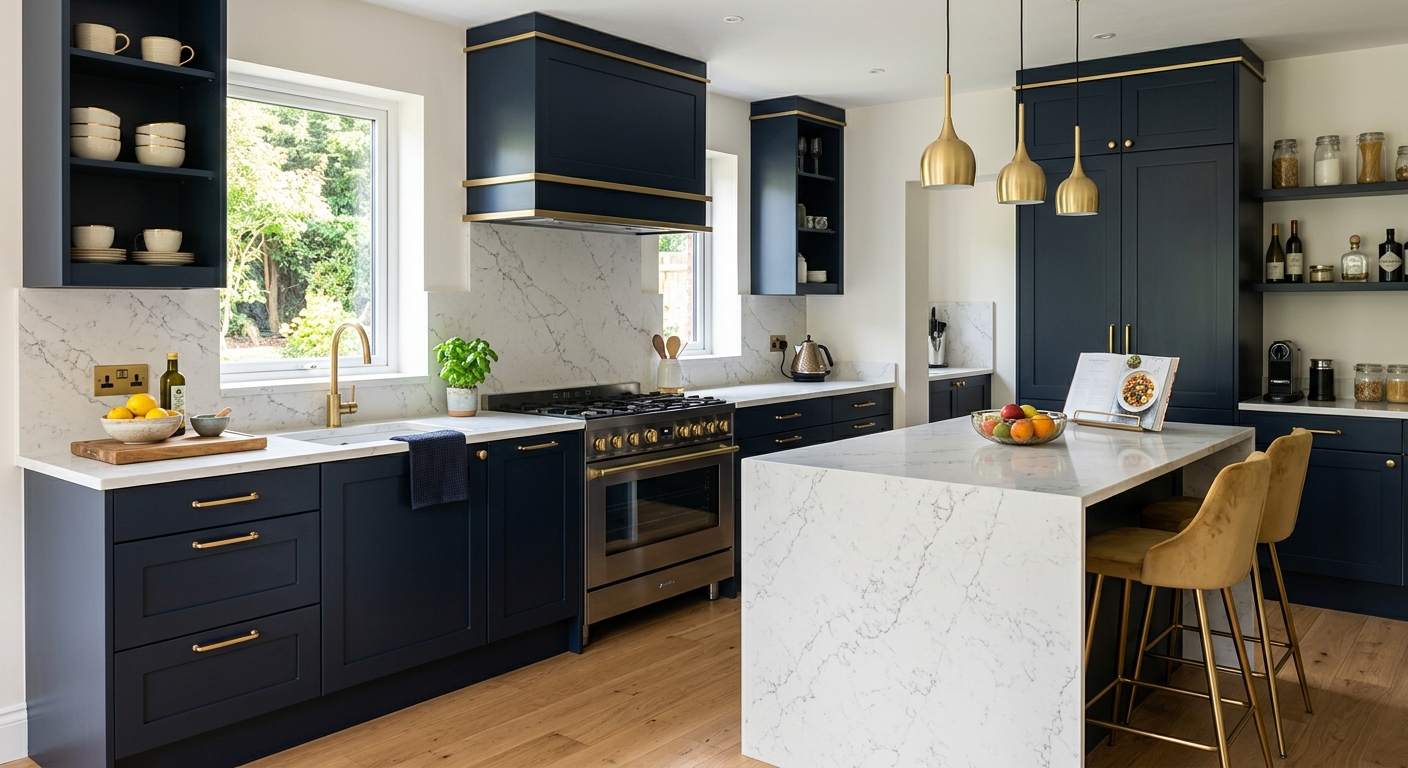
What a kitchen remodel costs in Charlestown
Charlestown homeowners are often surprised at how kitchen renovation costs line up with home values and the real incomes in this part of Chester County. With a median household income of $191,629 and an owner-occupancy rate over 89% (U.S. Census Bureau, ACS 2024), most local projects are not investor flips—they're long-term improvements, often by owners who expect to stay or want to stay. What you budget for a kitchen here will track with these economics.
The construction era matters. In many neighborhoods, especially those with homes built between the 1960s and 1980s, kitchens often get gutted for open layouts, cabinet upgrades, and better lighting, while some post-1980s kitchens need only new finishes. What blows up a budget is pricing for a simple replacement—then adding scope as you go, like moving sinks or adding circuits, which puts you into a different price tier entirely.
| Scope |
What's included |
Duration |
Price range |
| Full gut remodel, same layout |
cabinets, counters, appliances, flooring, lighting, fixtures |
6–10 weeks |
$38,500–$154,500 |
| Gut plus layout change |
all of the above plus moved plumbing, electrical, walls |
10–16 weeks |
$83,500–$154,500 |
| Cabinet replacement (stock to semi-custom) |
remove and install cabinets, hardware, patching |
1–3 weeks |
$9,000–$38,500 |
| Cabinet refacing |
new doors and drawer fronts, veneer, hardware |
3–6 days |
$9,000–$25,500 |
| Countertop replacement only |
template, fabricate, install, reconnect sink |
1–3 weeks |
$5,100–$20,500 |
| Kitchen flooring only |
remove existing, install new flooring |
3–6 days |
$6,400–$25,500 |
Estimates for a typical Charlestown kitchen. Cabinet grade and whether the layout changes move these figures more than square footage.
Appliance choices and the decisions they force
Charlestown kitchens often get tripped up at the appliance stage, and it’s not because homeowners make poor choices—it's the sequence. Cabinets are manufactured around appliance dimensions. If you pick cabinets and counters before appliances, you could end up forced into a refrigerator, oven, or dishwasher that doesn't fit your needs or your space. This is a classic and avoidable trap.
A standard-depth refrigerator sticks out beyond the cabinet line—fine for some kitchens, but in a new layout it makes for an awkward run. Counter-depth models cost more but integrate smoothly. Range choice matters: slide-in ranges have unfinished sides, designed for built-in looks, while freestanding ranges are more forgiving. Gas versus induction is not just about cooking style; induction requires a hefty new circuit, and in some homes from the 1960s–80s, your panel may not have the spare amperage. Panel-ready dishwashers add cost and lead time, but if cabinets are going custom, it’s a small lift at this point.
Range hood venting is another cost/consequence tradeoff. Ducted hoods move air outside—better for cooking and code—but require an exterior wall or roof penetration. Recirculating hoods are a compromise, filtering air but never removing cooking moisture.
Professional-grade appliances deliver durability and performance at a steep premium; for most in Charlestown, the real benefit is scaled control and look, not a measurable gain in food quality. Some appliance lead times now exceed cabinet lead times, so lock in your appliances before you finalize the kitchen plan.
Where the money actually goes
The sticker shock in Charlestown kitchen remodels is almost always about the distribution, not just the total. Cabinetry eats the largest single portion of a renovation budget, outranking even labor unless substantial layout changes are made. After cabinets comes installation labor, which climbs dramatically if you mess with layout, followed by countertops, appliances, then flooring, lighting, plumbing, and fixtures.
Too often, homeowners forget to allocate for what’s behind the walls—hidden electrical, plumbing, or framing issues. Set aside a real contingency for these surprises, especially in pre-1980 construction. Then there are the soft costs: permits, design fees, delivery, and debris disposal. These don’t feel like parts of your kitchen, but they’re unavoidable, and they add up.
If you have an extra thousand dollars, put it toward better drawer hardware or deeper cabinet boxes before splurging on a luxury range in a kitchen that will still have stock cabinets. Money spent on good cabinets pays back in function and resale, while a $5,000 fridge in a $250 cabinet line does not. For a moderate Charlestown kitchen gut (typical $83,500), these percentages translate into real dollar stakes.
| Category |
Share of budget |
Notes |
| Cabinetry |
25–35% |
the largest line and the longest lead time |
| Labour and installation |
20–30% |
rises sharply if the layout changes |
| Countertops |
8–15% |
material choice drives the swing |
| Appliances |
10–20% |
widest range of any category |
| Flooring |
5–10% |
|
| Lighting and electrical |
5–10% |
higher in older homes needing circuits |
| Plumbing and fixtures |
4–8% |
|
| Permits, design, disposal |
3–6% |
usually forgotten in early budgets |
| Contingency |
10–15% |
not optional in a pre-1980 house |
Code requirements for Charlestown kitchens
For most kitchen projects in Charlestown, the difference between work that requires a permit and work that does not is clear but easy to overlook. Cosmetic updates—painting cabinets, swapping hardware, replacing doors through refacing, or switching out countertops in place—typically don’t require a permit. But the minute you want to relocate plumbing pipes, install new electrical circuits, move a structural wall, or add a hood vent through the exterior, a permit is triggered. This is consistent with rules in neighboring West Chester and Tredyffrin, where such changes put you into plan review and inspection.
Electrical inspections in nearby municipalities like West Chester and West Goshen are often handled by third-party agencies—not always by local code officials—which surprises many homeowners and adds an extra step to scheduling.
Every contractor bidding work over $500 in Pennsylvania must hold Home Improvement Contractor (HIC) registration through the Attorney General. You can look them up at hic.attorneygeneral.gov. On jobs with workers, contractors are also required to carry private workers' compensation—a legitimate company can prove coverage through WCAIS.
Skipping permits for work that requires them is high risk in Chester County: unpermitted work gets flagged during resale, and enforcement is stricter in towns with dedicated code offices. Always make sure your contractor documents everything in a written contract as required by the Home Improvement Consumer Protection Act.
Cabinets are the critical path
Many Charlestown homeowners are frustrated to learn that kitchen renovations don't grind to a halt because of the demo or the tile setting—it's the wait for cabinets and then the wait for countertops after. In this market, where contractor density is high but crews are busy, nothing moves faster than the slowest supplier.
It starts with design—measuring, selections, and finalizing cabinet layouts. Once ordered, cabinets can take anywhere from 6 to 14 weeks to arrive, especially for semi-custom. Do not let anyone start demolition before your cabinets are scheduled and confirmed. Demo too soon and you risk living in a construction site for far longer than any worker needs.
After tear-out, any rough plumbing or electrical happens while the shell is open. Then those new circuits and lines are inspected, often by third-party agencies in this area, before walls are closed—and only then do cabinets go in. And here's the part no one tells you: the countertop fabricator cannot template until every base cabinet is leveled and secured. The industry-standard week or more waiting for template, fabrication, and install is unavoidable and always seems longer when the kitchen is out of commission.
The takeaway for Charlestown is simple: nail down your cabinet order before anyone swings a hammer. The long lead times are not a surprise; the impact just hasn't been explained properly.
What's behind the walls in a Charlestown kitchen
With almost a quarter of homes in Charlestown built before 1980, it’s common to start a kitchen project and uncover surprises. Walls and floors are rarely plumb—installers often need to shim base cabinets or cut scribe strips to get a level run, which can add days and $500–$2,500 in labor during installation.
Electrical surprises are next. It’s normal to find ungrounded wiring, minimal circuit capacity, or old-style fuse boxes in these homes, and bringing things up to modern code can run $1,000–$6,000 depending on panel and complexity. Plumbing is similar: galvanized pipes and cast iron drains need to go, usually at $2,000–$7,000 depending how deep you need to go into the walls or basement. Sometimes you’ll find minimal insulation behind exterior walls, a cheap fix but a missed opportunity if not addressed with the walls open.
Federal law requires lead-safe practices for any work in pre-1978 homes—a not uncommon scenario here. Disturbing old paint or certain 1970s vinyl flooring means undergoing EPA lead-safe work practices (verify at certifiedrenovatorsearch.epa.gov), which can add cost and a few days.
More recent homes may simply show builder-grade shortcuts: particleboard cabinet boxes sagging, original laminate counters swelling at seams, or older dishwashers leaking onto subfloors. If your kitchen is aging out, expect that everything will reach replacement age together, so do not count on partial updates unless you’re certain of what’s under the surface.
What moving the sink really costs
In a Charlestown kitchen, the moment you move the sink—or refrigerator, or range—you hit a cost cliff. Upgrading appliances, cabinets, or counters mostly stays within one pricing tier. The minute you rerun plumbing, electrical, or demo a wall, you step up to a completely different scope. The added cost is driven by factors most homeowners never see: relocating drain lines means maintaining slope, which is a challenge in slab foundations or over finished ceilings. Sometimes this means cutting concrete or pulling a permit just to touch the drain.
Electrical can be its own can of worms. If you want a relocated range or induction cooktop, you may need to upgrade your service panel to support a new circuit. That's not just running new wire—panel space is limited in many older homes, and upgrades are expensive. Removing or shifting a wall brings up the question: is it load-bearing? In that case, a structural engineer and a permit are automatic.
Exterior venting for a new range hood means a new, code-compliant wall or roof penetration, and routing ducts through ceiling cavities takes time, planning, and money.
The honest advice is this: don’t move the sink unless the existing layout is outright dysfunctional. The premium for layout change in Charlestown will commonly add $30,000–$70,000 to a typical project—sometimes more, seldom less. If your kitchen simply feels dated, focus your money on cabinets, counters, and lighting. Only invest in moving major utilities if it delivers genuine daily return.
Frequently asked questions — kitchen renovation in Charlestown
Why are kitchen quotes in Charlestown so far apart?
Quotes for kitchen projects in Charlestown can feel like apples and oranges, but the gap is almost always about scope and specification. The biggest variable is whether your project is a straightforward pull-and-replace (new cabinets and counters, same layout) or if you’re moving plumbing and wiring, which instantly bumps you into a different cost bracket—by as much as $30,000–$70,000. Contractor labor rates here also vary because finish-trade experience is at a premium, and busier firms don’t bother quoting small jobs or low margins. Finally, local overhead matters; some companies carry design services or project management in-house, which raises costs but can streamline the project. Two similar-sounding jobs may be priced very differently because of unseen structural, electrical, or permitting obligations unique to Chester County and these Main Line suburbs.
What should I expect in a pre-1980 Charlestown kitchen?
In Charlestown, about 24% of homes were built before 1980, and those jobs almost always reveal a surprise once demolition starts. Common findings include ungrounded wiring, galvanized pipes, minimal insulation in exterior walls, and sometimes lead paint or asbestos in old finishes. Remediating old wiring can run anywhere from $1,000–$6,000, and plumbing can cost similar if lines need full replacement. Disturbing old wall finishes often requires compliance with EPA’s Renovation, Repair and Painting Rule for lead safety. If permit records from previous remodels are missing, you may also have to address prior unpermitted work before selling. In the end, it all means you have to budget for contingency—Charlestown kitchens that look simple at first often aren't behind the walls.
What is the difference between stock and semi-custom cabinets?
The difference between stock and semi-custom cabinets comes down to fit, finish, and flexibility. Stock cabinets are the most affordable, coming in pre-set sizes, colors, and finishes, and are available in a matter of weeks. They work well in standard layouts, but if you have uneven walls or want features like pull-out trays or dovetail drawers, your options are limited. Semi-custom cabinets allow you to choose finishes, adjust cabinet depths or heights, and add functional upgrades—all at a premium. In Charlestown, a cabinet replacement job runs from $9,000–$38,500, with semi-custom options landing in the upper half of that range. For homes with out-of-plumb framing or unique needs, semi-custom is often the only practical route for a clean fit, especially in the 1960s and 1970s construction around Chester County.
How long does a kitchen renovation take in Charlestown?
For a typical full gut-and-replace—keeping the original layout—the process in Charlestown takes roughly 6–10 weeks, assuming cabinets are ordered up front and there aren’t major surprises. Changing the layout, adding new plumbing, or moving structural walls extends the timeline to the 10–16 week range. Cabinet lead times and sequencing matter more than anything else, as they drive the whole job’s cadence. Many homeowners expect flooring or tile to be the holdup, but it’s actually the time between cabinet order and countertop installation that leaves kitchens out of commission longest. If you’re tempted to demo before everything is lined up, expect a longer inconvenience in this high-demand market. Even a modest kitchen flooring job takes 3–6 days, but full projects come down to cabinetry, countertop, and inspection scheduling.
Should I reface or replace my kitchen cabinets?
Refacing cabinets—putting new doors, drawer fronts, and sometimes a veneer on existing boxes—saves money and avoids the disruption of a full tear-out, but it only works if your cabinet layout already suits your needs and the box construction is solid. In Charlestown, refacing typically runs $9,000–$25,500. For homes where the boxes are particleboard, have water damage, or where you want to move or add cabinets, replacement makes more sense. In 1960s–‘80s homes, boxes may be solid enough to keep, but by the time you move plumbing, add lighting, or change the floorplan, full replacement is usually better long-term value. If budget is tight and the boxes are in good shape, refacing can be a reasonable compromise.
What is a realistic contingency for a Charlestown kitchen?
For a kitchen in Charlestown, the prudent contingency budget is 10% to 15% of the construction cost—so for a midrange full gut at $83,500, plan for an extra $8,350–$12,525. With one in four homes built before 1980, surprises are the rule, not the exception. You may run into hidden plumbing leaks, unpermitted past work, electrical upgrades, or the need for structural fixes behind walls. Even in newer construction, product back-orders or minor framing issues can arise. Setting aside this buffer will keep your project moving if issues are discovered and protect you from mid-project cash crunches that add stress or delay. In this part of Chester County, skipping the contingency is rolling the dice.
Which upgrades are not worth the money?
In Charlestown, avoid overinvesting in luxury appliances unless your entire kitchen is being upgraded to match. A $10,000 pro-style range in a kitchen with basic cabinets and laminate counters looks out of place and doesn’t add much resale value. The same goes for specialty gadgets—built-in coffee systems, double-drawer dishwashers, or smart refrigerators are expensive ($2,500–$10,000) and rarely used to their potential. Waterfall countertops and exotic woods drive cost quickly without a big payoff. Spend your budget where it matters: durable cabinets, good hardware, and improved lighting. Trend finishes and technology are easy to add later, but structural components drive the real daily value and return in Chester County homes.
What happens if previous work was unpermitted?
If you discover previous unpermitted work in your Charlestown kitchen, you’re required to disclose this at sale, and it can stall or kill a real estate deal, since home inspectors and agents in Chester County are trained to look for it. Bringing unpermitted work up to code may mean opening walls, redoing wiring or plumbing, and pulling retroactive permits—often at higher cost than just doing it right initially. If hidden issues are found, the price tag easily reaches $10,000–$30,000, especially if structural or safety concerns are involved. On a practical level, code enforcement is stricter in municipalities like West Chester and surrounding townships, so don’t count on a quick pass. It’s always safer (and cheaper in the end) to permit work that requires it, even if the process feels like a hassle.
What is an allowance in a renovation quote?
An “allowance” is a placeholder budget line in your contractor’s quote for items not yet selected—think appliances, lighting, or tile. If you haven’t chosen a countertop material, your contractor might include a $7,500 allowance based on typical selections in Charlestown. If your choices end up more expensive, you pay the difference. If less, you get a credit. Allowances keep the project moving but can hide the true cost if set unrealistically low. Good practice is to request that allowances reflect actual market pricing—especially for frequently upgraded finishes in this Main Line area. Otherwise, sticker shock can hit late, when upgrades push you past that number and your renovation budget suddenly grows.