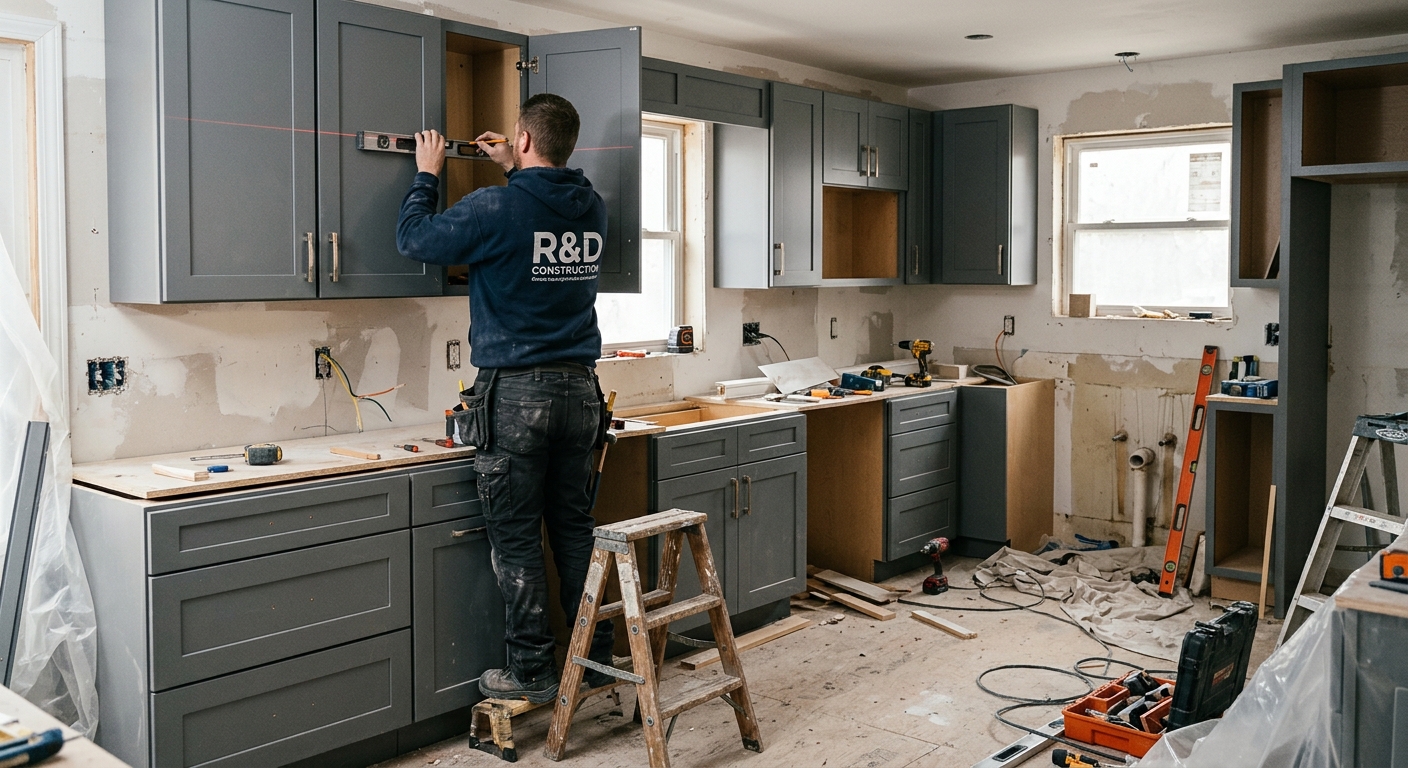
What a kitchen remodel costs in Cecil
Cecil homeowners approach a kitchen renovation differently than rental investors, and for good reason: with a 74.7% homeownership rate and a median household income of $99,844 (U.S. Census Bureau, ACS 2024), these projects are often planned to last decades, not just to freshen up for resale. The dominant local housing wave — homes built between 1950 and 1980 — means many kitchens here were designed for smaller appliances, closed layouts, and different daily life. If you’re in a classic tract house, you may be facing laminate counters, original cabinets, and a galley layout that no longer fits modern needs. By contrast, a 1990s kitchen might just need new surfaces, not new walls.
Most kitchen budgets blow up for one reason: pricing for a surface-level remodel but specifying new appliances, bigger islands, or moving fixtures partway through. Know your target scope up front to avoid a quote that starts at cosmetic and ends up at a full gut remodel price after a few “while you’re here” changes.
| Scope |
What's included |
Duration |
Price range |
| Full gut remodel, same layout |
cabinets, counters, appliances, flooring, lighting, fixtures |
6–10 weeks |
$32,000–$127,500 |
| Gut plus layout change |
all of the above plus moved plumbing, electrical, walls |
10–16 weeks |
$69,000–$127,500 |
| Cabinet replacement (stock to semi-custom) |
remove and install cabinets, hardware, patching |
1–3 weeks |
$7,400–$32,000 |
| Cabinet refacing |
new doors and drawer fronts, veneer, hardware |
3–6 days |
$7,400–$21,000 |
| Countertop replacement only |
template, fabricate, install, reconnect sink |
1–3 weeks |
$4,200–$17,000 |
| Kitchen flooring only |
remove existing, install new flooring |
3–6 days |
$5,300–$21,000 |
Estimates for a typical Cecil kitchen. Cabinet grade and whether the layout changes move these figures more than square footage.
What's behind the walls in a Cecil kitchen
Given that 35.1% of homes in Cecil were built before 1980 (U.S. Census Bureau, ACS 2024), it’s common for kitchen remodels here to run into several “hidden” surprises once demolition starts. Out-of-plumb walls and out-of-level floors are routine in houses from this era; fixing these usually means extra shimming for cabinets, sometimes adding $800–$2,500 to the total. Older wiring — think two-prong, undersized, or ungrounded — is also common. Fully upgrading electrical service during a kitchen project can add $2,500–$8,000, depending on what’s found.
Galvanized water lines and cast iron drains turn up in some pre-1970 homes and often need replacing during a renovation, with typical costs starting around $1,200–$4,000 if you’re already in the walls. No insulation on exterior kitchen walls is another surprise, especially in 1950s- and 1960s-era homes, and many owners find themselves adding rigid or batt insulation as part of a full gut. Sometimes, demo reveals previous unpermitted work — plumbing buried in walls, mystery junction boxes — and correcting those can balloon budgets fast.
Lead paint is a special concern for pre-1978 homes. The federal EPA Lead RRP Rule requires special handling, and anyone disturbing painted surfaces in these kitchens must be certified. For asbestos flooring in kitchens of the right era, hiring a certified pro for testing before disturbing materials is a must.
Newer suburban kitchens, from the 1980s onward, don’t typically have hazardous materials, but you may meet the builder-grade limit: particleboard cabinets at end of life, minimum electrical circuits, and original laminate counters all requiring attention at the same time.
Layout changes and the cost cliff
The difference between a reasonable kitchen remodel and an eye-watering final invoice in Cecil almost always comes down to layout changes. If you keep your fixtures — sink, dishwasher, range — in their original locations, your project stays within reach. As soon as one of those moves, costs jump, not just for materials, but for skilled labor, permits, and potentially, engineering.
Moving plumbing is never as simple as just shifting some pipes; drains require slope, and if your kitchen sits on a slab or above a finished ceiling, accommodating that slope often means opening up floors or ceilings. Shifting a gas or water line just six feet can easily tack on $3,500–$8,000 when patching, inspections, and new connections are tallied. Running new circuits for relocated appliances isn't just about stringing wire — panel space is a hard stop, and upgrades can snowball beyond the kitchen. Removing a wall? First, you have to know if it’s load-bearing, which means bringing in an engineer and pulling a building permit. Venting a new hood to the exterior means a new wall or roof penetration, subject to municipal review.
Look hard at your existing layout. In many 1950–1980 homes, it feels outdated, but ask if the annoyance is about function or just finishes. The cash spent shifting a sink across the room almost never delivers as much value as it costs. In Washington, any kitchen renovation involving structural changes, new circuits, or relocation of plumbing fixtures requires a building permit, so making these kinds of layout changes takes you from a $32,000–$69,000 project into the $69,000–$127,500 territory, with all the inspections and disruption that go with it.
Renovating to live in versus renovating to sell
For Cecil homeowners, a kitchen renovation is only sometimes about resale value. In practice, a new kitchen reliably helps a home sell faster — buyers picture themselves using the space and don’t subtract for “what needs done.” But renovation costs, especially at the upper end, are rarely fully recouped after closing. Mid-range projects that improve function and stay in the mainstream on style recover a bigger share than high-end, fully custom kitchens.
The key difference: renovating to sell is a formula. Neutral colors, durable but not extravagant finishes, and little or no layout change. This means you’re probably shopping in the $32,000–$69,000 range, replacing tired cabinets and counters but resisting the temptation to knock down a wall just because you don’t love it. The risk, especially in a market with a median household income of $99,844 (U.S. Census Bureau, ACS 2024), is spending well above what the neighborhood supports. Even the best kitchen on the block won’t return a $127,500 investment if it exceeds what buyers expect of Cecil homes.
If you’re renovating to stay, spend where it matters for you — on function, storage, and the features you use every day, not what an agent thinks will “wow” the next owner. The projects that go wrong financially are the ones that mix resale upgrades with custom work and expect above-average returns.
Code requirements for Cecil kitchens
Cecil Township, like most Washington County municipalities, requires building permits only for renovation work that moves plumbing, electrical, or involves structural changes. Cosmetic changes — such as paint, hardware swaps, countertop replacement in the existing layout, or refacing cabinets — do not typically need a permit. The moment your project includes new or relocated circuits, pipes, or walls, though, expect to submit plans and wait for approval.
In the City of Washington, all kitchen remodels that alter walls, electrical service, or plumbing risers require formal plan review. This is especially true for the layout-change type projects, where an engineer may need to certify load-bearing wall work. Inspections for electrical work throughout Washington County’s municipalities are often handled by third-party agencies like the Middle Department Inspection Agency, not always by the township itself. This surprises many homeowners, so always ask who to expect.
Contractors working on Cecil kitchens must hold a Home Improvement Contractor (HIC) registration through the Pennsylvania Office of Attorney General for any job over $500; always verify at hic.attorneygeneral.gov. If the contractor has employees on site, valid workers’ compensation coverage is mandatory; check this at WCAIS (wcais.pa.gov). Pennsylvania’s Home Improvement Consumer Protection Act requires a written contract and gives you a three business-day right of cancellation. Trying to slide under the radar with unpermitted work may seem simple in the short term, but it will almost always surface at resale and can complicate closing.
The biggest line item in your Cecil kitchen
Your biggest kitchen expense in Cecil isn’t the appliances, flooring, or even the labor — it’s the decision about your cabinets. Four real options shape the budget, each with pros and cons, and understanding the trade-offs will keep you from expensive mistakes.
Refacing uses your existing cabinet boxes, swapping doors, drawer fronts, hardware, and applying new veneer. It can look fantastic and costs much less, but only when existing boxes are sturdy, square, and the current layout works for you. You can’t reface if your goal is to change storage or layout. Stock cabinets come in set sizes and finishes, so they fit best in square rooms with standard dimensions; expect to see filler strips and sometimes awkward transitions when the space doesn’t cooperate. Semi-custom cabinets address non-standard walls and allow more finish choices — crucial in many Washington County tract homes, where old walls rarely line up perfectly. Full custom is top-tier, making anything you can draw, with a higher price and lead time.
Independent of price, look for plywood boxes over particleboard for durability, doweled or dovetailed joinery in drawers rather than staples, and soft-close or full-extension hardware. Frameless cabinets maximize space but require the walls to be nearly perfect to install — an issue in homes from the dominant 1950–1980 building wave.
| Option |
Cost |
Best when |
Limitation |
| Painting existing cabinets |
$1,200–$3,500 |
boxes and doors sound, tight budget |
no layout or style change |
| Refacing |
$7,400–$21,000 |
boxes square and layout works |
storage unchanged |
| Stock cabinets |
$7,400–$32,000 |
standard dimensions fit |
filler strips, limited finishes |
| Semi-custom |
$21,000–$32,000 |
non-standard walls or finishes |
6–12 week lead time |
| Full custom |
$21,000–$32,000 |
unusual layout or high-end design |
longest lead, highest cost |
Cosmetic, replacement, gut, or layout change?
The term “kitchen remodel” covers everything from a weekend paint job to a six-figure overhaul that moves walls and plumbing. Here’s how to separate what you really need — and what you can afford — in Cecil:
- Cosmetic refresh: This is paint, new hardware, backsplash, light fixtures — maybe counter refacing — with no cabinet or layout changes. The quickest, least expensive tier, best for solid but tired spaces where function is fine.
- Pull and replace (replacement): Remove old cabinets, install new (and new counters), but keep the original layout. No changes to plumbing or electrical location. Reliable outcomes, mid-range costs, and you avoid the permit process.
- Gut, same layout: Everything down to the studs comes out. Insulation, wiring, even floor are replaced, but fixtures go right back where they were. This is necessary in older homes with wiring or material issues, but cost stays lower by not relocating anything major.
- Layout change: Now you’re moving sinks, appliances, or knocking out walls to reconfigure the space. This triggers permits, design review, and inspection of plumbing and electrical. The cost jump is substantial — not just from finishing, but also the hidden upgrades and unknowns that surface when changing an old layout.
Most cost overruns start when a project slips from “pull and replace” to “layout change” because of mid-stream decisions. Decide your tier before hiring, or you’ll get numbers that mean nothing on the finished job. Contractors in Cecil can’t give you a real quote until you’re clear on this point — and neither can you compare bids that aren’t apples to apples.
Frequently asked questions — kitchen renovation in Cecil
What is the difference between stock and semi-custom cabinets?
Stock cabinets come in standardized widths, heights, and finishes, making them an economical choice for kitchens with mostly square corners and standard layouts common in post-1980 Cecil homes. With no major adjustments, they install quickly and cost less — often landing between $7,400–$21,000 for a typical kitchen. On the other hand, semi-custom cabinets are built to order, tailoring dimensions and storage to non-standard spaces, finish choices, or tricky wall conditions. This is especially helpful in Cecil’s 1950s–1980s homes, where walls often aren’t plumb and standard sizes require excessive filler strips. Expect costs for semi-custom to run $21,000–$32,000, plus longer lead times. Both can look great, but semi-custom solves more real-world fitting issues in this market.
Who inspects kitchen electrical work in Cecil?
Electrical inspections in Cecil Township and throughout much of Washington County are typically performed by third-party agencies such as the Middle Department Inspection Agency, not by the township directly. This arrangement surprises many homeowners, since some assume municipal inspectors will handle all work. You will need an inspection for new electrical circuits, upgrades, or whenever your kitchen renovation work is permitted for changes to the wiring. The cost of permitting and inspection is generally built into your project, but always confirm who will be coming out and when — getting a “final” before buttoning up the walls is critical. This system ensures that work in Cecil meets Pennsylvania Uniform Construction Code standards even if the township doesn’t employ their own inspectors.
Can I renovate a kitchen in stages?
Yes, you can phase a kitchen renovation in Cecil, but there are limitations. For example, you could update your countertops now for $4,200–$17,000 and handle cabinet replacement later. Staging lets you manage costs and disruption, which is important for families living in the home during construction. However, if your kitchen is older and has potential issues behind the walls — common in homes built before 1980 — you might end up redoing finished work when it’s time for the next phase. Also, pulling permits multiple times for each phase adds administrative overhead and cost. Ultimately, staged remodels work best when cosmetic or surface finishes are being updated rather than major layout, plumbing, or electrical changes, which truly benefit from a single, coordinated approach.
What are cabinet lead times in Cecil right now?
Even with moderate demand in Washington County, expect semi-custom and full-custom cabinets to require a 6–12 week lead time from order to delivery, as local suppliers serve the broader Pittsburgh metro. Stock options often arrive within a few weeks because larger distributors keep common sizes on hand. Choosing semi-custom because of Cecil’s older housing layouts — where walls are rarely perfectly square or plumb — is common, but it also means factoring cabinet production into your schedule. Work closely with your contractor on sequencing: a delay in cabinet delivery can affect every finish that follows, from countertops to flooring. For a typical kitchen, cabinets land in the $7,400–$32,000 range, so proper planning avoids costly gaps in your project timeline.
Why are kitchen quotes in Cecil so far apart?
Kitchen renovation bids in Cecil can easily land thousands — sometimes tens of thousands — apart for the same project. There are several reasons: First, the existing house stock varies widely, so the cost to gut a 1950s kitchen versus a newer one can be dramatically different. Second, some quotes include full service — design, permits, licensed trades — while others leave inspections and planning up to you. Material grades, especially for cabinets, range from painting for $1,200 to semi-custom or full custom at $32,000 and above. Lead times and labor rates also fluctuate, and finish-trade labor is tighter in Cecil than in core Pittsburgh areas, driving up price on busy jobs. Always stack up apples-to-apples quotes by matching the exact scope, material level, and services included.
How much do new kitchen cabinets cost in Cecil?
For most homes in Cecil, new kitchen cabinets fall between $7,400–$32,000 for stock or semi-custom options. The low end covers smaller kitchens or builder-grade replacements, while the upper figure includes more finish choices and customization — often necessary in older homes with walls that aren’t straight. If you want cabinet refacing instead, that typically lands in the $7,400–$21,000 range. When a fully custom design is needed for an unusual layout or high-end project, pricing is similar to or above the top end for semi-custom. The best value comes from matching your real needs to the stock or semi-custom line, as that also keeps lead times reasonable for a typical Cecil job.
Do older Cecil homes need electrical upgrades for a kitchen?
Many homes in Cecil built prior to 1980 still have outdated wiring — sometimes just two circuits for the whole kitchen, with no grounding and limited capacity. Major kitchen appliances today draw more power, and code now requires independent circuits for microwaves, dishwashers, and even countertop outlets. Full gut remodels that update wiring to modern standards usually add $2,500–$8,000 in electrical work, depending on panel upgrades and kitchen size. While upgrading may not be required for straight cabinet or countertop replacement, it’s often a practical necessity for kitchens of this age, making your remodel both safer and more attractive at resale. Rewiring is money well spent in a market where homebuyers are expecting modern convenience — and inspectors in Cecil will flag obvious deficiencies during permitted work.
How should renovation payments be scheduled?
In Cecil and throughout Pennsylvania, payments for renovation work are regulated by the Home Improvement Consumer Protection Act (HICPA). For projects over $500, a written contract is required, and you’re never expected to pay the entire price up front. Commonly, a deposit of 30% is standard, with progress payments due at material delivery (such as cabinets — which may be $7,400–$32,000 on their own) and substantial completion of each major milestone. The final payment should not be made until all work passes inspection and you are satisfied with the results. Never pay cash, always request receipts, and verify that your contractor’s registration and workers' compensation are valid before the first check clears.
Can I over-improve for my Cecil neighbourhood?
Yes — and it’s a common risk, especially in areas like Cecil with a median household income of $99,844 (U.S. Census Bureau, ACS 2024). Investing in a kitchen remodel that costs $69,000–$127,500 can price your house out of the local market if surrounding homes are more modest. The market supports upgrades in function and finish, but there’s a ceiling for value recouped on resale; buyers here are looking for practical layouts and updated surfaces, not trophy kitchens. Spend for your own needs if you plan to stay, but if selling in the short term, target the mid-range and avoid exotic customization. The houses that struggle to sell are usually those with a kitchen priced way ahead of what’s typical for the area.