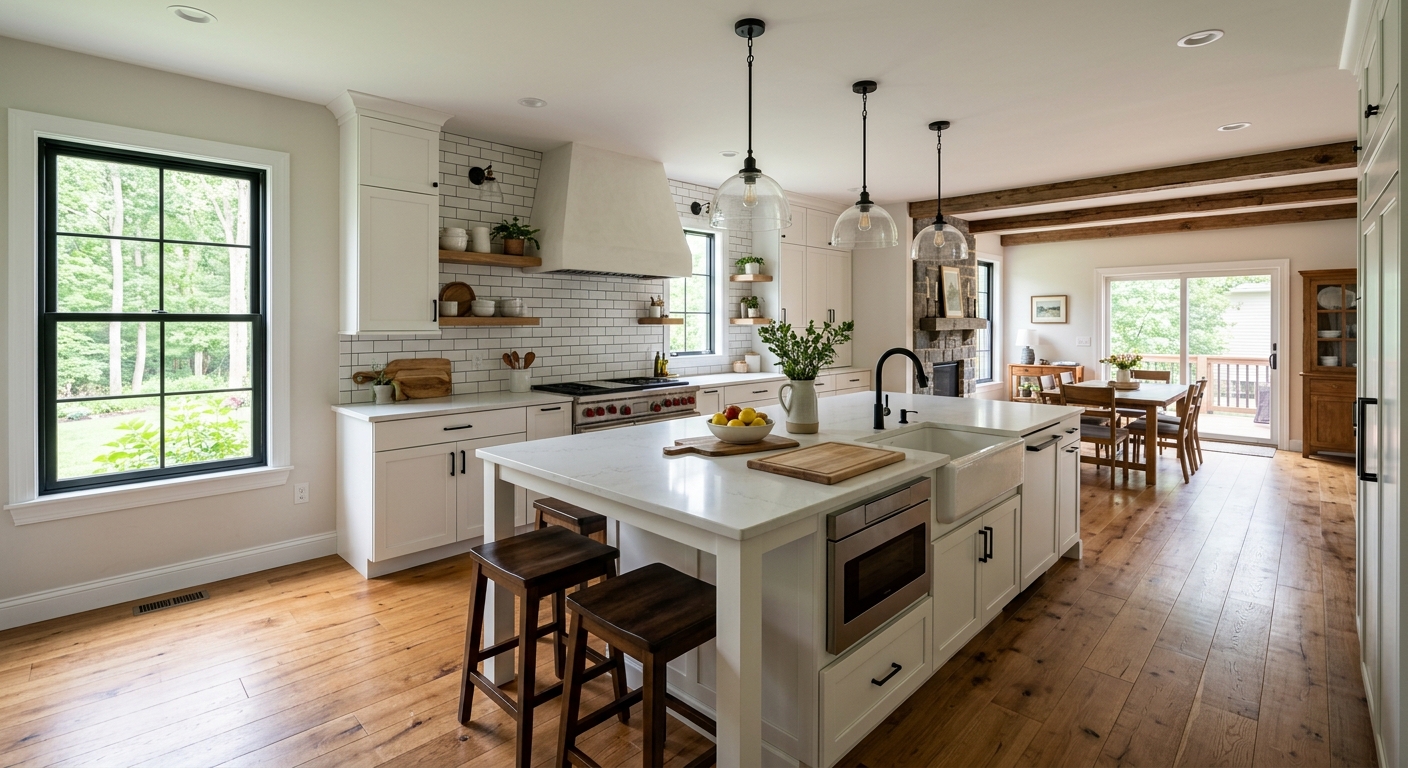
Kitchen renovation costs in Mount Lebanon — 2026
Mount Lebanon kitchen renovations land in a higher price bracket than many surrounding markets, influenced both by older, more character-rich homes and a strong owner-occupier base. With a median household income of $117,881 and a homeownership rate of 75.5% (U.S. Census Bureau, ACS 2024), residents typically plan kitchen projects with a long-term perspective, not just resale. The majority of homes were built before 1980, so it’s common to encounter small, closed-off kitchens in need of structural work—meaning more projects here require either a full gut or at least some wall changes. If you’re looking at a kitchen last updated in the 1950s or 1960s, expect a different scope (and cost) than a 1980s or newer space.
The main pitfall for Mount Lebanon homeowners is pricing out a minor update (like cabinet replacement) and then, mid-design, deciding to add wall removal, new lighting layouts, or relocated plumbing, which drives you up the most expensive tier. Most blown budgets start here: mismatching your pricing research with the real scope you settle on. Below is a realistic breakdown of costs for 2026, including what’s actually covered and how long you’ll be living without your kitchen.
| Scope |
What's included |
Duration |
Price range |
| Full gut remodel, same layout |
cabinets, counters, appliances, flooring, lighting, fixtures |
6–10 weeks |
$33,000–$132,000 |
| Gut plus layout change |
all of the above plus moved plumbing, electrical, walls |
10–16 weeks |
$71,500–$132,000 |
| Cabinet replacement (stock to semi-custom) |
remove and install cabinets, hardware, patching |
1–3 weeks |
$7,700–$33,000 |
| Cabinet refacing |
new doors and drawer fronts, veneer, hardware |
3–6 days |
$7,700–$22,000 |
| Countertop replacement only |
template, fabricate, install, reconnect sink |
1–3 weeks |
$4,400–$17,500 |
| Kitchen flooring only |
remove existing, install new flooring |
3–6 days |
$5,500–$22,000 |
Estimates for a typical Mount Lebanon kitchen. Cabinet grade and whether the layout changes move these figures more than square footage.
Choosing a countertop for a Mount Lebanon kitchen
In Mount Lebanon kitchens, the right countertop comes down to how you actually use the space, not just what looks sharp in a showroom. Quartz, which is engineered stone, is non-porous—meaning it won’t stain from everyday coffee spills or wine. It’s low-maintenance but does not tolerate direct hot pans; a countertop-sized burn mark isn’t repairable. Granite, a natural stone, brings uniqueness and heat tolerance but requires resealing every couple of years to avoid staining and etching in a busy household.
Laminate gets overlooked, but modern products are durable, stain resistant, come in hundreds of finishes and, especially in rental or budget-conscious Mount Lebanon homes, are a smart decision (not a downgrade). Butcher block delivers warmth, works in 1920s and 1950s houses, and is sandable, but it demands regular oiling and will nick and stain—most owners undervalue the maintenance after a year or so. Solid surface (like Corian) doesn’t resist heat as well as stone but scratches can be sanded out, making it a practical choice if you want something fixable.
Pricing is impacted not just by the material but by fabrication choices: a premium edge profile, multiple sink or cooktop cutouts, and where seams land—seams will always be more visible in strongly patterned stone. Templating requires the cabinets to be fully installed and leveled, not just measured from a drawing, which adds a built-in pause to the project. If you’re trying to hold down costs, a simple square edge and a single sink cutout, combined with laminate or a pre-fab granite, will go a long way.
General contractor, kitchen firm, or manage it yourself?
Who actually manages your Mount Lebanon kitchen renovation will dictate the outcome more than any specific tile or appliance. A design-build kitchen firm offers the all-in-one approach—design, product ordering, project management and finish work under one contract. It’s the most “hands-off” for you and puts all responsibility on one company, but you pay a premium for that streamlined process.
A general contractor model is the in-between: you, or a designer you hire, handle selections and design, and the contractor coordinates the trades—carpenters, plumbers, electricians, flooring and countertop installers. Costs land in the middle, and effort does too. You’ll be weighing in on daily decisions, but you do have professional backup when a scheduling snarl hits.
Owner-managed projects are at the lowest cost end, but in tight labor markets like Allegheny County—where demand for finish trades stays high—finding and scheduling good subs is tough. If your project triggers a permit or involves moving plumbing, let alone walls, managing it yourself is a false economy unless you are available full-time and have solid trade contacts. If you have a day job, don’t try to run a gut renovation here—scheduling slip-ups will cost far more than you’ll save.
Lead times, sequencing and why it takes longer
Homeowners in Mount Lebanon are often surprised by how much of the kitchen renovation timeline is dictated by what can’t be done all at once. Once you’ve finalized your kitchen layout and finishes, cabinet orders typically take weeks; you do not want to pull out your existing kitchen until your cabinets have ship dates in hand. Demolition only happens after product logistics are sorted—not the other way around.
After demolition, the rough-in trades—electrical, plumbing, sometimes HVAC—come next, followed by required inspections. Only then are cabinets installed. The key holdup is that countertops, especially stone or quartz, cannot be templated off your plans, only off the actual installed cabinets. That leaves an unavoidable week (sometimes two) where nothing happens: you’re waiting for the fabricator to template, cut, and return for install. It feels like a dead zone, but it’s physically necessary—nobody can skip it.
In high-demand markets like Mount Lebanon, with a dense contractor base, cabinet and countertop lead times don’t move faster for private homeowners. Getting this sequence wrong—waiting until after gutting to order cabinets—can leave you with a torn-up kitchen for months longer than needed. Plan on 6–10 weeks without a full-function kitchen for a simple renovation, more if layout changes or inspections cause delays.
Living through a kitchen renovation
Going without your kitchen for weeks isn’t just an inconvenience—it shapes your entire daily routine. In Mount Lebanon, where families are used to cooking at home, you’ll want to designate a temporary kitchen zone ahead of time. The fridge can often be moved to the dining room or garage, and a folding table with a microwave, toaster oven, and kettle covers most breakfasts and light meals. Expect to use bathroom or laundry sinks for dishes, and plan on disposable plates for anything beyond that.
Dust is a real concern—especially in older houses where demolition can spread fine debris far beyond the kitchen. Contractors should build temporary zip walls and use plastic sheeting to isolate spaces. If you have pets, be mindful that trades need the doors propped open for moving materials, and dumpsters or material drop spots typically claim part of your driveway or curb.
You do not have to move out for the full project, but the demolition phase is loud, messy, and sometimes includes a day without water or power. Many families choose to stay elsewhere during the first week. Finally, expect your food bill to jump—eating out more than planned for eight weeks usually costs more than new flooring. It’s a real, often overlooked, budget line.
Does a kitchen renovation pay back in Mount Lebanon?
In Mount Lebanon, a new kitchen always helps a house sell faster—buyers are walking through homes built before 1980, and a dated kitchen can easily be a deal-breaker. However, even with a median household income of $117,881, there’s a ceiling on what buyers are willing to pay, and spending at the very top end doesn’t guarantee you’ll recover every dollar.
Mid-range kitchen projects—where finishes are good but not extravagant, and the layout stays close to original—tend to recover a larger share of cost than high-end, customized renovations. For homeowners planning to sell in the next couple of years, focus on neutral finishes and skip dramatic layout changes. Instead, update cabinets, counters and lighting within the expected price bracket.
If you plan to stay long-term, build a kitchen around how you cook and live, not around resale data. The most expensive mistake is over-improving—sinking $132,000 into a kitchen when most homes in Mount Lebanon top out at a much lower renovation spend. Real estate agents in this area will tell you that buyers notice thoughtful, functional upgrades—storage, lighting, seating—more than exotic cabinets or imported hardware, and that’s where the money is genuinely well spent.
What requires a permit in a kitchen renovation
In Mount Lebanon and greater Allegheny County, you usually don’t need a building permit for cosmetic kitchen work: new cabinet fronts, new countertops set onto existing cabinets, hardware swaps or a fresh coat of paint can be done without calling the code office. However, once you move or add new electrical circuits, change plumbing locations, open up a wall, or install a new structural beam, you’re almost certainly triggering a permit requirement. In the City of Pittsburgh, any structural wall changes or relocating plumbing/electrical nearly always need permits. Most suburbs—including Mount Lebanon—follow similar lines.
Full kitchen remodels that change layout or structure are subject to plan review. After rough-ins, inspections are carried out either by the municipal code office or by approved third-party agencies—a detail that surprises many, as it’s not always city staff.
All kitchen renovation contractors in Pennsylvania taking on contracts over $500 must be registered as Home Improvement Contractors with the Commonwealth. You can check HIC registration at hic.attorneygeneral.gov. Every contractor with employees is also required to provide workers’ compensation insurance, and you can check their status via WCAIS (wcais.pa.gov). Not having the right permits is a common snag at resale—a missed permit can delay closing and force expensive retrofits to prove code compliance.
Frequently asked questions — kitchen renovation in Mount Lebanon
How much do new kitchen cabinets cost in Mount Lebanon?
New kitchen cabinets in Mount Lebanon, when going from stock up through semi-custom options, will typically run between $7,700–$33,000. Most homeowners in this area land in the lower half of that band, but choosing higher-end styles, pull-outs, or adding more cabinets can push into the upper range. If your existing kitchen dates to the 1940s or 1950s, plan for the higher end, as unpredictable wall and floor conditions often require carpentry work during installation. Remember, you’ll also need to budget for hardware, possible trim, and patched drywall—so use these numbers as the baseline for the cabinetry itself. Shop locally and avoid premium brands unless you have a specific feature in mind; standard semi-custom cabinets will last decades in most Mount Lebanon homes.
Why is there a gap after cabinets are installed?
The gap between cabinet installation and countertop installation is a common frustration for Mount Lebanon homeowners, but it’s unavoidable. Countertops—especially stone or quartz—are templated using precise digital or manual measurements once the cabinets are fully secured and level. Fabricators can’t create an accurate template from drawings or old cabinets, as small differences in placement make a big impact on fit and seam location. That adds a built-in pause of at least a week, sometimes longer if shops are busy. This period is part of every full remodel or countertop replacement (which runs $4,400–$17,500), so plan to have a work surface gap while you wait. There's no way to speed this up without risking a countertop that doesn't fit the actual layout.
What does a quartz countertop cost in Mount Lebanon?
Quartz countertops in Mount Lebanon kitchens are priced from $4,400–$17,500, with most projects in the $8,000–$12,000 range unless you have an unusually large kitchen or choose a premium brand. Quartz offers a non-porous, low-maintenance surface that’s great for busy households, but remember it’s more sensitive to heat than natural stone—so always use trivets for hot pans. The final cost depends on thickness, edge profile, and any upgrades like full-height backsplashes or waterfall ends. Local fabricators typically include templating, fabrication, installation, and sink cutout in the price, but plumbing reconnection or old countertop disposal can be extra.
Should I reface or replace my kitchen cabinets?
Refacing vs. replacing depends on your kitchen’s layout and the condition of your cabinets. In Mount Lebanon’s older homes, refacing makes sense if your cabinet boxes are sturdy, the layout works, and you just want a fresh look—expect $7,700–$22,000. If your cabinets are falling apart or you want to reconfigure the layout, full replacement is the way to go, with costs running up to $33,000. Refacing is usually less disruptive and quicker, but it won’t address shallow or awkward storage. Older Mount Lebanon houses sometimes have boxes too out-of-level or out-of-square to reface well; in those, replacement is a better long-term investment.
Do older Mount Lebanon homes need electrical upgrades for a kitchen?
Most Mount Lebanon homes, with over 87% built before 1980, require some level of electrical upgrade for modern kitchens. Older kitchens weren’t designed for today’s appliances, so you may hit code-required upgrades: separate circuits for microwaves, dishwashers, and countertop outlets. Even a modest kitchen update (in the $33,000–$71,500 range) will almost always reveal outdated wiring, non-GFCI outlets, or overloaded panels once walls are open. Upgrading not only brings you up to code but adds resale value and improves day-to-day safety. Local electricians can advise what’s required based on what’s behind your walls and your permit scope.
Can I cancel a renovation contract in Pennsylvania?
Yes, Pennsylvania’s Home Improvement Consumer Protection Act (HICPA) guarantees a three business-day right to cancel any home improvement contract over $500. This applies in Mount Lebanon and across the state, regardless of why you change your mind. The law also requires that contractors provide this written right of cancellation with every contract, covering full remodels, cabinet jobs over $7,700, and more. If your contractor did not give you these forms, they are out of compliance. Note: This right applies to consumer-initiated cancelation shortly after signing, but not after work has started. If you need to stop a project mid-way, resolve it through the contract’s exit terms or consult an attorney.
Is induction worth it over gas?
Induction cooktops are increasingly popular in Mount Lebanon, and the choice comes down to how you cook and value efficiency. Induction is faster, more energy-efficient, and cooler in the summer—no hot kitchen. Modern induction ranges (in kitchens running $33,000–$132,000) offer precise temperature control and easy cleaning but do require compatible cookware. Gas ranges still appeal for responsiveness, especially for certain cooking styles. With the recent attention to indoor air quality and discussions about gas in older homes, induction is a future-proof choice, especially in new or fully renovated setups. For most local homes, if your electrical panel can handle it and you like the faster pace, induction is well worth considering.
What is an allowance in a renovation quote?
An “allowance” in a Mount Lebanon kitchen renovation quote is a placeholder dollar amount set aside for a specific material or item you haven’t yet selected—like backsplash tile, plumbing fixtures, or appliances. For instance, your quote may include a countertop allowance of $9,900. If you pick a product above that, you pay the extra; if you choose below, you get a credit. Allowances help keep the contract moving while final decisions are pending. The pitfall is that real choices and market prices often exceed those allowances—so ask your contractor if the numbers reflect local material costs or the supplier you plan to use. Underestimating allowances is a common source of overages in Mount Lebanon projects.
What adds the most resale value in a kitchen?
In Mount Lebanon, where home buyers expect updated kitchens but aren’t shopping for luxury builds, the best return comes from practical improvements that show well and work for daily life. New cabinets and countertops (a combined $12,100–$50,500) make the biggest immediate impact, followed by upgraded lighting, modern fixtures, and flooring. High-end appliances and custom features usually don’t recover their cost at resale—especially if they push the kitchen’s total spend much above typical neighborhood ranges. Neutral finishes and a layout that makes the kitchen feel bigger or more open will appeal to the widest range of buyers and shorten your sale time. Avoid over-personalizing if you plan to sell soon.