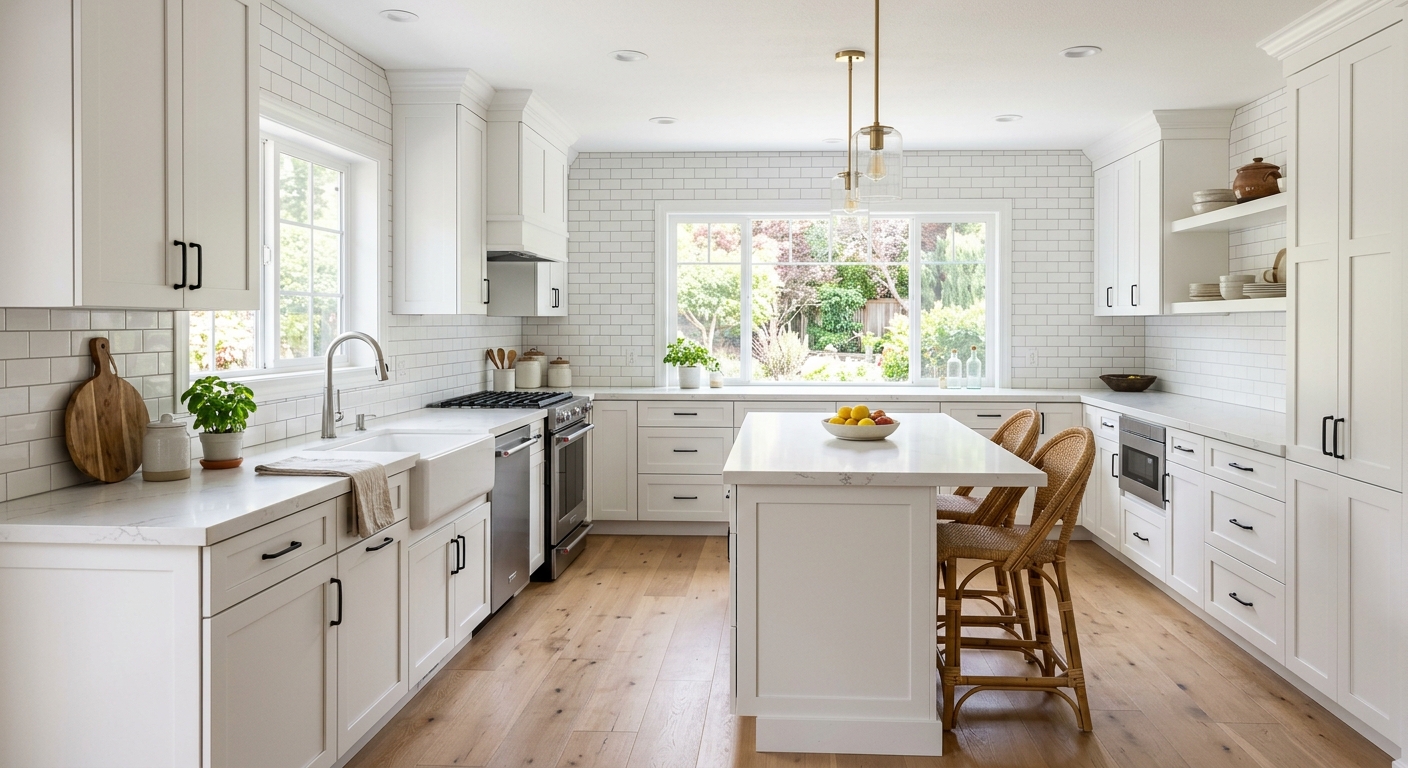
Kitchen renovation costs in Lower Swatara — 2026
Lower Swatara homeowners face a distinct set of kitchen renovation costs shaped by the area’s stubbornly high homeownership rate (85.1%) and a median household income of $80,837 (U.S. Census Bureau, ACS 2024). These factors mean most updates are owner-occupied decisions aimed at long-term benefit—less cutting corners, more careful planning. The housing stock is split: almost half of local homes were built before 1980, especially in the postwar 1945–1975 subdivisions. Many of these kitchens are small and galley-style, originally sized for simpler appliance setups and less open floor plans. In these houses, meaningful improvement usually means moving walls, plumbing, or electrical—not just swapping cabinets and counters.
The biggest mistake in kitchen planning is pricing out a basic replacement and then “just adding” features from a more complex remodel. The difference isn’t incremental—it often doubles the price and triples the scope. Homeowners consistently overestimate the amount they can control cost with design tweaks and underestimate the expense of moving fixtures, code upgrades, and addressing what’s behind the walls.
Here’s what local kitchen renovation projects look like by scope, what’s included, and how much time and money you should realistically allocate:
| Scope | What's included | Duration | Price range |
|---|
| Full gut remodel, same layout | cabinets, counters, appliances, flooring, lighting, fixtures | 6–10 weeks | $30,000–$120,000 |
| Gut plus layout change | all of the above plus moved plumbing, electrical, walls | 10–16 weeks | $65,000–$120,000 |
| Cabinet replacement (stock to semi-custom) | remove and install cabinets, hardware, patching | 1–3 weeks | $7,000–$30,000 |
| Cabinet refacing | new doors and drawer fronts, veneer, hardware | 3–6 days | $7,000–$20,000 |
| Countertop replacement only | template, fabricate, install, reconnect sink | 1–3 weeks | $4,000–$16,000 |
| Kitchen flooring only | remove existing, install new flooring | 3–6 days | $5,000–$20,000 |
Estimates for a typical Lower Swatara kitchen. Cabinet grade and whether the layout changes move these figures more than square footage.
The real timeline for a Lower Swatara kitchen
Many Lower Swatara homeowners are caught off guard by the true duration of a full kitchen renovation, especially when most kitchens here date back to postwar construction with layouts that now need significant work. Even a straight cabinet swap in a 1950s galley kitchen can stretch out if the room isn’t square, but full gut jobs with new layouts are on another level entirely. The process—and its delays—are dictated by the order and timing of each step, not just total workdays. The kitchen remains out of commission for weeks, even when everyone is moving swiftly.
The clock starts with design and measurement, followed by ordering the cabinets. This is not negotiable; cabinet orders in Lower Swatara usually take 6–9 weeks for anything semi-custom, slightly faster for stock. The mistake people make is waiting to order cabinets until after demolition and discovery. Instead, plan, measure, approve, and order cabinets before demolishing anything. Once delivered, demolition begins, then rough plumbing and electrical changes are made, followed by inspections—usually handled by local Dauphin County third-party agencies, not town staff.
Next are cabinet installation and, crucially, the countertop template. The template cannot be taken from plans or guesses: it happens once the base cabinets are set and leveled. Countertop fabrication takes another 1–2 weeks. This lag—a dead period with no countertops, no sink, and often no stove—catches almost every homeowner off guard.
After the counters come in, everything else—backsplash, flooring, painting, lighting, and trim—moves quickly. But the critical path is always cabinets and counters. That single week of empty waiting room is just as real in Lower Swatara as anywhere, and knowing about it in advance means less frustration and less panic.
How a Lower Swatara kitchen budget breaks down
In Lower Swatara, a kitchen renovation budget is often a reality check. Homeowners here, facing pre-1980 builds with non-standard walls or galley layouts, quickly discover that cabinetry is always the largest cost—and hard to dodge. Labour and installation follow, especially for work that involves moving infrastructure in older or original kitchens. Countertops are next, with their own pricing swings tied almost entirely to choice of material, followed by appliances, which can swing more than almost any other line depending on brand preferences.
Lighting, electrical, plumbing, and fixtures eat up a notable slice—expect costs to rise for homes needing new circuits or when plumbing runs are moved (again, common in our postwar homes). Flooring may be less if you’re dealing with a smaller footprint, but tile upgrades and tougher demo can push it up.
The two lines people forget: contingency—budget for what’s lurking behind the walls in any pre-1980 build—and soft costs like permits, design, delivery, and hauling away debris. Skipping these is a mistake. If you’re deciding where an extra amount should go, prioritize plumbing, electrical, or cabinets, not designer hardware or oversized appliances in a small space. High-end appliances in a kitchen with basic cabinets is almost always a waste.
| Category | Share of budget | Notes |
|---|
| Cabinetry | 25–35% | the largest line and the longest lead time |
| Labour and installation | 20–30% | rises sharply if the layout changes |
| Countertops | 8–15% | material choice drives the swing |
| Appliances | 10–20% | widest range of any category |
| Flooring | 5–10% | |
| Lighting and electrical | 5–10% | higher in older homes needing circuits |
| Plumbing and fixtures | 4–8% | |
| Permits, design, disposal | 3–6% | usually forgotten in early budgets |
| Contingency | 10–15% | not optional in a pre-1980 house |
Choosing cabinetry
In Lower Swatara, cabinetry sets your entire kitchen budget in motion. Most local homes run into wall irregularities or space issues from that heavy 1945–1975 postwar building boom—and that tips the scales toward semi-custom more often than owners expect.
Refacing is an often overlooked option. If the existing cabinet boxes are square, solid, and meeting your storage needs, skilled refacing gives a like-new look by swapping doors, drawer fronts, and covering exposed parts with veneer. You save thousands and a lot of disruption—but you cannot get more or better storage, nor can you change traffic flow, which is usually the real complaint with galley kitchens.
Stock cabinets are cheap, quick, and serviceable for unproblematic rooms, but they only come in set widths and heights. Expect to make up awkward gaps with filler strips, especially in older Swatara homes where room dimensions rarely match today’s standards. Finishes are limited. Semi-custom gives you more size and color options and fits the oddball walls that are everywhere in postwar subdivisions. Lead times stretch, but your kitchen fits and looks intentional. Full custom is for special needs—historic restoration, design statements, or truly awkward spaces—and usually not worth it for a typical home here.
Don’t let price tiers distract from actual cabinet quality: real plywood beats particle board for box sides, dovetail beats stapled drawers, full-extension soft-close hardware is worth the slight upcharge, and frameless can work in tight kitchens by gaining half an inch of drawer width.
| Option | Cost | Best when | Limitation |
|---|
| Painting existing cabinets | $1,200–$3,500 | boxes and doors sound, tight budget | no layout or style change |
| Refacing | $7,000–$20,000 | boxes square and layout works | storage unchanged |
| Stock cabinets | $7,000–$30,000 | standard dimensions fit | filler strips, limited finishes |
| Semi-custom | $20,000–$30,000 | non-standard walls or finishes | 6–12 week lead time |
| Full custom | $20,000–$30,000 | unusual layout or high-end design | longest lead, highest cost |
What requires a permit in a kitchen renovation
In Lower Swatara, permits are rarely needed for simple swaps: painting, refacing, or new flooring. However, any kitchen renovation that moves or installs new plumbing lines, adds or moves electrical circuits, changes walls, or significantly alters ventilation will need a building permit. These triggers are not minor: most meaningful remodeling in the area’s postwar kitchens falls into this category, especially if the goal is better flow or more storage. The plan review process in local municipalities like Lower Paxton requires showing where sinks, circuits, and lighting are going.
Electrical inspections in Dauphin County are commonly handled by approved third-party inspection agencies, not by a township or county inspector, which can mean faster scheduling but more rigorous paperwork. Always clarify who handles final inspection before work starts.
Contractor registration is mandatory for contracts over $500. Verify Home Improvement Contractor (HIC) registration at the Pennsylvania Office of Attorney General. For any employer performing the work, workers' compensation is required and publicly verifiable via WCAIS. If you ignore these steps, resale will become a nightmare—unpermitted work delays or kills closings.
Allowances, exclusions and change orders
The biggest trap in comparing kitchen quotes in Lower Swatara is misunderstanding allowances. An allowance is a placeholder sum—in the contract—for items not chosen yet (such as tile, lighting, or backsplash). Two bids can have similar bottom lines but wildly different outcomes if one carries a realistic tile allowance and the other only includes a rock-bottom placeholder. Always compare these lines in the written contract before caring about the big number.
Cabinet brand and construction details must be named, not just “quality cabinets.” Countertops should specify material, thickness, edge profile, and seam location. Be certain unforeseen conditions—rotted framing, hidden electrical—are covered, not just ignored.
Change orders, when surprises arise, should always be written and signed before work continues, not a handshake. Payment schedules need to tie to project milestones: not calendar dates. Lien waivers from subs at every payment are a must, so you never pay twice for the same work.
In Pennsylvania, any kitchen contract over $500 must be written, and you have a three business-day right to cancel under the Home Improvement Consumer Protection Act. Never accept verbal terms.
| Line item | What to look for | Red flag if… |
|---|
| Allowances | realistic amounts, itemised | round numbers with no basis |
| Cabinetry | brand, line, box construction | 'quality cabinets' |
| Countertops | material, thickness, edge, seams | material name only |
| Electrical | circuits to be added, GFCI scope | 'as needed' |
| Unforeseen conditions | how they are priced and approved | not addressed |
| Change orders | written approval before work | verbal |
| Payment | milestone-based, modest deposit | front-loaded |
| Lien waivers | from subs at each payment | not offered |
Circuits, GFCI and code compliance
Kitchens in Lower Swatara’s pre-1980 homes often surprise owners with the scale—and cost—of required code upgrades. Current code expects every kitchen to provide dedicated circuits for all countertop receptacles (small-appliance circuits), GFCI outlets for everything near the sink, 4’ maximum spacing between outlets, and dedicated circuits for the dishwasher, garbage disposal, and microwave. Electric ranges require their own 240-volt line. Most kitchens from the 1945–1975 boom have fewer circuits, some still ungrounded, and nearly all lack adequate GFCI protection.
Once the walls are open, permitted work is inspected against current code requirements—not the code in effect when the house was built. If your panel lacks enough open spaces or grounds, or if aluminum wiring is present, expect to upgrade more than just the kitchen. This is the most common surprise that pushes mid-project budgets upward, especially in postwar galley layouts that weren’t designed for modern appliances. Even late 1990s homes in Lower Swatara can come up short on circuit count by today’s standards. Realistically, budgeting $5,000–$15,000 for full electrical upgrade work is common for this market, especially where panels or wiring need expansion or replacement.
Frequently asked questions — kitchen renovation in Lower Swatara
Is lead paint a concern in Lower Swatara kitchen renovations?
Yes, lead paint should be considered whenever a Lower Swatara kitchen renovation involves a home built before 1978. Nearly half (47%) of local homes fall into this category, according to the U.S. Census Bureau, ACS 2024. The federal EPA Lead Renovation, Repair and Painting (RRP) Rule applies, so contractors disturbing paint-covered surfaces are required to be EPA certified. This protects your household and ensures safe cleanup of dust and debris. Always verify contractor certification via the EPA registry. Testing is inexpensive and can be included in initial assessments. While containment adds a bit of time and cost, it’s critical for safety. For projects where disturbing old surfaces is unavoidable, such as a full gut beginning at $30,000–$120,000, lead-safe practices are non-negotiable.
Should I hire a general contractor or a kitchen firm?
It depends on your project’s scope, but in Lower Swatara, specialized kitchen firms handle the majority of renovations efficiently—especially if the work involves standard layouts or modest updates. For a postwar kitchen needing walls moved, plumbing and electrical rerouted, or major structural updates, a general contractor (with their own HIC registration and workers' compensation) can be worth the coordination and accountability. However, for straightforward cabinet and counter upgrades, a reputable local kitchen company is often less expensive and just as effective. Check that any firm, regardless of type, is registered with the Pennsylvania Office of Attorney General for all jobs over $500. The written contract and consumer protections are the same in both cases by law.
What happens if previous work was unpermitted?
Unpermitted work is a major issue at resale in Lower Swatara and the rest of Pennsylvania. Most home sales now require you to disclose unpermitted remodeling under the Home Improvement Consumer Protection Act, and appraisers or home inspectors will flag missing permits. Municipal code offices or third-party electrical inspectors can require expensive “as-built” permits or even removal and redo of unapproved work. If found, you may have to pull permits retroactively—sometimes opening walls—to confirm code compliance. This can cost as much or more than doing it right the first time. If the kitchen remodel was in the $30,000–$120,000 range and didn’t touch infrastructure, the fix may be paperwork. For plumbing or electrical changes, it nearly always requires fees, inspection, and possibly fines.
How much more does moving the sink and range cost?
In a typical Lower Swatara home, shifting the sink or range is the dividing line between a simple upgrade and a major renovation. Moving plumbing means running new supply and drain lines, opening walls and possibly floors. Shifting a range means relocating gas or rewiring for 240-volt service. Each move typically increases the project cost by $5,000–$15,000 on top of base scope, depending on access to crawlspaces, floor joist direction, and local inspection requirements. Often, the total project jumps into the “gut plus layout change” band, which runs $65,000–$120,000. You should not make these changes unless they truly solve a key problem, because the added cost and permitting requirements are significant.
What does a quartz countertop cost in Lower Swatara?
Quartz countertops are a popular upgrade for Dauphin County homes and are well suited for galley and mid-sized kitchens common in Lower Swatara. Expect a full countertop replacement project—including removal, templating, fabrication, cutouts, and sink reconnection—to fall between $4,000–$16,000, with an average at the lower end for smaller spaces. The main factors are slab selection, edge treatment, and whether you want full-height backsplash. Ask specifically about material thickness and seam placement in your bid, as these details affect both cost and appearance. Avoid “lowball” per-square-foot quotes that omit removal or installation; always demand a total figure for the completed job.
Can I renovate a kitchen in stages?
Many Lower Swatara homeowners spread kitchen renovations in stages for budget reasons, especially on homes built before 1980. For example, you might replace flooring first (at $5,000–$20,000), then handle cabinets and counters later. This approach is possible but comes with downsides: double labor costs on trim and transitions, potential for new materials to get damaged, and difficulty matching finishes across separate phases. If you must break up the work, plan sequence carefully and stick with neutral, timeless choices early on. Avoid moving utilities or big fixtures twice—it quickly adds up. In most cases, grouping messy or structural work in the first phase is the smarter route.
What are cabinet lead times in Lower Swatara right now?
Cabinet lead times in Lower Swatara depend on what you order and the labor market, which sometimes pulls crews from York and Lancaster to cover local demand. As of 2026, stock cabinets often arrive in 2–4 weeks, but semi-custom orders take 6–9 weeks, and full custom can stretch even longer. The earlier you finalize designs and place your order, the smoother your project will run. Do not remove existing cabinets until your shipment date is confirmed; downtime waiting for cabinets can be a frustration with small kitchens, especially if you misjudge delivery dates. For a standard cabinet replacement project at $7,000–$30,000, expect at least a month’s advance planning on materials alone.
Should I renovate before selling or let the buyer do it?
Whether to renovate your Lower Swatara kitchen before selling depends on current condition and market trends. Full gut remodels seldom return 100% of their cost ($30,000–$120,000), but dated, visibly worn, or non-functioning kitchens will reduce your selling price more than the basic cost of fresh cabinets or counters. Buyers here are mostly owner-occupants who want a move-in ready kitchen, not a project. A well-executed moderate refresh (cabinet refacing, new counters) is often enough for a solid sale without risking a full-scale remodel investment. Walking away from necessary repairs or obvious problems often leads buyers to demand concessions larger than the cost to fix them. Consult your agent: sometimes less is more.
What is the difference between stock and semi-custom cabinets?
Stock cabinets in Lower Swatara are off-the-shelf products made in set sizes and finishes, delivered quickly and at lower prices—ideal if your kitchen is standard in layout and dimensions. Semi-custom cabinets, by contrast, are built to order, offering flexibility in sizing, design details, and finishes. This is valuable in local postwar homes, where walls may not be perfectly square and storage needs vary. The gap in price is also a gap in fit and finish: stock cabinet projects (at $7,000–$30,000) will almost always need more filler strips and might compromise on hardware. Semi-custom (usually at the top of that range) fits better and provides tailored options but comes with longer lead times and higher initial cost. Choose semi-custom whenever your walls or storage goals aren’t standard—the results will show.