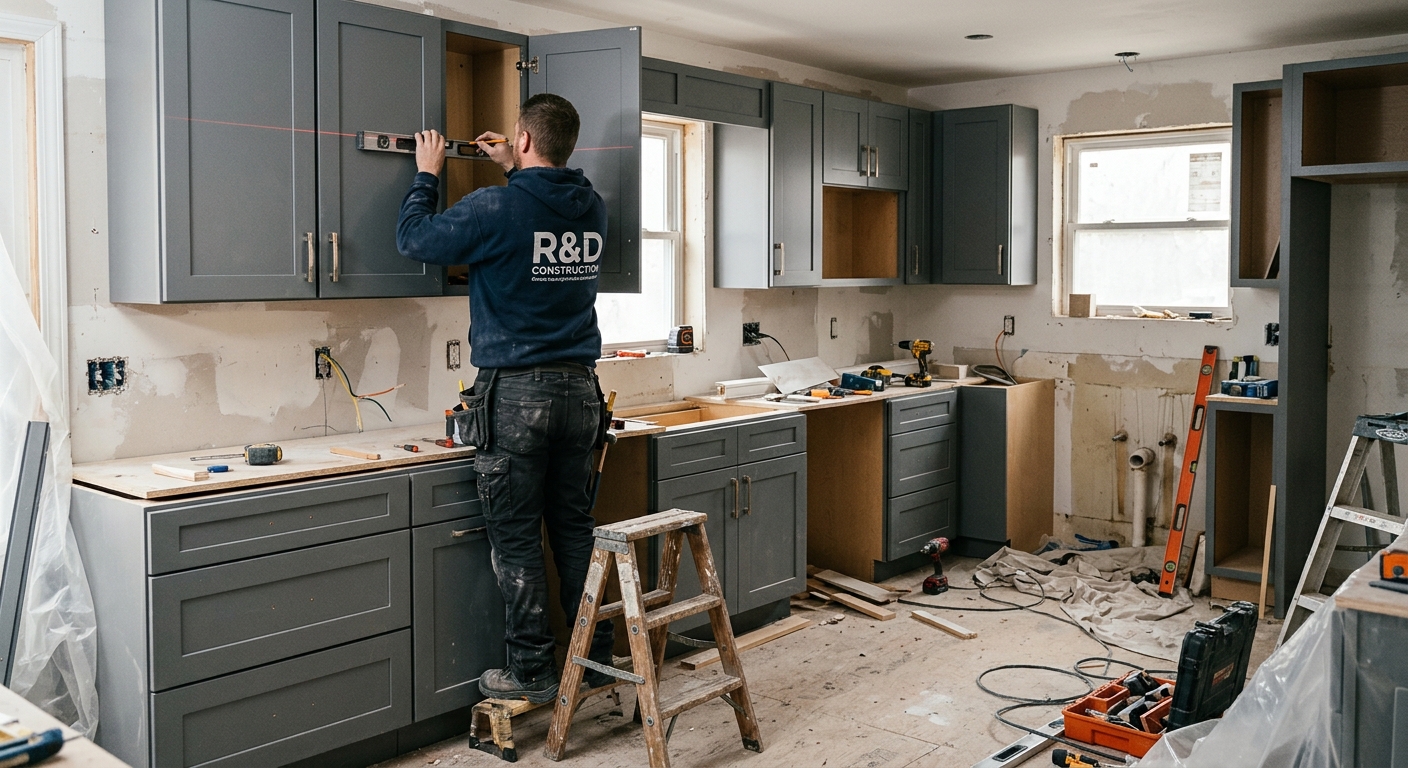
What a kitchen remodel costs in Downingtown
In Downingtown, a full kitchen remodel is a significant investment, and the cost-to-benefit calculation depends heavily on whether you plan to stay in your home or maximize resale. With a median household income of $74,323 and a homeownership rate of 52.9% (U.S. Census Bureau, ACS 2024), most Downingtown owners finance their remodel with careful attention to budget and return.
Many kitchens in Chester County towns like West Chester and Phoenixville date to the 1960s–1980s. This makes a huge difference for cost planning: the oldest kitchens were built for smaller appliances and often have cramped “galley” layouts, while anything updated after 1990 may only need modern surfaces, not walls moved. Layout changes or opening up to a family room add substantial cost, while keeping the layout and utilities largely in place keeps the project smaller and more predictable.
Most budget surprises come from pricing basic replacement and then tacking on the “dream kitchen” changes midstream. The biggest mistakes are deciding to move a wall or relocate the sink after the initial quote. Matching your scope to your budget from the beginning saves disappointment and cost shocks.
| Scope |
What's included |
Duration |
Price range |
| Full gut remodel, same layout |
cabinets, counters, appliances, flooring, lighting, fixtures |
6–10 weeks |
$33,000–$132,000 |
| Gut plus layout change |
all of the above plus moved plumbing, electrical, walls |
10–16 weeks |
$71,500–$132,000 |
| Cabinet replacement (stock to semi-custom) |
remove and install cabinets, hardware, patching |
1–3 weeks |
$7,700–$33,000 |
| Cabinet refacing |
new doors and drawer fronts, veneer, hardware |
3–6 days |
$7,700–$22,000 |
| Countertop replacement only |
template, fabricate, install, reconnect sink |
1–3 weeks |
$4,400–$17,500 |
| Kitchen flooring only |
remove existing, install new flooring |
3–6 days |
$5,500–$22,000 |
Estimates for a typical Downingtown kitchen. Cabinet grade and whether the layout changes move these figures more than square footage.
Why appliance selection comes first
In Downingtown, planning your kitchen layout before you’ve locked down your appliances is the quickest path to costly mistakes. Cabinet makers design fits and openings down to fractions of an inch; if you change refrigerator or range specifications after cabinets are ordered, you’re either living with filler strips or paying for a second round of carpentry. Start with appliances—always.
Standard-depth refrigerators stick out 4–6 inches past the countertop, while counter-depth models sit nearly flush. That changes adjacent cabinet runs and can affect the size and usability of a pantry or upper cabinets. Slide-in ranges place controls up front and need a countertop gap, while freestanding ranges do not—altering cabinet drawer arrangements on either side. Gas and induction cooking each have electrical implications: switching from gas to induction may require a new 240-volt line, which is a cost most Downingtown homes built before 1990 won’t already have.
Panel-ready dishwashers blend with cabinets, but require planned openings and custom panels, which can’t be retrofitted after installation. As for range hoods, venting to the outside is preferred—especially in households that cook regularly. Recirculating (ductless) hoods are a compromise and only reduce some odors; they don’t remove moisture or fine particulates.
Last point: Some sought-after appliances have longer lead times than cabinets—particularly specialty ranges and European refrigerators. If you wait until demolition is underway to order, you’re risking a schedule slip.
Comparing kitchen renovation bids in Downingtown
The first thing that trips up Downingtown homeowners comparing kitchen quotes is the “allowance.” An allowance is a placeholder value for an item—like tile, faucets, or cabinet hardware—which you haven’t selected yet. Bids can look identical in total dollars, but if one bid includes a $1,500 backsplash tile allowance and the other includes $300, they’re not comparable. Always compare allowance lines directly before looking at the bottom line.
Next, insist on specifics: cabinet brand and line (not just “quality cabinets”), specified countertop material and thickness, and clear direction on handling unforeseen rot or subfloor problems. Make sure change orders require written approval, not just a verbal go-ahead. Payment schedules tied to project milestones (e.g., after demo, after cabinet installation) are safer than heavy deposits before removal even starts. Lien waivers from subcontractors ensure no one sues you mid-project.
Pennsylvania requires a written contract for jobs over $500 under the Home Improvement Consumer Protection Act, giving you a three-business-day right of cancellation. Before signing, verify your contractor’s Home Improvement Contractor registration and workers’ compensation (see state registries listed below).
| Line item |
What to look for |
Red flag if… |
| Allowances |
realistic amounts, itemised |
round numbers with no basis |
| Cabinetry |
brand, line, box construction |
'quality cabinets' |
| Countertops |
material, thickness, edge, seams |
material name only |
| Electrical |
circuits to be added, GFCI scope |
'as needed' |
| Unforeseen conditions |
how they are priced and approved |
not addressed |
| Change orders |
written approval before work |
verbal |
| Payment |
milestone-based, modest deposit |
front-loaded |
| Lien waivers |
from subs at each payment |
not offered |
Circuits, GFCI and code compliance
The step that catches most Downingtown homeowners off guard is what happens behind the walls—especially with homes built before 1980. Current code expects dedicated 20-amp small-appliance circuits for your countertop plugs, GFCI protection anywhere there’s a chance of water contact, and a dedicated circuit for each of your dishwasher, disposal, and microwave. Electric ranges require a 240-volt line. New code spacing also means you’ll have a plug within 24 inches of any countertop edge.
But what’s actually in the walls of many West Chester and Phoenixville houses? Often, a single circuit running the whole kitchen, sometimes with ungrounded (two-wire) outlets or aluminium branch wiring—not to modern standards. Panels in houses circa 1960s have limited capacity, and adding four or five new circuits may mean a panel upgrade. None of this is optional: once your kitchen walls are open, inspections require all replaced wiring to meet the latest code, under Pennsylvania Uniform Construction Code (UCC) as enforced in your municipality.
Even a late-1990s kitchen often lacks the current circuit count. The cost to bring your kitchen electrical up to code—panel upgrades, new circuits, and GFCIs—typically falls in the $4,400–$17,500 band, depending heavily on existing conditions. It’s the most common budget shock, and, in Chester County, it isn’t avoided by skimping: inspectors won’t close out the permit until it’s made right.
Living through a kitchen renovation
Nobody likes to talk about the weeks spent without a real kitchen, but if you’re in Downingtown planning a full gut remodel, this is the honest inconvenience. You’ll need a temporary kitchen—fridge somewhere else, a folding table with a microwave and kettle, and probably running to a bathroom or basement sink for dishes. Most people discover their grocery and takeout costs jump: expect to spend more eating out over a long project (the total is often higher than the new floor itself).
Dust will travel. Good contractors seal off work zones with plastic and zip walls, but even so, fine debris makes its way into drawers and onto furniture. The dumpster and deliveries will claim a chunk of your driveway; ask ahead how and when crews plan to use your space. The door will be propped open on demo and delivery days—plan for pets or bolting cats and dogs.
Some homeowners do move out for the noisiest, dustiest week—especially if you’re sensitive to disruption or have kids and pets who won’t tolerate mess. But most stay. The better you plan where to stage your essentials, the easier the downtime.
Budget for meals out: weeks with no real kitchen add up—figure roughly what you’d spend on takeout for your whole household for as long as your kitchen is offline. It’s a real project cost.
Quartz, granite, laminate or butcher block
The right countertop for your Downingtown kitchen depends on how you cook, clean, and live day-to-day—not what looks nice in a showroom. Quartz is engineered stone, non-porous, and won’t stain, but it’s not fully heat-proof: set down a hot pan and you risk discoloration or cracking. Granite is durable and heat-resistant, but needs resealing every year or two to stay stain-resistant, especially in the humid Pennsylvania summer.
Laminate, long derided, is actually a strong choice for a modest kitchen or a durable rental—modern versions resist stains and scratching surprisingly well, and they’re the easiest to repair if you do chip an edge. Butcher block is warm and friendly, but it demands oiling and will stain and scorch if you’re not careful. Solid-surface tops (like Corian) can be refinished and re-seamed if nicked or scratched; seams are the most visible with patterns and darkest with granite, least so with solid color quartz or solid-surface.
The fabrication side matters: fancy edges, undermount sink cutouts, or extra holes for soap dispensers add cost. A precise template visit is key—measurements alone don’t catch all the out-of-square quirks in older Chester County houses. Where possible, limit seams in high-use areas like between the sink and range.
If you own a rental or want to keep your costs in line, don’t feel pressured: laminate, in a well-installed Downingtown kitchen, is no compromise. It’s tough, cleanable, and doesn’t require seasonal upkeep.
Permits and inspections for a Downingtown kitchen
Permitting for kitchen projects in Downingtown depends strictly on what’s being done. Cosmetic changes—paint, new cabinet hardware, door and drawer refacing, or swapping a countertop without moving it—typically do not require a permit in West Chester or Tredyffrin Township. However, as soon as you add or move electrical circuits, plumbing lines, or alter any structural wall, you’ll need a permit. West Chester Borough specifically requires plan review if you’re changing structural elements or any mechanical, electrical, or plumbing systems.
Electrical inspections here are often done by third-party agencies such as United Inspection Agency, not the township itself. This surprises many homeowners, but it’s standard practice throughout West Chester and West Goshen Township. One more reason to make sure your contractor understands the local process—and isn’t skipping mandated steps.
Every contractor must be registered with the Pennsylvania Office of Attorney General for projects above $500—double check their number at hic.attorneygeneral.gov. All employers on your jobsite should also carry workers’ compensation (verify through WCAIS at wcais.pa.gov).
The local market is strict: unpermitted work can become a resale headache, delaying or even derailing a home sale if the title company discovers additions or modifications done without the right inspections. Have your paperwork in order.
Frequently asked questions — kitchen renovation in Downingtown
What is an allowance in a renovation quote?
An allowance is a placeholder amount in your estimate for items not fully specified yet—common examples are backsplash tile, cabinet hardware, or lighting fixtures that you haven’t picked out. In Downingtown, this can swing the bottom line by thousands. Let’s say your bid includes a tile allowance of $1,000; if you end up picking something closer to $2,500, that overage comes straight out of your pocket after the fact. Always check that the allowance amounts match what you expect to spend, not just the total bid number. Carefully compare these lines between quotes—this is often where the real difference hides. In Pennsylvania, clear allowance documentation is part of the required written contract.
Why is there a gap after cabinets are installed?
That gap you sometimes see after cabinets have been set in a Downingtown kitchen renovation isn’t a mistake—it’s left for the countertop installation. Temples and seams in older Chester County homes are almost never perfectly square, and precise stone countertops (like granite or quartz) get measured after cabinets are firmly anchored. The 1/8"-1/2" space behind or beside a cabinet lets the fabricator measure for an accurate fit, compensating for walls that may bow or floors that may slope—a common reality in our area’s 1960s–1980s construction. This sequencing prevents expensive scribing and awkward patches. After countertops are set, the gaps are covered or filled neatly, giving a clean, finished look.
Why are kitchen quotes in Downingtown so far apart?
Kitchen estimates in Downingtown range widely—sometimes from $33,000 to $132,000—because of differences in labor rates, the scope of work, and (most often) in how products and allowances are specified. The high contractor density on the Main Line means you’ll see both volume operators using lower allowances and boutique builders specifying premium lines. Another factor: old houses here often conceal electrical or plumbing surprises, and some bids include a real contingency while others don’t. Be sure to compare the actual allowance and scope lines, not just the total price, before choosing a contractor.
Can I over-improve for my Downingtown neighbourhood?
Yes, you definitely can. Downingtown has a range of home values and, with a median household income near $74,323, it’s easy to spend more on a kitchen than you’d recoup at resale—especially if you choose the highest-end cabinets or luxury appliances. If you’re planning to move within five years, a mid-price full gut remodel in the $71,500 range is already above what many Main Line buyers expect for homes built in the 1960s–1980s stock. Match your scope and materials to homes in your price band and what buyers in Chester County want, not just the catalogs.
Are Downingtown kitchens typically small galley layouts?
Many homes in Downingtown—especially those built before 1980—do have smaller, galley kitchens. According to recent surveys, over 73% of the local housing stock predates 1980 (U.S. Census Bureau, ACS 2024), meaning cramped layouts are common. Owners frequently opt for layout changes to open the kitchen to living or dining spaces, which is why full remodels with layout adjustments are common here. Expanding a galley kitchen to a more open plan will push the cost into the higher band, from $71,500 up to $132,000, especially if plumbing and electrical need to move.
How much do new kitchen cabinets cost in Downingtown?
New cabinets are often the single largest material expense for a Downingtown kitchen renovation. Stock to semi-custom cabinets typically cost between $7,700–$33,000, depending on the number of cabinets, finish, hardware, and whether installation requires patching up old walls. Most projects land right around $22,000 for a “typical” Chester County kitchen. Custom lines, intricate details, or upgrades like pull-out pantry cabinets or specialty organization systems will push costs upward. If your current cabinets have a sound structure, consider refacing at the lower-end of the band to save money.
Is laminate countertop a bad choice?
Laminate countertops aren’t a bad choice for Downingtown kitchens, especially rentals or smaller spaces. They typically run from $4,400–$9,900 in installed cost—much lower than granite or quartz. Modern laminates can mimic stone or wood convincingly, are far easier to clean, and resist most stains and scratches from day-to-day use. Heat and sharp objects remain the weak spots, so if you do a lot of cooking or need to set down hot pans, quartz or granite are a better match. Laminate is a perfectly solid option for many Chester County homeowners on a budget.
Do I need to change my kitchen layout?
Not always. In Downingtown, keeping your kitchen’s existing footprint is the most cost-effective choice by far. A full gut remodel with no layout change usually runs $33,000–$71,500, depending on finish level. If your work triangle works and your kitchen connects well to dining or living space, cosmetic updates or cabinet replacements may be all you need. But if you’re working in a cramped 1970s galley or want to open things up to family space, the cost can escalate quickly. The best answer is to prioritize what doesn’t work and only change those layout features.
Can I cancel a renovation contract in Pennsylvania?
Yes. In Pennsylvania, all home improvement contracts over $500 must be in writing, and you have a three-business-day right of cancellation after signing under the Home Improvement Consumer Protection Act. If you’re undertaking a kitchen remodel in Downingtown, make sure your contract spells this out clearly. The three-day window starts once you receive a complete and signed copy of your contract. If you do cancel, send written notice within the time frame. This consumer protection is there for exactly this kind of major decision—use it if you have second thoughts or need more time for review before any real work begins.