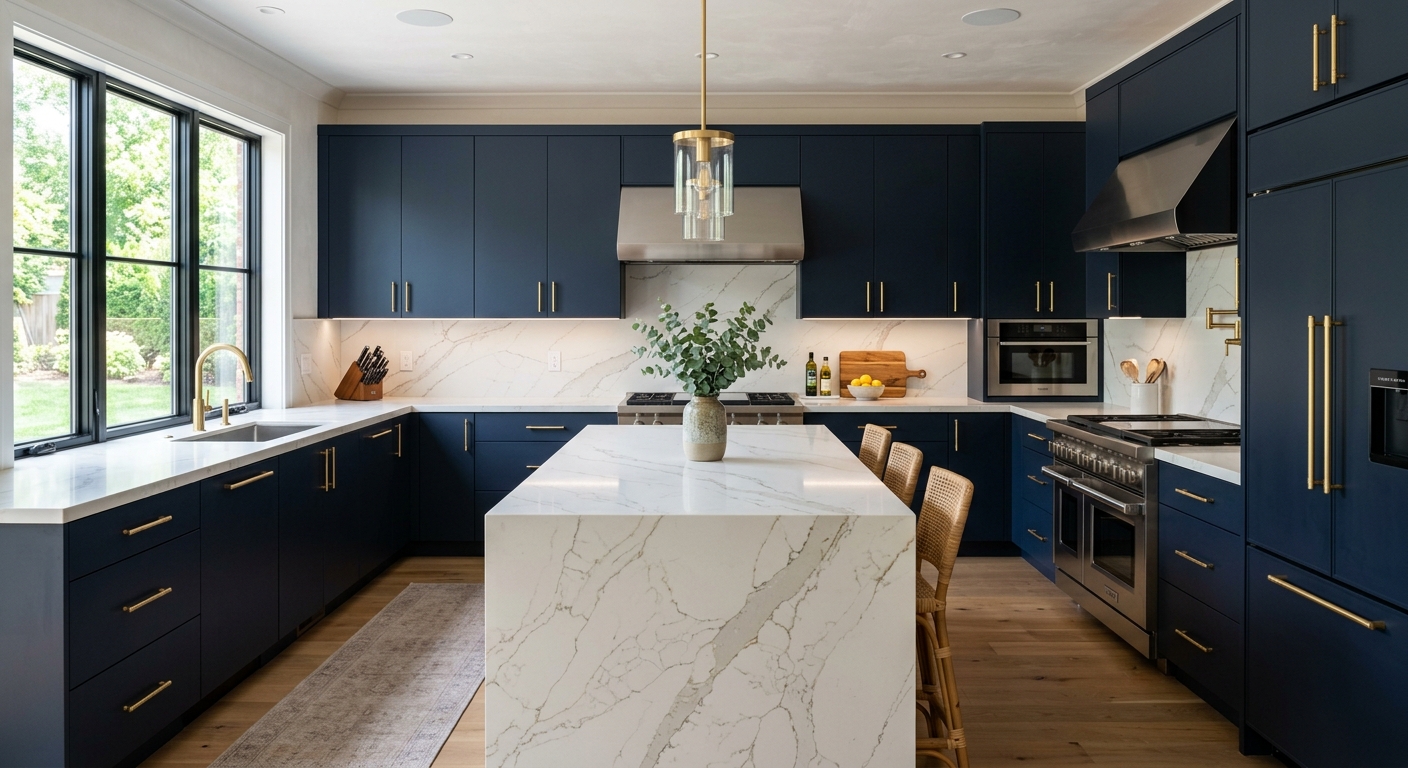
What a kitchen remodel costs in Wilkinsburg
Wilkinsburg’s kitchen renovation costs track closely with Pittsburgh metro pricing, but the calculation for most homeowners is shaped by the area's 30.0% homeownership rate and a median income of $46,013 (U.S. Census Bureau, ACS 2024). With so many older homes—much of the local housing was built before 1940—gut renovations are common to open up small, compartmentalized kitchens. In contrast, a late-20th-century home may only need finish upgrades.
The widest cost swings happen when a project starts with the “pull and replace” scope (cabinets and surfaces, same layout) but ends up upgrading electrical or moving walls. This “scope creep” is the most common source of budget overrun—it’s easy to compare prices for dramatically different jobs without realizing it.
Below are typical costs and timelines for different project scopes in Wilkinsburg. Allowances and finish grades matter more than total square footage, and moving plumbing or changing layouts puts you in an entirely different price class.
| Scope |
What's included |
Duration |
Price range |
| Full gut remodel, same layout |
cabinets, counters, appliances, flooring, lighting, fixtures |
6–10 weeks |
$28,000–$113,000 |
| Gut plus layout change |
all of the above plus moved plumbing, electrical, walls |
10–16 weeks |
$61,000–$113,000 |
| Cabinet replacement (stock to semi-custom) |
remove and install cabinets, hardware, patching |
1–3 weeks |
$6,600–$28,000 |
| Cabinet refacing |
new doors and drawer fronts, veneer, hardware |
3–6 days |
$6,600–$19,000 |
| Countertop replacement only |
template, fabricate, install, reconnect sink |
1–3 weeks |
$3,800–$15,000 |
| Kitchen flooring only |
remove existing, install new flooring |
3–6 days |
$4,700–$19,000 |
Estimates for a typical Wilkinsburg kitchen. Cabinet grade and whether the layout changes move these figures more than square footage.
Code requirements for Wilkinsburg kitchens
In Wilkinsburg, code requirements for kitchen renovation are enforced under the Pennsylvania Uniform Construction Code (UCC), rooted in the International Residential Code. Most cosmetic upgrades—including painting, refacing cabinets, swapping out hardware, or replacing countertops in their existing locations—do not require a building permit. However, if your remodel involves relocating plumbing or electrical lines, adding new circuits, or changing structural walls, a permit is typically triggered. Installing a new mechanically vented range hood may sometimes also require a mechanical permit.
For kitchen projects that alter layout or structure, plan review is generally handled by the local municipal code office in Wilkinsburg. Electrical inspections may be performed by either municipal inspectors or, in some nearby suburbs, approved third-party inspection agencies—which can surprise homeowners expecting just one government authority.
Contractors performing work with a contract over $500 must be registered as a Home Improvement Contractor (HIC) through the Pennsylvania Office of Attorney General. Always verify registration at hic.attorneygeneral.gov. Employers must carry workers’ compensation insurance; you can check compliance through WCAIS (wcais.pa.gov).
Most importantly, if work that requires a permit is done without one, you may run into serious problems at resale—including being required to undo or redo the work to pass inspection. Relying on a contractor unfamiliar with Wilkinsburg’s requirements is a fast route to surprise costs and delays.
Allowances, exclusions and change orders
The biggest reason kitchen bids can’t be compared apples-to-apples is the allowance: a budget placeholder your contractor plugs in for things you haven’t picked yet (tile, fixtures, lighting, etc.). One contractor may put a realistic $30/sf for tile, while another sticks in $5/sf to make the total seem lower. Thousands of dollars of difference can hide here. Always ask for a detailed, itemized list of allowances and compare those before comparing grand totals.
Insist the cabinet brand and line are specified by name—"semi-custom" alone doesn’t mean anything. Countertop proposals should specify material, thickness, and edge details, not just "stone." Make sure the contract covers what happens if hidden water damage or electrical issues pop up and check if changes (change orders) require written approval. Payments should be milestone-based and align with work completed. For large jobs, ask for lien waivers from subcontractors at each payment—this protects you from unpaid supplier claims.
Under Pennsylvania’s Home Improvement Consumer Protection Act, any contract over $500 must be in writing, and you have a three-business-day right to cancel.
| Line item |
What to look for |
Red flag if… |
| Allowances |
realistic amounts, itemised |
round numbers with no basis |
| Cabinetry |
brand, line, box construction |
'quality cabinets' |
| Countertops |
material, thickness, edge, seams |
material name only |
| Electrical |
circuits to be added, GFCI scope |
'as needed' |
| Unforeseen conditions |
how they are priced and approved |
not addressed |
| Change orders |
written approval before work |
verbal |
| Payment |
milestone-based, modest deposit |
front-loaded |
| Lien waivers |
from subs at each payment |
not offered |
The real timeline for a Wilkinsburg kitchen
The real timeline for a kitchen renovation in Wilkinsburg rarely matches what new clients expect. Here’s the reason: after you finalize your design and pick out your finishes, the largest variable is the lead time for cabinets and countertops. In Allegheny County, saturated contractor demand means cabinet factories and countertop fabricators are often booking several weeks out. Until cabinets actually arrive, nothing can proceed. If you wait to order cabinets until after demo, your kitchen sits empty for a month or more—a common and very avoidable headache.
The typical sequence goes like this: design and selections, site measurement, ordering cabinets and special-order items, demolition, rough-in work (plumbing, electrical, any framing), rough inspection, then cabinet installation. Only after base cabinets are in can your countertop be templated, since fabricators require final installed cabinets to measure. There is always a dead period—a week, sometimes two—waiting on countertop fabrication before installation, which is when the project can feel stalled.
Once counters go in, finishing steps like plumbing hook-ups, backsplash tile, flooring, and lighting finish out the job. In Wilkinsburg, higher labor demand can stretch each of these phases a little longer as finishing trades book up. To avoid costly gaps, coordinate your material orders early, and always order cabinets before you start teardown.
Layout changes and the cost cliff
If there’s one place Wilkinsburg homeowners lose their budgets, it’s underestimating what layout changes mean. Keeping cabinets, sink, range, and wiring where they are keeps you in one price range. Move even one plumbing line or chase an outlet into a new wall, and you jump to another class altogether. It’s not just the material or distance—relocating a sink or dishwasher means drain lines need precise slope, which in these older homes can get tricky if your kitchen sits above finished space or a concrete slab. New electrical circuits may require panel upgrades, especially with pre-1940 wiring in so much of the housing stock.
Removing or moving walls means determining if they’re load-bearing—and if they are, you have to bring in an engineer and pull permits. Relocating a range brings its own challenge: vent hood ducting to the exterior, meaning a new wall or roof penetration and more code review.
The honest assessment: ask yourself if the old layout is truly unworkable, or just unfashionable. You can spend a great deal of money moving a sink four feet—and in Wilkinsburg, moving from a full gut in the same layout $28,000–$113,000 to a gut remodel with layout changes $61,000–$113,000 nearly doubles your minimum project cost. Even if a new layout is what you want, you owe it to yourself to know what the jump really buys you. Permit and plan review are a fact of life for these changes, and they drive both cost and schedule.
Does a kitchen renovation pay back in Wilkinsburg?
The straight answer for Wilkinsburg: a well-renovated kitchen helps your house sell faster and for more, but it doesn’t guarantee full return of what you spend—especially if you go above midrange. Most buyers here are working within a budget, and Wilkinsburg’s median household income of $46,013 means a $100,000 kitchen simply doesn’t pencil for resale. If you spend at the top of the range, don’t count on recovering the difference.
Your goals matter. Renovating to sell is about broad appeal, neutral colors, and spending on visible items—think new counters and cabinets, not luxury upgrades or complex layout changes. Midrange projects, often in the $28,000–$61,000 band, usually return a higher percentage of your investment than going all-in. If the renovation is for your own use over the next decade, different rules apply—comfort and daily enjoyment have real value that won’t show up on a sales sheet.
In short: renovate for your life or renovate to sell, but set your budget by what’s sensible for your part of Wilkinsburg, not the high end of the market.
Cosmetic, replacement, gut, or layout change?
Calling something a “kitchen remodel” in Wilkinsburg can mean upgrading a faucet—or gutting everything to the studs and building a new room. Here are the four tiers to help you frame your project before you call anyone:
- Cosmetic refresh: Paint, hardware, new backsplash, lighting. No cabinets or layout change. This is affordable, fast, and a good fit for prepping a rental or quick sale.
- Pull and replace: New cabinets and counters, keeping the same footprint. Plumbing and electrical stay where they are. For most 1980s–90s kitchens, this is all you need, and costs are predictable.
- Gut, same layout: Everything down to the studs. All services are updated in place, but no walls moved. Necessary in much of Wilkinsburg’s aging housing, especially where there’s old wiring or water damage.
- Layout change: Walls, plumbing, or structure moved. This is where the cost leap happens. Plan review, engineering, and all new services come into play.
The true “cost cliff” is between gutting and changing layout: moving the sink or range triggers both code enforcement and a different contractor echelon, which is why layout questions can nearly double project price. Know your tier before calling contractors—a good estimate needs a clear scope, and no reputable pro can give a firm number until you’ve decided where you land within those four.
Frequently asked questions — kitchen renovation in Wilkinsburg
Should I renovate before selling or let the buyer do it?
For most homes in Wilkinsburg, a modest renovation before listing pays off in speed and buyer interest, but over-renovating won’t bring a big premium. If your kitchen is functional but dated, a cosmetic refresh—paint, lighting, fixtures, maybe new counters—offers good return and keeps spending in the $3,800–$15,000 band. Complete gut remodels can run $28,000–$113,000 and exceed what most buyers are willing to pay, especially given the local median income of $46,013 (U.S. Census Bureau, ACS 2024). Neutral finishes and mid-range quality sell kitchens here; letting buyers do their own thing risks a price discount if your kitchen is truly obsolete, but most value is in showing a clean, move-in ready space. Avoid custom splurges—save that for renovating to live, not to sell.
How much does a kitchen renovation cost in Wilkinsburg?
Kitchen renovation costs in Wilkinsburg span a wide range, depending on scope. A cosmetic update like painting cabinets, new hardware, and lighting can land below $6,600. Full cabinet replacement and finishes, without layout changes, generally runs $6,600–$28,000. If you’re gutting the space and keeping the layout, expect $28,000–$113,000. The cost climbs steeply if you change layouts, move plumbing, or add circuits—then you’re looking at the upper half of that range. Cabinet grade and the age of the home matter more than square footage. Since much of Wilkinsburg’s housing stock is pre-1940, surprises during demolition are common, so build a contingency into your budget.
What does a full gut kitchen remodel cost in Wilkinsburg?
For a complete gut renovation in Wilkinsburg, where everything is demoed down to the studs and rebuilt—cabinets, counters, flooring, appliances, lighting, and plumbing—the typical price band is $28,000–$113,000. Most projects with no layout change are grouped around $61,000. The high end of this range covers specialty finishes, all-new appliances, and complex site conditions, which are more likely in the area’s older homes. If you also move walls, plumbing, or the range location, plan for the higher half of the range. Structural changes require permits and will trigger plan review with the local code office, which adds to both time and cost. For most owner-occupied Wilkinsburg houses, a careful scope keeps costs under control.
What is the cheapest way to update a Wilkinsburg kitchen?
If your kitchen layout works but the finishes are tired, a cosmetic refresh is the most cost-effective move in Wilkinsburg—think paint, replacing hardware and lighting, and sometimes refacing cabinet doors. These improvements often fall under $6,600. Countertop replacement for laminate, butcher block, or entry-level stone comes in around $3,800–$8,500. Since many older Wilkinsburg homes have solid wood cabinets, a quality refacing job at $6,600–$19,000 may make better sense than full replacement. Only spend on a complete gut if you’ve got severe deterioration or are reconfiguring the room. Cosmetic work doesn’t need a permit and will show well to buyers or tenants.
Are Wilkinsburg kitchens typically small galley layouts?
Yes, much of Wilkinsburg’s housing was built before 1940, during a period when kitchens were separate, compartmentalized rooms—so you’ll often find compact galley or U-shaped setups. This is why full gut renovations are so common here: owners want to open up walls, gain more workspace, or improve the connection to dining and living areas. If your kitchen has a workable footprint and you can live with the layout, updating finishes is cost-effective. If you’re looking to reconfigure a tight galley, plan for higher costs (starting at $61,000–$113,000) since moving walls and services in older homes is major work. Always check for structural or mechanical complications behind those plaster walls.
What countertop material is best for a family kitchen?
In Wilkinsburg, durability, ease of cleaning, and value matter most. Quartz is popular for families because it’s nonporous, resists stains, and comes in a huge range of styles. Granite is another solid option—less forgiving to install at old, uneven walls, but very tough. Laminate remains cost-effective for those on a tight budget, with installations typically running $3,800–$8,500. Quartz installations often land just below the typical countertop band of $8,500 for small-to-average kitchens. For vintage homes where quirks are common, discuss seam placement and supports with your contractor. Stay away from high-maintenance materials (like marble) if you’re after low-fuss, family-friendly longevity.
Do I need a permit for a kitchen renovation in Wilkinsburg?
No permit is usually needed for straightforward cosmetic upgrades in Wilkinsburg—painting, hardware swaps, basic tile, cabinet refacing, and straightforward countertop replacement don’t trigger code review. But as soon as you move plumbing or electrical lines, relocate appliances, or remove a structural wall, a permit is typically required under the Pennsylvania Uniform Construction Code. Structural or major mechanical scope means plan review as well. Electrical work may be inspected locally or by an approved third-party agency. Kitchens in older Wilkinsburg homes frequently uncover wiring or structural surprises, so plan ahead if you’re gutting or changing the layout. Getting the right permits is critical for resale; unpermitted work can mean inspection failures and forced corrections when selling.
What is a change order and how should it work?
A change order is a written amendment documenting any change to the original kitchen renovation contract once work has begun—say, if you upgrade your counter pick or discover hidden water damage. In Pennsylvania, including Wilkinsburg, you should never proceed with extra work until both parties sign a clear change order stating what’s changing and the price impact. Verbal agreements are risky and do not protect you. Make sure your contractor’s process pauses work for written approval, not just a text or call, and that any new cost is tied to your payment schedule. Contracts over $500 require written terms by law. If you don’t see a clear change order process in your contract, ask up front—this is where many Wilkinsburg budget overruns start.
How far ahead should I book a contractor in Wilkinsburg?
Wilkinsburg, as part of the Pittsburgh metro, sees steady demand for good kitchen contractors and trades, especially during spring and summer. Plan to book 2–4 months in advance for a full gut remodel or a substantial cabinet replacement in the $19,000–$61,000 band. Cabinet lead times alone can stretch 4–10 weeks, depending on finish and manufacturer. If you wait until after demolition to place orders, your kitchen may sit idle waiting for delivery. For small cosmetic work, one to two months is common. Confirm your contractor holds a valid Home Improvement Contractor registration and stay flexible—the skilled finish labor market here is tighter than in outer counties, so last-minute bookings are rare exceptions.