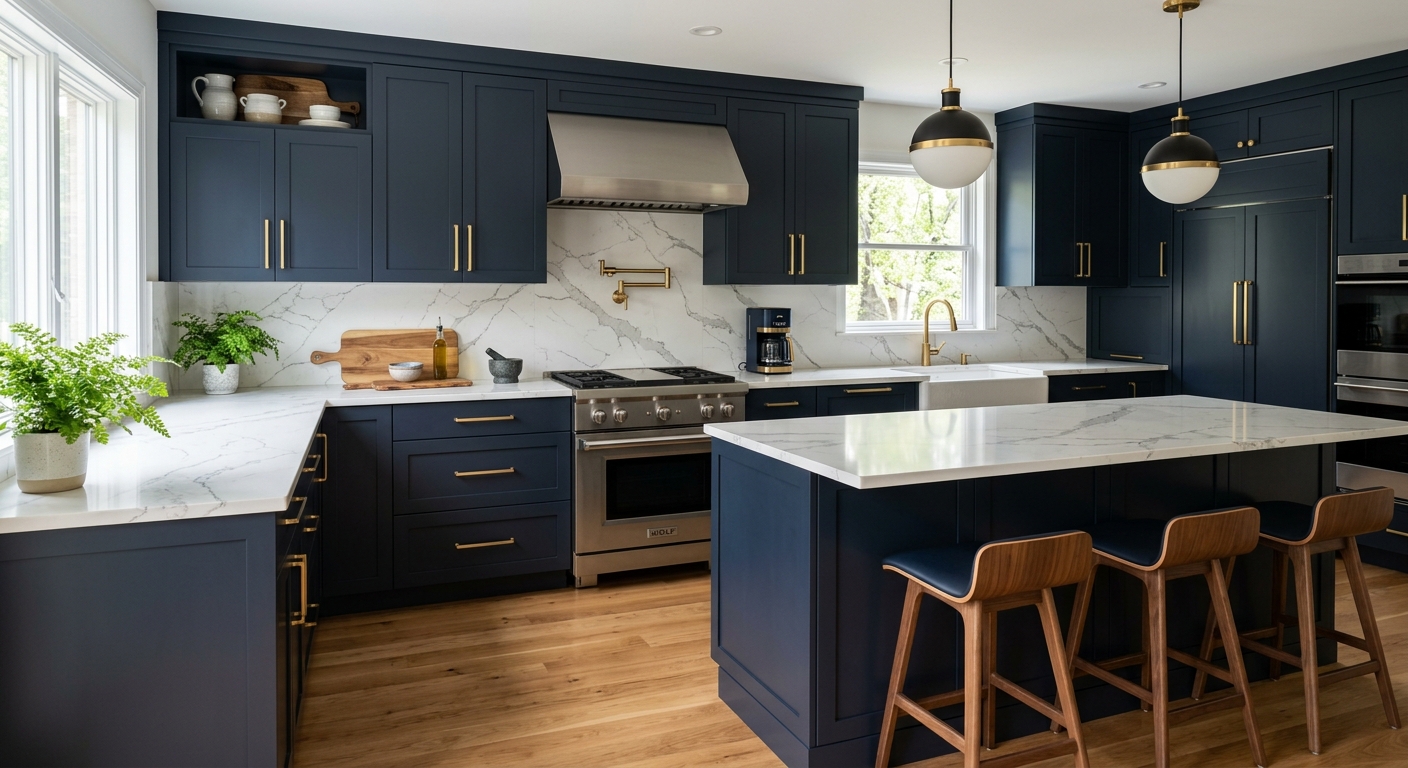
Upper Yoder kitchen renovation prices by scope — 2026
Upper Yoder’s kitchen renovation market tracks closely with how and when its homes were built, and who owns them. With a median household income of $68,603 and nearly three-quarters of homes owner-occupied (U.S. Census Bureau, ACS 2024), most projects are initiated by homeowners planning to stay, not landlords maximizing rent turnover. A kitchen from the 1900–1940 Johnstown or Westmont stock often lacks both space and modern layout, so “renovation” frequently means gutting, moving walls, or flattening slopes, not simply replacing doors.
Most blown budgets in Upper Yoder start by pricing a finish-only update, then discovering the need for “behind the wall” work after demolition. If your house still has knob-and-tube or cast iron buried under tile, you are simply not in the “surface only” tier, no matter what your first estimate says.
| Scope | What's included | Duration | Price range |
|---|
| Full gut remodel, same layout | cabinets, counters, appliances, flooring, lighting, fixtures | 6–10 weeks | $29,000–$115,000 |
| Gut plus layout change | all of the above plus moved plumbing, electrical, walls | 10–16 weeks | $62,500–$115,000 |
| Cabinet replacement (stock to semi-custom) | remove and install cabinets, hardware, patching | 1–3 weeks | $6,700–$29,000 |
| Cabinet refacing | new doors and drawer fronts, veneer, hardware | 3–6 days | $6,700–$19,000 |
| Countertop replacement only | template, fabricate, install, reconnect sink | 1–3 weeks | $3,800–$15,500 |
| Kitchen flooring only | remove existing, install new flooring | 3–6 days | $4,800–$19,000 |
Estimates for a typical Upper Yoder kitchen. Cabinet grade and whether the layout changes move these figures more than square footage.
Why the contingency exists
Upper Yoder’s kitchen projects run into surprise costs because so many houses—77.2%—were built before 1980. Gutting a kitchen in the 1900–1940 core means you’ll often find out-of-plumb walls and out-of-level floors. Correcting these is why cabinet installation can cost days of extra labor and shimming. You may also discover ungrounded wiring or an undersized panel; rewiring an older kitchen to meet code may add $3,800–$15,500 just in electrical work. Galvanized supply lines and cast iron drains, common in the area’s older stock, need replacing to avoid leaks—if your plumber opens a wall and finds these, budget for upgrades.
A lack of insulation behind an exterior wall in a prewar house isn't rare and adds cost if you want energy efficiency; blowing in insulation before closing walls can climb to four figures quickly. Old repairs, unpermitted work, or creative DIY solutions are also frequent, often needing correction to pass resale.
For pre-1978 homes, the federal EPA Lead RRP Rule applies. Testing for lead paint or asbestos flooring (typical in homes built through the 1970s) is required before disturbance. If found, safe removal adds cost, but skipping it is both unsafe and can create downstream problems at resale or with insurance. Newer suburban homes? The surprises trade off: think particleboard cabinets that droop, thin laminate counters, and circuit counts too low for today’s appliances, all tending to wear out at the same time.
What requires a permit in a kitchen renovation
Upper Yoder and nearby municipalities draw a pretty clear line: cosmetic work—changing cabinet fronts, painting, swapping a countertop onto existing cabinets—typically does not require a permit. The moment you start moving or adding electrical circuits, relocating plumbing, taking down (or adding) walls, or installing a mechanical range hood that alters ductwork, a permit is almost always needed. In the City of Johnstown, even minor electrical or plumbing relocations usually trigger a building permit. Full-gut remodels that rework structure require formal plan review before any work can begin.
After application, your project is inspected. In many Cambria County municipalities, electrical inspections are not handled directly by the township but by third-party agencies such as Middle Department Inspection Agency. This outsourcing surprises some homeowners when booking inspections or getting final sign-off.
Your contractor must have a Pennsylvania Home Improvement Contractor (HIC) registration for jobs over $500—you can verify this at hic.attorneygeneral.gov. All employers must carry workers' compensation, checkable at wcais.pa.gov. These are state requirements that cover your risk as a homeowner, not a formality. Unpermitted work can prevent you from selling your home on time, or force expensive remediation if caught during a buyer’s inspection.
Resale value and kitchen spending
A freshly renovated kitchen in Upper Yoder almost always helps a house sell—outdated kitchens are easy for buyers to spot and cost them in negotiation. But a renovation rarely returns its full cost, and the further upgrades go beyond what’s typical for the neighborhood, the less likely you’ll ever see those dollars back.
The smart play for resale in Upper Yoder: mid-range finishes, classic colors, no extensive layout changes, and a spend that matches surrounding homes. With a median household income of $68,603 (U.S. Census Bureau, ACS 2024), over-improving—such as a $115,000 luxury kitchen amidst blocks of modest 1930s colonials—doesn’t return the excess.
If you’re renovating to sell, don’t chase luxury appliance brands or rare stones. Instead, ensure everything functions, looks fresh, and appeals to as wide a buyer pool as possible. If you’re renovating to stay, do what makes you happy to cook in your own house for years—ignore “resale value” except as a psychological brake on truly extravagant spending. Tailor your budget to how you’ll use the space, not someone else’s theoretical payoff.
Planning appliances before cabinets
Nothing crashes a schedule—or a homeowner’s mood—like finding out your fridge or range doesn’t fit into the cabinets you’ve just installed. In Upper Yoder, careful sequencing matters: appliances should always be planned (and ideally purchased or at least specified) before any cabinets are ordered or built. Cabinet openings are sized around appliance specs, not vice versa.
The main traps: Counter-depth fridges require deeper cabinets or panels and align flush with faces; going standard-depth after cabinetry is locked means the fridge will stick out. Slide-in or professional ranges dictate how counters end and backsplashes run—all decided before final cabinet drawings. Choosing induction or high-output gas ranges may require running a new 240V circuit or gas line, both easier and cheaper before drywall goes back up. Panel-ready dishwashers create a seamless look but need specific cabinet sizing.
On range hoods, venting outside is always more effective in removing cooking moisture and odors. Recirculating (ductless) hoods are only a compromise when venting isn’t possible. Professional-grade appliances look great but are usually about brand perception and style more than day-to-day function—quality mid-range appliances often offer 95% of the same performance at half the price.
Finally, appliance lead times can now outpace even custom cabinet orders, so lock in your choices before finalizing cabinetry, not after.
Three ways to organise the project
How you organize your Upper Yoder kitchen renovation makes more difference than your choice of cabinet finish. The three structural choices set your cost, your stress, and your control.
A design-build kitchen firm offers the highest cost and the least hassle—they design, supply, build, subcontract, and warranty everything under one contract. This is for those who want a single source of accountability and have the budget to match. Next is hiring a general contractor, where a GC coordinates each trade, pulls necessary permits, and keeps the flow moving. The GC option sits in the middle for price and homeowner involvement; you’ll likely work directly with a designer or cabinet source.
Owner-managed jobs—the budget route—mean you hire every trade and coordinate everyone yourself. This is not recommended unless you’ve got open time and a firm grasp on construction sequencing. With Cambria County’s thin finish-trade labor market, self-managing can mean long delays for subs and surprise costs if schedules slip. If your chosen scope will trigger a permit (moving plumbing, new circuits, structural changes), owner-management threatens both inspection headaches and timeline chaos unless you’re home during business hours.
How a Upper Yoder kitchen budget breaks down
Most homeowners are surprised when the price of cabinets alone dwarfs every other line—Cabinetry typically eats a quarter to a third of the entire project budget. Labor runs close behind, particularly in older Upper Yoder homes where nothing is square and every “simple” task takes extra hours. Countertops can stretch or shrink to fit the remaining balance, appliances swing wildly based on style, and flooring, lighting, and plumbing run smaller but necessary shares.
Homeowners often forget two major lines: contingency for what’s behind the walls (10–15% is essential in any house built before 1980), and soft costs like permits, design fees, delivery, and disposal. If you’re looking for ways to stretch an extra thousand dollars, put it into improved cabinet function (better drawers over shelves), more robust underlayment for flooring, or upgraded lighting. Where not to spend extra? Premium appliances make no sense next to budget cabinetry. Let the structure and basic finishes lead, match appliance spend to the kitchen’s level, and only splurge if everything else is already squared away.
| Category | Share of budget | Notes |
|---|
| Cabinetry | 25–35% | the largest line and the longest lead time |
| Labour and installation | 20–30% | rises sharply if the layout changes |
| Countertops | 8–15% | material choice drives the swing |
| Appliances | 10–20% | widest range of any category |
| Flooring | 5–10% | |
| Lighting and electrical | 5–10% | higher in older homes needing circuits |
| Plumbing and fixtures | 4–8% | |
| Permits, design, disposal | 3–6% | usually forgotten in early budgets |
| Contingency | 10–15% | not optional in a pre-1980 house |
On a $62,500 full remodel, cabinetry alone is likely $15,625–$21,875. That’s the real driver for most Upper Yoder kitchens.
Frequently asked questions — kitchen renovation in Upper Yoder
What is the cheapest way to update a Upper Yoder kitchen?
Cosmetic updates go a long way in Upper Yoder’s older houses—especially if the original layout is functional and the cabinets are solid. The lowest-cost, highest-impact strategies are cabinet refacing, new hardware, updated lighting, and a fresh coat of paint. You might add a new laminate or affordable solid-surface countertop. These changes can leave a tired 1960s galley kitchen almost unrecognizable. Cabinet refacing projects typically come in around $6,700–$19,000 and can be completed in under a week. If your kitchen is pre-1980, make sure surfaces aren’t lead-painted before sanding or disturbing old materials. Save the full gut and rewire for another budget cycle unless safety or real function is compromised.
How much does a kitchen renovation cost in Upper Yoder?
In Upper Yoder, the cost to renovate a kitchen covers a big range depending on how much you change. If you keep the layout and focus on replacing cabinets, counters, appliances, and flooring, expect a project cost in the $29,000–$115,000 range, with most landing near $62,500. Simply swapping out cabinets (no major layout or services moved) often falls in the $6,700–$29,000 range. Gutting and moving walls, plumbing, or electrical jumps you straight to the top end. Always budget a contingency if your house is part of Upper Yoder’s pre-1980 majority, as surprises behind the walls can easily tack on thousands.
What should I expect in a pre-1980 Upper Yoder kitchen?
Most kitchens in Upper Yoder fall into the pre-1980 era. Plan to uncover some surprises—out-of-level floors and walls, old wiring (sometimes knob-and-tube, often ungrounded), and galvanized pipes are par for the course. Lead paint is a concern; homes built before 1978 must be handled under the federal EPA Lead RRP Rule, so testing should happen before any work disturbs painted or finished surfaces. Asbestos flooring or linoleum is also common in homes from the 1940s–70s. Remediating these issues will add cost—sometimes requiring a jump from a simple cabinet job to a full modernization. Properly addressing everything in a gut remodel could bring your project into the $29,000–$115,000 range.
What is the difference between stock and semi-custom cabinets?
Stock cabinets are mass-produced in standard sizes and usually come with fewer finish options. They are best for simpler layouts, are the most affordable, and are widely used in straightforward Upper Yoder replacements. Semi-custom cabinets allow you to tweak width, depth, finishes, and storage accessories—useful for fitting older Johnstown and Westmont homes where walls are rarely plumb. While stock cabinets can get a quality makeover with new hardware or paint, semi-custom might be necessary to maximize awkward or narrow spaces typical of local prewar layouts. A full cabinet replacement falls into the $6,700–$29,000 bracket here and leans higher the more customization you need.
How long does a kitchen renovation take in Upper Yoder?
The timeline depends on scope. A straightforward cabinet replacement or refacing in Upper Yoder can take just 1 to 3 weeks, or even less if you’re just swapping countertops or flooring—think $4,800–$19,000 and less than a week for new resilient flooring. Larger gut renovations (especially with layout changes or old home quirks) average 6 to 10 weeks, but can extend to 16 weeks if complications arise or if trades are booked out. Labor is often slower to schedule in Cambria County than Pittsburgh or Altoona due to a thinner market, so always factor in possible delays when considering your project start date.
Why are kitchen quotes in Upper Yoder so far apart?
The price spread comes down to three things: the home’s era, the actual scope of work, and the contracting model. In Upper Yoder’s mostly pre-1980 homes, labor intensity is usually higher—walls and floors need correcting just to accept new cabinets, and nearly every full remodel runs into outdated wiring or plumbing. Design-build outfits and high-end trades price in handling all these headaches with fewer change orders, pushing costs toward $115,000. Owner-managed jobs come in lower but rely on you to catch every surprise and schedule every sub. Always get multiple, apples-to-apples quotes, and be wary of any that seem much lower than the typical $62,500 range for a full rebuild.
How should renovation payments be scheduled?
In Upper Yoder and across Pennsylvania, legitimate contractors follow the Home Improvement Consumer Protection Act—never pay full price up front. It’s typical for payment to be divided: a deposit upon contract signing (often 10–30%), a further chunk upon delivery of major items (like cabinets), progress payments as key milestones are met (after installation of cabinets, then countertops), and a final balance only after full completion and all inspections. Larger remodels in the $29,000–$115,000 band might require four to five draws. Review your contract carefully; it must be written for jobs over $500 and include all payment terms and your cancellation rights.
Should I renovate before selling or let the buyer do it?
In Upper Yoder, your call should be strategic. If your kitchen is outdated but functional, a simple update—cabinet refacing, new counters, fresh paint for $6,700–$19,000—can help your house sell faster and for more, but rarely recoups a full gut remodel. If the cabinets are falling apart or appliances unsafe, you must fix basics regardless. However, spending at the high end of the market, like a $115,000 kitchen, does not come back at resale. For most, keeping updates clean and neutral is the best return. If your price point draws investors, a full gut is unlikely to be repaid.
How do I verify a kitchen contractor in Pennsylvania?
Every contractor performing work over $500 in Pennsylvania must have a Home Improvement Contractor (HIC) registration issued by the Attorney General, available for homeowners to verify at hic.attorneygeneral.gov. Workers’ compensation coverage is mandatory for all employers and can be confirmed at wcais.pa.gov. Both protect you from liability and fly-by-night operators. Make sure your contract is in writing—this is state law for Upper Yoder and Cambria County—outlining scope, price, payment schedule, and start/end dates. For a kitchen remodel of $29,000–$115,000, do not advance funds or start work without seeing these credentials and a valid PA contract.