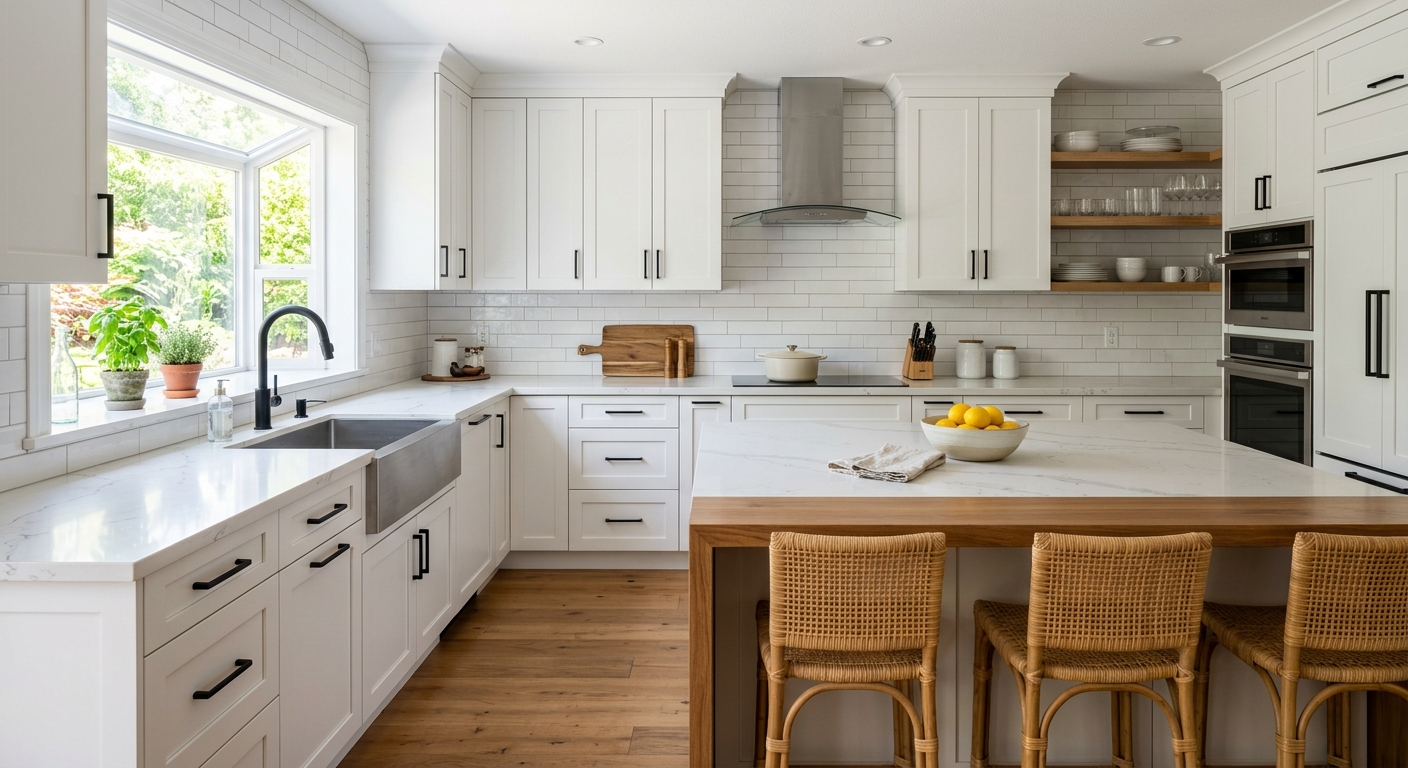
What a kitchen remodel costs in Findlay
In Findlay, where the median household income is $85,991 and 72.0% of homes are owner-occupied (U.S. Census Bureau, ACS 2024), kitchen renovations are often weighed carefully—especially because projects above a certain size represent a real investment. The local housing stock is a mix, but nearly half of homes were built before 1980, with many dating to the pre-1940 era common to southwestern Allegheny County. If your kitchen fits the mold of a small, closed-off room from decades past, expect both costs and scope to reflect the need to reconfigure layout, open up walls, and address outdated systems. On the other hand, homes from the 1990s and newer may only require cosmetic upgrades or a cabinet swap to feel current.
Most blown kitchen budgets in Findlay happen when a homeowner prices "pull and replace" finishes but then decides on a full gut, or assumes plumbing will stay put and later moves it—transforming the project category, and with it, the cost and timeline. Planning starts with matching your intended scope to local realities.
| Scope |
What's included |
Duration |
Price range |
| Full gut remodel, same layout |
cabinets, counters, appliances, flooring, lighting, fixtures |
6–10 weeks |
$30,500–$122,500 |
| Gut plus layout change |
all of the above plus moved plumbing, electrical, walls |
10–16 weeks |
$66,500–$122,500 |
| Cabinet replacement (stock to semi-custom) |
remove and install cabinets, hardware, patching |
1–3 weeks |
$7,100–$30,500 |
| Cabinet refacing |
new doors and drawer fronts, veneer, hardware |
3–6 days |
$7,100–$20,500 |
| Countertop replacement only |
template, fabricate, install, reconnect sink |
1–3 weeks |
$4,100–$16,500 |
| Kitchen flooring only |
remove existing, install new flooring |
3–6 days |
$5,100–$20,500 |
Estimates for a typical Findlay kitchen. Cabinet grade and whether the layout changes move these figures more than square footage.
Practical survival during the work
Renovating a kitchen in Findlay means planning for a few tough weeks of living around dust, noise, and disruption—especially if your home was built before 1980 and the project is a gut remodel. Setting up a temporary kitchen makes the difference: move the fridge outside the work zone (often the dining room or basement), place a microwave and kettle on a folding table, and budget for more disposable plates and utensils than seems reasonable. Running water is a hurdle—most people use the laundry or bathroom sink for washing dishes. If you’re doing a full gut, honestly, many families see their grocery bill rise from eating out or ordering in; over 6–10 weeks, this extra cost can easily outpace the price of a new floor ($5,100–$20,500).
Dust control is worth every minute spent taping up zip walls or plastic sheeting between the work area and the rest of the house. In southwestern Pennsylvania, especially with drafty older homes, construction dust travels farther than you expect. The crew will need a spot for a dumpster (driveway or curb) and stage materials—plan the parking accordingly.
Pets are a practical concern: with workers coming and going, doors are open more than you think and a stressed cat or dog can easily slip out. For the demolition week, moving out may be wise, especially if you're sensitive to noise, have small kids or pets, or if lead paint is a concern.
What requires a permit in a kitchen renovation
In Findlay and Allegheny County, most kitchen cosmetic work—painting, changing hardware, refacing cabinets, or swapping out countertops without layout changes—does not require a building permit. The moment you move electrical, plumbing, or knock down (or cut open) a structural wall, you typically need a permit, especially within Pittsburgh city limits, but many boroughs have similar practices. Installing a new circuit for an appliance, relocating a sink, or venting a new range hood nearly always triggers permit review.
In Pittsburgh, plan review is standard when the remodel alters layout or structure; permits are usually required if you move plumbing or electrical lines. Surrounding municipalities run their own code offices and may refer electrical inspections to approved third-party agencies, so ask how inspections will be handled early. For most jobs, electrical inspection authority follows the municipality or its designated third-party inspector, which catches people by surprise if they've only worked with municipal offices elsewhere.
Any contract over $500 must be written, and your contractor must be registered with the Pennsylvania Attorney General's Home Improvement Contractor (HIC) program—check their number at hic.attorneygeneral.gov. Workers' compensation is mandatory in Pennsylvania for all employers; you can verify at WCAIS (wcais.pa.gov).
Skipping permit requirements can come back to bite you at resale, especially around mortgage inspections or with older homes, which often have past “bootleg” work. Avoiding the permit to save time is a false economy.
What a kitchen quote should specify
If you’re comparing kitchen renovation quotes in Findlay, focus on more than the bottom line. The key is understanding allowances: these are placeholder dollar amounts for products not yet selected—like tile, lighting, or appliances. One contractor might include a realistic tile allowance, while another lists a fraction of what’s required. Suddenly, that “lower” quote looks better up front but will likely run thousands higher once you pick real materials.
Ask to see every allowance line. Compare the specifics: what cabinet brand, line, and box construction; countertop material and thickness; the edge and seams; and which appliance model numbers are spelled out. Don’t overlook how “unforeseen conditions” (like water damage or old electrical) will be handled. Change orders—meaning any work not in the original contract—should require your written approval before the contractor proceeds, and payments should be tied to actual milestones (such as “after cabinets arrive,” not arbitrary calendar dates).
In Pennsylvania, any job over $500 requires a written contract with a 3-day right to cancel under the Home Improvement Consumer Protection Act. Insist on lien waivers from subcontractors with each payment to protect yourself from future claims.
| Line item |
What to look for |
Red flag if… |
| Allowances |
realistic amounts, itemised |
round numbers with no basis |
| Cabinetry |
brand, line, box construction |
'quality cabinets' |
| Countertops |
material, thickness, edge, seams |
material name only |
| Electrical |
circuits to be added, GFCI scope |
'as needed' |
| Unforeseen conditions |
how they are priced and approved |
not addressed |
| Change orders |
written approval before work |
verbal |
| Payment |
milestone-based, modest deposit |
front-loaded |
| Lien waivers |
from subs at each payment |
not offered |
Why the contingency exists
Nearly half of Findlay’s homes were built before 1980, so older home surprises are the rule, not the exception. Once demolition starts, it’s common to find out-of-plumb walls and uneven floors that require shimming and custom scribing to install cabinets—a process that can add $2,000–$7,000 to the job, depending on severity. Old kitchens often hide electrical issues: undersized wiring and a lack of grounding are routine, running up costs for new circuits and GFCI protection ($2,000–$8,000 if full rewiring is triggered). Pipe issues are almost a given in homes with galvanized supply lines or cast iron drains, either of which can mean a day or more of plumbing labor ($1,400–$5,000).
A cold exterior kitchen wall without insulation is also common—expect to add spray foam or batts ($900–$2,000). Sometimes you’ll find previous DIY or unpermitted work in the walls, which can force you to address violations and bring everything to code. Lead paint is a real concern in homes built before 1978; federal law (the EPA RRP rule) requires certified practices, testing, and proper containment whenever disturbing painted surfaces.
If your Findlay house is newer, you’re more likely looking at builder-grade cabinets and laminate counters reaching replacement age together, with minimal circuits—so the surprises are more about hidden leaks or shortcuts than hazardous materials.
When a Findlay kitchen needs walls moved
The decision to move walls, plumbing, or major appliances in your Findlay kitchen is a cost cliff—not a gentle ramp. Keeping the sink, range, and fridge where they are lets you stay in the lower bands—think a full gut remodel in the same layout at $30,500–$122,500. But even modest movement—like shifting a sink to a new window—can trigger big jumps.
Relocating drain lines isn’t just about running a new pipe; drains need a certain slope to work, which is tough if your floor is a slab or you have finished ceilings below. Electrical service is another constraint: adding more circuits for relocated appliances or code-required outlets can tip you into an expensive service upgrade if your panel is full. Removing a wall means asking first if it’s load-bearing. If so, you’ll need a PE (professional engineer) to draw up a plan and get through plan review (in Pittsburgh) or satisfy your township. That adds design, permit, and structural costs.
Don’t forget venting for a new range or hood—new penetrations in a brick or stone wall or siding aren’t trivial, either. For all these reasons, figuring out if your current layout is unworkable or just dated is worth real debate. Spending $36,000 more to move a sink four feet is rarely money well spent unless the new layout solves every frustration at once.
Four kinds of kitchen project, four budgets
A “kitchen remodel” means four different things in Findlay—each with a different budget and disruption. Knowing your category before you call anyone saves time and prevents sticker shock.
-
Cosmetic refresh: Paint, new cabinet hardware, updated lighting, maybe a tile backsplash. No cabinet or layout changes. This is the easiest, fastest, and lowest cost—DIY options abound.
-
Pull and replace: Existing cabinets and counters come out, new ones go in the same place. Plumbing and electrical stay put. Budget is mainly determined by cabinet quality and countertop material, in the $7,100–$30,500 (cabinets) and $4,100–$16,500 (counters) bands.
-
Gut, same layout: Everything comes out to the studs, walls may get new insulation, wiring, and plumbing, but the footprint and service locations stay the same. More disruptive, more expensive, but you get a practically new kitchen without moving the “bones.”
-
Layout change: Walls moved or removed, plumbing/electrical relocated, possible structural changes or expansion. This is the steepest price jump, starting in the $66,500–$122,500 band, because you pay for design, permits, engineering, and master trades.
The cliff comes between “gut, same layout” and “layout change”—the code requirements, level of contractor, and range of inspections all jump together. Decide your tier before you start calling for quotes; without a settled scope, any number a contractor gives you is just a guess.
Frequently asked questions — kitchen renovation in Findlay
What does a quartz countertop cost in Findlay?
In Findlay, quartz countertops run much like the rest of Allegheny County, reflecting both material cost and local fabrication. For an average kitchen, expect to pay between $4,100–$16,500 depending on thickness, edge profile, and complexity (more cutouts or seams drive the upper end). Quartz costs more than basic laminates but generally comes in less than premium natural stones. If your kitchen is on the smaller side or you have a galley layout common in local older homes, your total may come in closer to the lower half of the range. Always verify whether installation, sink cutouts, and backsplashes are included in the price. Remember, pricing is for material and labor together—not slabs alone.
Should I reface or replace my kitchen cabinets?
If your existing cabinet boxes in Findlay are sturdy and well-built—many mid-century or 1970s kitchens in the area used solid plywood—you may want to consider refacing. Refacing, which means new doors, drawer fronts, and veneer, is dramatically less disruptive (usually 3–6 days) and costs $7,100–$20,500. Replacing with new stock or semi-custom cabinets, by contrast, is more expensive at $7,100–$30,500 and takes longer. But if your old boxes are particleboard, sagging, or not worth upgrading—as sometimes found in 1980s developments—replacing is the better investment. Always base your decision on current cabinet condition, not just style.
Is lead paint a concern in Findlay kitchen renovations?
Lead paint is a widespread concern in Findlay and the broader Pittsburgh metro, especially since nearly 48% of homes were built before 1980. If your house was built prior to 1978, the federal EPA Lead Renovation, Repair, and Painting (RRP) Rule applies whenever painted surfaces will be disturbed. This means any demolition, sanding, or removal of original cabinetry can only be done by EPA-certified renovators using approved containment and cleanup methods. Testing happens before disturbance, so if you’re planning a gut remodel, make sure your contractor is certified and can provide documentation. Lead-safe practices can add a few days and extra cost, but skipping them isn’t worth the risk or liability.
What adds the most resale value in a kitchen?
In Findlay, putting your money where future buyers will see and use it works best—cabinets, durable counters, and smart, code-compliant lighting. A “pull and replace” or even a gut, same layout, lets you update function and look without the cost (and permit hassle) of structural or layout changes. Spending in the $30,500–$66,500 range typically yields the best return: new cabinets, durable counters (quartz or granite), and improved lighting. High-end appliances and designer fixtures rarely return their premium locally. On older homes, addressing visible layout flaws or adding counter space moves the value needle more than custom features. Avoid over-improving your kitchen if home values near you don't support the investment.
How much more does moving the sink and range cost?
Moving plumbing or electrical in a Findlay kitchen renovation—especially for the sink or range—normally pushes your project from a “pull and replace” or gut/same layout (starting at $30,500) up into the full remodel with layout change category—which begins around $66,500–$122,500. The simple act of shifting a sink can mean trenching new drains, adding venting, patching or re-running supply lines, and sometimes opening finished ceilings or floors. Code also requires new GFCI outlets and, when moving a gas or electric range, panel upgrades or new supply lines. There’s no formula, but this scope shift doubles total cost for many Findlay kitchens. Make sure the benefit outweighs the budget jump.
Should I order cabinets before demolition?
In Findlay, given the supply chain delays and changeable labor schedules, it’s wise to have your cabinets ordered and at least confirmed—if not delivered—before tearing into your kitchen. For custom or semi-custom lines (costing $7,100–$30,500), lead times are often eight to twelve weeks. But, if your home is older, wait until after “demo day” to verify wall and floor conditions; many carpenters in Allegheny County have opened up walls only to discover framing or out-of-square dimensions that force a re-order. Final measurements should always be taken after demolition, especially in pre-1980 homes. Rushing leads to fitment or layout problems.
Who inspects kitchen electrical work in Findlay?
In Findlay Township and most of Allegheny County, kitchen electrical inspections follow the local code office process—but there are some exceptions. In Pittsburgh itself, electrical work is inspected by the city’s Department of Permits, Licenses, and Inspections. In Findlay and surrounding boroughs, inspections may be performed by the township or by a third-party inspection agency approved by the municipality. It’s not always the same outfit that inspects plumbing or structural work. Always ask your contractor or the local code office who the authority is. Electrical inspections matter not just for safety, but for resale—lenders and new buyers nearly always want permit history on record, especially for work above the counter level.
What is an allowance in a renovation quote?
An allowance in a Findlay kitchen renovation quote is a placeholder dollar amount for an item—like tile, lighting, or appliances—that hasn’t been picked out yet. Let’s say your contractor lists a $2,000 tile allowance, but the style you want actually costs $4,000 installed. That overage comes straight out of your pocket. Allowances can tilt the “total” of a bid by thousands. When comparing quotes in Findlay, look for a fully itemized list of allowances and check whether they reflect brands and styles you’d truly choose. A realistic quote for new countertops, for example, would fall in the $4,100–$16,500 range (material and labor included). Lowball allowances are a red flag; they mask the true cost and set you up for disappointment or conflict.
What flooring works best in a kitchen?
In Findlay, thanks to freeze-thaw cycles and common clay subgrades, many older homes see some floor movement seasonally. For kitchens, look for durable, water-resistant choices: luxury vinyl plank (LVP), ceramic/porcelain tile, or engineered hardwood rated for kitchen use. LVP stands up well to spills and is softer underfoot than tile, making it popular in busy family kitchens. Tile is long-lasting but harder; consider radiant heat if comfort matters, especially on a slab. Hardwood can work if installed correctly and humidity is controlled. Budget for professionally installed kitchen flooring in the $5,100–$20,500 range depending on material and square footage. Skip basic laminate; it’s not moisture-tolerant enough for local kitchens with snow and mud in winter months.