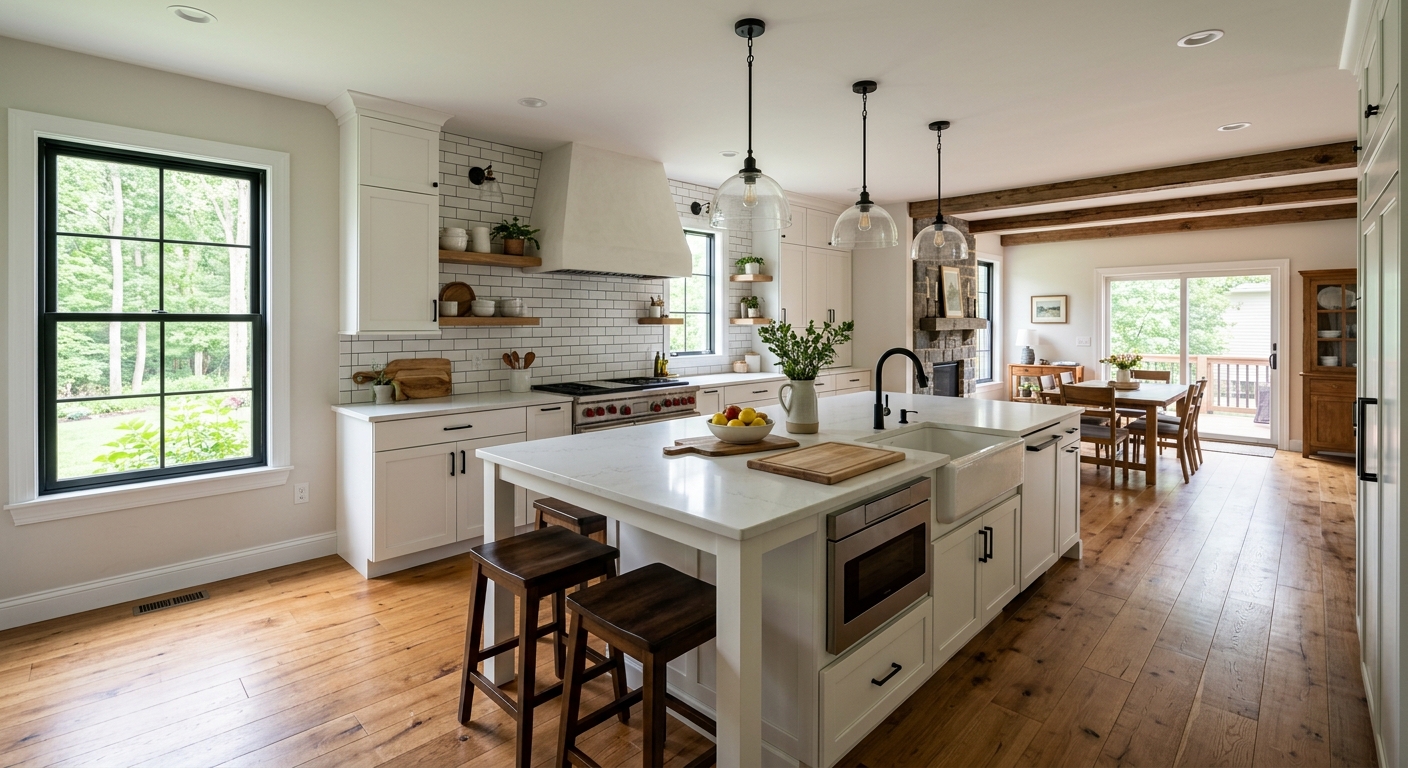
What a kitchen remodel costs in Clay
Homeowners in Clay looking at a kitchen remodel should start with two numbers in mind: Clay’s high homeownership rate and a median household income of $73,875 (U.S. Census Bureau, ACS 2024). High owner occupancy means that most renovation dollars spent are to benefit the owner’s lifestyle, not just a rental turnaround, and budgets track the value of single-family homes. With over 40% of homes built before 1980, you’re likely dealing with a kitchen that hasn’t been fully modernized since the post-war tract housing wave that touched Lancaster and nearby Manheim Township. In these homes, kitchen projects often move beyond new cabinets to reworking a dated footprint, or finally overhauling plumbing and electrical that are still original to the house.
The biggest source of cost overruns is quoting one level of work — say, a basic cabinet swap — then adding scope midstream, like moving a sink or re-routing electrical. That leap in complexity and price can be steep. To avoid it, you need to know the differences in scope, not just finishes or brands.
| Scope |
What's included |
Duration |
Price range |
| Full gut remodel, same layout |
cabinets, counters, appliances, flooring, lighting, fixtures |
6–10 weeks |
$29,500–$117,500 |
| Gut plus layout change |
all of the above plus moved plumbing, electrical, walls |
10–16 weeks |
$63,500–$117,500 |
| Cabinet replacement (stock to semi-custom) |
remove and install cabinets, hardware, patching |
1–3 weeks |
$6,900–$29,500 |
| Cabinet refacing |
new doors and drawer fronts, veneer, hardware |
3–6 days |
$6,900–$19,500 |
| Countertop replacement only |
template, fabricate, install, reconnect sink |
1–3 weeks |
$3,900–$15,500 |
| Kitchen flooring only |
remove existing, install new flooring |
3–6 days |
$4,900–$19,500 |
Estimates for a typical Clay kitchen. Cabinet grade and whether the layout changes move these figures more than square footage.
Planning appliances before cabinets
The single most common misstep in Clay kitchen renovations is choosing appliances after ordering cabinets. All cabinetry is mapped to the exact dimensions and clearances of your appliances — refrigerator depth, range width, dishwasher height — and missing this sequence leads to pricey fixes, like a fridge that sticks out or a stove that can’t be reached by the oven door. Decide on your appliances first, and get spec sheets in hand before a cabinet drawing is finalized.
If you’re looking at refrigerators, standard-depth models extend 3–4 inches beyond your counters, while counter-depth versions offer a built-in look but cost more and hold less. For ranges, a slide-in model drops cleanly between cabinets for a custom look; freestanding ranges are more forgiving but don’t offer that seamless line. If you’re switching from gas to induction, know that most post-war Clay homes are underpowered, so it’s not just an appliance swap — you’ll likely need a new dedicated electrical circuit.
Panel-ready dishwashers allow for a cabinet front and blend in, but dimensions have to be precise. Range hoods: recirculating types only filter and return air; true ducted hoods vent to the exterior — much better for air quality, but sometimes more expensive to install, especially in houses with complex framing or brick walls.
Be aware: premium “pro” appliances mostly deliver improved durability and looks; actual cooking performance jumps most in ovens and ventilation. Also, appliance backorders now sometimes outlast even custom cabinetry lead times, so order early.
Eight weeks without a kitchen
Living through a kitchen renovation in Clay — especially one that runs six to eight weeks — takes some honest advance planning. You’ll want to set up a temporary kitchen before the crew arrives. A folding table, plugged in for a microwave and kettle, with your current fridge nearby beats eating out every meal. Most Clay homes have a laundry or utility sink that stands in for dishwashing, but if not, a bathroom sink will work with some patience. Plan on paper plates and prepped foods; it’s not an ideal time to take up bread baking.
Expect plastic sheeting and zipper walls to separate the work zone from your living space. This isn’t just for dust — it keeps kitchen grit out of furniture, HVAC returns, and the lungs of anyone with allergies. Crews will need clear access to the house, space for a dumpster, and a spot on your driveway or yard for material staging. If you have pets, think through doors being propped open and unfamiliar faces moving in and out.
During demolition, the noise, dust, and disruption can be significant. Some families choose to move out for a week if they have that flexibility. Most don’t, but know that eating restaurant meals for eight weeks in Clay has a way of outpacing the cost of new flooring — a reality few budgets account for up front.
Cosmetic, replacement, gut, or layout change?
A kitchen remodel in Clay spans several tiers, and deciding your tier up front keeps your budget and expectations in line. Here’s how they break down:
- Cosmetic refresh: New paint, hardware, backsplash, light fixtures. You keep your existing cabinets and layout. A good fit if your cabinets are solid and you just want a fresh look.
- Pull and replace: New cabinets and counters, keeping existing footprint and locations for sink, appliances, and electrical. The most direct path to a “new kitchen” when the old one is tired, but you’re avoiding moving services.
- Gut, same layout: Everything down to studs, new drywall, updated electrical and plumbing — but all in original places. Required for many mid-century Clay homes with outdated wiring or poor insulation, especially those built before 1980.
- Layout change: Moving walls, relocating the sink or appliances, or opening up walls to another room. This is where budgets jump: moving services or removing structure triggers building permits, engineering, and longer construction timelines.
The biggest “cost cliff” is between gutting with the same layout and changing the layout. The moment you move plumbing or major electrical, you add permit requirements, formal inspections, and different contractor skills — all cost multipliers. A contractor can’t give a real number until your scope is clear. Picking your tier is the key first step for any Clay homeowner thinking of a kitchen overhaul.
Allowances, exclusions and change orders
Ask to see an itemized bid and you’ll usually get “allowances” — placeholder amounts for things you haven’t picked yet, like tile or fixtures. In Clay, this is where most kitchen estimates become impossible to compare. If two contractors both show a bid total of $50,000, but one has a tile allowance of $800 and the other $3,000, you’re not looking at the same real price. Before you pick low bid, ask to compare allowance lines separately.
Every major kitchen bid should spell out the cabinet brand, line, and construction (not just “quality cabinets”), exact countertop material and thickness, and how seams will be handled. Check electrical lines for how many and what type of circuits are being added — “as needed” is vague and a red flag. Make sure there’s a process for unforeseen conditions, especially in older Clay homes that may have hidden structural issues or dated wiring. Change orders, when the scope changes, should be in writing and signed before the extra work starts. Payment schedules should be tied to milestones, not calendar dates, and contractors should provide lien waivers from their trades as you pay out, not just at the end.
Pennsylvania’s Home Improvement Consumer Protection Act requires a written contract for jobs over $500, and you have a three-day cancellation right. These protect you more than any handshake ever could.
| Line item |
What to look for |
Red flag if… |
| Allowances |
realistic amounts, itemised |
round numbers with no basis |
| Cabinetry |
brand, line, box construction |
'quality cabinets' |
| Countertops |
material, thickness, edge, seams |
material name only |
| Electrical |
circuits to be added, GFCI scope |
'as needed' |
| Unforeseen conditions |
how they are priced and approved |
not addressed |
| Change orders |
written approval before work |
verbal |
| Payment |
milestone-based, modest deposit |
front-loaded |
| Lien waivers |
from subs at each payment |
not offered |
How a Clay kitchen budget breaks down
Most Clay homeowners are caught off guard when they see just how much of a kitchen budget is allocated to cabinetry — it's routinely the largest single line, especially with post-war layouts and premium finishes. Labour comes next, and spikes if any plumbing or walls move. Countertops, appliances, flooring, lighting, and plumbing fixtures follow in proportional order. But the two most overlooked expenses are contingency (for what’s lurking behind original walls) and soft costs such as permits, design, delivery, and debris haul-off. On a typical $63,500 gut remodel, that’s real money.
Spend the extra thousand dollars on cabinet features (full-extension drawers, plywood boxes) or better lighting — those are daily-use upgrades. Conversely, top-end appliances in a kitchen with budget cabinets or laminate counters are money badly spent. In Clay’s pre-1980 homes, reserve contingency funds for surprise wiring or plumbing. Permits and soft costs are a smaller fraction, but they’re not optional if you’re updating services.
| Category |
Share of budget |
Notes |
| Cabinetry |
25–35% |
the largest line and the longest lead time |
| Labour and installation |
20–30% |
rises sharply if the layout changes |
| Countertops |
8–15% |
material choice drives the swing |
| Appliances |
10–20% |
widest range of any category |
| Flooring |
5–10% |
|
| Lighting and electrical |
5–10% |
higher in older homes needing circuits |
| Plumbing and fixtures |
4–8% |
|
| Permits, design, disposal |
3–6% |
usually forgotten in early budgets |
| Contingency |
10–15% |
not optional in a pre-1980 house |
Code requirements for Clay kitchens
In Clay, cosmetic kitchen projects — painting, updating hardware, refacing cabinets, or changing countertops — generally don’t require a permit. However, the moment your project includes new or relocated plumbing, new electrical circuits, or structural changes (like removing a wall), permitting is standard, especially within the City of Lancaster, where a building permit and formal plan review are part of the process for system and layout changes. In nearby Lancaster County townships, a simple cabinet or countertop replacement can often proceed without a permit as long as you’re not touching utilities.
Electrical inspections here are primarily performed by certified third-party agencies, such as the Middle Department Inspection Agency, which is different from places where the city office sends their own inspector — a detail that frequently surprises Clay homeowners. If you’re tackling serious electrical or plumbing work, a permit streamlines resale: local appraisers and buyers expect documentation of permitted work, and it’s a sticking point in sales of older Lancaster County homes.
All contractors working on jobs over $500 in Pennsylvania must carry Home Improvement Contractor registration from the Office of Attorney General — you can check their number at hic.attorneygeneral.gov — and must provide proof of workers' compensation coverage, verifiable on the state WCAIS system. Skipping permits and qualified contractors in favor of a lower price can cost far more if you’re caught at resale, or if a claim arises with your insurer later.
Frequently asked questions — kitchen renovation in Clay
Can I over-improve for my Clay neighbourhood?
While Clay's homeownership rate is high and homes are well cared for, it is possible to over-invest, especially with high-end selections in a moderate-value market. If you spend on a full gut-and-layout change kitchen at the high end of the range — around $117,500 — in a neighborhood of similar homes with original kitchens, you may not recoup those costs at resale. Focus your budget on key upgrades (durable cabinets, solid counters, good lighting) rather than splashy features. Around here, most buyers expect an updated kitchen, but rarely pay a premium for imported stone or luxury appliances unless the entire home supports that level of finish. Consider your goals — if you’re staying long term, choose what improves your daily experience. If a move is in the next few years, match your investment to typical sale prices in your part of Clay.
Do older Clay homes need electrical upgrades for a kitchen?
Yes, especially if your home is among the 40% built before 1980 in Clay. Original wiring in these houses often cannot safely handle modern kitchen appliances, which draw more power and require GFCI protection. Upgrading circuits, adding AFCI (arc-fault) breakers, and grounding is now standard for a full gut remodel. These upgrades typically add to both cost and timeline, especially when walls are opened up. If you’re only refreshing finishes, you might get by without new wiring, but any new appliances (especially induction cooktops or built-in microwaves) may tip the scale. Plan for an electrical update in your scope and expect that it will show up clearly in bids for work in the $29,500–$117,500 range.
How long does a kitchen renovation take in Clay?
For a standard full gut kitchen renovation in Clay — think new cabinets, counters, appliances, flooring, lighting — plan for 6 to 10 weeks from active demolition to punch list. If your project involves a layout change, such as moving walls or major services, you’re realistically looking at 10 to 16 weeks due to permit processing, inspections, and possible delays waiting for materials in the local labor market. Simple cabinet replacements or countertop swaps can be done faster, sometimes in just 1–3 weeks. Lead times for some appliances now rival cabinet lead times, so ordering early is wise. Structurally, Clay’s post-war homes are straight-forward to demo and rebuild, but the schedule can be affected by discoveries behind the walls or supply chain snags.
Is a cosmetic refresh enough or do I need a gut remodel?
If your Clay kitchen layout is functional, your cabinets are sturdy, and you’re primarily unhappy with colors or minor wear, a cosmetic refresh — new paint, hardware, lighting, and backsplash — might be all you need, with costs well below a full remodel. For many post-war homes, though, inefficiencies or aging systems make a pull-and-replace or even a gut remodel more practical, especially when you want to swap appliances or fix electrical issues. Cosmetic upgrades often run beneath $6,900, while a gut remodel appropriate to a mid-century Clay home ranges from $29,500–$117,500. If you’re eyeing bigger changes, it makes sense to gut and insulate or completely modernize, especially with pre-1980 wiring and plumbing.
What does a quartz countertop cost in Clay?
Quartz countertop replacement for a typical Clay kitchen falls between $3,900–$15,500, with most homeowners spending about $8,800 installed. Pricing depends on the brand, color, edge detail, and whether you need a full-height backsplash or special cutouts. Expect fabrication, local delivery, and install to be included at that range. Seam placement and sink cutouts are important details to review with your fabricator before signing, as these can affect both cost and the final look. In older post-war kitchens where cabinet boxes vary in size or aren't level, extra labor can slightly bump up costs.
What countertop material is best for a family kitchen?
For most Clay families, quartz is the best blend of durability, ease of maintenance, and value. It resists stains and scratches and looks high-end without the care requirements of marble or the unpredictability of natural granite. If you’re budget-minded, premium laminates can work, but many buyers in this market prefer the feel and look of stone. Solid surface counters are less heat resistant, which can be an issue in a busy kitchen. Sintered stone and porcelain slabs are trending for high-durability, but often cost more. In terms of total investment, a quartz counter in Clay will fall within $3,900–$15,500, and is less likely to look dated than trendy alternatives five to ten years out.
Do I need a permit for a kitchen renovation in Clay?
Not always, but many project scopes do trigger a permit. If you’re swapping cabinets or counters in place, with no changes to plumbing or electrical, most townships in Lancaster County allow that work without a permit. If you’re working in Lancaster city or making changes to layout, plumbing, or circuits, you’ll need a permit and (often) plan review. Expect your electrical work to be inspected by a third-party agency rather than the city itself, as is typical in this region. Working with an HIC-registered contractor, as required in Pennsylvania for jobs over $500, means you’ll get the paperwork you need for resale and insurance. Permitting costs are a small percentage of the overall budget but are essential for a smooth project.
What is a change order and how should it work?
A change order is a written amendment to your original kitchen remodeling contract. Whenever you — or the contractor — want to add, remove, or swap something not in the initial scope (think: changing cabinet style, moving the sink, or discovering subfloor rot), a change order spells out the cost and schedule impact. In Clay and throughout Pennsylvania, it's a regulatory best practice and required in contracts over $500 under the Home Improvement Consumer Protection Act. The key is insistence on written, signed approvals before work begins on the added item. Verbal approvals aren’t enough; they lead to later disputes and budget surprises. Don’t release additional payments until you see the change order in writing, and keep each one with your contract records for warranty and resale clarity.
What is a realistic contingency for a Clay kitchen?
For an older Clay home (built before 1980), a realistic contingency is 10–15% of your total budget, or $3,000–$18,000 on a remodel in the $29,500–$117,500 band. This covers surprises: finding old wiring, plumbing behind walls that needs updating, or structural repairs beneath the floor. Skimping on contingency in our local market almost always leads to stress and difficult decisions mid-project. For newer homes, you can sometimes get by with 5–10%, but for most of the post-war houses common in Clay, a healthy contingency is what keeps the project moving if you hit an unexpected problem behind the drywall.