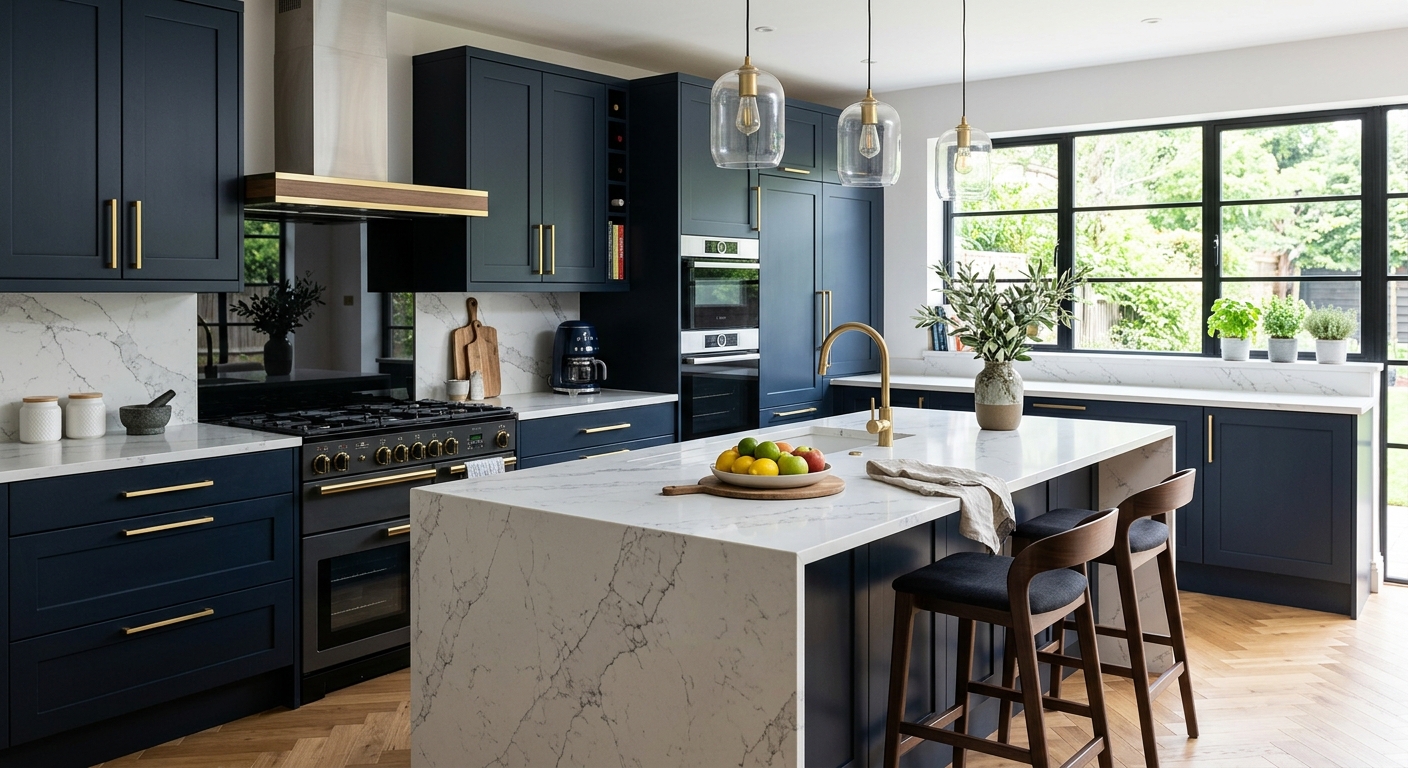
Kitchen renovation costs in Southampton — 2026
In Southampton, a kitchen renovation is one of the most significant home investments you can make. With a homeownership rate of 84.2% and median household income of $77,004 (U.S. Census Bureau, ACS 2024), most owners here weigh the long-term use of their kitchen against current home values, not just trends or resale. Franklin County’s housing is largely made up of post-1960 homes along US-11 and I-81. That means most kitchens being renovated are due for a “mid-life” upgrade: original cabinetry and finishes may be tired, but walls and layouts usually suit modern needs — or need less drastic changes than a cramped 1950s galley would.
The biggest drain on a kitchen budget in Southampton comes from pricing based on a basic project, then upsizing to a more elaborate scope: for example, budgeting for a cabinet refacing, but switching to a semi-custom or full remodel. It’s critical to know what’s actually involved in your chosen project scope, as this determines whether you stay within your budget or see it balloon by tens of thousands during design changes, mechanical work, or layout changes.
| Scope |
What's included |
Duration |
Price range |
| Full gut remodel, same layout |
cabinets, counters, appliances, flooring, lighting, fixtures |
6–10 weeks |
$29,500–$118,500 |
| Gut plus layout change |
all of the above plus moved plumbing, electrical, walls |
10–16 weeks |
$64,000–$118,500 |
| Cabinet replacement (stock to semi-custom) |
remove and install cabinets, hardware, patching |
1–3 weeks |
$6,900–$29,500 |
| Cabinet refacing |
new doors and drawer fronts, veneer, hardware |
3–6 days |
$6,900–$20,000 |
| Countertop replacement only |
template, fabricate, install, reconnect sink |
1–3 weeks |
$4,000–$16,000 |
| Kitchen flooring only |
remove existing, install new flooring |
3–6 days |
$4,900–$20,000 |
Estimates for a typical Southampton kitchen. Cabinet grade and whether the layout changes move these figures more than square footage.
Cabinets: reface, stock, semi-custom or custom
Cabinets are the single decision that most shapes your kitchen budget. In Southampton’s typical post-1960 homes, original boxes are often worn but usually square and laid out broadly as you want — making them decent candidates for refacing unless you crave a totally new style or more storage. Refacing means replacing only the doors, drawer fronts, and visible surfaces, saving money and dust if the cabinet boxes are still in good shape. The downside is you cannot change the storage or modify the layout this way.
Stock cabinets are pre-sized and work where walls are standard, but Southampton’s mid-century and ’90s homes can have just-off-standard walls, leading to gaps and filler strips. Semi-custom allows for tweaks in dimension and finish, and fits these “almost generic, but not quite” kitchens. Custom cabinets offer any look or fit but at a premium, with longer lead times.
Across all types, build quality matters more than the name: plywood boxes last almost twice as long as particleboard, dovetail drawer joints beat stapled, and full-extension, soft-close hardware will keep doors and drawers working long after finish trends pass. Frameless (“Euro”) construction gives you more usable space than face-frame but can be less forgiving for installation in out-of-plumb walls.
Given Franklin County’s domination by mid-life, post-1960 homes, semi-custom cabinets are the most frequent solution in Southampton, whether initially planned or not — simply because the original walls rarely match stock sizes perfectly.
| Option |
Cost |
Best when |
Limitation |
| Painting existing cabinets |
$1,200–$3,500 |
boxes and doors sound, tight budget |
no layout or style change |
| Refacing |
$6,900–$20,000 |
boxes square and layout works |
storage unchanged |
| Stock cabinets |
$6,900–$29,500 |
standard dimensions fit |
filler strips, limited finishes |
| Semi-custom |
$20,000–$29,500 |
non-standard walls or finishes |
6–12 week lead time |
| Full custom |
$20,000–$29,500 |
unusual layout or high-end design |
longest lead, highest cost |
Resale value and kitchen spending
For most Southampton homeowners, a kitchen renovation will help your home sell faster and draw more interest, but it will not guarantee a full return on cost. Most mid-range kitchen projects recover a larger share of their cost than high-end ones, because buyers here rarely pay above the area’s ceiling to recoup a seller’s design splurges. With a median household income of $77,004 (U.S. Census Bureau, ACS 2024), kitchens priced well above what’s typical in the neighborhood risk over-improvement — and the excess spend is unlikely to be recovered at resale.
The most valuable framing: renovate to live in, or renovate to sell — they are very different projects. If you plan to sell soon, lean toward neutral finishes, a mid-range spend ($29,500–$64,000), and skip costly layout changes. If you plan to stay long-term, invest in how you actually cook, entertain, and live, and forget resale until your needs genuinely change. Smart splurges are those you’ll use daily — not those that exist to impress a buyer who might never materialize.
Improving a Southampton kitchen generally yields the strongest resale response when you eliminate obvious datedness and deferred maintenance: worn-out floors, chipping cabinets, and mismatched appliances. If your home is above-average for the area, spend cautiously — you are competing with newer homes, and buyers may value square footage or location over a luxury kitchen remodel.
Circuits, GFCI and code compliance
Electrical work is the most frequent source of a surprise budget jump in Southampton’s kitchens — especially in homes built before the 1980s, which account for 43.3% locally. Today’s code requires at least two dedicated 20-amp small-appliance circuits, GFCI protection for all countertop outlets, outlets spaced every four feet, and dedicated circuits for microwaves, dishwashers, and disposals. An electric range needs its own 240-volt line, and lighting is kept separate from appliance circuits.
If your Southampton kitchen is original to a post-1960 house, there may still only be one or two general-use circuits or no GFCI outlets at all. Older panels are often full, with limited capacity for new breakers. In rare cases, homes built before about 1970 may have two-wire (no ground) wiring, which is a non-starter for new kitchens. Once walls are open and work starts, compliance with current code is not negotiable, and inspectors often require upgrades that were not part of the owner’s initial plan or budget.
Even late-1990s kitchens often fall short of today’s code for circuit count and GFCI protection, so plan for electrical upgrades even if you are not moving walls or appliances. In Franklin County, bringing a kitchen’s electrical up to current standards usually adds $3,500–$8,500 for rewiring, new circuits, and panel upgrades if needed — a significant sum, but skipping this step will derail both permits and resale later.
Code requirements for Southampton kitchens
In Southampton, cosmetic kitchen work such as repainting, repairing, cabinet refacing, and swapping out a countertop (if nothing moves) can be done without a permit. But as soon as you move or add plumbing or electrical circuits, change the kitchen layout, or do any structural work, permits are triggered. In Chambersburg and most Franklin County municipalities, a permit and plan review are standard any time kitchen work involves system changes — such as moving a sink, reconfiguring lighting, or installing a larger range requiring electrical upgrades.
Electrical inspections are not always handled by the municipality directly; in Franklin County, third-party agencies like Approved Code Services or Commonwealth Code Inspection Service often take care of inspections — a surprise for many homeowners coming from larger cities. Always check who will inspect your project before work starts.
For jobs over $500, any contractor working in your home must have an active Home Improvement Contractor (HIC) registration, which you can verify with the Pennsylvania Office of Attorney General. Employers must carry workers’ compensation coverage, which you can check via the WCAIS system. If your property is in a pre-1978 building, contractors must comply with the EPA Lead RRP Rule.
Skipping the permit process leads to headaches at sale: unpermitted work often stalls closings in Pennsylvania, since buyers and lenders now routinely check for missing approvals and code issues.
Comparing kitchen renovation bids in Southampton
When looking at kitchen renovation bids in Southampton, most of the key differences are in the details, not the total. Allowances are the common stumbling block: an allowance is a placeholder dollar value for an item not yet selected (like tile, plumbing fixtures, or lighting). Two bids with similar totals can differ by thousands once you pick final products, if one bid uses realistic allowances and the other uses lowball figures just to look competitive on paper. Review allowance lines before even glancing at the grand total.
Key comparison points for Southampton projects: the cabinet brand and line named in the bid (not just “good cabinets”), the countertop material, edge, and thickness, whether all electrical circuits needed for code are included, and what the process is for handling surprises in the walls. A transparent bid spells out how change orders are priced, whether your written approval is required before extra work starts, and sets up a payment schedule tied to project milestones — not arbitrary dates. Professional bids will also promise lien waivers from subcontractors at each payment so you are not caught in the middle if the general skips a payment.
Pennsylvania law, through the Home Improvement Consumer Protection Act (HICPA), requires that contracts over $500 be in writing and gives homeowners a 3-business day cancellation right. Don’t sign any proposal without these protections clearly spelled out.
| Line item |
What to look for |
Red flag if… |
| Allowances |
realistic amounts, itemised |
round numbers with no basis |
| Cabinetry |
brand, line, box construction |
'quality cabinets' |
| Countertops |
material, thickness, edge, seams |
material name only |
| Electrical |
circuits to be added, GFCI scope |
'as needed' |
| Unforeseen conditions |
how they are priced and approved |
not addressed |
| Change orders |
written approval before work |
verbal |
| Payment |
milestone-based, modest deposit |
front-loaded |
| Lien waivers |
from subs at each payment |
not offered |
Why appliance selection comes first
In every Southampton kitchen project, appliances must be selected upfront — not as an afterthought — because cabinetry is designed around their exact dimensions. Finalizing cabinets before picking appliances is how people end up unable to fit a preferred refrigerator or a slide-in range, or find that their panel-ready dishwasher will not line up with new doors. Standard fridges often stick out past counters, while counter-depth models need cabinets precisely gapped behind for a proper fit. Slide-in ranges, which sit virtually flush, require different counter cuts than freestanding ranges.
If you’re debating gas, induction, or electric, know up front: switching to induction or a pro-grade electric range will require a 240-volt dedicated circuit, and sometimes panel upgrades. Panel-ready dishwashers or built-in microwaves each have their own sizing quirks — get data sheets during cabinet design. For venting, always duct the range hood to the outside if possible; recirculating hoods satisfy code minimally but won’t keep cooking odors out of the house.
Professional-grade appliances (the “pro” look) absolutely offer heavier-duty feel and sometimes digital controls or dual-fuel, but cost premiums in Southampton are mostly about looks and resale perception, not real cooking needs. For certain models, lead times are now longer than for custom cabinets — waiting to pick appliances can set your timeline back by months.
Frequently asked questions — kitchen renovation in Southampton
What should I expect in a pre-1980 Southampton kitchen?
Most pre-1980 kitchens in Southampton have electrical and plumbing systems that are not up to current standards. Many still have just one or two basic circuits, often ungrounded, and may lack GFCI outlets at countertops. Cabinet layouts from that era are usually boxy but may have odd wall dimensions, leading to gaps if you try using stock cabinets. You might also find original solid hardwood floors under layers of vinyl. Lead paint is a potential hazard in homes built before 1978, so any work disturbing painted surfaces must comply with the EPA Lead RRP Rule. Renovating these kitchens usually adds costs for unplanned upgrades — electrical updates alone often run $3,500–$8,500. Site-built cabinets are common, which limits refacing options if box construction is crude. On the upside, older kitchens often have more demo flexibility if you’re set on a full gut remodel.
What adds the most resale value in a kitchen?
In Southampton, the best return for resale comes from a moderate, neutral remodel that erases obvious age and wear but does not splurge for high-end features. Buyers look for new cabinets (or well-done refacing), trouble-free countertops, updated lighting, and working appliances — not specialty items or luxury brands. A mid-range project in the $29,500–$64,000 range is rarely regretted at resale, while spending toward the top of the market has diminishing returns compared to the area’s median household income level. Skip major layout reconfigurations or ultra-premium finishes unless you are staying long term; buyers rarely pay back-cost for taste-specific upgrades. Consistency and condition matter more than brand names or imported countertops in Franklin County homes.
Do I need a permit for a kitchen renovation in Southampton?
Whether you need a permit depends on your project’s scope. In Southampton and across most Franklin County municipalities, no permit is required if you only paint, reface cabinets, replace hardware, or swap a countertop as long as nothing is moved. Once you relocate electrical or plumbing, knock out a wall, or add structure or mechanical features (like exhaust hoods vented outside), you are in permit territory. Plan review is standard in Chambersburg and for any significant changes elsewhere in the county. Electrical inspections are often handled by third-party agencies, not just the township. If you skip permits, you risk trouble down the road: unpermitted work routinely holds up home sales in Pennsylvania. For budget reference, a code-compliant kitchen remodel usually falls in the $29,500–$118,500 range, depending on scope.
Should I reface or replace my kitchen cabinets?
In Southampton, the choice comes down to whether your cabinet boxes are square, sturdy, and laid out as you like. Refacing is a good option if your current layout works, cabinet interiors are in decent shape, and you’re happy with current storage — typically priced in the $6,900–$20,000 range. Replacement is smarter if boxes are sagging, water-damaged, or the layout is wrong for your needs. Many post-1960 homes in Franklin County have decent original boxes, making refacing practical. But if you want to add cabinets, change the kitchen flow, or increase storage, it’s better to replace outright. Just check the integrity of the boxes first; not every aging cabinet can be saved by new doors and veneer.
What countertop material is best for a family kitchen?
For most Southampton families, quartz tops the list for easy maintenance and looks, as it resists stains, does not need sealing, and handles everyday spills. Granite is nearly as durable, but some varieties need periodic sealing to keep looking new. Laminate is still practical for tight budgets but doesn’t handle hot pots well and won’t add value at resale. Solid surfaces like Corian can be repaired if scratched, but they’re softer than stone. For a typical family kitchen, expect to spend $4,000–$16,000 on new countertops. Unless you have unique cooking needs, skip exotic options — they rarely offer more than style points in daily life, and most Franklin County homes sell just fine with quartz or granite.
How do I set up a temporary kitchen?
While your Southampton kitchen is under renovation, set up a temporary space somewhere convenient — usually the dining room or basement. Move your fridge, microwave, toaster oven, and coffee maker into this area. Use folding tables for prep, deep sink for washing, and disposable plates to minimize cleanup. An electric skillet or hot plate is handy, but keep safety in mind and avoid running too many devices at once on outlets. Stock up on non-perishable foods and easy-to-prepare meals. If your renovation is a full gut (often taking 6–10 weeks and costing $29,500–$118,500), consider creating a plan for dining out a few times a week. Communication with your contractor on timing and dust control will help make the temporary setup bearable.
How long does a kitchen renovation take in Southampton?
The duration depends on scope and contractor workload. In Southampton and across Franklin County, a full gut remodel where the layout stays the same usually runs 6–10 weeks, while more involved changes (moving plumbing or walls) stretch to 10–16 weeks. Lead times can be longer than in Harrisburg because skilled trades are in shorter supply locally. Cabinet-only projects range from 1–3 weeks for replacement and as little as 3–6 days for refacing. Material delays, inspections, or unplanned upgrades (like electrical) can all extend the timeline. Plan realistically: most families live with disruption for at least 2 months for a major project in the $29,500–$118,500 range, with more time if you add layout or system changes.
How much does a kitchen renovation cost in Southampton?
In Southampton, a full kitchen gut remodel typically costs $29,500–$118,500, with mid-range projects landing around $64,000. Simple cabinet replacements start at $6,900, while partial updates like countertops only or flooring run $4,000–$20,000. The wide price range covers everything from modest cabinet and finish swaps to fully customized layouts with new systems and high-end appliances. The largest swings in cost come from cabinet grade, countertop selection, and whether you’re moving walls or keeping the original kitchen footprint. Most Southampton homeowners spend within the mid-range unless the house is high-end for Franklin County.
How much do new kitchen cabinets cost in Southampton?
New kitchen cabinets in Southampton range widely — for stock or semi-custom options (the most common locally), expect to spend $6,900–$29,500, with most jobs around $20,000 for a moderate-size, U-shaped kitchen. Refacing for similar size falls between $6,900–$20,000. Full custom increases the price but is rarely necessary unless you have a very unusual kitchen or particular design in mind. Labor and travel surcharges can affect the total because Franklin County contractors often work over long distances. Always weigh cabinet construction (plywood versus particleboard), hardware, and style, as well as any need for fillers or modifications to fit non-standard walls in older or custom homes.