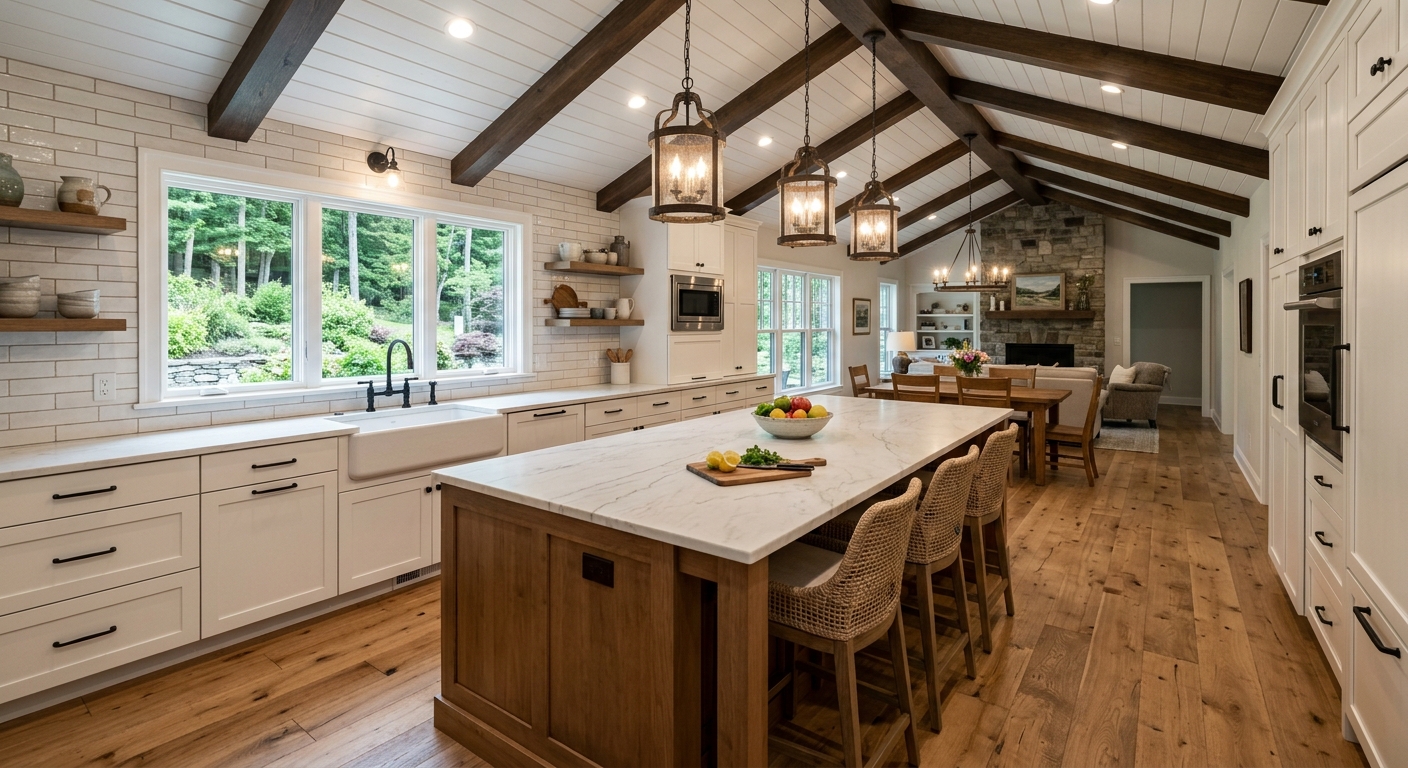
Lower Macungie kitchen renovation prices by scope — 2026
Lower Macungie’s kitchen renovation costs track right with its high ownership rate — 84.7% of households own their homes (U.S. Census Bureau, ACS 2024) — and a median household income of $116,750 makes mid-range and above projects common. The township’s wave of post‑1960 tract homes now reaching full kitchen replacement age means you are likely looking at either a basic 1980s L‑shaped kitchen whose bones you keep, or you’re ready to gut and update a layout built for another era entirely. That construction era matters, since bringing a 1950s galley up to modern family standards can mean new openings, moved plumbing, and doubled electrical load, while most 1990s builds only need finish upgrades unless you’re chasing a completely open plan.
The single biggest reason Lower Macungie kitchen renovations go over budget is not cost overruns — it’s pricing only for a cosmetic refresh and then falling for the upgrades that put you in full remodel territory. Setting realistic expectations upfront is the best protection.
| Scope |
What's included |
Duration |
Price range |
| Full gut remodel, same layout |
cabinets, counters, appliances, flooring, lighting, fixtures |
6–10 weeks |
$33,500–$134,000 |
| Gut plus layout change |
all of the above plus moved plumbing, electrical, walls |
10–16 weeks |
$72,500–$134,000 |
| Cabinet replacement (stock to semi-custom) |
remove and install cabinets, hardware, patching |
1–3 weeks |
$7,800–$33,500 |
| Cabinet refacing |
new doors and drawer fronts, veneer, hardware |
3–6 days |
$7,800–$22,500 |
| Countertop replacement only |
template, fabricate, install, reconnect sink |
1–3 weeks |
$4,500–$18,000 |
| Kitchen flooring only |
remove existing, install new flooring |
3–6 days |
$5,600–$22,500 |
Estimates for a typical Lower Macungie kitchen. Cabinet grade and whether the layout changes move these figures more than square footage.
Lead times, sequencing and why it takes longer
In Lower Macungie and the wider Lehigh County area, most kitchen renovations take longer than homeowners expect. A tight finish-trade labor market — tighter than Philadelphia’s, but still deeper than Carbon County — means scheduling delays are common, especially for highly regarded kitchen specialists. The normal sequence starts with design and detailed measurements. Cabinets must be selected, ordered, and shipped, and here’s the real local issue: cabinet lead times often run 6 to 12 weeks, even for semi-custom lines. Order them at contract signing. Do not wait for demolition, because you will be stuck staring at an empty space for weeks.
The critical path in Lehigh County is always the same: demolition, rough carpentry, rough plumbing and electrical (with required inspections in many townships), then cabinet installation. Only after the new cabinets are set and leveled can your countertop fabricator measure for a template — no reputable shop will cut stone from plans or drawings. Fabrication (usually off-site in Allentown or Bethlehem) adds a week or more, and then installation calls the plumber back to reconnect. Flooring, backsplashes, and final trim come last. This means your kitchen may look “almost there” for ten days as everyone waits on the counters, because nothing else can move forward safely. Many contractors gloss over this downtime — but it’s real and it’s built in.
The local market is highly competitive, but waiting for good trades and smart scheduling will save you frustration. Rushing the early steps is never worth it. Plan for a longer lead, especially if you want anything beyond plain white shaker cabinets.
Living through a kitchen renovation
Surviving a kitchen renovation in Lower Macungie comes down to preparation and setting expectations. Most families set up a temporary kitchen somewhere — putting a fridge in the garage or dining room, a microwave and toaster oven on a folding table, and using a kettle for coffee. A laundry sink can pinch-hit if you have one; otherwise, plan on the bathroom for washing up. Stock up on disposable plates, because even the most organized setup gets old fast, and eating out or grabbing takeout becomes a bigger expense than most realize — often as much as the new flooring, and sometimes more.
Dust control is another underappreciated challenge. Contractors should use plastic sheeting and zip walls to contain demolition debris, but cutting, sanding, and moving materials in and out still mean dust spreads. Sealing off HVAC registers in the work zone and planning dedicated pathways for the crew helps protect the rest of your home.
Material staging takes space. Expect a dumpster in your driveway and deliveries of new cabinets, appliances, and flooring to consume your garage or a clear corner of the house. With crews coming and going and the main door propped open, pets are at risk of slipping out, so secure them in another area. If you are sensitive to noise or have small kids, consider moving out for the demolition phase, even if only for a few nights. Eating out for six to eight weeks can cost thousands — budget for it from the start.
Permits and inspections for a Lower Macungie kitchen
In Lower Macungie and the rest of Lehigh County, most kitchen projects break into two categories when it comes to permits. Cosmetic work — like painting cabinets, swapping knobs, or even refacing — does not trigger permitting in surrounding Lehigh Valley townships. However, if your project involves relocating any plumbing lines, adding new electrical circuits, or moving gas piping, you’ll need a building permit in cities like Allentown. Plan review is required in Allentown if you’re changing the layout, modifying structural elements, or making major system changes; many surrounding townships have their own requirements, but the threshold is usually similar.
Electrical inspections in Allentown are handled directly by the city’s Bureau of Building Standards, but most smaller townships and boroughs rely on third‑party agencies (listed by each municipal office) for that sign-off — a surprise to many homeowners who expect all work to be inspected by an in-house official.
For contracts over $500, Pennsylvania requires Home Improvement Contractor (HIC) registration, issued by the Office of Attorney General. Homeowners can verify registration status at hic.attorneygeneral.gov. Workers’ compensation coverage is mandatory for all employers and can be checked through the WCAIS system. All contracts over $500 must be in writing under the Home Improvement Consumer Protection Act, which also gives you three business days to cancel. Skipping the permit when required can hurt you at resale — unpermitted work is a red flag for buyers and their lenders.
Comparing kitchen renovation bids in Lower Macungie
Bids for kitchen renovations around Lower Macungie can look similar on the surface but be wildly different in their details. The biggest reason: allowances. An allowance is just a round number placeholder for an item not chosen yet (for example, “backsplash tile allowance: $1,000”). One contractor might carry a realistic figure for all tile and grout, while another drops a token amount to keep the total low — leaving you picking up the difference later. Always compare allowance lines directly before giving any weight to the bottom line.
The next detail is specificity: the bid should name the cabinet brand, line, and box construction, not just say “quality cabinets.” For countertops, you should see the material, thickness, edge profile, and location of seams. Every contract should state how unforeseen conditions (like water damage behind walls) are priced and who must approve any extra work — written change orders offer real protection. Payment should be tied to milestones (such as completion of demolition or cabinet set), not arbitrary calendar dates, with front-loaded deposits a red flag. Lien waivers, provided by subcontractors as each payment is made, protect you from legal claims on your property for unpaid bills.
Under Pennsylvania’s Home Improvement Consumer Protection Act, you’re required to sign a written contract for work over $500 and are entitled to three business days to cancel. Take time to line bids up side-by-side for real apples-to-apples comparison.
| Line item |
What to look for |
Red flag if… |
| Allowances |
realistic amounts, itemised |
round numbers with no basis |
| Cabinetry |
brand, line, box construction |
'quality cabinets' |
| Countertops |
material, thickness, edge, seams |
material name only |
| Electrical |
circuits to be added, GFCI scope |
'as needed' |
| Unforeseen conditions |
how they are priced and approved |
not addressed |
| Change orders |
written approval before work |
verbal |
| Payment |
milestone-based, modest deposit |
front-loaded |
| Lien waivers |
from subs at each payment |
not offered |
Choosing cabinetry
The bulk of your kitchen renovation budget pivots on the cabinetry decision. In Lower Macungie, where most houses are tract builds from the post‑1960 suburban boom, the existing kitchen layout usually makes the starting point. If your cabinet boxes are sturdy, square, and you can live with the current layout, refacing is a solid option that replaces only the doors, drawer fronts, and exterior skins — an excellent value when boxes are of good quality, but it will not improve function or storage.
Painting existing cabinets cuts costs even further, but it only makes sense when damage and warping are minimal. Stock cabinets, built in fixed sizes, fit best in simple, standard layouts, but expect to see wider filler strips or gaps in homes with uneven walls — which is common here, especially in 1970s or 1980s houses as they settle. Semi-custom cabinets adjust height, width, and finish, and are the go-to in Lower Macungie for anyone running into scribed corners or mismatched wall conditions, though you’ll be waiting up to 12 weeks for delivery. Full custom work stretches both timeline and cost, but solves unusual layout and high-end design requests completely.
Look for plywood box construction, dovetail drawers, full-extension soft-close hardware, and — for modern styles — frameless boxes. Particleboard and staple-fastened drawers crop up in lower-end lines. The reality in this market: most homeowners opt for semi-custom without expecting it, because local wall and floor conditions make stock dimensions a tough fit even in apparently simple homes.
| Option |
Cost |
Best when |
Limitation |
| Painting existing cabinets |
$1,200–$3,500 |
boxes and doors sound, tight budget |
no layout or style change |
| Refacing |
$7,800–$22,500 |
boxes square and layout works |
storage unchanged |
| Stock cabinets |
$7,800–$33,500 |
standard dimensions fit |
filler strips, limited finishes |
| Semi-custom |
$22,500–$33,500 |
non-standard walls or finishes |
6–12 week lead time |
| Full custom |
$22,500–$33,500 |
unusual layout or high-end design |
longest lead, highest cost |
Renovating to live in versus renovating to sell
Many Lower Macungie homeowners wonder if a kitchen renovation pays back at resale. The honest answer: modernizing an outdated kitchen does help a house sell, and will likely recover a substantial portion of your spend — but almost never the full amount, especially above the mid-range. In this market, with a median income of $116,750 (U.S. Census Bureau, ACS 2024), over-improving — building a kitchen that is “too nice” for the neighborhood — means you’ll leave the difference on the table when you sell.
Renovating to sell is a fundamentally different project from a kitchen you plan to enjoy for years. To sell, you want neutral cabinets, stone or lookalike countertops, and a mainstream appliance package well under $33,500. Keep the original layout if possible, and don’t chase the latest features. To live in, target your budget where you spend the most time — storage, better lighting, or a prep island — and forget what will matter to the next buyer. Only gut and reconfigure a kitchen if it solves your everyday problems, not because you expect to recover every dollar at sale. Locally, the best return comes from clean, functional, updated spaces at mid-market spend. High-end one-off projects rarely see the investment returned.
Frequently asked questions — kitchen renovation in Lower Macungie
Is laminate countertop a bad choice?
Laminate countertops are still a practical and valid choice, especially in many Lower Macungie homes built during the post-1960 boom, where laminate was standard for decades. Today’s laminates hold up better to heat and spills than older versions, and come in a variety of patterns that mimic stone or solid surfaces. The main limitations are durability compared to quartz or granite, and visible seams in longer runs. However, if you’re renovating a kitchen on a tight budget or planning to sell in a few years, laminate may make more sense than spending $4,500–$18,000 on stone counters. In most of Lower Macungie’s housing stock, a quality laminate top does not turn off buyers in modest homes, though premium houses may expect granite or quartz. It’s not a bad choice — just know where it fits.
Can I live in the house during a kitchen renovation?
Most homeowners in Lower Macungie do live in their homes during a kitchen renovation, especially for projects expected to run between three and ten weeks. The key is to prepare a temporary kitchen space — typically a corner of the dining room or garage with the fridge, microwave, and a coffee station. Be aware: there will be a week or more with no running water in the kitchen, so plan on using a laundry or bathroom sink. Dust and noise are a constant during demolition and cabinet installation, and keeping pets and kids safe can be challenging. Some families choose to move out just for the demolition phase, especially if sensitive to dust or noise. Either way, add in the cost of eating out for this period — it often totals more than your new flooring, sometimes running up to $5,600–$22,500. The disruption is real, but good planning makes it livable.
What adds the most resale value in a kitchen?
In Lower Macungie, the kitchen upgrades that add the most resale value are new cabinets, stone or solid-surface countertops, and updated lighting. Most buyers expect a move-in ready kitchen in this market; homes with tired laminate counters and worn cabinets often sit longer or sell for less. A full gut remodel is rarely justified if you’re selling soon, because the highest-cost features — custom cabinetry or rough layout changes — aren’t usually recouped. Instead, spend for broad appeal: painted or refaced cabinets, a quartz or granite counter in the $4,500–$18,000 band, a simple tile backsplash, and fresh fixtures. Avoid layout changes unless the existing kitchen is truly unworkable. Neutral, functional upgrades are the most reliable way to help your home sell quickly and for top dollar in this area.
Should I reface or replace my kitchen cabinets?
The choice between refacing and replacing depends on your existing cabinet boxes and your goals. If your boxes are solid, square, and the kitchen layout works for your needs — which is fairly common in Lower Macungie’s 1980s and 1990s homes — refacing can deliver a brand-new look for $7,800–$22,500. Refacing can’t address storage limitations, layout issues, or structural damage. If you want different cabinet heights, to add drawers or organizers, or if base cabinets are showing water damage or warping, replacement is the right call. Stock cabinets fit basic layouts but often need filler strips in local tract homes, while semi-custom options work best where walls aren’t square. Refacing is an excellent value when layout is right. Replacement makes sense when you need a true upgrade in function.
How much more does moving the sink and range cost?
Moving major fixtures like your sink or range almost always tips a project into higher permit and labor costs in Lower Macungie. Even shifting the sink a few feet means rerouting supply and drain lines, possibly relocating gas piping, and almost certainly adding or moving electrical circuits. In Allentown and most Lehigh County townships, these changes require a building permit and inspection, and the added work can shift a straightforward cabinet project toward a full gut remodel. Expect costs for a reconfiguration to land at the high end of a remodel, in the $72,500–$134,000 range. The complexity of this work is the main reason many homeowners keep the sink and range close to their original locations. Unless your current kitchen layout just doesn’t work, moving plumbing and gas rarely pays back in resale.
What happens if previous work was unpermitted?
If previous owners renovated the kitchen in your Lower Macungie home without the required permits, it can be a headache when you go to sell. Buyers’ lenders and home inspectors will look for signs of non-compliance, especially in cities like Allentown where structural or utility changes must go through plan review and inspection. Sometimes, you may be asked to open walls for an after-the-fact inspection, pay fees, or even redo certain work if it doesn’t meet local code. Skipping the permit saves money up front, but creates problems at resale — in some cases, stopping the sale entirely or leading to costly negotiations. It’s always better, in both legal and financial terms, to ensure all work above a cosmetic level is permitted and inspected as required in Lehigh County.
Is lead paint a concern in Lower Macungie kitchen renovations?
Lead paint may be a factor in some Lower Macungie homes — about 30.8% were built before 1980, according to the U.S. Census Bureau (ACS 2024). If your kitchen is original and predates 1978, federal EPA Lead Renovation, Repair and Painting (RRP) rules apply. Any contractor disturbing painted surfaces must be EPA-certified and follow safe containment and cleanup procedures. You can verify certification at the federal registry (certifiedrenovatorsearch.epa.gov). Most post‑1960 tract homes in the township have already undergone some upgrades, but it’s wise to ask about testing if you suspect older coatings beneath newer paint. Lead protocols do add cost — usually a small percentage of the total, rarely more than a few thousand dollars on a $33,500–$134,000 gut job — but keep your family, pets, and crew safe.
What does a quartz countertop cost in Lower Macungie?
Quartz countertops are popular in Lower Macungie because they offer the look of stone with easier maintenance and plenty of color options for both traditional and modern homes. For a typical kitchen, quartz falls in the $4,500–$18,000 band, with most homeowners ending up in the $10,000 range for material, templating, fabrication, and installation. The main factors are thickness, edge detail, color choice, and whether your layout has seams or cutouts for things like farmhouse sinks. Prices trend higher for premium brands or more intricate layouts, and lower for straightforward installations. Compared to granite, quartz is sometimes a bit more expensive up front but offers more color consistency. In Lower Macungie, a quartz top is a safe investment for both use and resale.
What are cabinet lead times in Lower Macungie right now?
As of 2026, cabinet lead times in Lower Macungie generally run six to twelve weeks — a common reality for semi-custom and custom options in this part of Lehigh County. Stock cabinets may be available slightly faster, but local market competition and continuing post-pandemic supply chain delays mean even “in stock” often still takes several weeks to organize and deliver. If you want a custom color or door style, expect lead times closer to the twelve-week mark. This is longer than what some big box stores or national chains advertise, but it is accurate for dedicated kitchen contractors and the suppliers they use in the Lehigh Valley area. Since cabinets set the start date for almost everything else, order yours as soon as your layout and selections are final. Waiting to order until demolition starts will commonly stretch a project from six weeks into three months or more, with an overall price of $7,800–$33,500 for most replacement projects.